
种植业

Search documents
内蒙古以标准引领赋能经济社会高质量发展
Xin Lang Cai Jing· 2026-01-02 18:29
Core Viewpoint - Inner Mongolia is implementing a standardization strategy to enhance high-quality development across various sectors, including agriculture, industry, and social services, leading to significant improvements in product quality and economic benefits [4][5][6][7][8][11]. Agricultural Sector - The annual grape production in Wuhai increased from 680 tons to 800 tons due to standardized cultivation methods [4] - The introduction of the "Meng" brand standard has improved the quality and marketability of local agricultural products, resulting in increased income for farmers, such as a 150 CNY increase per sheep for herders [7] - The establishment of 25 high-quality development standard systems in agriculture has led to significant economic, social, and ecological benefits [8] Industrial Sector - Inner Mongolia has developed 30 high-quality standard systems in the industrial sector, focusing on unique industries like cashmere and rare earth materials, which has filled several industry standard gaps [11] - The rare earth hydrogen storage materials standard system has improved product quality and stability, with sales reaching 1,087 tons in 2023, generating an additional revenue of 23.63 million CNY [11][12] Social Services - The construction of high-quality standard systems in social services, such as elderly care and public safety, has improved service quality and operational standards, leading to enhanced efficiency in governance [5][6] - The implementation of a standardized community elderly care service system has resulted in the establishment of 17 local standards, promoting better service delivery [5] Ecological Governance - Inner Mongolia has developed a comprehensive standard system for ecological governance, focusing on sustainable land management and ecological protection, contributing to the region's ecological safety [6] - The establishment of 23 high-quality development standards in ecological governance has supported the construction of a significant ecological safety barrier in northern China [6] Regional Cooperation - Inner Mongolia is actively participating in regional standardization initiatives, enhancing cooperation with neighboring provinces and promoting the mutual recognition of local standards [13][14] - The region has established a collaborative local standard system for ecological protection in the Yellow River basin, facilitating inter-regional standard connectivity [13] International Standards - Inner Mongolia has led or participated in the development of 21 international standards, enhancing its influence in global industries [15] - The region is working to align its standards with international benchmarks, facilitating the global acceptance of "Chinese standards" [15]

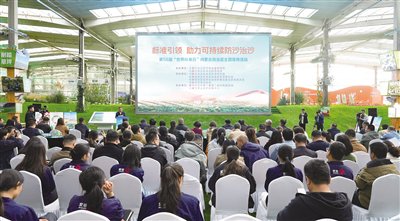
兵团推动农业产业化联农带农促增收
Xin Lang Cai Jing· 2026-01-02 18:29
Core Insights - The article highlights the significant development of the oilseed industry in the Xinjiang Production and Construction Corps, emphasizing the role of systematic policy support in driving high-quality industrial growth and employment increase [1][2] Group 1: Policy Support - The Corps has implemented 25 financial policies aimed at supporting agriculture, which have created over 100,000 job opportunities closely linked to agricultural industries in southern Xinjiang [1] - The establishment of a three-tiered cultivation system has led to the creation of six national-level advantageous specialty industry clusters and five national-level modern agricultural parks [1] Group 2: Financial Subsidies - Financial subsidies include 230 yuan per mu for wheat and 300 yuan per mu for soybean planting, along with a target price subsidy of 18,600 yuan per ton for seed cotton [2] - A total of 360 million yuan has been allocated for livestock industry subsidies, and facility agriculture has been included in the national loan interest subsidy pilot program [2] Group 3: Training and Risk Management - The Corps is actively organizing training programs focused on agricultural machinery operation and digital planting to help traditional farmers transition to skilled technicians [2] - Agricultural insurance covers seven types of crops and sheep, with a 92% coverage rate for specialty fruit and nut insurance in southern Xinjiang, along with small loan interest subsidies for impoverished populations [2]
通州草莓熟了,采摘尝鲜正当时~
Xin Lang Cai Jing· 2026-01-01 09:27
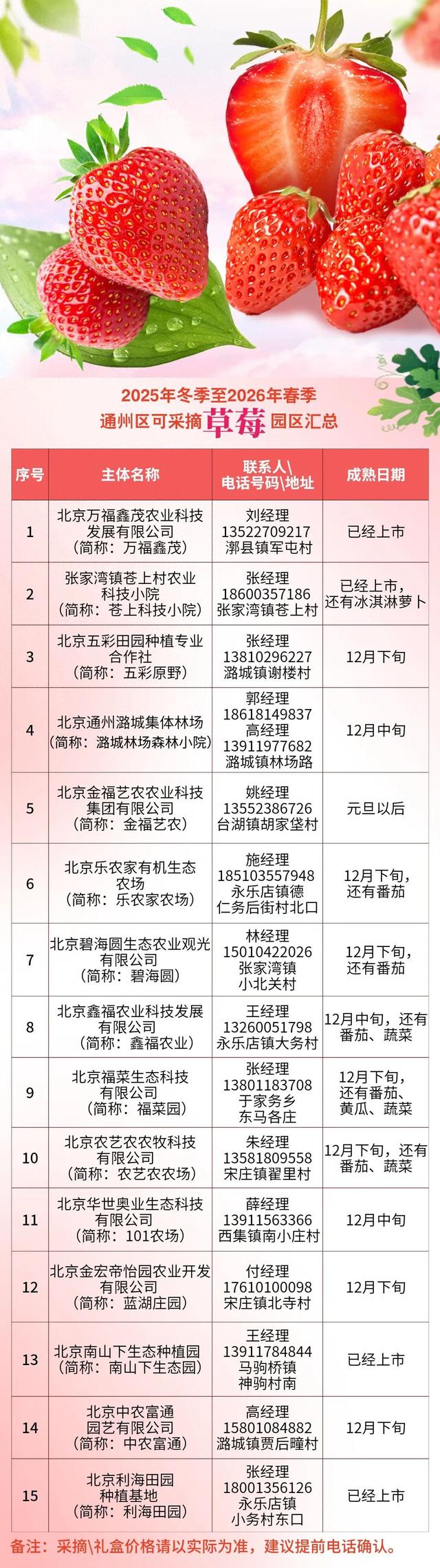
不如暂别城市喧嚣 转自:北京日报客户端 元旦假期怎么过? 带上家人朋友 走进通州的草莓园 亲手摘下 2026年的第一份甜蜜~ 在通州各大草莓园里 饱满多汁的草莓 早已缀满枝头 品相诱人 正值最佳风味~ 通州草莓采摘攻略 通州区可采摘 | 大 | 园区汇总 | 联系人 | | 序号 | 主体名称 | | 成熟日期 | | --- | --- | --- | --- | --- | --- | | 电话号码\地址 | | | | | | | 刘经理 | | | 北京万福鑫茂农业科技 | | | | 已经上市 | | 1 | 发展有限公司 | 13522709217 | | | (简称:万福鑫茂) | | | | 郭县镇军屯村 | | | 张经理 | | 2 | 张家湾镇苍上村农业 | | 已经上市, | | 科技小院 | | | | 18600357186 | 还有冰淇淋萝卜 | | (简称:苍上科技小院) | | | | 张家湾镇苍上村 | | | 张经理 | | 3 | 北京五彩田园种植专业 | | 12月下旬 | | 合作社 | | | | 13810296227 | | | (简称:五彩原野) | | | ...
东西问丨穆罕默德·曼苏里:中国实践如何助力保障全球粮食安全?
Zhong Guo Xin Wen Wang· 2026-01-01 08:07
Core Insights - The global food security situation remains severe, with approximately 673 million people facing hunger and 2.3 billion in food insecurity, exacerbated by regional conflicts, extreme weather, and trade barriers [1] - China's practices in ensuring food security and promoting rural revitalization offer valuable insights for the world, particularly as the FAO approaches its 80th anniversary in 2025 [1] Group 1: Effective Practices in Rural Revitalization - The FAO's strategic pillars of "better production, better nutrition, better environment, and better life" align closely with China's rural practices observed during the visit [2] - China demonstrates effective production methods that balance productivity and sustainability, including diverse agricultural practices and livestock farming [2] - There is a strong emphasis on diversified food production, creating job opportunities, and enhancing quality of life through the development of fresh produce and health-related food products [2] - Environmental protection efforts include wetland conservation and the production of green and organic foods, showcasing a commitment to sustainable practices [2] Group 2: Key Characteristics of China's Rural Revitalization - Two notable characteristics of China's rural revitalization are the guiding role of local governments and the entrepreneurial spirit of rural residents [5] - Local governments provide public investment and ensure that development benefits cooperatives and farmers, while also maintaining fair pricing mechanisms [5] - The entrepreneurial drive among rural residents has led to successful local businesses that create jobs and contribute to poverty alleviation [5] Group 3: Investment in Human Capital - Investment in human capital is crucial for sustainable development, yet rural development has often focused more on physical infrastructure than on enhancing human capabilities [8] - Human capital investment includes education, training, and health, which are essential for empowering farmers and entrepreneurs [8] - The FAO has identified six key recommendations for human capital investment, emphasizing the importance of partnerships, inclusive policies, and continuous innovation [9] Group 4: China's Contributions to Global Food Security - China has made significant contributions to global food security, achieving the UN Millennium Development Goal of halving extreme poverty and hunger ahead of the 2030 target [11] - The country has ensured stable supplies of staple foods and maintained abundant availability of various agricultural products, improving national nutrition [11] - China's experience in poverty alleviation and food security serves as a model for other countries, particularly through South-South cooperation initiatives [12]

南农晨读 | 元旦
Nan Fang Nong Cun Bao· 2026-01-01 02:05
南农晨读 | 元旦_ 南方+_南方plus 0:00 / 0:18 (南农晨读 | 元旦,时长共18秒) 【今日关注】 在时间的长河 旁,等候一场生 长丨2026南方农 村报新年社论 又是一年将尽 时。当金柚一个 个离开枝头,当 晚稻一穗穗归入 仓廪,2025年悄 然步入尾声,我 们站在时光隧道 的入口,即将迈 进2026年的门 楣。 全国农业农村厅 局长会议召开 12月30日,全国 农业农村厅局长 会议在京召开, 农业农村部党组 书记、部长韩俊 出席会议并讲 话。会议强调, 要以习近平新时 代中国特色社会 主义思想为指 导,深入贯彻党 的二十大和二十 届历次全会精 神,全面贯彻习 近平总书记关 于"三农"工作的 重要论述和重要 指示精神,认真 落实中央经济工 作会议、中央农 村工作会议部 署,锚定农业农 村现代化,深入 学习运用"千万 工程"经验,扎 实推进乡村全面 振兴,加快建设 农业强国,全力 做好明年和今后 一个时期农业农 村工作,奋力开 创农业农村现代 化新局面。 2026,愿每粒种 子都找到属于它 的春天 没有什么比泥土 里长出的相遇更 值得纪念。珠江 潮水记得每一艘 载满农产的航 船,广交会的灯 ...

美媒:通货膨胀和关税政策下的美国农民在苦苦挣扎
Zhong Guo Xin Wen Wang· 2025-12-31 15:25
Core Viewpoint - Despite a $12 billion relief plan from the U.S. federal government, American farmers continue to struggle under the pressures of inflation and tariff policies [1][2]. Group 1: Economic Impact on Farmers - The Biden administration's inflation has led farmers to hope for a more favorable economic environment, but extensive tariffs on foreign imports have dashed these hopes [2]. - Tariffs on specific goods, including steel and aluminum, have increased costs for essential farming equipment and supplies, such as tractors, combines, and fertilizers [2]. - The number of U.S. farmers filing for bankruptcy protection has increased by 60% compared to the same period in 2024, marking the highest rate since 2020 [2]. Group 2: Government Relief and Its Limitations - The relief plan is seen as a recognition that past government policies have significantly altered the agricultural landscape and threatened farmers' livelihoods [1][2]. - Some farmers believe the relief may come too late, with many expressing doubts about the effectiveness of the government's assistance [3]. - The agricultural relief plan is viewed as insufficient, with farmers indicating that it will not lead to wealth and that some may not survive the current economic conditions [3]. Group 3: Personal Accounts and Concerns - Farmers like Mike Phillips are questioning how much of the promised relief will actually reach them and are advocating for more sensible economic and trade policies instead of reliance on government aid [3]. - The situation is compared to the agricultural crisis of the 1980s, with concerns about low food prices, high input costs, and industry consolidation [3].
尼泊尔农业与畜牧业发展部将蘑菇生产、推广与商业化列为优先事项
Shang Wu Bu Wang Zhan· 2025-12-31 13:53
Core Viewpoint - The production, promotion, and commercialization of mushrooms have been prioritized by Nepal's Ministry of Agriculture and Livestock Development, highlighting the sector's potential for economic contribution and job creation [1] Group 1: Industry Development - The Ministry has initiated technical promotion and market expansion plans for mushroom cultivation [1] - Mushrooms contribute 0.15% to Nepal's total agricultural output, with approximately 35,000 farmers engaged in mushroom farming [1] - Nepal has 1,150 mushroom species, of which 147 are edible, 70 have medicinal value, and 100 are toxic [1] Group 2: Economic Impact - The diverse geography and climate of Nepal allow for year-round mushroom production [1] - Commercial cultivation of mushrooms can create job opportunities and contribute to the agricultural economy [1] - The Minister called for enhanced coordination among stakeholders in research, infrastructure development, and market promotion to advance the mushroom industry [1]
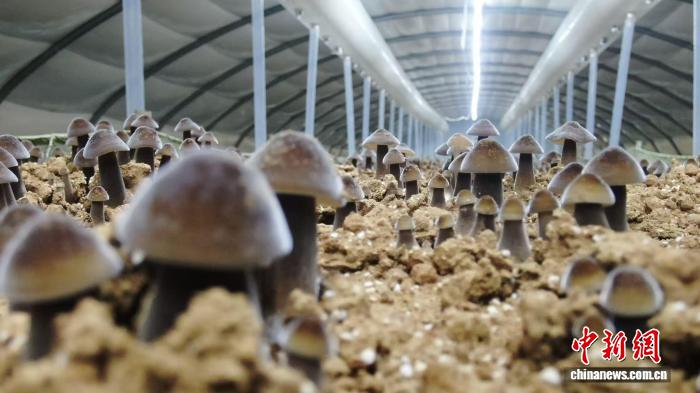
(乡村行·看振兴)山西代县:黑皮鸡枞菌种植“发力” 带动乡村就业增收
Zhong Guo Xin Wen Wang· 2025-12-31 11:11
Core Viewpoint - The introduction of black fungus cultivation in Hongqiang Village, Shanxi, has become a new highlight in local agricultural industry, driving employment and income growth for villagers [1][2]. Group 1: Agricultural Development - Hongqiang Village has optimized its agricultural structure by introducing diversified specialty agriculture, specifically focusing on black fungus cultivation [2][5]. - The cultivation area for black fungus has reached over 500 square meters, following comprehensive research on cultivation techniques and market sales conducted by the village committee [2]. Group 2: Economic Impact - The project has provided flexible employment opportunities for villagers, particularly benefiting elderly workers, with daily earnings ranging from 30 to 50 yuan, leading to monthly incomes of around 1,000 yuan [4]. - The cultivation project not only supports individual income but also strengthens the collective economy of the village, contributing to overall economic growth [4]. Group 3: Quality Assurance and Market Engagement - Modern cultivation techniques are employed to ensure the quality and yield of black fungus, including strict control of environmental factors such as temperature, humidity, and light [2]. - A buyer expressed satisfaction with the quality of the mushrooms, leading to repeat purchases and plans for long-term cooperation with the cultivation base [2].
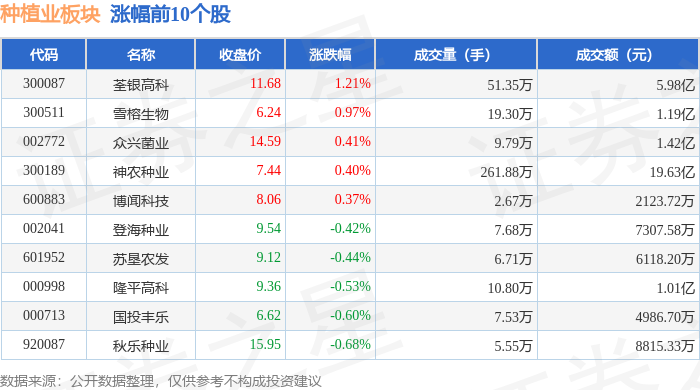
种植业板块12月31日跌0.89%,华绿生物领跌,主力资金净流出2.02亿元
Zheng Xing Xing Ye Ri Bao· 2025-12-31 08:56
Market Overview - The planting industry sector declined by 0.89% on December 31, with Huagu Green Bio leading the decline [1] - The Shanghai Composite Index closed at 3968.84, up 0.09%, while the Shenzhen Component Index closed at 13525.02, down 0.58% [1] Stock Performance - Notable gainers in the planting sector included: - Jingyin Gaoke (300087) with a closing price of 11.68, up 1.21% [1] - Xue Rong Bio (300511) at 6.24, up 0.97% [1] - Zhongxing Junye (002772) at 14.59, up 0.41% [1] - Major decliners included: - Huagu Green Bio (300970) at 20.51, down 4.87% [2] - Dunhuang Seed Industry (600354) at 6.47, down 3.58% [2] - Nuofushin (002215) at 10.59, down 2.58% [2] Trading Volume and Capital Flow - The planting sector experienced a net outflow of 202 million yuan from main funds, while retail funds saw a net inflow of 47.16 million yuan [2] - The trading volume for key stocks included: - Shen Nong Seed Industry (300189) with a net inflow of 46.49 million yuan from main funds [3] - Wanxiang Denong (600371) with a net outflow of 0.0642 million yuan from main funds [3] - New Agricultural Development (600359) with a net outflow of 0.2976 million yuan from main funds [3]


人勤冬不闲 黑土地上“充电”忙——黑龙江农区冬季生产服务一线见闻
Xin Hua She· 2025-12-31 05:29
Group 1 - The agricultural sector in Heilongjiang is actively engaged in various activities during the winter season, including soil testing and personalized fertilization recommendations to enhance productivity for the upcoming year [1] - The implementation of soil testing and fertilization techniques has led to cost savings for farmers, with one farmer reporting a reduction of over ten yuan per mu in costs and an increase in rice yield to over 100 tons from 150 mu [1] - The promotion of scientific fertilization techniques is contributing to sustained agricultural productivity in Heilongjiang's black soil region [1] Group 2 - In Wangkui County, local food companies are utilizing traditional methods to produce products like sticky rice dumplings, providing stable income for workers during the winter months [2] - Agricultural training sessions are being conducted for farm managers and growers, focusing on high-yield cultivation, green pest control, and scientific selection of seeds and fertilizers, which are expected to enhance crop yields in the coming year [2] - The active participation of farmers in training sessions indicates a strong commitment to improving agricultural practices and productivity [2]