科技制造

Search documents
万亿A股巨头,宣布大手笔分红
Zhong Guo Ji Jin Bao· 2025-10-20 22:41
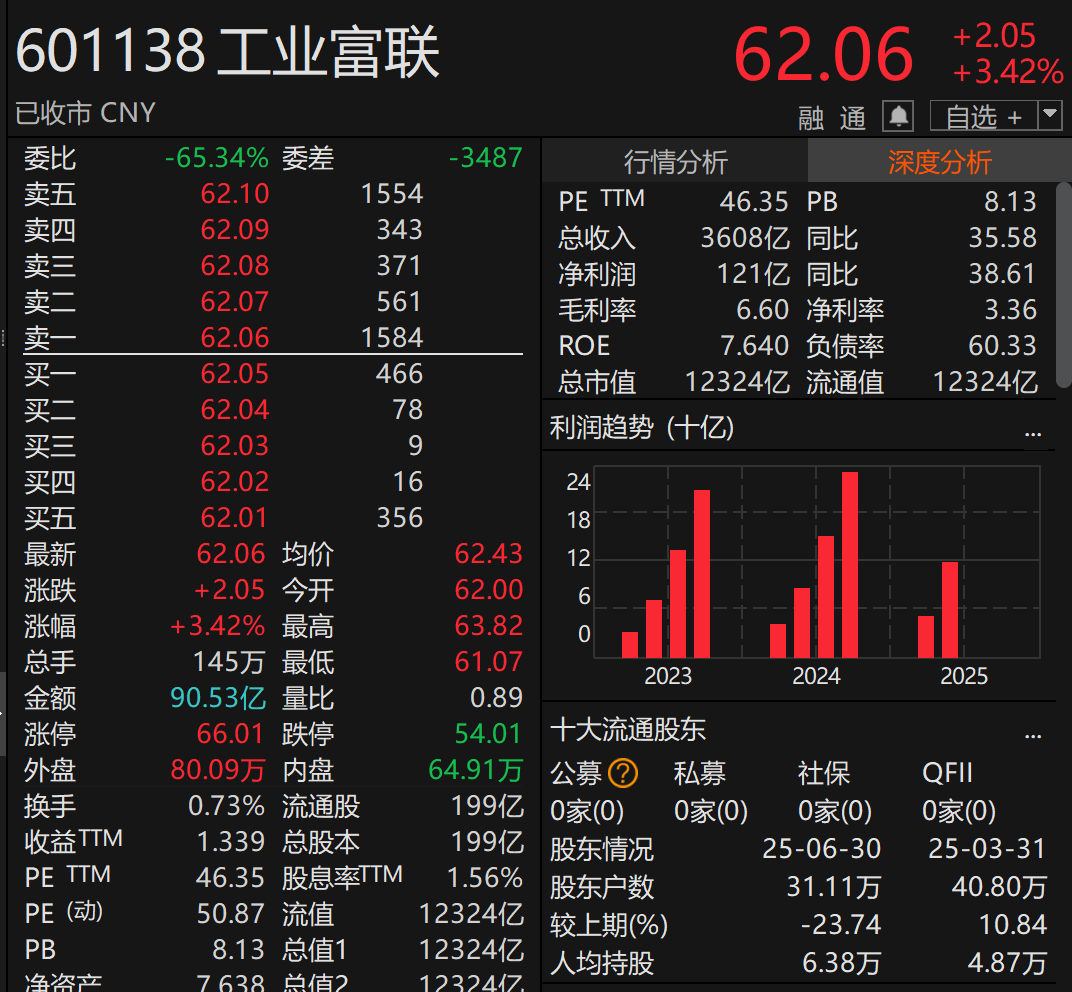
Core Viewpoint - Industrial Fulian announced its first-ever semi-annual profit distribution plan since its listing in 2018, proposing a cash dividend of 3.3 CNY per 10 shares, totaling 6.551 billion CNY, which accounts for 54.08% of its net profit for the first half of 2025 [1][2]. Financial Performance - For the first half of 2025, Industrial Fulian reported revenue of 360.76 billion CNY, a year-on-year increase of 35.58%, and a net profit attributable to shareholders of 12.113 billion CNY, up 38.61% [2][3]. - The company's non-recurring net profit reached 11.668 billion CNY, reflecting a growth of 36.73% year-on-year [2]. AI Business Growth - The revenue from AI servers in the second quarter of 2025 saw a significant increase, with a year-on-year growth rate exceeding 60% [3]. - The demand for 800G high-speed switch products surged, with revenue in the first half of 2025 reaching nearly three times that of the entire year of 2024, driven by the rising need for data transmission [3]. Shareholder Engagement - Industrial Fulian's semi-annual dividend plan is seen as part of a broader trend in the A-share market towards enhancing shareholder returns, with more leading companies adopting mid-term dividends as a standard practice [3]. - The company has maintained a strong annual dividend record since its listing, with total dividends exceeding 56.5 billion CNY, and has distributed over 10 billion CNY annually for three consecutive years from 2022 to 2024 [2][3]. Stock Performance - Industrial Fulian's stock price has more than doubled in 2023, closing at 62.06 CNY per share on October 20, 2023, with a total market capitalization of 1,232.4 billion CNY [3].


刚宣布!万亿A股巨头,大手笔分红!
Zhong Guo Ji Jin Bao· 2025-10-20 15:01
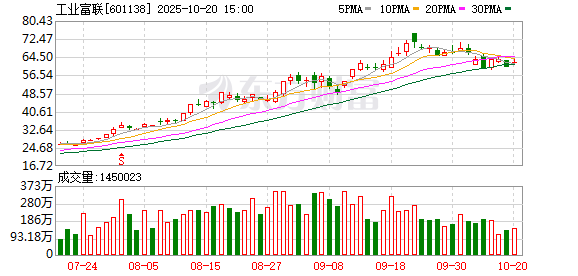
Core Viewpoint - Industrial Fulian plans to distribute a cash dividend of 3.3 yuan (including tax) for every 10 shares to all shareholders, totaling 6.551 billion yuan, which accounts for 54.08% of the net profit attributable to shareholders for the first half of 2025 [2][3]. Financial Performance - For the first half of 2025, Industrial Fulian reported revenue of 360.76 billion yuan, a year-on-year increase of 35.58% - The net profit attributable to shareholders reached 12.113 billion yuan, up 38.61% year-on-year - The net profit excluding non-recurring items was 11.668 billion yuan, reflecting a growth of 36.73% year-on-year [3][5]. Dividend Policy - This marks the first interim dividend distribution since Industrial Fulian's listing in 2018, highlighting a shift towards regular shareholder returns - The company has maintained a high annual dividend payout since its IPO, with total dividends exceeding 56.5 billion yuan, and has distributed over 10 billion yuan annually for three consecutive years from 2022 to 2024 [2][4]. Market Position and Growth Drivers - The strong performance is attributed to the company's strategic focus on AI business, which has entered a "harvest period" and is now a core growth driver - AI server revenue saw significant growth, with a year-on-year increase of over 60% in the second quarter of 2025, driven by demand from global cloud service providers and tech companies [3][4]. Stock Performance - Industrial Fulian's stock price has more than doubled this year, closing at 62.06 yuan per share on October 20, with a total market capitalization of 1,232.4 billion yuan [5].
刚宣布!万亿A股巨头,大手笔分红!
中国基金报· 2025-10-20 14:58
Core Viewpoint - Industrial Fulian plans to distribute a cash dividend of 3.3 yuan (including tax) for every 10 shares to all shareholders, totaling 6.551 billion yuan (including tax), which accounts for 54.08% of the net profit attributable to shareholders for the first half of 2025 [2][5]. Financial Performance - For the first half of 2025, Industrial Fulian reported revenue of 360.76 billion yuan, a year-on-year increase of 35.58%, and a net profit attributable to shareholders of 12.113 billion yuan, up 38.61% year-on-year [5][6]. - The company achieved a non-recurring net profit of 11.668 billion yuan, reflecting a growth of 36.73% year-on-year [5]. AI Business Growth - The revenue from AI servers in the second quarter of 2025 saw a significant increase, with a year-on-year growth rate exceeding 60% [6]. - The demand for 800G high-speed switch products surged, with revenue in the first half of 2025 reaching nearly three times that of the entire year of 2024, driven by the rising need for data transmission [6]. Shareholder Returns and Market Position - Industrial Fulian has consistently maintained high annual dividends since its listing, with total dividends exceeding 56.5 billion yuan, and has distributed over 10 billion yuan annually for three consecutive years from 2022 to 2024 [5]. - The company's stock price has more than doubled this year, closing at 62.06 yuan per share on October 20, 2025, with a total market capitalization of 1,232.4 billion yuan [6].

邮储银行上海分行破解融资难题 全方位支持科技企业
Zheng Quan Ri Bao Zhi Sheng· 2025-10-19 15:14
Core Viewpoint - Shanghai is advancing its role as a global technology innovation center, which is crucial for supporting national strategies and enhancing high-end industry leadership [1] Group 1: Financial Support for Technology Enterprises - Postal Savings Bank of China (PSBC) Shanghai Branch is deeply engaged in technology finance, providing comprehensive financial support throughout the lifecycle of technology enterprises [2] - The bank customizes financing solutions for technology companies, exemplified by its support for Shanghai Guanjia Electronics Co., which achieved significant growth and international market penetration with the bank's assistance [2] - The company secured a $10 million order from a French firm at the 2024 China International Import Expo, highlighting the international competitiveness of Chinese manufacturing [2] Group 2: Innovative Evaluation Systems - PSBC Shanghai Branch has introduced a "Technology Flow" evaluation system to address the financing challenges faced by technology enterprises, enabling better assessment of their value and potential [3] - This system has successfully facilitated the provision of a 34 million yuan loan to Datang Energy Technology Co., showcasing its effectiveness in meeting the financial needs of rapidly growing technology firms [3] - The bank aims to foster a virtuous cycle of "technology, industry, and finance" by focusing on financial innovation and supporting Shanghai's unique technology innovation industries [3]

近8亿元资金逆势布局!恒生科技ETF(513130)显著放量,昨日成交额再上百亿元
Mei Ri Jing Ji Xin Wen· 2025-10-14 03:41
Core Viewpoint - The Hong Kong stock market's technology sector has seen a recent adjustment, but market funds are taking the opportunity to invest, particularly in the Hang Seng Tech ETF (513130), which has experienced significant inflows and trading volume increases [1] Fund Performance - The Hang Seng Tech ETF (513130) recorded a capital inflow of 775 million yuan on October 13, with a trading volume of 10.267 billion yuan, representing a 56% increase from the previous trading day [1] - As of October 13, the ETF's total shares and scale reached 49.35 billion shares and 40.161 billion yuan, with year-to-date growth of 49% and 101% respectively [1][2] Index Composition - The Hang Seng Tech Index, closely tracked by the ETF, includes 30 Hong Kong-listed companies related to technology, with major components benefiting from AI developments [1] - The top five constituents as of October 13 include Alibaba-W, SMIC, Tencent Holdings, NetEase-S, and Meituan-W, all recognized leaders in the internet or tech manufacturing sectors [1] Valuation Metrics - The current price-to-earnings (P/E) ratio of the Hang Seng Tech Index is 23.36, which is lower compared to the Nasdaq 100's 36.40, indicating potential valuation upside [1] Market Outlook - Huatai Securities noted that many quality tech companies are concentrated in the Hong Kong market, with stable performance expected in the first half of 2025, particularly in sectors like new consumption, innovative pharmaceuticals, and technology [1] - Despite ongoing market volatility, the technology sector is anticipated to present structural opportunities post-correction [1] ETF Characteristics - The Hang Seng Tech ETF (513130) is popular among investors, with over 220,000 account holders as of the latest mid-year report [1] - The ETF offers advantages such as large scale, good liquidity, T+0 trading support, and low fees, making it a key tool for investors looking to access core tech assets in Hong Kong [1] Management Background - The ETF is managed by Huatai-PB Fund, one of the first ETF managers in China, with extensive experience in managing large-scale ETFs, including the leading CSI 300 ETF [1]
广发基金观富钦:关注科技板块“戴维斯双击”机会
Shang Hai Zheng Quan Bao· 2025-10-12 15:11
Core Viewpoint - The article emphasizes the significant investment opportunities in the TMT (Technology, Media, and Telecommunications) sector, particularly driven by advancements in artificial intelligence (AI) and the concept of "Davis Double" in investment strategies [1][6]. Group 1: Investment Strategy - The investment framework prioritizes valuation protection, industry trends, and company value, with a focus on acquiring good companies at favorable prices [4][5]. - The manager specializes in identifying opportunities during the commercialization phase of technology, particularly from "1 to 10" in the growth cycle [1][2]. - The strategy includes deep research on industry leaders and exploring opportunities within the supply chain of these leaders [3][5]. Group 2: Focus Areas - The investment focus is on three types of companies: industry leaders in sectors like consumer electronics and AI chips, collaborators in the supply chain, and those experiencing supply-demand mismatches during high-growth cycles [2][3]. - The portfolio includes long-term holdings in technology manufacturing leaders across various sectors, such as consumer electronics and new energy [3][6]. Group 3: Market Outlook - The current market dynamics are influenced by economic recovery and the sustainability of technological innovations, particularly AI [6][7]. - TMT is viewed as a core sector capable of producing trillion-dollar companies, with significant investment opportunities arising from technological iterations [6][7]. - Future investment directions include focusing on computing power as AI infrastructure, software applications with reasonable valuations, and innovations in consumer electronics and smart driving technologies [6][7].
天铁科技:年产5万套液冷系统产品及20万根液冷管路项目目前已在政府部门网站完成了行政许可的公示
Mei Ri Jing Ji Xin Wen· 2025-10-09 01:07
Core Viewpoint - Zhejiang Tiantian Technology Co., Ltd. is progressing with its project to produce 50,000 sets of liquid cooling systems and 200,000 liquid cooling pipes, having completed the administrative approval process [1] Group 1: Project Progress - The project for producing 50,000 liquid cooling systems and 200,000 liquid cooling pipes is currently proceeding as planned, with administrative licensing completed [1] - The company will disclose any substantial progress in accordance with legal requirements [1] Group 2: Future Plans and Market Strategy - The company is focused on monitoring national policy directions and market trends, emphasizing innovation to enhance its product system [1] - There is an ongoing effort to expand customer base and market space, aiming to continuously improve the competitiveness of its products [1]
嘉实基金孟夏: 以“质量”与“均衡”穿越科技制造新周期
Zhong Guo Zheng Quan Bao· 2025-09-28 20:54
Group 1: Core Insights - The core engine of building a technology-driven nation is technology innovation and high-end manufacturing, with sectors like semiconductors, chips, innovative drugs, and robotics gaining momentum this year [1] - The investment opportunities in the technology manufacturing sector are highlighted as the market focuses on quality companies and balanced industry allocation to achieve growth returns across cycles [1] Group 2: Market Analysis - Following a recent peak in A-share indices, the market is undergoing a healthy consolidation phase, which is beneficial for sustainable development [2] - Since September 24, 2024, the market has shown significant structural differentiation, with technology growth sectors leading the way, indicating that A-share valuations still have room for recovery compared to global markets [2] Group 3: Long-term Optimism Factors - The transition of China's economic development from labor and engineering advantages to technology innovation is reshaping the underlying capabilities of technological advancement [3] - Key long-term factors driving market trends include the formation of a unified national market, strong manufacturing competitiveness, and the combination of AI technology with China's vast engineering resources [3] Group 4: Investment Strategy - The investment approach emphasizes selecting high-quality growth companies, with a focus on cash flow discount models for valuation, allowing for reasonable assessments even for unprofitable firms [4] - The investment philosophy prioritizes long-term sustainable returns from excellent companies, adhering to principles of quality over short-term gains [4] Group 5: Performance Metrics - The performance of funds managed by the company has shown significant long-term excess returns, with notable growth rates in net asset values compared to benchmarks [5] Group 6: Future Opportunities - The company sees potential in manufacturing going overseas and a reversal in domestic demand, with a focus on companies that can build commercial barriers and enhance global market share [6] - Specific sectors like AI, autonomous driving, and pharmaceuticals are identified as having long-term investment value [6] Group 7: Investment Participation - Given the competitive nature of the technology manufacturing sector, the company advises investors to consider professional fund management or systematic investment approaches to effectively share in the sector's growth [7]
人工智能+制造能“加”出什么?联想走出新解法
Zheng Quan Ri Bao· 2025-09-25 07:13
Group 1 - The core viewpoint of the articles emphasizes the transformative impact of integrating artificial intelligence (AI) with manufacturing in China, marking a shift from merely upgrading technology to a complete reshaping of the industrial landscape [1][5] - The Chinese government is planning to implement a special action plan for "AI + manufacturing," indicating a strong policy push to enhance the manufacturing sector through AI [1] - Lenovo serves as a prime example of successful integration of AI in manufacturing, showcasing its advanced operational model and significant production capabilities [2][4] Group 2 - Lenovo has established a comprehensive global supply chain with over 30 manufacturing bases and 2,000 suppliers, enabling efficient management and local delivery [2] - The company has achieved remarkable production efficiency, with an average of one laptop produced every nine seconds and an annual output exceeding 3 million units at its Tianjin facility [2][3] - Lenovo's manufacturing facilities have implemented AI in 80% of their smart manufacturing scenarios, leading to a 200% increase in production efficiency and a 30% reduction in defect rates [3] Group 3 - Lenovo is not only a practitioner of smart manufacturing but also an enabler for other large manufacturers, helping them transition to intelligent operations [4] - The company has developed a full-stack AI strategy, providing AI terminals, infrastructure, and solutions to major manufacturers like Geely and SANY Heavy Industry [4] - Lenovo's dual role as both a smart manufacturing leader and an industry enabler positions it as a crucial link between technological innovation and practical application in the manufacturing sector [4][5]

未来经济发展有了新方向!“要素化市场”试验开展,让人拭目以待
Sou Hu Cai Jing· 2025-09-20 11:48
Core Viewpoint - The article discusses the challenges and opportunities presented by the comprehensive reform of factor market allocation in ten pilot regions in China, which collectively account for over a quarter of the national economy, aiming to enhance efficiency and break through existing barriers [1][3][24]. Group 1: Selected Pilot Regions - The ten pilot regions were strategically chosen, representing major economic areas across eastern, central, and western China, including the Guangdong-Hong Kong-Macao Greater Bay Area and regional growth poles like Changsha-Zhuzhou-Xiangtan and Chengdu-Chongqing [3][5]. - These regions have a strong economic foundation and are expected to serve as experimental grounds for reform, leveraging their unique characteristics and existing reform initiatives to reduce trial and error costs [5][9]. Group 2: Changes in Factor Allocation - The article highlights the historical barriers in China's factor markets, including inefficient flows of land, labor, and capital, and notes that a transformation in allocation rules is underway [7][9]. - Innovations such as the rural property information trading platform in Shenyang have demonstrated effective land resource utilization, with a reported premium rate of 23% for leasing farmland [7][9]. - The Shenzhen Data Exchange has pioneered new data circulation models, significantly reducing the time for health insurance claims from 2-3 days to an average of 28 minutes [7][9]. Group 3: Opportunities Created by Reform - The market-oriented reform is generating multi-layered development opportunities, particularly for technology-driven enterprises, which are gaining access to more funding channels [11][14]. - Companies like Weifang Tianxin Radiator Co., Ltd. and Zibo Boxin Agricultural Technology Co., Ltd. have successfully secured loans through innovative financing mechanisms despite lacking traditional collateral [11][14]. Group 4: Challenges in Reform Implementation - The reform faces challenges such as local protectionism, which may hinder the free flow of factors and the formation of a unified market, as seen in the Beijing-Tianjin-Hebei region [16][19]. - There are existing policy barriers across different regions regarding land quotas, tax distribution, and environmental standards, as well as a lack of unified standards for new factors like data property rights [16][19]. Group 5: Ensuring Effective Reform - Successful implementation of the factor market reform requires collaborative efforts across various stakeholders, with an emphasis on establishing effective coordination mechanisms [19][21]. - The establishment of a comprehensive legal and regulatory framework is essential to clarify property rights, transaction rules, and regulatory standards for factor allocation [21][24].