
种植业

Search documents
年内A股控制权变更持续升温 产业协同和治理优化成主线
Zheng Quan Ri Bao· 2025-12-29 13:06
Group 1 - The core viewpoint of the article highlights the increasing trend of control rights transactions in the A-share market since 2025, with nearly 170 companies disclosing plans for control changes this year, indicating a significant resource optimization in the capital market [1] - The entry of state-owned capital has become a notable trend, with new controlling shareholders often bringing in capital injections and governance optimizations, which contribute to the high-quality development of companies [1][4] - Control rights changes are seen as market-driven behaviors for resource reallocation, with quality capital entering to empower companies and promote industrial integration, aligning with the current demand for high-quality development in the real economy [1] Group 2 - Specific cases illustrate that new controlling shareholders often accompany capital injections and governance optimizations, leading to substantial benefits for company development [2] - For instance, Guo Ao Technology announced a control change with a capital raise of up to 432 million yuan to enhance liquidity, while Xue Rong Biotechnology's control change aims to improve governance and operational capabilities [2] - The driving factors behind the increase in control rights changes include a resonating effect between policy and market forces, with regulatory changes providing a more inclusive environment for mergers and acquisitions [3] Group 3 - State-owned capital has emerged as a strategic partner for many listed companies, leveraging financial strength and industrial resources [4] - Examples include Jiangxi Xinsheng Investment's acquisition of control in Lianchuang Electronics, and Jiang Pharmaceutical's investment of over 1 billion yuan in Tai Long Pharmaceutical to enhance strategic development in the healthcare sector [4] - The deep involvement of state-owned capital reflects the top-level design direction of deepening state-owned enterprise reform and optimizing the layout of the state economy [5] Group 4 - Looking ahead, the A-share control rights market is expected to remain active, shifting focus from "scale expansion" to "quality improvement," emphasizing ownership structure optimization to drive technological upgrades and modern governance [6] - Strengthening corporate governance will become a crucial aspect of high-quality development for listed companies [6]




数览中国脉动丨粮稳天下安!“大国粮仓”高位增产
Xin Hua Wang· 2025-12-29 10:42
Core Viewpoint - Food security is a national priority, and the foundation for food security is being strengthened through continuous improvements in agricultural production and resilience against adverse conditions [1]. Group 1: Grain Production and Yield - In 2025, China's grain production is expected to reach a new high of 14,297.5 billion jin, an increase of 167.5 billion jin or 1.2% from the previous year, maintaining stability above 14 trillion jin [3]. - The national grain planting area has reached 1.791 billion mu, an increase of 1.348 million mu or 0.1%, marking six consecutive years of growth [6]. - The average grain yield per mu has increased to 399.1 kg, up by 4.4 kg or 1.1% from the previous year [9]. Group 2: Crop-Specific Data - Corn planting area is 674 million mu, an increase of 3.301 million mu; rice planting area is 435 million mu, up by 790,000 mu; while wheat planting area is 354 million mu, remaining stable with a slight decrease of 83,000 mu [6]. - Corn yield is 446.7 kg per mu, an increase of 1.6%; rice yield is 480.4 kg per mu, up by 0.7%; wheat yield remains stable at 396 kg per mu; soybean yield is 135.9 kg per mu, an increase of 2.5% or 1.9% [9]. Group 3: Resilience and Disaster Response - The resilience of China's grain production has strengthened, achieving a bountiful harvest despite severe adverse weather conditions [12]. - The central government allocated over 6 billion yuan to support disaster prevention and recovery efforts, including drought and flood response measures [12]. - Emergency plans were implemented to facilitate rapid harvesting and drying of crops, with significant resources mobilized, including 252,000 tracked harvesters and over 2,490 mobile dryers [12].


《土壤中200种农药及其代谢物残留量的测定》等364项农业行业标准批准
仪器信息网· 2025-12-29 09:03
Core Viewpoint - The Ministry of Agriculture and Rural Affairs has approved 364 agricultural industry standards, including the "Technical Specifications for Apple Dwarf Rootstock Cultivation," which will be implemented starting May 1, 2026. The standards can be accessed on the official website from April 1, 2026 [2][3]. Summary by Relevant Sections - **Approved Standards**: The Ministry has approved various standards, including those for apple dwarf rootstock cultivation, citrus grafted seedling breeding, and techniques for various crops such as pears, tomatoes, and soybeans [3][5][6]. - **Implementation Date**: All approved standards will come into effect on May 1, 2026, with the texts available for review on the Ministry's website starting April 1, 2026 [2][3]. - **Standard Catalog**: The document includes a comprehensive list of the 364 standards, detailing their specific titles and identification numbers, covering a wide range of agricultural practices and quality assessments [5][6][7].

种植业板块12月29日跌0.51%,神农种业领跌,主力资金净流出2.44亿元
Zheng Xing Xing Ye Ri Bao· 2025-12-29 08:55
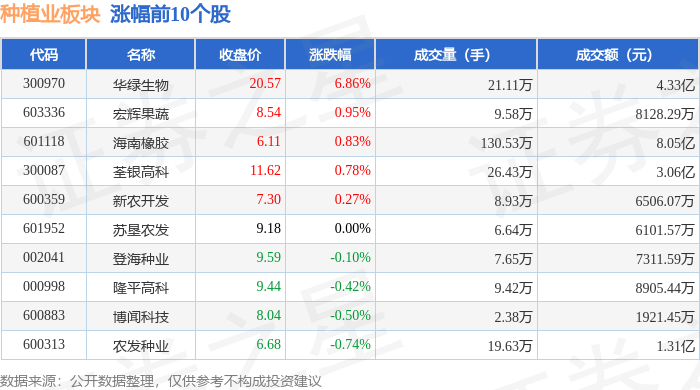
证券之星消息,12月29日种植业板块较上一交易日下跌0.51%,神农种业领跌。当日上证指数报收于 3965.28,上涨0.04%。深证成指报收于13537.1,下跌0.49%。种植业板块个股涨跌见下表: | 代码 | 名称 | 收盘价 | 涨跌幅 | 成交量(手) | 成交额(元) | | | --- | --- | --- | --- | --- | --- | --- | | 300970 | 华绿生物 | 20.57 | 6.86% | 21.11万 | | 4.33亿 | | 603336 | 宏连果蔬 | 8.54 | 0.95% | 9.58万 | 8128.29万 | | | 601118 | 海南橡胶 | 6.11 | 0.83% | 130.53万 | | 8.05亿 | | 300087 | 茎银高科 | 11.62 | 0.78% | 26.43万 | | 3.06亿 | | 600359 | 新农开发 | 7.30 | 0.27% | 8.93万 | 6506.07万 | | | 601952 | 苏垦农发 | 9.18 | 0.00% | 6.64万 | 6101.57万 | | | ...

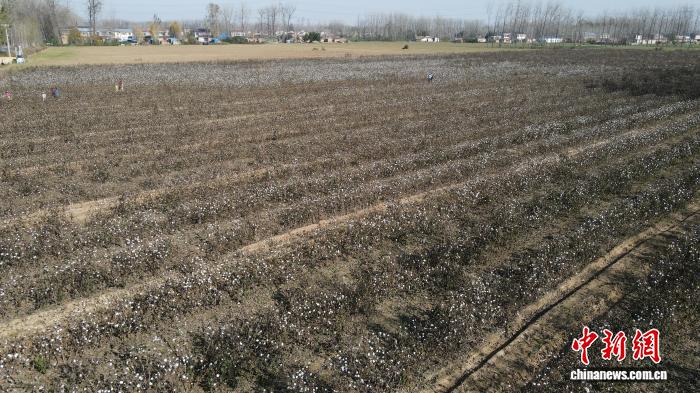
江苏宿迁张渡村:棉豆套种增收 暖心棉被传温情
Zhong Guo Xin Wen Wang· 2025-12-29 08:00
Core Viewpoint - Zhangdu Village in Jiangsu Province has successfully implemented a cotton-soybean intercropping model, leading to increased income and community support through the production of natural cotton quilts [1][3]. Group 1: Agricultural Innovation - Zhangdu Village collaborated with the Suqian Agricultural Science Research Institute to explore a cotton-soybean strip intercropping model, resulting in a successful harvest of cotton [1]. - The selected cotton variety "Simian 181" is an early-maturing, high-quality type that is particularly suitable for the intercropping model, achieving a cotton yield of up to 200 kilograms per mu [3]. Group 2: Economic Impact - The sale of cotton quilts has significantly contributed to the village's collective economy, providing a new revenue stream beyond traditional wholesale methods [2][3]. - Local residents have expressed satisfaction with the quilts, highlighting their natural quality and the community's efforts to support local families in need [2][3]. Group 3: Community Support - The village has produced over 20 new quilts filled with locally sourced cotton, which were distributed to underprivileged families, demonstrating a commitment to community welfare [3]. - Residents have noted the warmth and care provided by the village leadership, reinforcing the social fabric and support within the community [3].
学习规划建议每日问答 | 如何理解把农业建成现代化大产业
Xin Hua She· 2025-12-29 07:23
Core Viewpoint - The Chinese government emphasizes the modernization of agriculture as a strategic industry, aiming to transform it into a large-scale modern industry during the 14th Five-Year Plan period, reflecting an accurate understanding of the current agricultural development situation [1] Group 1: Agricultural Development Trends - The agricultural sector is experiencing significant changes and opportunities, with a shift from merely ensuring food security to enhancing food quality and health [1] - From 2013 to 2023, per capita consumption of grains decreased by 13.2%, while consumption of eggs, fresh fruits, meat, aquatic products, and vegetables increased by 82%, 60.9%, 55.7%, 45.9%, and 16.5% respectively, indicating a trend towards diversified and healthier diets [1] Group 2: Key Focus Areas for Agricultural Modernization - The primary task is to ensure national food security by enhancing comprehensive grain production capacity and expanding food resource development from traditional agricultural products to a broader range of biological resources [2] - The development of modern facilities for planting, livestock, and aquaculture is emphasized, along with the establishment of modern processing and logistics facilities to improve production efficiency and diversity [2] Group 3: Agricultural Product Processing and Integration - The optimization of agricultural product processing and circulation is crucial, focusing on enhancing initial processing, deep processing, and comprehensive utilization to promote multi-level value addition [3] - The integration of agriculture with secondary and tertiary industries is encouraged, leveraging local resources to develop diverse agricultural functions and foster deep integration with tourism, education, culture, and health industries [3] Group 4: Technological Empowerment in Agriculture - The promotion of technological advancements in agriculture is essential, including the integration of AI breeding, IoT, big data, and advanced agricultural machinery to enhance productivity [4] - The development of smart farms, plant factories, and intelligent agricultural machinery is prioritized to drive innovation and efficiency in agricultural practices [4]
四中全会精神在基层丨村里有了“产业飞地”
Xin Hua She· 2025-12-29 07:09
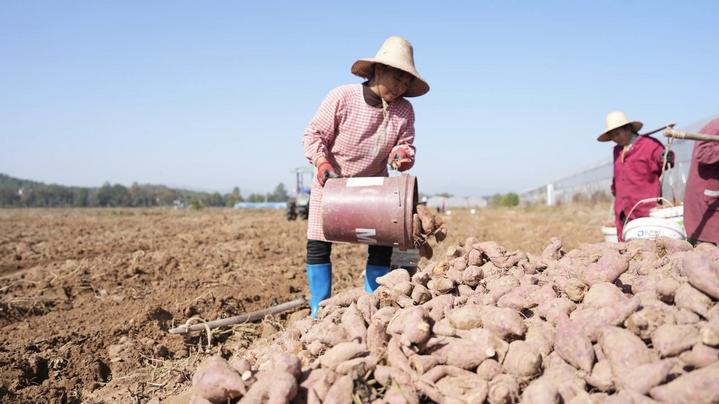
Core Insights - The article highlights the successful implementation of the "industrial enclave" model in Yongfeng County, Jiangxi Province, which has led to the first dividend distribution for the village collective from external industrial investments [1][2]. Group 1: Development Model - Yongfeng County has innovatively established a "Party building + company + collective + farmer" development model, creating one county-level "common prosperity company" and over 40 village-level "common prosperity companies" to achieve full coverage of villages and towns [1][2]. - The county-level "common prosperity company" is responsible for resource integration and market connection, effectively bridging cross-regional resource interactions [1]. Group 2: Industrial Collaboration - The collaboration between Yicun Township and Zaluo Township in the sweet potato industry represents the first "industrial enclave" project in Yongfeng County, aimed at upgrading the local agricultural industry [2]. - The integration of 250,000 yuan of village collective funds into the Zaluo Township sweet potato base has led to the construction of drip irrigation facilities and market expansion, resulting in a significant increase in sweet potato prices, with new varieties fetching over 3 yuan per pound [2]. Group 3: Economic Impact - The "industrial enclave" model not only revitalizes village collective economies but also creates job opportunities for villagers, as seen in the establishment of a cold storage facility in Shuizhuang Village, which generates stable rental income and multiple job positions [2]. - Yongfeng County has coordinated over 30 million yuan in various funds to implement multiple "industrial enclave" projects across sectors such as specialty planting, agricultural product processing, and photovoltaics [2]. Group 4: Policy Support - The Fourth Plenary Session of the 20th Central Committee emphasized optimizing village and town layouts and promoting integrated planning and management of county infrastructure, which aligns with the ongoing efforts in Yongfeng County [3][4]. - The county is focused on deepening the "common prosperity company" system and refining the regional industrial layout to sustain rural development momentum, as stated by the county's organizational department minister [4].
学习规划建议每日问答丨如何理解把农业建成现代化大产业
Xin Hua She· 2025-12-29 06:06
Core Viewpoint - The article emphasizes the importance of modernizing agriculture as a strategic industry for national stability and economic development, highlighting the favorable conditions and opportunities for agricultural growth during the "14th Five-Year Plan" period [1]. Group 1: Agricultural Development Trends - The shift in consumer preferences towards diversified food consumption is evident, with per capita consumption of grains decreasing by 13.2% from 2013 to 2023, while consumption of eggs, fresh fruits, meat, aquatic products, and vegetables increased by 82%, 60.9%, 55.7%, 45.9%, and 16.5% respectively [1]. - The integration of urban and rural areas is deepening, leading to a broader definition of agricultural development and the emergence of industry convergence as a trend [1]. Group 2: Key Focus Areas for Agricultural Modernization - The primary task is to ensure national food security by enhancing comprehensive grain production capacity and expanding food resource development from traditional agricultural products to a wider range of biological resources [2]. - The optimization and upgrading of agricultural product processing and circulation are crucial, promoting multi-level utilization and value addition through coordinated development of initial, deep processing, and comprehensive utilization [3]. - The integration of primary, secondary, and tertiary industries is essential, driven by market demand and innovative business models, to create a modern industrial system that combines agriculture with tourism, education, culture, and health [3]. Group 3: Technological Empowerment in Agriculture - The promotion of technological advancements in agriculture is vital, focusing on the large-scale integration and dissemination of scientific achievements, as well as the development of new breeding models [4]. - The application of smart technologies, such as IoT, big data, and advanced agricultural machinery, is being accelerated to enhance agricultural productivity and efficiency [4].
周观点:猪价旺季企稳,饲料价格普涨影响养殖利润-20251229
AVIC Securities· 2025-12-29 02:50
Investment Rating - The industry investment rating is "Hold," indicating that the growth level of the industry is expected to be similar to that of the CSI 300 index over the next six months [67]. Core Insights - The report highlights that the pig farming industry is undergoing a cycle of capacity reduction due to losses in pig farming and government policies aimed at reducing competition. This is expected to stabilize pig prices and improve the performance of leading companies in the sector [7]. - The report suggests focusing on leading pig farming companies such as Muyuan Foods and Wens Foodstuffs, which are expected to maintain good profitability due to their management and cost advantages [9]. - The animal health sector is anticipated to recover alongside improvements in farming operations, with a potential increase in market concentration as weaker players exit the market [9]. - The report emphasizes the importance of global food supply and demand dynamics, particularly in the context of geopolitical tensions affecting grain production [11][12][13][14]. Summary by Sections Livestock Industry - In November, the total sales of 12 pig farming companies reached 15.8394 million pigs, a month-on-month decrease of 2.45%. The average selling price of pigs increased to 11.67 yuan/kg, up 1.71% month-on-month [8]. - The report indicates that the profitability of self-bred and purchased pig farming is currently negative, with losses of 130.11 yuan and 162.80 yuan per head, respectively [8][49]. Planting Industry - The global wheat outlook for 2025/26 shows an increase in supply, consumption, trade, and ending stocks, with a projected increase of 7.5 million tons to 109.78 million tons [11]. - The global rice supply is expected to increase by 1.7 million tons, reaching 73.07 million tons, while consumption is projected to decrease by 0.5 million tons [12]. - The global corn production forecast for 2025/26 is slightly down to 157.6 million tons, with various countries experiencing production adjustments [13]. Pet Industry - The report expresses optimism for domestic pet food companies, projecting a compound annual growth rate of 17% for pet staple foods and 25% for pet snacks by 2026 [15]. - Leading pet food companies are actively pursuing globalization strategies to diversify their production and brand presence [15]. Market Performance - The report notes that the agricultural sector index increased by 0.25% during the week of December 20-27, 2025, with various sub-sectors showing mixed performance [16][17].
田间地头新力量:超三成是85后 年轻化高学历专业化融合化特质鲜明 上海“新农人”探索农业“进化论”
Jie Fang Ri Bao· 2025-12-29 01:41
Core Insights - The rise of "new farmers" in Shanghai, characterized by their diverse backgrounds and modern approaches, is reshaping the agricultural landscape and addressing the question of who will farm as the older generation retires [1][2] Group 1: Identity Reshaping - New farmers are defined as innovative individuals with modern business concepts and professional skills, breaking the traditional narrative of agriculture being tied to heritage [2] - A significant portion of new farmers, 62.9%, transitioned from other industries such as finance, law, and media before entering agriculture [2] - The demographic of new farmers is notably younger, with those born after 1985 making up 35.2% of the group, and 4.0% being from the post-2000 generation [2] Group 2: Conceptual Innovation - New farmers face challenges such as an aging workforce, with many laborers over 70 years old, leading to difficulties in maintaining agricultural operations [4] - The agricultural sector is looking towards technological advancements, particularly from countries like the Netherlands, to enhance productivity and address labor shortages [4][5] - New farmers are adopting integrated business models, with 36.1% engaging in industry convergence, combining agriculture with tourism and social services [5] Group 3: Strength Integration - New farmers are crucial in connecting rural resources with broader markets, forming cooperatives to unify small farmers under modern agricultural practices [7] - Initiatives like the "cooperative + base + farmer" model are helping local farmers increase their income and employment opportunities [7] - The Shanghai government is actively promoting talent development in rural areas, aiming to build a robust talent pipeline to support agricultural modernization [8]