私募基金

Search documents
资管盛会,就在明天!
Sou Hu Cai Jing· 2025-10-14 12:05
二十余载风雨兼程 证券私募行业从萌芽到繁盛,格局一新 历经牛熊周期淬炼与监管规范洗礼 行业守正砺新,破局而立 一年一度的资管盛会即将到来 10月15日 深圳 2025私募基金高质量发展大会 将隆重举行! 今朝业内菁英再聚 纵论宏观格局,把脉投资机遇 分享真知灼见,凝聚共识智慧 携手擘画私募高质量发展新蓝图! 届时同步举办 "国信证券杯·第十六届私募金牛奖"颁奖典礼 盛况空前 本届大会主题为"固本 砺新 行远"。 今年以来,政策发力显效,A股市场展现出强劲韧性和活力。作为资本市场的重要组成部分,证券私募机构是资本市场发挥价值发现、资源配置和居民财 富管理等功能的重要力量,也是形成活跃资本市场合力的生力军。随着AI大模型横空出世,中国私募行业在技术创新与资本赋能领域迈入新阶段。 《私募证券投资基金运作指引》施行满一年,私募基金步入更加法治化、规范化的轨道,同时也将面临更激烈的竞争。行业整体结构持续优化,对机构专 业性及合规性提出更高要求。 未来,在全球宏观环境依然复杂、市场波动难以避免的背景下,如何平衡收益与风险,如何在策略趋同中保持独特性,如何在规模扩张中守护业绩初心, 是摆在每一家机构面前的现实课题。高质量发 ...


陕西:规范招商引资行为,防止“内卷”式恶性竞争
Sou Hu Cai Jing· 2025-10-14 10:49
Core Viewpoint - The recent measures announced by the Shaanxi Provincial Government aim to enhance foreign investment confidence, improve the quality of investment cooperation, and prevent unhealthy competition in attracting foreign investment. Group 1: Policy Implementation - The implementation of market access policies will enhance the level of foreign investment liberalization, supporting foreign institutions to establish or expand operations legally [1][6] - The plan encourages foreign investment in commercial pension and health insurance sectors, allowing the establishment of foreign-owned insurance companies [1][6] - There will be further facilitation for foreign financial institutions to participate in the bond market and engage in national debt futures trading [1][6] Group 2: Investment Attraction - The government will increase policy support to enhance the attractiveness of foreign investment, particularly in manufacturing and high-tech sectors [2][8] - Foreign enterprises investing in encouraged industries will benefit from tax exemptions on imported self-use equipment, excluding specific items [2][8] - The plan promotes the establishment of private equity funds by foreign investors in Shaanxi [2][8] Group 3: Optimizing Business Environment - The government aims to optimize the business environment by ensuring fair competition in bidding processes and treating domestic and foreign enterprises equally in government procurement [3][10] - There will be a focus on maintaining fair competition and eliminating practices that hinder a unified national market [3][10] - The plan emphasizes the importance of knowledge property rights protection and the establishment of a rapid response system for intellectual property disputes [10][11] Group 4: Promoting Investment Projects - The strategy includes innovative methods for attracting foreign investment, such as collaborating with international chambers of commerce and conducting targeted investment promotion activities [12][13] - The government will create a brand "Invest in China, Choose Shaanxi" to attract multinational companies and promote investment in key sectors [12][13] - There will be a focus on precise investment attraction efforts, targeting industries with significant market potential and leveraging local advantages [12][13]
中微公司全资子公司入股上海海望合纵私募基金
Qi Cha Cha· 2025-10-14 03:45
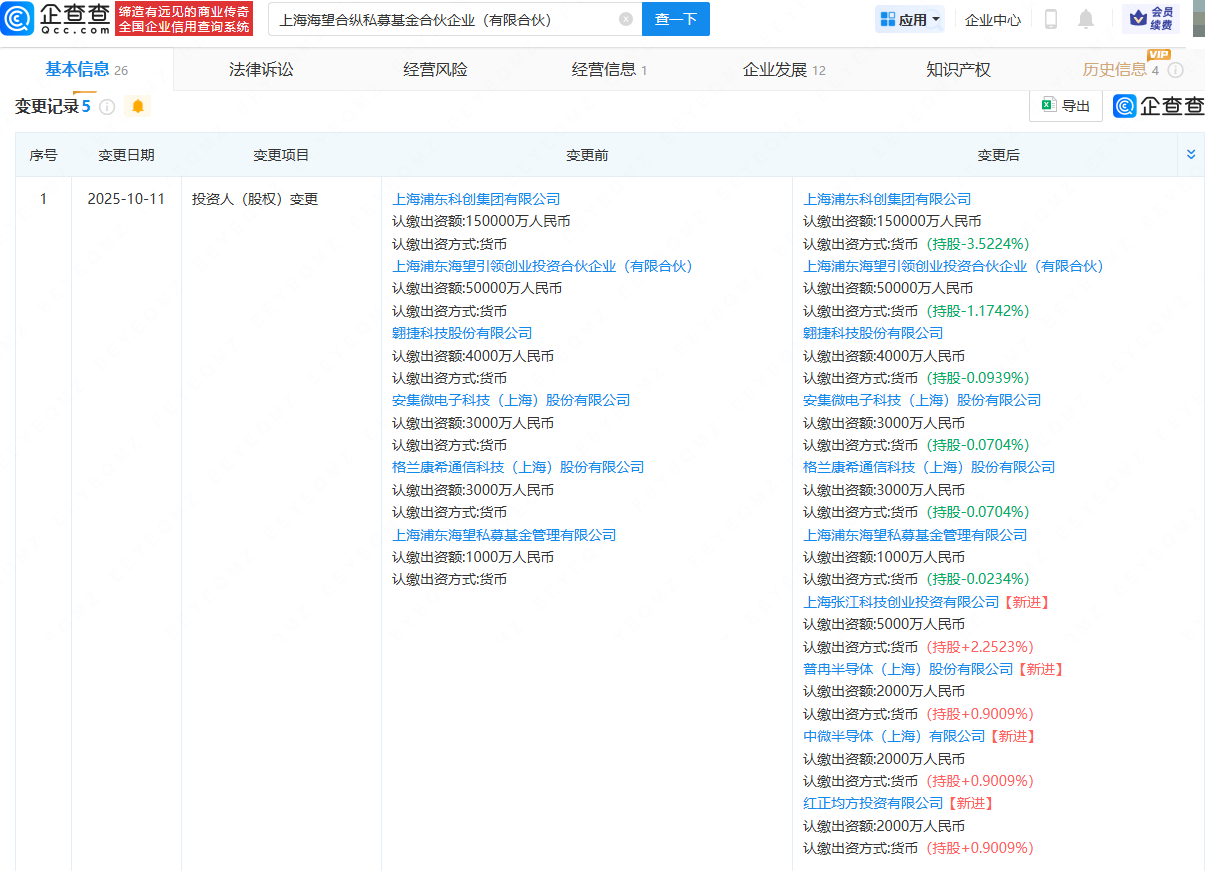
Core Insights - Shanghai Haiwang Hezong Private Equity Fund Partnership (Limited Partnership) has undergone a business change, with new shareholders including Zhongwei Company (688012) and its wholly-owned subsidiary Zhongwei Semiconductor (Shanghai) Co., Ltd. [1] - The fund was established in March 2025 with a registered capital of 2.22 billion RMB, focusing on private equity investment, investment management, and asset management activities [1]. Group 1 - The new shareholders include Zhongwei Semiconductor (Shanghai) Co., Ltd. and Puran Co., Ltd. (688766) [1] - The fund's registered capital is 2.22 billion RMB, indicating significant financial backing for its investment activities [1] - The fund's operational scope includes private equity investment, investment management, and asset management [1]

近1年CTA冠军!旭冕东升,无冕之王 | 一图看懂私募
私募排排网· 2025-10-14 00:00
Core Viewpoint - The article highlights the achievements and strengths of Xumian Investment, emphasizing its expertise in the black industry and its successful investment strategies, particularly in futures and derivatives [2][9]. Company Overview - Xumian Investment Management Co., Ltd. was established in 2015 by experienced professionals from the private equity sector and skilled traders, focusing on macroeconomic analysis and black futures trading [2]. - As of September 19, the average return of Xumian Investment's products in the 0-5 billion private equity category reached ***%, ranking first in the "small but beautiful" private futures and derivatives strategy group [2]. Development History - 2015: Xumian Investment was founded and registered with the China Securities Investment Fund Association [4]. - 2017: The company fully launched its asset management business [4]. - 2018: Participated in various competitions and won multiple awards [4]. - 2019: Expanded by hiring six fund managers [4]. - 2025: Signed a distribution agreement with Paipai Network, with product scale exceeding 100 million [4]. Team Composition - The company consists of 11 members, including 7 in research and investment, 1 in compliance and risk control, 2 in operations, and 1 in marketing [6]. Key Personnel - Hu Qing, Chairman and Fund Manager, has extensive experience in futures trading and has successfully navigated multiple market downturns [7]. - Hu Yuan, Fund Manager and General Manager, has ten years of experience in securities and fund management, with a strong background in private equity regulations [7]. Core Advantages - The company has achieved profitability for eight consecutive years, showcasing its rich investment experience [9]. - Deep understanding of stock indices and black commodity fundamentals, with a strong historical performance and large capacity [10]. - Multi-strategy ecosystem, offering a flexible product lineup for institutional investors [10]. - The team has an average investment experience of over ten years, ensuring high stability and mutual trust [11]. Product Line - The company offers various products, including: - Xumian Black Gold No. 1, focusing on macroeconomic and black industry fundamentals [13]. - Xumian Magpie No. 1, utilizing high-frequency arbitrage strategies [14]. - Xumian Jingjian, also based on macroeconomic and black industry fundamentals [15]. Performance Overview - The performance of Xumian Investment's funds has been consistently strong, with specific products achieving notable returns since their inception [16]. Awards and Recognition - Xumian Investment has received numerous awards in various competitions, including: - Third place in the 2017 Guohai Securities Private Equity Competition [17]. - First place in the 2018 Asset Management Network Futures Real Trading Competition [17]. - Multiple awards in subsequent years, highlighting its competitive edge in the private equity sector [18].

年内1009家私募基金管理人已注销
Zheng Quan Ri Bao· 2025-10-13 15:58
Core Insights - The private equity fund industry in China is undergoing a significant phase of "eliminating the inferior and promoting the superior," with over 1,000 fund managers having been deregistered in 2023 alone, indicating a trend towards regulatory compliance and stability in the market [1][2] Industry Overview - As of October 13, 2023, a total of 1,009 private fund managers have been deregistered this year, a decrease of approximately 22% compared to the same period last year [1] - The types of deregistration include 481 "voluntary deregistrations," 454 "association deregistrations," 71 "12-month no-managed deregistrations," and 3 "announcement deregistrations," with voluntary deregistrations making up about 47.67% of the total [1] - The trend of deregistration has been consistent since 2021, with over 1,000 fund managers deregistered each year, peaking at 2,537 in 2023 [1] Regulatory Environment - The China Securities Regulatory Commission (CSRC) has reported that around 7,000 "zombie institutions" have been cleared out, and risks from "pseudo-private equity" have been largely contained [1] - The regulatory environment is becoming stricter, with new regulations and self-regulatory rules being introduced, raising compliance costs for fund managers [3] Market Dynamics - The slowing pace of deregistration suggests that the industry has moved past a phase of large-scale exits, with many non-compliant or poorly managed institutions having already left the market [2] - The ongoing "elimination of the inferior" is seen as a joint effort between regulators and the market to enhance the quality of institutions, leading to increased differentiation and competitive advantages among compliant fund managers [2] Implications for Fund Managers - The trend towards regulatory compliance is expected to compel fund managers to improve their professional capabilities and strengthen their core competitiveness [2] - A comprehensive compliance system and timely, accurate information disclosure are likely to enhance investor satisfaction and loyalty [3]
因从事私募基金业务活动存违规行为,德弘联信私募被监管警示
Bei Jing Shang Bao· 2025-10-13 12:31
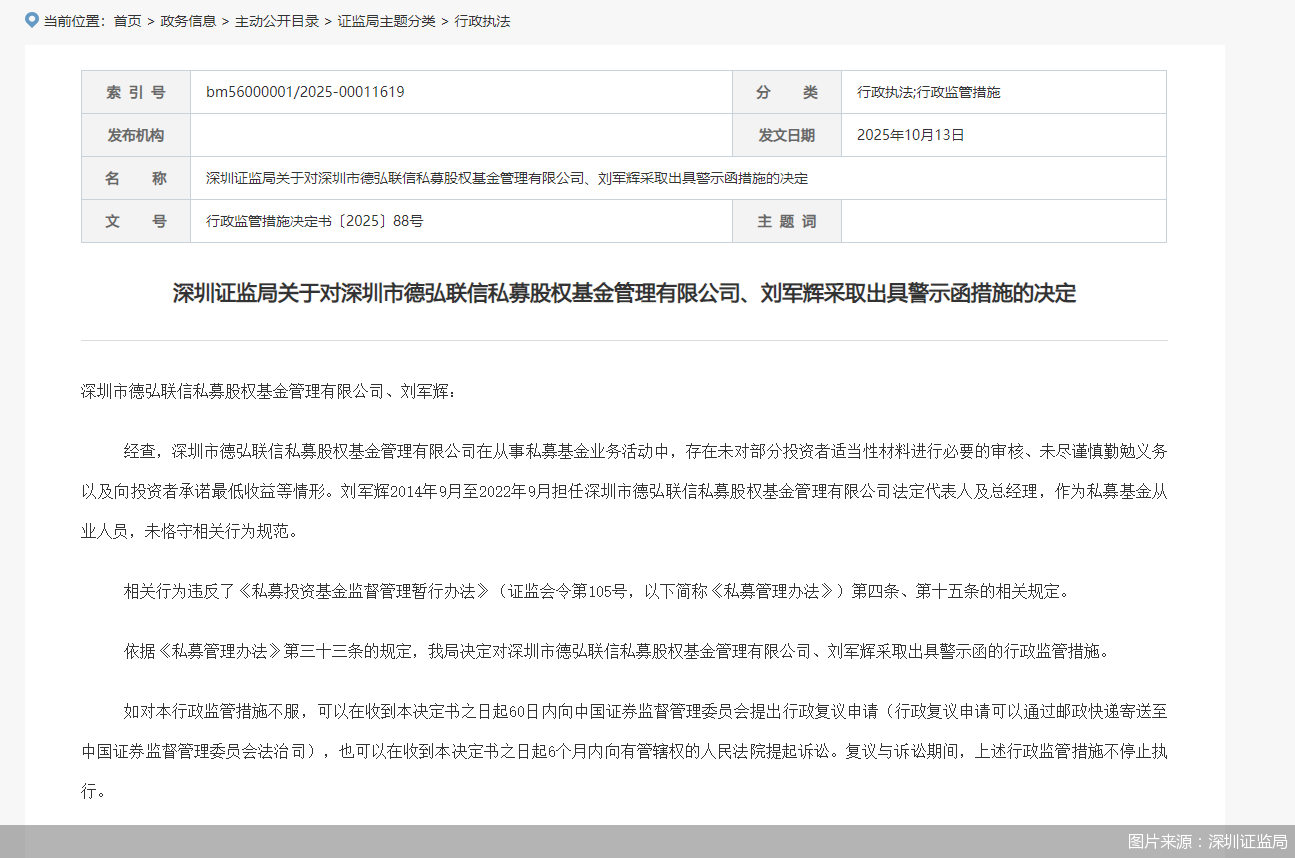
Core Viewpoint - Shenzhen Securities Regulatory Bureau issued a warning letter to Shenzhen Dehong Lianxin Private Equity Fund Management Co., Ltd. and Liu Junhui for regulatory violations in private equity fund operations [3][4]. Group 1: Regulatory Violations - Dehong Lianxin Private Equity failed to conduct necessary reviews of suitability materials for some investors and did not fulfill due diligence obligations [3]. - The company made commitments to investors regarding minimum returns, which is against regulatory requirements [3][4]. Group 2: Administrative Measures - The Shenzhen Securities Regulatory Bureau decided to impose administrative regulatory measures by issuing a warning letter to both Dehong Lianxin Private Equity and Liu Junhui [4].
佳期投资:以科学方法为舵,以技术创新为帆,驶向量化投资的未来
私募排排网· 2025-10-13 00:00
本文首发于公众号"私募排排网"。 (点击↑↑ 上图查看详情 ) 上海佳期私募基金管理有限公司(以下简称"佳期投资")自2014年成立以来,始终以科学、系统化的投资理念为指引,依托持续的技术创新,在充满 变数的资本市场中不断前行,致力于在严控风险的基础上为客户创造可持续的优质回报。目前,佳期投资的管理规模约400亿元。 精英汇聚,夯实人才基石 佳期投资团队是国内专注于量化投资的早期实践者。 历经十余年市场周期淬炼,团队在跨资产类别投资中积累了深厚的实战经验。目前公司团 队规模超过150人,近80%成员拥有硕士或博士学历,背景高度集中于数学、物理、统计学、计算机科学等STEM领域,主要毕业于清华、北 大、复旦、上海交大、中科大,以及哈佛、普林斯顿、斯坦福、耶鲁等海内外顶尖高校。 团队成员中不乏曾在国际权威期刊发表论文、斩获知名学术竞赛奖项的科研人才,亦有多人具备国内外顶尖金融机构或科技企业的资深从业经 验。这一高度 专业化、多元化的"全明星"阵容 ,为公司持续发展构筑了坚实的人才基础和核心竞争力。 创新驱动,构筑硬核实力 佳期投资始终将科技创新视为发展驱动力,不仅在研发算力设施上持续重投入,更在多个创新性研发方向 ...
“借基入市”热情依旧私募积极看待四季度行情
Shang Hai Zheng Quan Bao· 2025-10-12 15:11
Group 1 - In September, over 2000 private equity securities funds completed registration, indicating a high level of activity despite a slight month-over-month decline [1][2] - The stock strategy remains the dominant approach, with 668 new stock strategy private equity funds registered in September, accounting for 64.98% of total new registrations [1] - The average position of subjective long-only private equity funds was 78% at the end of September, indicating a high level of investment activity [3] Group 2 - Investors' willingness to allocate to equity assets has increased, driven by structural market trends and government support for technology and high-end manufacturing [2][3] - A balanced allocation strategy is becoming a consensus among private equity firms for the fourth quarter [4] - Companies are optimistic about various investment opportunities, including rare resources, coal industry prospects under the "anti-involution" policy, and traditional consumer stocks benefiting from policy signals [5]
投资决策不独立、核心人员竟无劳动关系!深圳前海鼎运资本及两名负责人收警示函
Sou Hu Cai Jing· 2025-10-11 09:44
三是未妥善留存部分投资者适当性管理方面的相关资料。 日前,深圳证监局发布公告,对深圳前海鼎运资本管理有限公司、杨东函、麦伟彪采取出具警示函措 施。 经查,深圳前海鼎运资本管理有限公司在从事私募基金业务活动中,存在以下情形: 一是未独立进行投资决策、未按合同约定进行投资运作、管理的基金投资层级不符合国务院金融管理部 门的规定、负责私募基金投资运作的人员未与公司建立劳动关系,说明公司未履行谨慎勤勉义务; 二是未按中国证券投资基金业协会规定,及时更新管理人及其从业人员信息; 依据《私募管理办法》第三十三条的规定,深圳证监局决定对深圳前海鼎运资本管理有限公司、杨东 函、麦伟彪采取出具警示函的行政监管措施。 来源:读创财经 据天眼查APP,深圳前海鼎运资本管理有限公司,成立于2015年,位于广东省深圳市,是一家以从事商 务服务业为主的企业。企业注册资本1000万人民币,实缴资本1000万人民币。 杨东函、麦伟彪实际负责深圳前海鼎运资本管理有限公司日常经营管理及投资运作等工作,作为私募基 金从业人员,未恪守相关行为规范。 相关行为违反了《私募投资基金监督管理暂行办法》(证监会令第105号,以下简称《私募管理办 法》)第四 ...
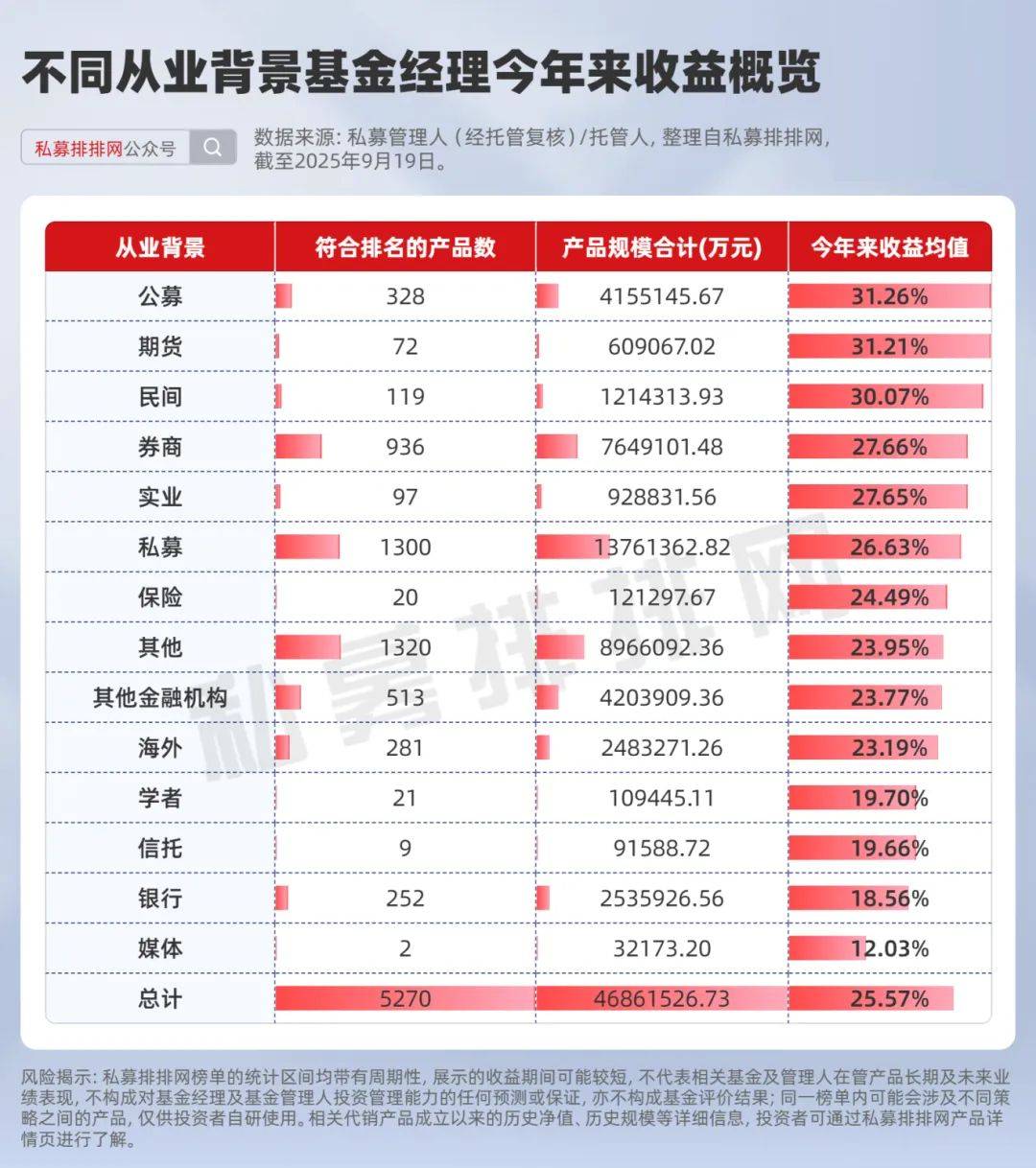
私募江湖风起云涌!“公募派”问鼎!“券商派”不敌期货、民间派
Sou Hu Cai Jing· 2025-10-11 07:33
Core Insights - The private equity fund industry is characterized by diverse investment philosophies and strategies influenced by the backgrounds of fund managers, which directly impacts product performance and risk profiles [1][4] - As of September 19, 2025, the average return for private equity fund managers this year is 25.57%, with 2,669 managers and 5,270 products reported [2][4] - Fund managers from public offerings and futures backgrounds lead in performance, with public fund managers achieving an average return of 31.26% and futures managers at 31.21% [2][4] Summary by Category Public Fund Managers - There are 859 public fund managers, with 328 products meeting ranking criteria, achieving an average return of 31.26% this year [4][2] - The top three products from public fund managers are managed by Lu Wentao, Nian Shouhua, and Wang Zheng, with Lu's product leading significantly [3][4] Futures Fund Managers - There are 251 futures fund managers, with 72 products achieving an average return of 31.21% this year, slightly below public fund managers [9][4] - The top three products from futures fund managers are managed by Liu Kejiao, Yin Zhiping, and Liang Tao, with Liu's product leading the group [10][12] Private Fund Managers - There are 298 private fund managers, with 119 products achieving an average return of 30.07%, ranking third among all backgrounds [14][4] - The top three products from private fund managers are managed by Tang Yunjie, Li Jiabin, and Han Guangbin, with Tang's product leading in performance [15][17]