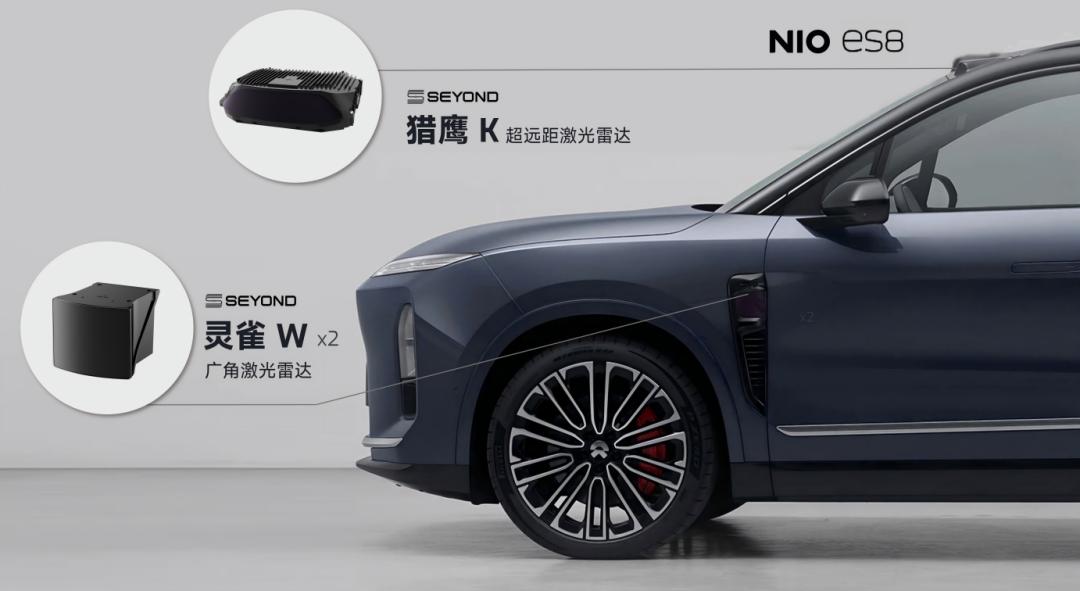
激光雷达

Search documents
曝京东管控商家定价:不许比京东低,违规或罚500万起;超过60岁不能办eSIM?中国电信被喷后改口;Meta AI裁员600人
雷峰网· 2025-10-24 00:45
Group 1 - JD.com has formed a patrol team to monitor merchant pricing during the Double Eleven shopping festival, prohibiting prices on other platforms from being lower than those on JD.com, with penalties starting at 5 million yuan for violations [3] - Lu Weibing from Xiaomi stated that future smartphone brands will be divided into two categories: those with self-developed chips and those without, emphasizing the importance of self-developed chips for better integration of hardware and software [6] - CEO of Leap Motor, Zhu Jiangming, reflected on his decision to enter the automotive industry, describing it as a choice made without fear due to his lack of prior experience in the sector [7][8] Group 2 - TikTok has undergone organizational adjustments, with the operations department's reporting structure shifting to the product team, enhancing the influence of young executive Zhi Ying [9] - A report from the China Electronic Commerce Association revealed that OPPO had the lowest complaint rate among major smartphone brands over the past five years, with a total of 32,680 complaints recorded [11] - Hesai Technology continues to lead the market in automotive lidar installations, achieving a market share of 46% and planning to produce over 2 million units annually [12] Group 3 - Xiaopeng Motors' CEO, He Xiaopeng, explained the company's strategy to develop range-extended electric vehicles, emphasizing the need to meet diverse global demands [17] - JD.com announced a record auction price of 78.19 million yuan for its "001" vehicle, with plans to reward participants with additional benefits [20] - Alibaba's Quark app has launched an AI dialogue assistant, integrating search and conversational capabilities to enhance user experience [22] Group 4 - Meta has laid off approximately 600 employees from its AI department, focusing on streamlining operations within its "superintelligent laboratory" [32] - Tesla's CEO Elon Musk revealed that TSMC and Samsung will collaborate on the production of the AI5 chip, while maintaining the use of NVIDIA's processors for certain tasks [34] - Reports indicate that Apple may skip the iPhone 19 and directly release the iPhone 20 in 2027 to commemorate the 20th anniversary of the iPhone [36]



禾赛已连续7个月车载主激光雷达市占率第一
Zheng Quan Ri Bao Zhi Sheng· 2025-10-23 11:11
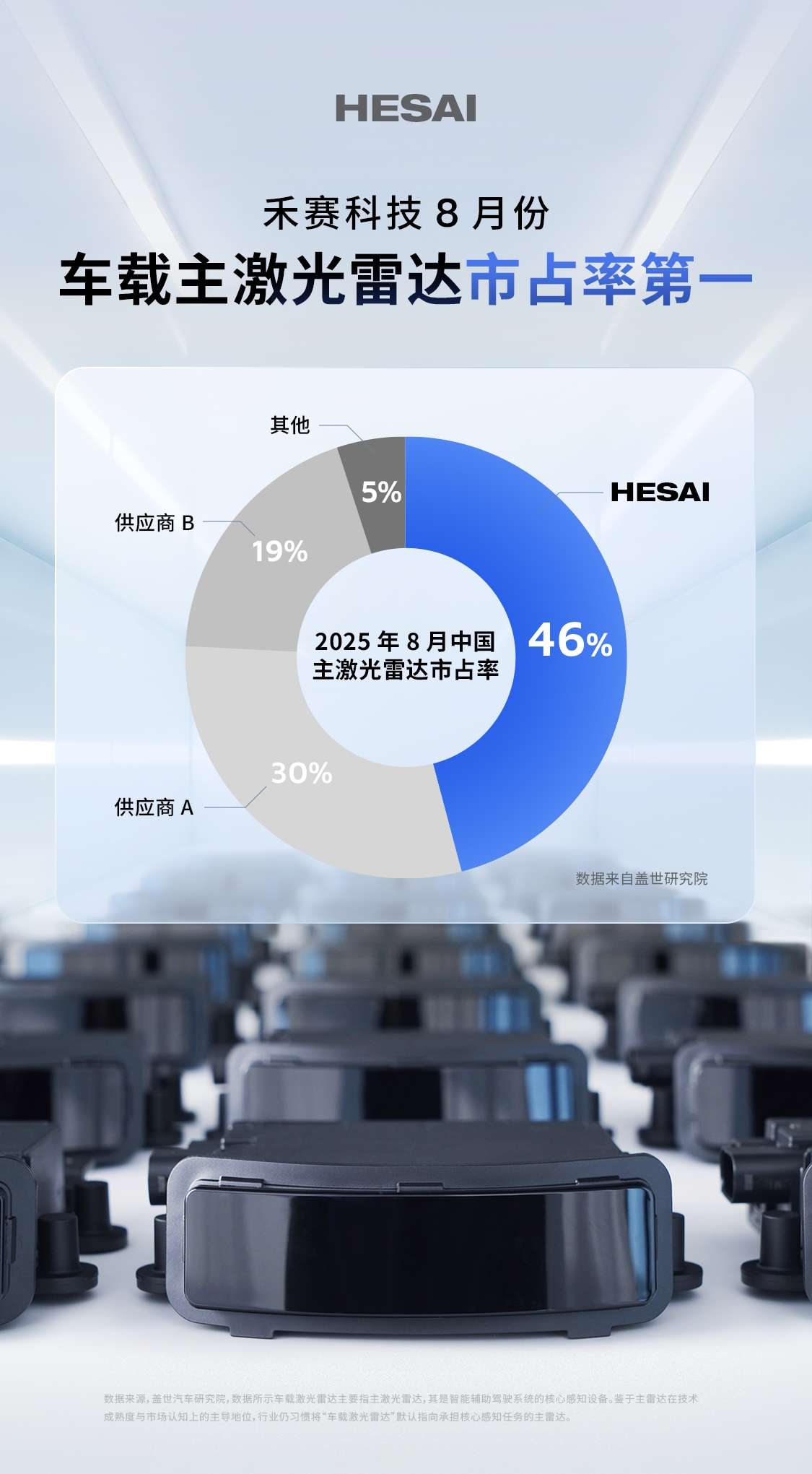
Core Insights - The report from Gaishi Automotive Research Institute indicates that Hesai Technology has maintained its position as the leading supplier of automotive LiDAR systems, achieving a market share of 46% as of August 2025, which is 1.5 times that of the second place and 2.4 times that of the third place [1][2] Group 1: Market Performance - In the period from January to August 2025, the cumulative installation of main LiDAR systems in China's front-mounted production reached 1.31 million units, with Hesai's contribution being 510,000 units [1] - Hesai's monthly installation volume of LiDAR systems has surged from 33,485 units to 97,583 units, nearly tripling [1] - The penetration rate of LiDAR in new energy passenger vehicles reached 19% by August 2025, indicating that nearly one in five new cars is equipped with this technology [1] Group 2: Production and Strategic Developments - Hesai plans to achieve an annual production capacity exceeding 2 million units in 2025, with expected deliveries ranging from 1.2 million to 1.5 million units [2] - As of the end of September 2025, Hesai became the first company globally to produce over 1 million LiDAR units in a year, marking the entry into a "million-unit" mass production era [2] - Hesai has officially listed on the Hong Kong Stock Exchange, becoming the first company in the industry to achieve dual listing on both US and Hong Kong markets, reflecting international market recognition of Chinese LiDAR technology [2] Group 3: Client Base and Product Applications - This year, Hesai's LiDAR technology has supported the launch of several popular vehicle models, including Li Auto's i6, Xiaomi's YU7, and Leap Motor's B10 [2] - Hesai has secured mass production contracts with over 24 OEMs for more than 120 vehicle models, with planned deliveries from 2025 to 2027 [2] - Key clients include top-tier automotive manufacturers such as a leading European OEM, a global champion in new energy vehicle sales, and major Chinese brands like Geely, Great Wall, and Changan [2]
市占率46%!禾赛持续领跑车载激光雷达市场
Zhi Tong Cai Jing· 2025-10-23 09:52
Core Insights - The report from Gaishi Automotive Research Institute indicates that Hesai Technology has maintained the leading position in the automotive lidar market for seven consecutive months, with a market share of 46% as of August 2025, significantly higher than its competitors [1][6][14] Group 1: Market Performance - In the first eight months of 2025, the cumulative installation of automotive lidar in China reached 1.31 million units, with Hesai's contribution being 510,000 units [6] - Hesai's monthly installation volume increased from 33,485 units to 97,583 units, nearly tripling [6] - The penetration rate of lidar in new energy passenger vehicles reached 19% by August 2025, indicating a growing trend towards making lidar a standard feature in new cars [11] Group 2: Production and Capacity - Hesai plans to achieve an annual production capacity exceeding 2 million units in 2025, with expected deliveries between 1.2 million to 1.5 million units [13] - By the end of September 2025, Hesai became the first lidar company globally to produce over 1 million units in a year, marking the entry into a new era of large-scale production [13] Group 3: Technological Advancements - Hesai has developed a complete series of self-researched chips, achieving mass production of all seven key components necessary for lidar functionality, which has created a strong technological barrier [13][14] - The fourth-generation self-developed chip has optimized lidar functions and performance by integrating all critical components [13] Group 4: Market Recognition and Partnerships - Hesai is recognized as the only company globally to have independently developed all seven key components of lidar and has successfully achieved mass production of the chip modules [14] - The company has secured production contracts with over 24 major automotive manufacturers for more than 120 vehicle models, including partnerships with leading brands such as Ideal, Xiaomi, and Toyota [14]
市占率46%!禾赛(02525)持续领跑车载激光雷达市场
智通财经网· 2025-10-23 09:37
Core Insights - Hesai Technology has maintained the leading position in the automotive lidar market for seven consecutive months, with a market share of 46%, significantly higher than its competitors [1][6][14] - The total installed volume of automotive lidar in China from January to August 2025 reached 1.31 million units, with Hesai contributing 510,000 units, marking a nearly threefold increase in monthly installation from 33,485 units to 97,583 units [6][11] - The penetration rate of lidar in new energy passenger vehicles reached 19% by August 2025, indicating a growing trend towards making lidar a standard feature in new cars [11] Company Developments - Hesai plans to achieve an annual production capacity of over 2 million units in 2025, with expected deliveries between 1.2 million and 1.5 million units [13] - The company has become the first in the world to produce over 1 million lidar units in a year, marking a significant milestone in large-scale production [13] - Hesai has successfully listed on the Hong Kong Stock Exchange, becoming the first company to achieve dual primary listings in both the US and Hong Kong, reflecting international market recognition of its technology [13] Technological Advancements - Since 2017, Hesai has focused on developing dedicated lidar chips (ASIC), enhancing performance, quality, and cost-effectiveness through optimized design [13][14] - The fourth-generation self-developed chip integrates all seven key components of lidar, showcasing significant technological advancements [13] - Hesai is the only company globally to have independently developed all seven key components of lidar and successfully achieved mass production of the chip modules [14] Market Position - According to Yole Group, Hesai holds the top global market share in automotive lidar, ADAS lidar, and L4 autonomous driving lidar, maintaining a leading position for four consecutive years [14] - The company has secured mass production contracts with over 24 OEMs for more than 120 vehicle models, with key clients including top European manufacturers and leading Chinese automakers [14]
禾赛科技跌4.7%创新低 上市募41.6亿港元高瓴浮亏
Zhong Guo Jing Ji Wang· 2025-10-23 09:13
Core Viewpoint - Hesai Technology's stock price has dropped significantly, reaching a new low since its listing, indicating potential challenges in market performance and investor sentiment [1]. Group 1: Stock Performance - Hesai Technology's stock closed at HKD 171.40, with a decline of 4.725%, and hit an intraday low of HKD 166.80, marking a new record low since its IPO [1]. - The stock price has fallen below the initial public offering price [1]. Group 2: IPO Details - Hesai Technology was listed on the Hong Kong Stock Exchange on September 16, 2025, with a total of 19,550,000 shares offered globally, including 1,955,000 shares for the Hong Kong public and 17,595,000 shares for international investors [1]. - The final offer price was set at HKD 212.80, with a maximum indicative price of HKD 228.00, raising a total of HKD 4,160.24 million, and a net amount of HKD 4,005.25 million after expenses [3]. Group 3: Use of Proceeds - Approximately 50% of the net proceeds from the IPO is planned for research and development investments, 35% (around HKD 1,297.1 million) for production capacity investments, 5% for business development, and 10% for working capital and general corporate purposes [3]. Group 4: Cornerstone Investors - Major cornerstone investors include HHLRA, Taikang Life, WT Asset Management, Grab Inc., Hongda Group, and Commando Global Fund, with HHLRA being the largest investor contributing USD 50 million [4].
禾赛盘前涨1.1%,此前发布机器人多模态融合感知与控制解决方案
Ge Long Hui· 2025-10-23 09:12
Core Viewpoint - Hesai (HSAI.US) has seen a pre-market increase of 1.1%, reaching $22.02, following a strategic partnership with Guanghetong to launch a multi-modal perception and control solution based on LiDAR, stereo vision, and RTK technology [1] Group 1 - The collaboration between Hesai and Guanghetong aims to enhance robotic capabilities through advanced perception and control solutions [1] - The newly developed solution has already been successfully implemented in a leading domestic intelligent robotics company, empowering its next-generation benchmark robotic products [1]


美股异动|禾赛盘前涨1.1%,此前发布机器人多模态融合感知与控制解决方案
Ge Long Hui· 2025-10-23 08:56
Core Viewpoint - Hesai (HSAI.US) has seen a pre-market increase of 1.1%, reaching $22.02, following a strategic partnership with Guanghetong to launch a multi-modal perception and control solution based on LiDAR, stereo vision, and RTK technology [1] Group 1 - The strategic collaboration between Hesai and Guanghetong aims to enhance robotic capabilities through advanced perception and control solutions [1] - The newly developed solution has already been successfully implemented in a leading domestic intelligent robotics company, empowering its next-generation benchmark robotic products [1]
激光雷达全链条生产项目德州投产
Zheng Quan Shi Bao Wang· 2025-10-23 03:55
Core Viewpoint - The launch of the LiDAR and sensor industrialization project in Dezhou marks the establishment of a complete domestic LiDAR production chain, filling a significant gap in the industry [1] Group 1: Project Overview - The project was inaugurated on October 21 and is expected to achieve full production by the end of next year [1] - Once fully operational, the project is projected to produce 1 million LiDAR units annually, generating an estimated annual sales revenue of 8 billion yuan [1] Group 2: Industry Impact - The project aims to break the foreign technology monopoly and achieve self-sufficiency in core LiDAR chip technology [1] - Experts from the China Electronic Materials Industry Association believe that the completion of this project will fill the gap in the domestic LiDAR production chain [1]
华为拿下激光雷达供应商装机量第一
是说芯语· 2025-10-23 02:07
Core Insights - The Chinese lidar market is showing significant head concentration, with Huawei and Hesai Technology together holding a market share of 73.9%, an increase of 8.7 percentage points from 65.2% in the first five months of the year, solidifying a "dual oligopoly" structure [1][6]. Group 1: Company Performance - Huawei ranks first with an installation volume of 643,800 units, achieving a market share of 41.1%. Its lidar is a core component of its smart automotive solutions, primarily supplied to the Hongmeng Intelligent Driving ecosystem and HI model partners, covering brands like AITO, Zhiji, and others [5]. - As of August, Huawei's QianKun lidar cumulative shipments exceeded 1 million units, with its intelligent driving system supporting 22 different models, including those capable of L3 level autonomous driving [5]. - Hesai Technology ranks second with an installation volume of 514,200 units and a market share of 32.8%. The company has established competitive barriers through self-developed chips and scaled production, becoming the first lidar manufacturer globally to exceed an annual production of 1 million units [6]. Group 2: Market Dynamics - The remaining market positions are relatively fragmented, with Suteng Juchuang holding a 19.5% market share and Tudatong at 6.7%, while other manufacturers collectively account for less than 1% [6]. - The overall market for lidar in China is expected to exceed 5 billion yuan by 2025 and grow to over 20 billion yuan by 2030, with a compound annual growth rate of 18.5%. The autonomous driving sector is projected to account for 45% of this market by 2030 [6]. - Analysts indicate that the differences in technological paths among leading companies are key drivers of the increasing concentration, with Huawei leveraging ecosystem integration and Hesai focusing on chip development and capacity expansion [6][7].
告别「够用」时代,L3 智驾呼唤高性能激光雷达上量
3 6 Ke· 2025-10-22 00:02
Core Viewpoint - The debate over the optimal approach for intelligent driving technology has concluded, with a consensus on the necessity of a multi-sensor fusion strategy that includes cameras, millimeter-wave radar, and LiDAR [1][3]. Group 1: Technical Insights - The integration of LiDAR is essential for L3 autonomous driving due to its ability to compensate for the limitations of visual perception in extreme lighting conditions [1]. - LiDAR serves as a critical safety component in intelligent driving systems, providing necessary redundancy in perception capabilities [1][4]. - The commercial rollout of L3 autonomous driving will initially focus on highways and urban expressways, where the complexity of scenarios is relatively lower [5][22]. Group 2: Market Dynamics - The transition from L2 to L3 driving systems necessitates a shift in responsibility from human drivers to the system, requiring enhanced reliability and redundancy in perception systems [4][8]. - The demand for high-performance LiDAR has transformed it from an optional component to a prerequisite for L3 autonomous driving [3][19]. - Companies like TuSimple are leading the market with their advanced LiDAR solutions, having achieved significant milestones in mass production and technology validation [18][28]. Group 3: Competitive Landscape - The L3 LiDAR market features three main player categories: leading manufacturers like Hesai and TuSimple, cross-industry players like Huawei, and international firms like Luminar and Innoviz [19][21]. - The competition is shifting from purely technical specifications to a comprehensive evaluation of performance, cost, and mass production capabilities [21][29]. - TuSimple has established a unique position by developing both 1550nm and 905nm LiDAR technologies, creating a complete product matrix for various driving scenarios [26][28].