家电制造

Search documents
海信家电(000921.SZ)发布前三季度业绩,归母净利润28.12亿元,同比增长0.67%
智通财经网· 2025-10-28 15:38
Core Viewpoint - Hisense Home Appliances (000921.SZ) reported a slight increase in revenue and net profit for the first three quarters of 2025, indicating stable performance amidst market conditions [1] Financial Performance - The company achieved an operating revenue of 71.533 billion yuan, representing a year-on-year growth of 1.35% [1] - The net profit attributable to shareholders of the listed company was 2.812 billion yuan, with a year-on-year increase of 0.67% [1] - The net profit attributable to shareholders after deducting non-recurring gains and losses was 2.327 billion yuan, reflecting a year-on-year growth of 1.65% [1]
马斯克AI百科上线首日演砸,小米智能家电工厂竣工投产 | 蓝媒GPT
Sou Hu Cai Jing· 2025-10-28 15:36
Group 1 - Grokipedia, powered by GrokAI, launched on October 27, 2023, but faced significant issues including a crash within an hour due to unexpected traffic, indicating a rushed launch [1] - The platform has been accused of plagiarism from Wikipedia and exhibiting bias, particularly in its entry on "gender," which emphasizes a binary classification of biological sex [1] - Grokipedia has also been criticized for factual inaccuracies, such as fabricating information about Elon Musk's involvement in a fictitious "DOGE service" personnel change [1] Group 2 - PayPal announced a partnership with OpenAI to integrate payment functionalities within ChatGPT, allowing users to check out instantly through PayPal, benefiting millions of merchants [2] - Ant Group's AI health application AQ ranked 7th in China's AI native applications, achieving a remarkable 83.4% compound growth rate, significantly higher than the industry average of 13.5% [2] - Baidu's AI search saw a quarter-on-quarter increase of 18.63% in monthly active users, reaching 382 million, maintaining its position as the leader in the domestic AI search sector [2] Group 3 - Xiaomi's smart home appliance factory in Wuhan has officially commenced production, with a total investment exceeding 2.5 billion yuan and an annual production capacity of 7 million units [3] Group 4 - "58 Intelligent" completed a strategic financing round of approximately 500 million yuan, with funds aimed at accelerating the construction of a pilot base and advancing core technologies in embodied robotics [4] Group 5 - Baidu's AI glasses, named "Baidu AI Glasses Pro," will begin pre-sales on November 1, 2023, featuring stylish designs and advanced functionalities such as AI translation and recording capabilities [5]


澳柯玛(600336.SH):前三季度净亏损905.91万元
Ge Long Hui A P P· 2025-10-28 12:18
Group 1 - The core viewpoint of the article is that Aucma (600336.SH) reported a decline in revenue and a net loss for the first three quarters of 2025 compared to the previous year [1] Group 2 - For the first three quarters of 2025, the company achieved total operating revenue of 5.671 billion yuan, a year-on-year decrease of 11.14% [1] - The net profit attributable to shareholders of the parent company was -9.0591 million yuan, compared to a net profit of 2.8266 million yuan in the same period last year [1] - The basic earnings per share were -0.0114 yuan [1]

欧圣电气(301187):2025年三季报点评:马来工厂爬坡影响费用率,静待底部回暖
Shenwan Hongyuan Securities· 2025-10-28 11:42
Investment Rating - The investment rating for the company is "Buy" (maintained) [6] Core Views - The company's revenue performance fell short of expectations, with Q1-3 2025 revenue at 1.454 billion yuan, a year-on-year increase of 11%, while net profit attributable to the parent company was 130 million yuan, a year-on-year decrease of 29% [6] - The ramp-up of the Malaysian factory is impacting the expense ratio, with initial high personnel costs due to the transfer of staff to support production [6] - Despite short-term challenges, long-term demand in North America remains strong, and the company is expected to return to normal profit levels in the future [6] Financial Data and Profit Forecast - Total revenue projections for 2025E are 1.997 billion yuan, with a year-on-year growth rate of 13.2% [2] - Net profit attributable to the parent company is forecasted at 278 million yuan for 2025E, reflecting a year-on-year increase of 9.7% [2] - Earnings per share (EPS) is expected to be 1.09 yuan for 2025E [2] - The gross profit margin is projected to be 34.2% for 2025E [2] - Return on equity (ROE) is expected to be 17.6% for 2025E [2] Market Data - The closing price on October 27, 2025, was 28.68 yuan, with a one-year high of 48.75 yuan and a low of 23.38 yuan [3] - The market capitalization of the circulating A-shares is 1.902 billion yuan [3] - The price-to-earnings (PE) ratio is projected to be 26 for 2025E [2][3]
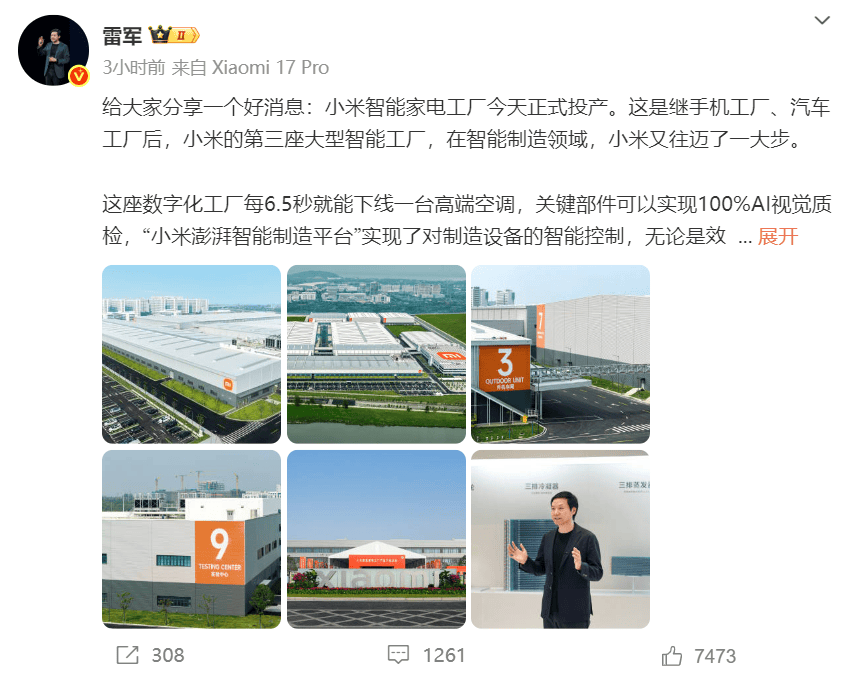
6.5秒下线一台空调!雷军现身武汉,官宣小米家电工厂正式投产
Sou Hu Cai Jing· 2025-10-28 09:29
Core Insights - Xiaomi has officially launched its first smart home appliance factory in Wuhan, marking a significant step in its smart manufacturing strategy and moving away from reliance on OEM production [4][5][9] Group 1: Factory Overview - The new smart home appliance factory is Xiaomi's third large-scale manufacturing facility, following its smartphone and automotive factories [3][5] - The factory was established in a record time of approximately 14 months, significantly shorter than the industry average [7] - The total investment for the first phase of the project is 2.5 billion RMB, covering an area of 500,000 square meters, with a peak production capacity of 7 million units and an expected output value of 14 billion RMB [9] Group 2: Production Capabilities - The factory will initially focus on air conditioning products, including both household and central air conditioning systems, and is equipped with six core air conditioning assembly plants [9][11] - The production efficiency is notable, with one air conditioning unit being completed every 6.5 seconds due to advanced AI technology and highly automated production processes [11] Group 3: Strategic Importance - The establishment of the factory aligns with Xiaomi's long-term strategic goals and serves as a way to contribute to the development of its founder's hometown, Wuhan [11] - The R&D team in Wuhan has grown to 4,000-5,000 members, with plans to expand to a scale of 10,000 [11]

海信家电(00921.HK):前三季度净利润28.12亿元 同比增加0.67%
Ge Long Hui· 2025-10-28 09:03
Core Insights - Hisense Home Appliances (00921.HK) reported a revenue of 71.533 billion RMB for the first three quarters of 2025, representing a year-on-year increase of 1.35% [1] - The net profit attributable to shareholders of the listed company was 2.812 billion RMB, reflecting a year-on-year increase of 0.67% [1] - The net profit attributable to shareholders after deducting non-recurring gains and losses was 2.327 billion RMB, which is a year-on-year increase of 1.65% [1] - The basic earnings per share stood at 2.06 RMB [1]
海信家电:第三季度净利润7.35亿元 同比下降5.40%
Xin Lang Cai Jing· 2025-10-28 08:40
海信家电(000921.SZ)公告称,公司发布2025年第三季度报告,第三季度营收为221.92亿元,同比增长 1.16%;净利润为7.35亿元,同比下降5.40%。前三季度营收为715.33亿元,同比增长1.35%;净利润为 28.12亿元,同比增长0.67%。 ...
「罚款500万」事件为造谣?京东回应!
Xin Lang Ke Ji· 2025-10-28 08:00
Core Viewpoint - Recent rumors regarding JD's high-pressure pricing strategy during the Double 11 shopping festival have circulated on social media, including claims that Midea Group was fined 5 million yuan by JD for pricing issues. However, insiders from both companies have indicated that these claims are false, suggesting possible manipulation by certain platforms [1]. Group 1 - JD Group confirmed that the rumor about the fine imposed on Midea Group is true [1]. - Midea Group has not yet responded to the claims regarding the fine [1]. - There are indications of platform manipulation behind the spread of these rumors, including the "choose one from two" strategy attributed to JD [1].


83岁何享健家族财富达2780亿元,年增430亿元涨幅18%,排名下滑3位降至第八
Xin Lang Cai Jing· 2025-10-28 07:37
Core Insights - The Hu Run 2025 Rich List indicates that the He Xiangjian family of Midea Group has a wealth of 278 billion RMB, an increase of approximately 43 billion RMB, or 18% from the previous year [1] - Midea Group's ranking dropped from 5th to 8th place in the list [1] - Midea Group achieved record high performance last year with revenue of 407.1 billion RMB, a year-on-year growth of 9.4%, and a net profit of 38.5 billion RMB, up 14% [1] Financial Performance - Midea Group's revenue reached 407.1 billion RMB, reflecting a 9.4% increase year-on-year [1] - The net profit attributable to shareholders was 38.5 billion RMB, marking a 14% growth compared to the previous year [1] - The ToB (business-to-business) segment generated 104.5 billion RMB in revenue, serving as a "second engine" for growth [1] Strategic Developments - Midea Group completed its H-share issuance, establishing a dual-platform (A+H) strategy to enhance its global expansion efforts [1] - The company distributed over 9 billion RMB in dividends in the past year [1]
新纪录!5300亿元,中国首富,是他
中国基金报· 2025-10-28 07:30
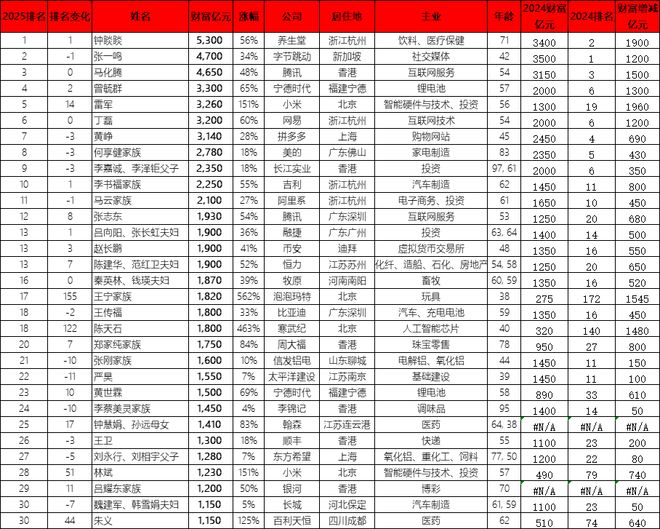
Core Insights - Zhong Shanshan has become the richest person in China for the fourth time, with a wealth of 530 billion RMB, setting a new record for the wealth of a Chinese billionaire [2][3] - Lei Jun from Xiaomi has seen a wealth increase of 196 billion RMB, making him the "wealth growth king" among listed entrepreneurs, primarily benefiting from the growth of Xiaomi's automotive sector and breakthroughs in high-end smartphones [2][3] Wealth Rankings - The top five wealth rankings include: 1. Zhong Shanshan - 530 billion RMB (56% increase) [3] 2. Zhang Yiming - 470 billion RMB (34% increase) [3] 3. Ma Huateng - 465 billion RMB (48% increase) [3] 4. Zeng Yuqun - 330 billion RMB (65% increase) [3] 5. Lei Jun - 326 billion RMB (151% increase) [3] Overall Wealth Trends - The total wealth of listed entrepreneurs approaches 30 trillion RMB, with 1,434 entrepreneurs having wealth exceeding 5 billion RMB, reflecting a year-on-year growth of 31% [4] - The significant increase in the number of billionaires is attributed to a substantial recovery in the stock market [4] Industry Performance - Six major industries have shown notable wealth growth among entrepreneurs: - **New Energy Vehicles**: Benefiting from favorable policies and global market demand, Lei Jun and Zeng Yuqun have seen significant wealth increases [6] - **Consumer Electronics**: Driven by the popularity of short videos and sustained global demand for smart hardware, new entrants like Liu Jingkang and Wang Tao have made substantial gains [6] - **New Consumption**: The emergence of new models and emotional consumption has led to significant wealth increases for entrepreneurs like Wang Ning from Pop Mart [6] - **AI Industry**: Entrepreneurs like Chen Tianshi have seen wealth growth of nearly 150 billion RMB [6] - **Biopharmaceuticals**: Notable wealth increases among several entrepreneurs in the innovative drug sector [8] - **Securities Services**: Wealth growth due to the stock market recovery, with significant increases for companies like Dongfang Caifu and Tonghuashun [8] Regional Insights - The Yangtze River Delta region has 483 entrepreneurs on the list, accounting for 34% of the total, while the Guangdong-Hong Kong-Macau Greater Bay Area has 363, making up 25% [10] - The top three cities for listed entrepreneurs are Shanghai, Shenzhen, and Beijing, with significant increases in the number of entrepreneurs from these cities due to the stock market recovery and industry concentration [10][11]