
铁路建设

Search documents
新疆区域深度汇报
2025-09-15 01:49
Summary of Key Points from the Conference Call Industry Overview - The report focuses on the Xinjiang region's economic development and infrastructure projects, with a specific emphasis on coal and coal chemical industries, as well as transportation infrastructure related to the Belt and Road Initiative [1][2][3][4][5][6][7][14][18]. Core Insights and Arguments - **Economic Growth Targets**: Xinjiang aims for a GDP growth of approximately 6% in 2025, with fixed asset investment growth targeted at 10%. In 2024, GDP is expected to grow by 6.1%, with per capita GDP increasing by 5.4% [1][7]. - **Infrastructure Investment**: The region plans to implement 500 key projects with a total investment of 3.47 trillion yuan (approximately 0.5 trillion USD) in 2025, with 4.069 billion yuan planned for completion that year. Infrastructure investment will account for 23% of this, while industrial investment will make up 74% [1][12]. - **Coal Production**: Xinjiang's raw coal production is projected to reach 543 million tons in 2024, marking an 18% year-on-year increase. The region has significant coal resources, with a total approved coal mine capacity of 208 million tons [1][14]. - **Belt and Road Initiative**: Xinjiang plays a crucial role in the Belt and Road Initiative, enhancing its strategic position as a hub connecting China with Central Asia and Europe. The region's export growth rate ranks among the top three in the country [3][6][19]. Significant Developments - **Major Projects**: Key projects include coal chemical initiatives, the China-Kyrgyzstan-Uzbekistan railway, and the New Tibet Railway. Companies like China Chemical and China Railway are expected to benefit from these developments [5][20]. - **Infrastructure Progress**: Xinjiang has made notable advancements in infrastructure, with significant investments in roads and railways. The total road mileage reached 11,000 kilometers, with over 94% of counties connected by expressways [7][9]. - **Policy Support**: The upcoming 70th anniversary celebrations and the Fourth Central Xinjiang Work Conference are anticipated to bring additional policy support and development plans, similar to past events [4][13]. Additional Important Insights - **Water Resource Management**: The South-to-North Water Diversion West Line Project may indirectly enhance water resource management in Xinjiang, improving overall water utilization efficiency [17]. - **Investment from State-Owned Enterprises**: 25 state-owned enterprises have signed contracts for 183 projects in key sectors such as oil, gas, coal, and renewable energy, with expected investments ranging from 400 billion to 500 billion yuan [2][14]. - **Future Outlook**: The ongoing development of coal chemical projects and infrastructure improvements is expected to lead to significant economic growth and increased investment in Xinjiang over the coming years [15][20].





“轨道版”深中通道有实质进展
Shen Zhen Shang Bao· 2025-09-15 01:09
Group 1 - The project for the Shenzhen-Nansha Intercity Railway planning and construction scheme has been awarded to China Railway Fifth Survey and Design Institute Group Co., Ltd. and Shenzhen National High-tech Industry Innovation Center for 1.681 million yuan, marking significant progress in connecting Shenzhen, Nansha, and Zhongshan [1][2] - The project aims to study station positioning, system standards, and financing plans, laying the groundwork for inclusion in the Greater Bay Area intercity railway construction plan [1][2] - The Shenzhen-Nansha Intercity Railway is planned to connect with the Zhongshan Cuiheng New District South Zhong Pearl Intercity Railway to the west and the Shenzhen Airport area to the east, achieving rail connectivity across the Pearl River Estuary [1][2] Group 2 - The successful bid for the Shenzhen-Nansha Intercity Railway planning scheme indicates that the highly anticipated intercity line and stations will commence preliminary research, marking a breakthrough in the interconnectivity of the Greater Bay Area's "horizontal corridor" [2]
铁路完成固定资产投资5041亿元
Ren Min Ri Bao· 2025-09-14 20:28
Group 1 - The core point of the article highlights that from January to August this year, China's national railway completed fixed asset investment of 504.1 billion yuan, representing a year-on-year increase of 5.6%, which effectively stimulates social investment and injects new momentum into the domestic demand and economic recovery [1] - The National Railway Group has made significant progress in railway construction, with several key projects completed, including the Chongqing to Xiamen high-speed railway and the Zhengzhou to Kaifeng intercity railway, enhancing regional transportation networks [1] - Ongoing construction projects are advancing smoothly, with a focus on safety, quality, and environmental protection, exemplified by the breakthrough of the Dabieshan Tunnel in Hubei and the progress of the Maolingjiang Bridge in Guangxi [1] Group 2 - The National Railway Group plans to continue focusing on serving national strategies and regional economic development, aiming to efficiently advance key railway projects and ensure the successful completion of the "14th Five-Year Plan" for railways [2]
【砥砺奋进七十载 天山南北谱华章】天堑织网变通途
Yang Shi Wang· 2025-09-14 11:57
Core Points - Xinjiang has accelerated the construction of a modern comprehensive transportation network since the 18th National Congress of the Communist Party, transforming previously isolated areas into accessible regions [1][2] - The Uwei Expressway is nearing completion, expected to be operational in just over two months, enhancing connectivity between northern and southern Xinjiang [1] - New industrial parks and cold chain bases are being established along the expressway, indicating economic development in previously underserved areas [1] - The region has seen significant improvements in transportation infrastructure, including the first high-altitude airport in Xinjiang and the completion of the world's first desert-ring railway [1][2] Transportation Infrastructure - Xinjiang's railway operating mileage has reached 9,557 kilometers, covering over 80% of county-level administrative regions [2] - The region boasts 28 airports, the highest number in the country, with 628 operational flight routes [2] - The total length of highways in Xinjiang has reached 231,900 kilometers, with expressways connecting all prefecture-level cities [2] - Rural roads are improving access to local agricultural products, facilitating their distribution to major markets [2]
全国铁路建设持续推进 前8个月完成固定资产投资超5000亿元
Xin Hua Wang· 2025-09-14 07:58
Core Insights - The construction of railways in China is progressing steadily, with fixed asset investment exceeding 500 billion yuan in the first eight months of the year, marking a year-on-year increase of 5.6% [1][2] Group 1: Investment and Economic Impact - In the first eight months of this year, the total fixed asset investment in railways reached 504.1 billion yuan, which has effectively stimulated social investment and contributed to the recovery of the economy [1] - The investment in railway construction is seen as a new driving force for expanding domestic demand and promoting economic growth [1] Group 2: Ongoing Projects and Developments - Major railway projects are being completed, including the Chongqing to Xiamen high-speed railway and the Zhengzhou to Kaifeng intercity railway, enhancing regional transportation networks [1] - The construction of significant tunnels and bridges, such as the Daba Mountain Tunnel and the Maoling River Bridge, is progressing well, with various construction units optimizing their operations for safety and quality [2] - The National Railway Group plans to continue focusing on national strategies and regional economic development while ensuring the successful completion of the 14th Five-Year Plan for railway infrastructure [2]
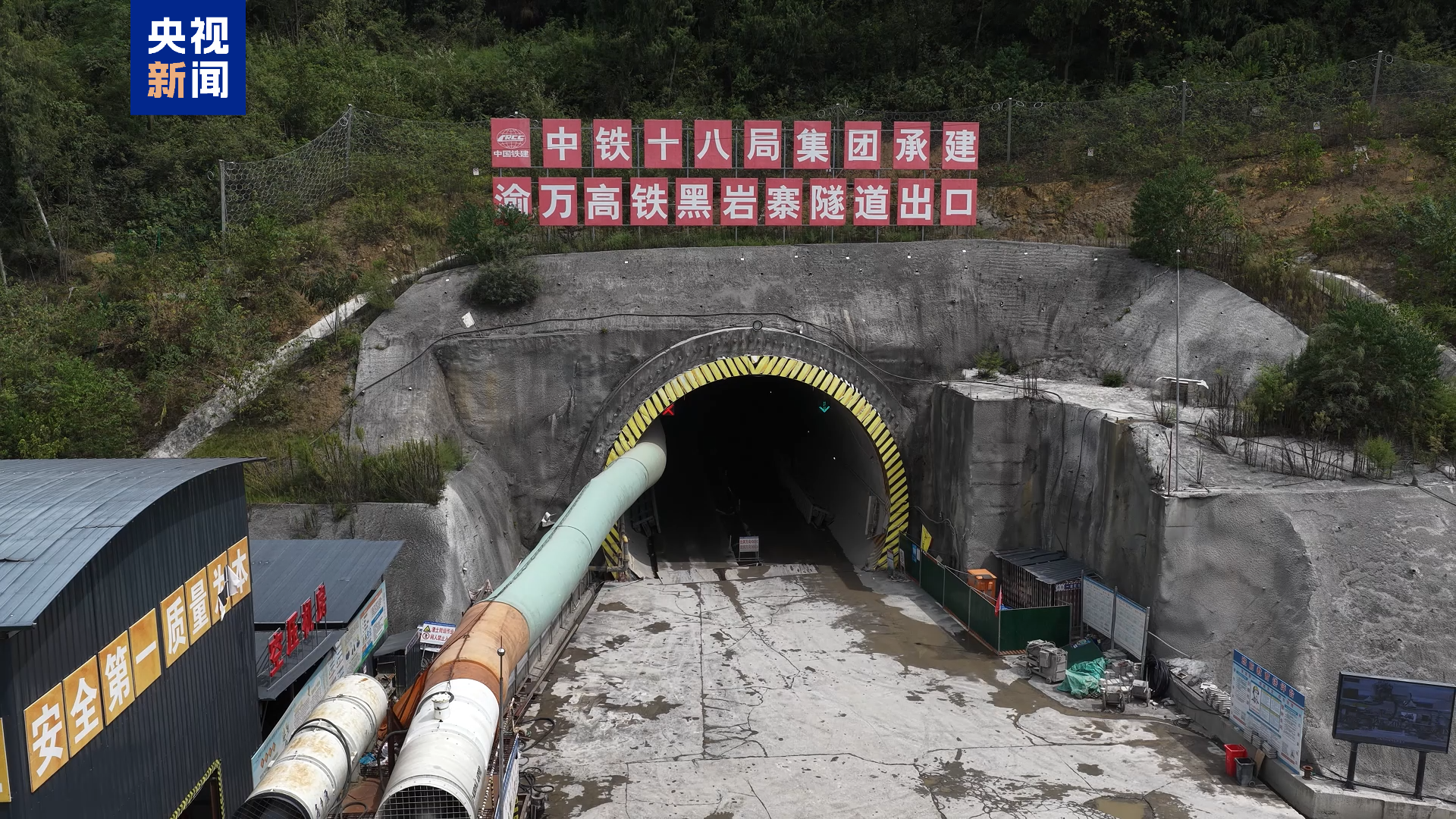
新渝万高铁黑岩寨隧道顺利贯通
Yang Shi Xin Wen Ke Hu Duan· 2025-09-12 07:30
Core Insights - The Heiyanzhai Tunnel, located in Chongqing, is a significant infrastructure project with a length of 3,465 meters and a maximum burial depth of approximately 250 meters, presenting considerable construction challenges and safety risks due to geological conditions [1][3]. Group 1: Construction Challenges - The tunnel is situated in a low mountain hilly area with significant terrain fluctuations, leading to high construction difficulty and safety risks, including the potential for gas and harmful gas emissions, as well as collapses in the sandstone and mudstone interlayers [1]. - The construction unit has adopted innovative techniques such as a "36-meter hydraulic trestle + full-section arch steel template" combination, along with advanced equipment like intelligent lining vehicles and fully automatic anchor drilling machines to enhance safety and quality [3]. Group 2: Strategic Importance - The New Chongqing-Wanzhou High-Speed Railway, with a total length of 251 kilometers and a design speed of 350 kilometers per hour, serves as a rapid transit corridor connecting the main urban area of Chongqing with the northeastern region of the Three Gorges Reservoir area [5]. - Upon completion, the railway will significantly reduce travel time between cities along the route, facilitating easier public transportation and accelerating the flow of regional resources, thereby playing a crucial role in the implementation of the Chengdu-Chongqing economic circle strategy and promoting the integration of the Belt and Road Initiative with the Yangtze River Economic Belt [5].

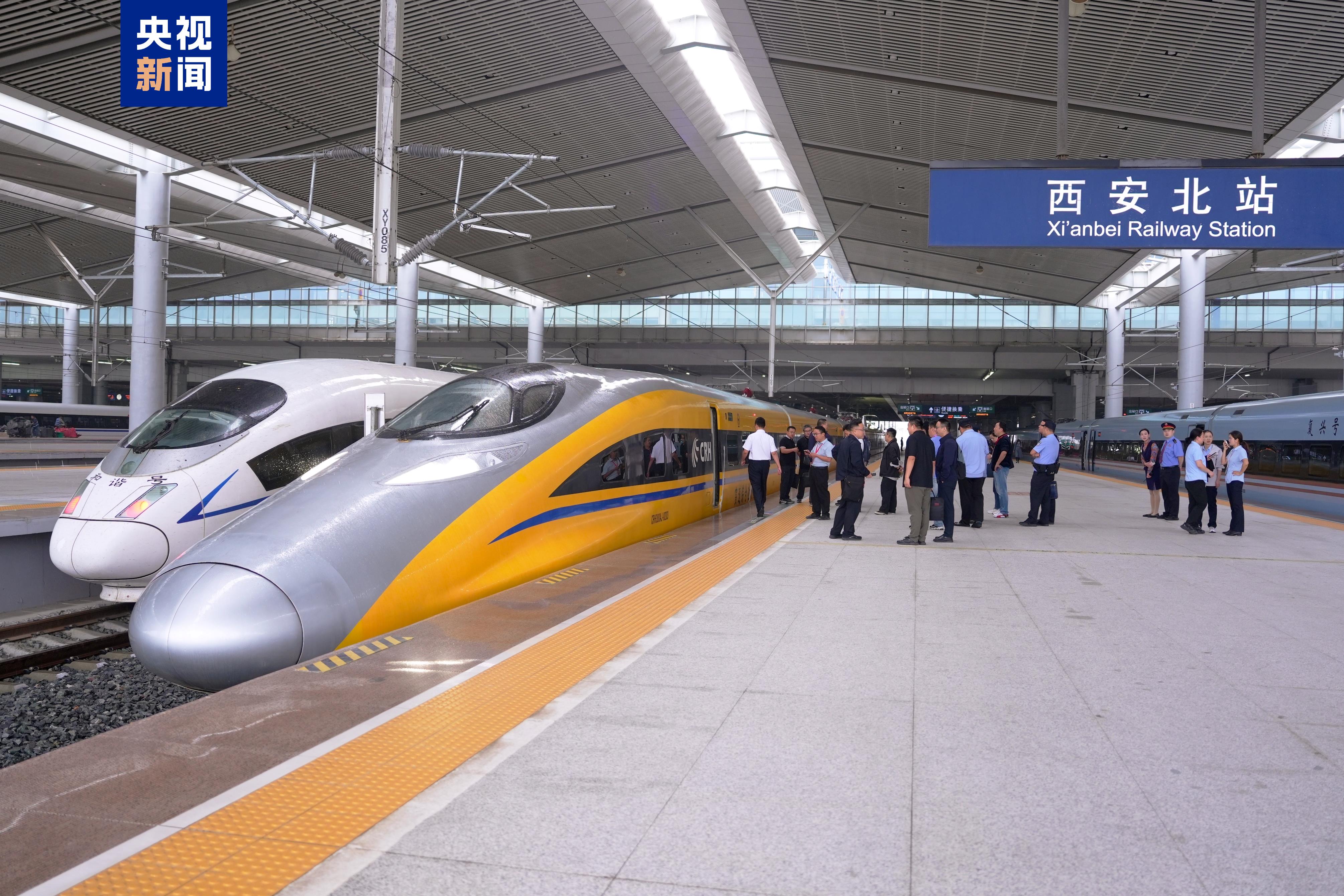
进度条刷新 西延高铁正式进入联调联试阶段
Yang Shi Xin Wen· 2025-09-11 04:45
Core Points - The Xi'an to Yan'an high-speed railway has officially entered the joint debugging and testing phase, marking a significant step towards its operational launch [1] - The joint debugging and testing phase is crucial for verifying and optimizing the compatibility of various systems, including track, power supply, and signaling, ensuring technical reliability for the railway's opening [1][3] Infrastructure Details - The Xi'an to Yan'an high-speed railway spans a total length of 299.8 kilometers, designed as a double-track high-speed railway with a maximum speed of 350 kilometers per hour [5] - The railway features 47 tunnels and 67 major and medium bridges, with the bridge-tunnel ratio accounting for 91% of the newly constructed line length [3] Strategic Importance - Once operational, the railway will enhance Shaanxi's geographical advantages and its position within the national railway network, contributing to the optimization of the high-speed railway layout in China [5] - The project is expected to support rural revitalization in revolutionary old areas and facilitate the new pattern of western development [5]
AI技术助运营铁路桥梁“移旧换新”
Ke Ji Ri Bao· 2025-09-11 00:01
Core Viewpoint - The application of artificial intelligence (AI) in the replacement of railway bridge beams marks a significant advancement in China's railway infrastructure, providing a new solution for the renovation and upgrade of existing railways [1] Group 1: AI Implementation - The project at Shaoxing intercity railway's Keqiao station successfully utilized AI technology for the first time in the operation of railway bridges, achieving millimeter-level precision in beam placement [1] - The AI system comprises three main modules: perception, simulation, and control, which work together to monitor and manage the beam replacement process [1] Group 2: Technical Details - The perception module integrates advanced technologies such as grating, wire sensors, strain gauges, and BeiDou positioning to monitor the beam's settlement, stress, and displacement in real-time [1] - The simulation module visualizes the entire construction process through a digital twin platform, while the control module uses intelligent algorithms to predict beam movement trends and automatically corrects any deviations [1] Group 3: Engineering Significance - This project represents the first instance of a switch continuous beam replacement in China, addressing the unique structural and stress characteristics of the switch area [1] - The development of a high-precision finite element analysis model allows for comprehensive simulation and analysis throughout the entire process, filling a gap in the field of switch area renovation [1]
连接两个“世界级城市群”,关键工程要开工了!
Bei Jing Ri Bao Ke Hu Duan· 2025-09-10 10:13
Core Viewpoint - The construction of the Wenzhou-Fuzhou High-Speed Railway is set to begin on September 30, marking a significant advancement in the project timeline and enhancing connectivity between key economic regions in China [2][5][6]. Group 1: Project Overview - The Wenzhou-Fuzhou High-Speed Railway will connect Wenzhou and Fuzhou, featuring a total length of 302.4 kilometers and a total investment of approximately 897 billion yuan [5][6]. - The railway will be a double-track electrified passenger line with a design speed of 350 km/h, significantly reducing travel time between Wenzhou and Fuzhou from nearly 2 hours to about 1 hour [6][8]. - The project includes 11 stations, enhancing regional accessibility and integration [6]. Group 2: Economic and Strategic Importance - The Wenzhou-Fuzhou High-Speed Railway is a crucial segment linking the Yangtze River Delta and the Guangdong-Hong Kong-Macao Greater Bay Area, expected to stimulate economic growth and collaboration between these regions [6][9]. - The project aligns with national strategies to promote coordinated development in the southeastern coastal areas, enhancing the flow of people, goods, and information [9][10]. - The railway is part of the national comprehensive transportation network, contributing to the development of modern urban clusters and metropolitan areas [9][10]. Group 3: Infrastructure Development - The construction of the Wenzhou East Hub, a major transportation complex, will integrate multiple transport modes, including air, high-speed rail, and urban transit, facilitating urban spatial structure upgrades [11][13]. - The Wenzhou East Hub is positioned as a key component of the urban center, supporting regional industrial development and enhancing the city's connectivity [11][13]. - The project is included in the "Hundred Projects, Thousand Billion" major construction list for Wenzhou, indicating strong governmental support for infrastructure development [13]. Group 4: Future Prospects - The Ningbo-Taizhou-Wenzhou High-Speed Railway, which is expected to connect with the Wenzhou-Fuzhou line, is still in the early planning stages, with future development contingent on the completion of the Wenzhou-Fuzhou project [14]. - Continued communication with the National Railway Group is planned to expedite the initiation of the Ningbo-Taizhou-Wenzhou project [14].

中交一公局集团宜昌三峡疏港铁路项目赵家坪特大桥桩基施工全部完成
Ren Min Wang· 2025-09-10 09:12
Core Points - The completion of the pile foundation construction for the Zhaojiaping Grand Bridge marks a significant progress in the Yichang Three Gorges Port Railway project [1] - The project spans a total length of 11.99 kilometers, featuring 8 bridges, 3 tunnels, 3 culverts, and 1 station, with a bridge-tunnel ratio of 86% [1] - The Zhaojiaping Grand Bridge crosses several critical points, including Huzhou Road, Qiaobian River, and Xiling Expressway, and runs parallel to the existing Yichang-Wanzhou Railway with a minimum track spacing of 13.21 meters [1] Project Significance - The Yichang Three Gorges Port Railway project is crucial for enhancing the comprehensive transportation system of the Three Gorges area and establishing a water-rail intermodal logistics center [1] - Upon completion, the project will effectively extend the coverage of the national railway network and alleviate bottlenecks in Yangtze River shipping, holding significant political and economic implications [1]