支付

Search documents
维萨卡公司早盘下跌0.9%,扭转前两日涨势
Xin Lang Cai Jing· 2025-09-18 15:09
Group 1 - Visa Inc. (NYSE: V) shares declined by 0.9% during early trading on Thursday [1] - This decline followed two consecutive days of increases in the stock price [1]

独家丨亚马逊云前任大中华区一号位张文翊加入支付巨头Visa
雷峰网· 2025-09-18 09:58
Group 1 - Visa has appointed Zhang Wenyu as the Senior Vice President and General Manager for Greater China, previously the head of AWS in the region [2][4] - Zhang Wenyu has over 30 years of experience across various fields including semiconductors, online retail, and cloud computing, having held significant positions at Intel and Amazon [4] - Visa, established in 1958, operates in over 200 countries and regions, and along with MasterCard, dominates the global card payment market with approximately 80% market share [4] Group 2 - Zhang Wenyu's transition to Visa represents a significant career shift, as she lacks direct experience in the highly regulated financial sector, which may pose challenges in her new role [5]


谷歌联合 Coinbase 推 AP2 协议,智能体现在能自主支付了
3 6 Ke· 2025-09-18 02:47
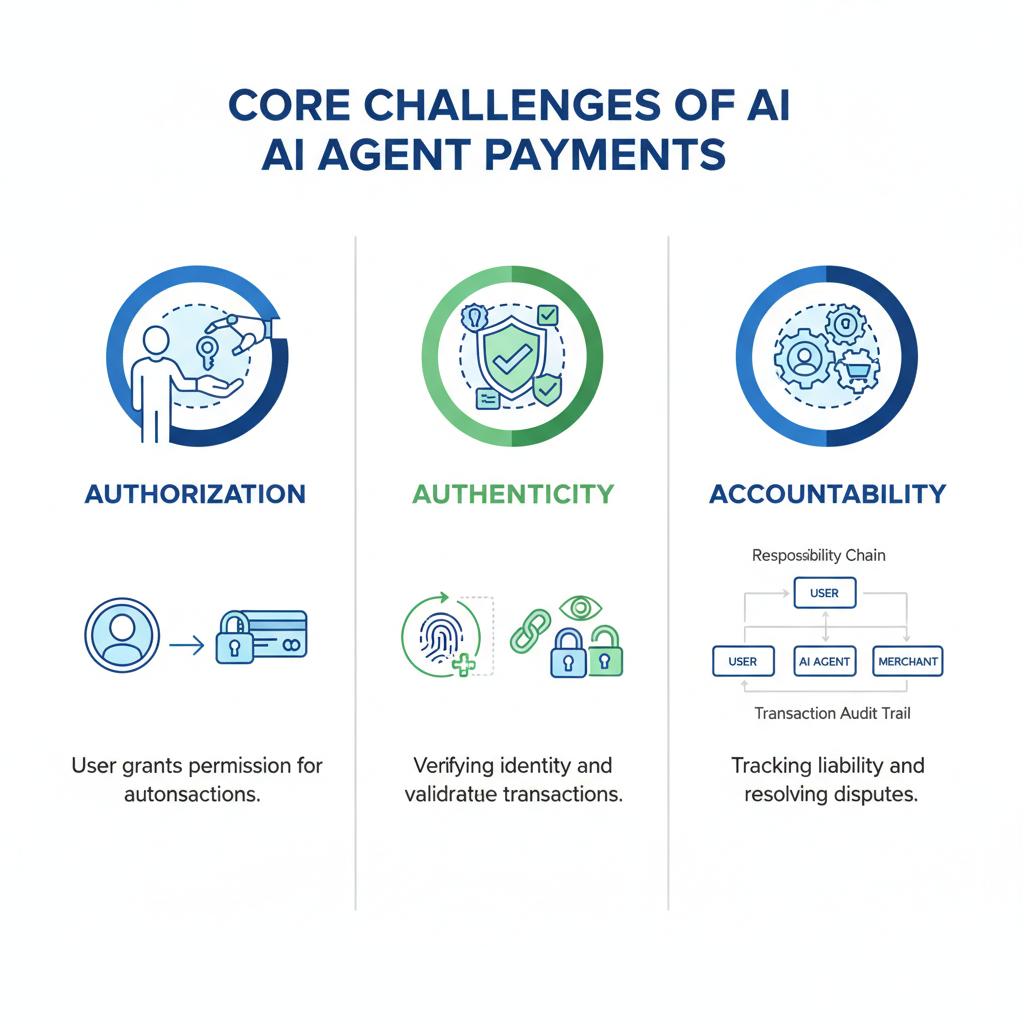
Core Viewpoint - Google and Coinbase have launched a new protocol called AP2 (Agentic Payments Protocol) aimed at enabling AI agents to make secure payments autonomously [1][2]. Group 1: Challenges Addressed by AP2 - The emergence of AI agents capable of executing complex tasks raises concerns about how these agents can safely handle payments [3]. - Google identifies three core challenges in AI payments: Authorization, Authenticity, and Accountability [4][7]. - Without a unified standard, the market could become chaotic and insecure, which AP2 aims to address by providing an open solution [7]. Group 2: Mechanism of AP2 - AP2 introduces a concept called "Mandate," which acts as a verifiable authorization step before payment is made, ensuring that user intent is accurately captured and protected [8]. - The protocol transforms the traditional "click to buy" model into a more rigorous "contractual dialogue" model, binding user intent, AI actions, and final payments together [8]. Group 3: Use Cases of AP2 - AP2 is designed for two main scenarios: real-time purchases where the user is present and delegated purchases where the user is not present [12]. - In real-time purchases, users must confirm and sign off on a shopping cart before AI can complete the payment [12]. - In delegated purchases, users provide pre-authorization for AI to act on their behalf under specified conditions [12][13]. Group 4: Role of Coinbase - Coinbase plays a crucial role by integrating cryptocurrency, particularly stablecoins, into the AP2 protocol, allowing AI agents to have their own wallets [14][15]. - This integration addresses the challenge of AI agents lacking legal identities to open traditional bank accounts, facilitating efficient micro-payments between AI agents [15]. Group 5: Ecosystem and Support - The AP2 protocol is supported by over 60 leading companies across various sectors, including traditional payment giants and blockchain firms, ensuring compatibility with multiple payment methods [17][21]. - This broad collaboration aims to prevent fragmentation of technology standards and promote interoperability for future smart commerce [21]. Group 6: Future Implications - The introduction of AP2 paves the way for the "Agent Economy," where AI can autonomously handle complex tasks and transactions, enhancing user experience and creating new business models [22][23]. - While still in early stages, the protocol's potential impact on shopping and service delivery is significant, allowing users to delegate complex tasks to AI [23].


跨境支付的牌照竞赛
Bei Jing Shang Bao· 2025-09-18 02:12
Core Insights - The cross-border payment industry is entering a new phase characterized by a significant trend of "going global," with companies actively seeking overseas licenses to enhance their competitive edge [1][2][3] Group 1: Company Developments - CoGoLinks International has officially obtained a "money service license" in the UAE, allowing it to operate payment accounts, process transactions, and issue payment tools [2][3] - CoGoLinks is a subsidiary of the Jiehang Technology Group, focusing on providing digital solutions in cross-border trade, including e-commerce and traditional foreign trade [2] - The company has also received preliminary approval from the Monetary Authority of Singapore to prepare for a large payment institution license [3] Group 2: Industry Trends - The competition among cross-border payment institutions has shifted from a "channel war" to a "license arms race," with many companies applying for and acquiring licenses globally [3][4] - As of now, companies like Lianlian Digital and PingPong hold numerous licenses across key markets, indicating a trend towards building a robust compliance foundation [3][4] Group 3: Market Dynamics - The push for overseas licenses is driven by intense competition in the domestic payment market and the higher fees associated with cross-border payments [4][5] - Companies are expanding their services beyond simple payment processing to include local acquiring, multi-currency settlement, and foreign exchange management [6][10] Group 4: Strategic Considerations - Firms are advised to prioritize obtaining key licenses in strategic markets to balance compliance depth with service breadth [8][10] - The focus is shifting from merely acquiring licenses to enhancing comprehensive service capabilities, including technology innovation and localized service [9][10] Group 5: Challenges and Risks - Obtaining overseas payment licenses involves navigating complex regulatory environments and can take 1-2 years, requiring extensive communication with local regulators [7][9] - There are risks associated with license retention, as some countries may revoke licenses if certain market performance indicators are not met [9]
首批机构接入“统一网关” 跨境支付“一点对接”进展顺畅
Shang Hai Zheng Quan Bao· 2025-09-17 19:28
Core Viewpoint - The introduction of a unified cross-border QR code payment gateway in China aims to enhance the payment experience for international travelers by addressing compatibility issues and streamlining payment processes [1][4]. Group 1: Unified Gateway Overview - The unified gateway is a cross-border payment infrastructure developed under the guidance of the People's Bank of China, allowing domestic and foreign institutions to connect through a single interface for QR code payment cooperation [2][5]. - Since its trial launch at the end of July, the unified gateway has attracted numerous foreign wallets, with Ant Group and Tencent leading the initial pilot [2][3]. Group 2: Participation and Integration - Ant Group's Alipay now supports seven major international card brands and 31 electronic wallets from 12 countries and regions, with recent additions from Indonesia, Uzbekistan, and Thailand [2][3]. - Tencent's WeChat wallet and several other international wallets, including PayPal and various Southeast Asian wallets, are set to integrate with the unified gateway [2][3]. Group 3: Operational Impact - As of September 11, the unified gateway has processed 1.981 million transactions, amounting to 427 million yuan [3]. - The unified gateway aims to resolve previous issues of fragmented payment systems and enhance the interoperability of payment platforms, thereby simplifying cross-border transactions [4][5]. Group 4: Future Prospects - The unified gateway is expected to facilitate tourism, commerce, and cultural exchanges by creating a seamless payment experience for foreign visitors in China [6]. - The gateway will continue to expand its network of participating institutions and enhance cross-border payment capabilities [7].

跨境二维码统一网关有何影响
Bei Jing Shang Bao· 2025-09-17 16:54
Core Viewpoint - The launch of the "Cross-Border QR Code Unified Gateway" aims to enhance the efficiency of cross-border payments and improve the payment experience for foreign users in China [2][6]. Group 1: Key Developments - The People's Bank of China announced the progress of the "Cross-Border QR Code Unified Gateway" to facilitate cross-border payment cooperation among domestic and foreign institutions [2][6]. - Tencent has committed to opening its WeChat Pay service to support more foreign wallets for QR code payments in China, with several international wallets set to be integrated soon [3][4]. - Ant Group's Alipay is among the first institutions to participate in the pilot of the "Cross-Border QR Code Unified Gateway," supporting seven major international card brands and 31 electronic wallets from 12 countries and regions [4][5]. Group 2: Benefits and Features - The unified gateway addresses three main pain points: the complexity of technical integration, cost efficiency, and user experience for foreign wallets entering the Chinese market [6][7]. - By establishing a standardized cooperation framework, the gateway reduces the technical burden and enhances the efficiency of introducing foreign wallets, avoiding market fragmentation [6][7]. - Users can utilize their existing wallet apps without additional registration or complex settings, allowing for a seamless payment experience in China [7]. Group 3: Industry Impact - The initiative is expected to enhance the overall synergy of China's payment industry and improve its international competitiveness [6][7]. - The gateway allows for real-time processing of transaction information, ensuring efficient and orderly cross-border payment operations [7].
不止“扫码自由”!跨境二维码统一网关来了,支付巨头响应
Bei Jing Shang Bao· 2025-09-17 15:09
Core Viewpoint - The launch of the "Cross-Border QR Code Unified Gateway" aims to enhance the efficiency of cross-border payments and improve the payment experience for foreign users in China [2][6]. Group 1: Institutional Responses - Multiple payment institutions, including Tencent and Ant Group, have quickly responded to the People's Bank of China's announcement by implementing measures to support the new gateway [1][3]. - Tencent plans to open its WeChat Pay service to more foreign wallets, allowing them to make payments in China using QR codes [3][9]. - Ant Group's Alipay supports seven major international card brands and 31 electronic wallets from 12 countries and regions for use in China [4][5]. Group 2: Technical and Operational Benefits - The unified gateway addresses the complexities of cross-border payment integration, allowing foreign wallets to connect with multiple domestic payment institutions through a single interface [6][7]. - It reduces costs and improves efficiency by standardizing the integration process, thus enhancing the overall user experience for foreign visitors [7][10]. - The system allows foreign users to use their existing wallet apps without needing to register or switch payment methods frequently [7][8]. Group 3: Future Developments and Ecosystem - The unified gateway is expected to expand its network of participating institutions and enhance cross-border payment interoperability [11][12]. - The People's Bank of China aims to create a more open and inclusive payment ecosystem, supporting the internationalization of the RMB and facilitating Chinese financial services abroad [12]. - Institutions are encouraged to embrace an open ecosystem, enhance compliance risk management, and invest in technological innovation to improve competitive advantages [12].
跨境支付“卷”出海,拿牌竞赛的高成本博弈
Bei Jing Shang Bao· 2025-09-17 14:25
Core Viewpoint - The cross-border payment industry is entering a new phase characterized by a significant trend of "going global," with companies actively seeking overseas licenses to enhance their competitive edge in the market [1][3][4]. Group 1: License Acquisition - CoGoLinks International has officially obtained a "money service license" in the UAE, allowing it to operate payment accounts, process transactions, and issue payment tools [3][4]. - The company is the first Chinese cross-border payment platform to receive a formal payment license in the UAE, which is a key financial and trade hub in the Middle East [3][4]. - CoGoLinks has also secured licenses in Hong Kong, the US, and is in the process of preparing for a large payment institution license in Singapore [4][5]. Group 2: Market Trends - The competition among payment institutions has shifted from a "channel war" to a "license arms race," with firms intensively applying for and acquiring licenses globally [4][5]. - Major players like LianLian Digital and PingPong hold numerous licenses across various markets, indicating a trend towards building a robust compliance foundation [4][5]. - The focus of license acquisition is on mature markets like Europe and the US, as well as emerging markets in Southeast Asia and the Middle East [5][8]. Group 3: Business Expansion - Payment institutions are diversifying their services beyond simple payment processing to include local acquiring, multi-currency settlement, and foreign exchange management [7][8]. - CoGoLinks has developed a product suite that combines platform collection, foreign trade collection, and service trade collection, enhancing its service capabilities [7][8]. - The target clientele for these institutions includes both Chinese enterprises going abroad and local consumers in foreign markets [7][8]. Group 4: Challenges and Considerations - Obtaining overseas licenses is complex and time-consuming, often requiring extensive communication with local regulators and a deep understanding of market conditions [8][9]. - Companies face challenges such as differing regulatory policies and cultural nuances, which can complicate the license application process [9][10]. - There is a risk of license revocation if market performance metrics are not met within specified timeframes after obtaining the license [10][11]. Group 5: Future Outlook - The next phase of competition in cross-border payments will focus on comprehensive service capabilities and compliance technology, moving beyond mere license acquisition [11]. - Companies are encouraged to transform into comprehensive service providers that address the integrated needs of businesses, including fund management and local compliance [11]. - The growth potential for payment institutions that leverage technology and provide seamless, value-added services is expected to be significant in the evolving market landscape [11].

打破壁垒!支付产业积极构建开放互联生态
Xin Hua She· 2025-09-17 13:55
Core Insights - The recent advancements in China's payment sector include the interconnection of mainland and Hong Kong rapid payment systems, the trial operation of a unified cross-border QR code gateway, and the launch of a cross-border QR code interconnection project with Indonesia [1][2] Industry Developments - The concept of "interconnection" has become a focal point in the payment industry, as it is seen as essential for addressing payment pain points and achieving high-quality industrial development [2] - The payment industry in China is transitioning from rapid growth to a phase of high-quality development, with a consensus emerging on the need for an open and interconnected ecosystem [2][3] Challenges and Solutions - High industry concentration, insufficient interconnectivity between different networks, and a lack of compatibility in business rules and standards are identified as obstacles to high-quality development [2] - The introduction of foreign wallets has revealed issues such as inconsistent standards and redundant infrastructure among domestic partners, which can negatively impact payment experiences [2] Technological Innovations - New technologies like blockchain and artificial intelligence are pivotal in reshaping the payment landscape, enhancing clearing efficiency, reducing transaction costs, and expanding financial service boundaries [4][5] - The recent peak transaction volume on the Netlink platform reached 3.71 billion transactions in a single day, highlighting the need for robust technological support for high-volume transaction processing [4] Ecosystem and Collaboration - The emergence of new payment hardware has expanded user scenarios and fostered a complete ecosystem involving hardware suppliers, smart terminals, and service providers [5] - Industry leaders emphasize the importance of adopting a proactive approach to incorporate global technological innovations and enhance the competitiveness of the payment sector [5] Risk Management - The acceleration of global payment network interconnectivity has increased risks such as information leakage and fraud, prompting the need for enhanced regulatory frameworks [6] - The People's Bank of China is committed to establishing a digital regulatory framework to improve early identification and management of payment risks [6] - Recent measures have led to the cancellation of 2,280 outsourcing service institutions, promoting a competitive market environment [6]
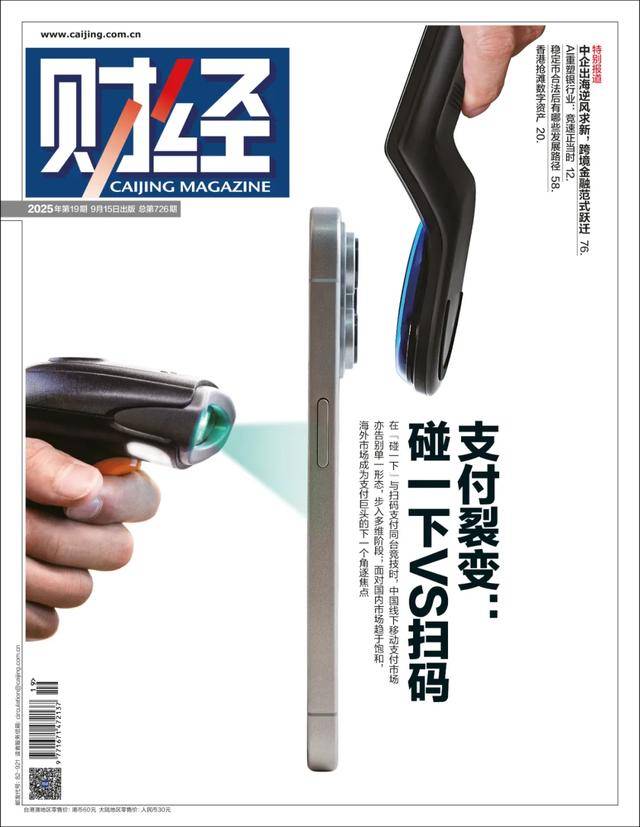
支付裂变,碰一下会取代扫码吗?|《财经》封面
Sou Hu Cai Jing· 2025-09-17 12:55
Core Viewpoint - The Chinese offline mobile payment market is evolving from a single form to a multi-dimensional stage, with the introduction of "tap to pay" technology competing alongside QR code payments, as companies look to expand into overseas markets due to domestic saturation [2][9]. Group 1: Market Evolution - The "tap to pay" technology, based on NFC (Near Field Communication), has gained significant traction, with over 200 million users reported within a year of its launch in June 2024 [3][11]. - The mobile payment landscape in China has shifted dramatically since the introduction of QR code payments, which became dominant after the People's Bank of China recognized their compliance in 2016 [3][4]. - In 2016, the transaction volume for third-party mobile payments reached approximately 38 trillion RMB, significantly outpacing the U.S. market [3]. Group 2: Competitive Landscape - The competition between Alipay and WeChat Pay has intensified, with market shares shifting dramatically from a 70-30 split in favor of Alipay at the end of 2015 to a near reversal by the end of 2016 [4][27]. - WeChat Pay has maintained a strong presence in offline payment scenarios due to its integration with social media, while Alipay is now attempting to regain lost market share through the promotion of "tap to pay" [6][24]. - The introduction of "tap to pay" is seen as a strategic move by Alipay to counter WeChat's competitive pressure and to better position itself in international markets [9][47]. Group 3: User Experience and Adoption - "Tap to pay" offers a more streamlined user experience, reducing transaction time to 3-5 seconds compared to 15-30 seconds for QR code payments, which may enhance user adoption [6][13][20]. - The rapid adoption of "tap to pay" is attributed to the increasing prevalence of NFC-enabled smartphones, with projections indicating that by 2024, 70% of sold smartphones will support NFC [16][17]. - Despite the advantages of "tap to pay," QR code payments remain deeply ingrained in consumer habits, with a penetration rate of 92.7% for QR code payments among users [21]. Group 4: Future Outlook - The global mobile payment market is expected to grow at a rate of 20% annually, potentially exceeding $30 trillion by 2026, prompting Chinese payment giants to seek opportunities abroad [9][45]. - Alipay's "tap to pay" is anticipated to align better with international payment habits, providing a competitive edge in overseas markets [47]. - The coexistence of multiple payment methods, including QR code and "tap to pay," is likely to create a dynamic market where both can thrive, catering to different user preferences and scenarios [33][32].