
医药生物

Search documents
质量回报双提升·深市样本|深市“质量回报双提升”行动显实效 471家公司多路径夯实质量增强回报
Zheng Quan Ri Bao Wang· 2025-12-23 11:42
Core Viewpoint - The Shenzhen Stock Exchange has initiated the "Quality and Return Dual Improvement" action in February 2024 to enhance the quality of listed companies and increase investor returns, establishing a solid foundation for the healthy development of the capital market [1] Group 1: Company Quality Improvement - As of November 2025, 471 companies in the Shenzhen market have disclosed their action plans for the dual improvement initiative, focusing on enhancing core business awareness, innovation capabilities, and investor returns [1][2] - Among the participating companies, 293 are part of the Shenzhen Component Index, 88 are included in the CSI 300 Index, and 82 are in the ChiNext Index, collectively representing about 50% of the total market capitalization of the Shenzhen market [2] - The companies are diversifying across 30 sectors, including electronics, power equipment, pharmaceuticals, and computers, indicating a broad and robust participation structure [2] Group 2: Paths to Quality Enhancement - Companies are focusing on three main paths: deepening core business, advancing technological innovation, and ensuring regulatory compliance [2][3] - In terms of core business, companies are driving internal growth through technological upgrades and expanding into new markets via internationalization [2] - Companies are also enhancing their governance structures and improving information disclosure quality to build a solid governance foundation [3] Group 3: Enhancing Investor Returns - Companies are utilizing dividends and share buybacks as key methods to enhance shareholder returns, with some companies establishing themselves as models for consistent returns [4][5] - Actions by major shareholders and management, such as share buybacks and commitments not to sell shares, are crucial for stabilizing market confidence and increasing shareholder value [5] - Companies are improving communication channels with investors to build trust, employing various methods to maintain close interaction and transparency [6] Group 4: Sustainable Development and ESG Practices - Companies are integrating ESG practices into their business processes and strategic decisions, promoting sustainable development while enhancing value creation [6]
电力设备行业主力资金净流入超36亿元
Xin Lang Cai Jing· 2025-12-23 10:48
人民财讯12月23日电,从今日(12月23日)主力资金情况来看,沪深两市全天主力资金净流出322.18亿 元。6个行业获主力资金净流入,电力设备行业主力资金净流入36.56亿元,居首;基础化工、建筑材 料、银行行业主力资金净流入金额分别为12.78亿元、3.58亿元、1.28亿元。 25个主力资金净流出的行业中,国防军工、电子行业主力资金净流出金额居前,均超50亿元;通信、计 算机、汽车行业主力资金净流出金额均超30亿元;医药生物、非银金融、农林牧渔等行业主力资金净流 出金额均超10亿元。 ...
质优了、回报实了!471家深市企业领航资本市场向“质”行丨深市“质量回报双提升”系列报道
证券时报· 2025-12-23 10:47
Core Viewpoint - The "Quality Return Dual Improvement" initiative launched by the Shenzhen Stock Exchange aims to enhance company quality and investor returns, with significant progress observed by November 2025 [1][10]. Group 1: Overview of the Initiative - As of November 2025, 471 companies in the Shenzhen market have disclosed their action plans under the "Dual Improvement" initiative, focusing on core business enhancement, innovation, and investor returns [1]. - These companies represent approximately 50% of the total market capitalization of the Shenzhen market, with 293 being part of the Shenzhen Component Index and 88 in the CSI 300 Index [3]. Group 2: Company Performance and Characteristics - The participating companies show a tiered market capitalization structure, with 366 companies valued over 10 billion and 43 over 100 billion [3]. - The initiative covers 30 industries, including electronics, power equipment, and pharmaceuticals, with a broad geographical representation across 31 provinces [3]. - Nearly 70% of the participating companies are private enterprises, highlighting their crucial role in driving high-quality development in the capital market [3]. Group 3: Focus Areas for Development - Companies are enhancing their core business and international presence, with examples like Mindray Medical investing heavily in R&D and global expansion [5]. - There is a strong emphasis on technological innovation, with companies like BYD increasing R&D spending to 54.2 billion yuan in 2024 [6]. - Governance and information disclosure standards are improving, with nearly 60% of companies receiving an A-grade in the 2024 information disclosure assessment [3][6]. Group 4: Investor Engagement and Returns - Companies are increasing dividend payouts and share buybacks, with a compound annual growth rate of 10% in total dividends from 2022 to 2024 [11]. - 378 companies have maintained continuous dividends over the past three years, representing about 80% of the participants [12]. - The average stock price increase for these companies from February 2024 to November 2025 was 77.2%, significantly outperforming the Shenzhen Component Index [12]. Group 5: ESG and Sustainable Practices - Many companies are integrating ESG principles into their business strategies, with Longyuan Power linking ESG performance to management incentives [9].


科创板平均股价42.23元,79股股价超百元
Zheng Quan Shi Bao Wang· 2025-12-23 09:47
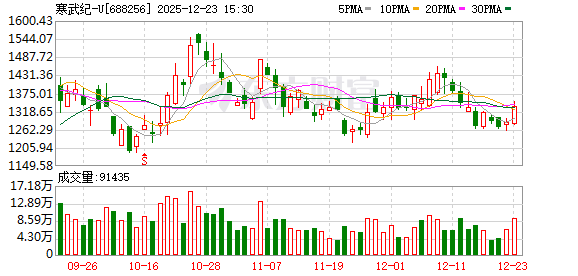
Group 1 - The average stock price of the Sci-Tech Innovation Board is 42.23 yuan, with 79 stocks priced over 100 yuan and the highest being Cambrian-U at 1336.02 yuan, which increased by 3.99% [2] - A total of 215 stocks rose while 376 stocks fell today on the Sci-Tech Innovation Board, with 38 stocks in the 100 yuan category showing an average increase of 0.52% [2] - Andar Intelligent's stock price reached 110.30 yuan, marking a 15.51% increase, with a turnover rate of 5.01% and a transaction volume of 4.34 billion yuan [2] Group 2 - The average premium of the latest closing prices of 100 yuan stocks relative to their issue prices is 477.00%, with the highest premiums seen in companies like Shunwei New Materials (4129.73%), Cambrian-U (1974.89%), and Anji Technology (1622.96%) [3] - The sectors with the highest concentration of 100 yuan stocks include electronics (44 stocks), pharmaceuticals (10 stocks), and computers (9 stocks) [3] - The net outflow of main funds from 100 yuan stocks today totaled 1.60 billion yuan, with significant inflows into Cambrian-U, Tengjing Technology, and Dekeli, while major outflows were seen in Zhenlei Technology, Muxi Shares-U, and SMIC [3] Group 3 - The total financing balance for 100 yuan stocks is 1033.30 billion yuan, with Cambrian-U, SMIC, and Haiguang Information having the highest financing balances of 146.58 billion yuan, 129.33 billion yuan, and 74.94 billion yuan respectively [3] - The total margin balance for 100 yuan stocks is 4.51 billion yuan, with Haiguang Information, Cambrian-U, and SMIC leading in margin balances of 0.34 billion yuan, 0.32 billion yuan, and 0.28 billion yuan respectively [3]



从这些关键词中寻找确定性:科技、长期主义、多元配置|2025雪球嘉年华
雪球· 2025-12-23 08:27
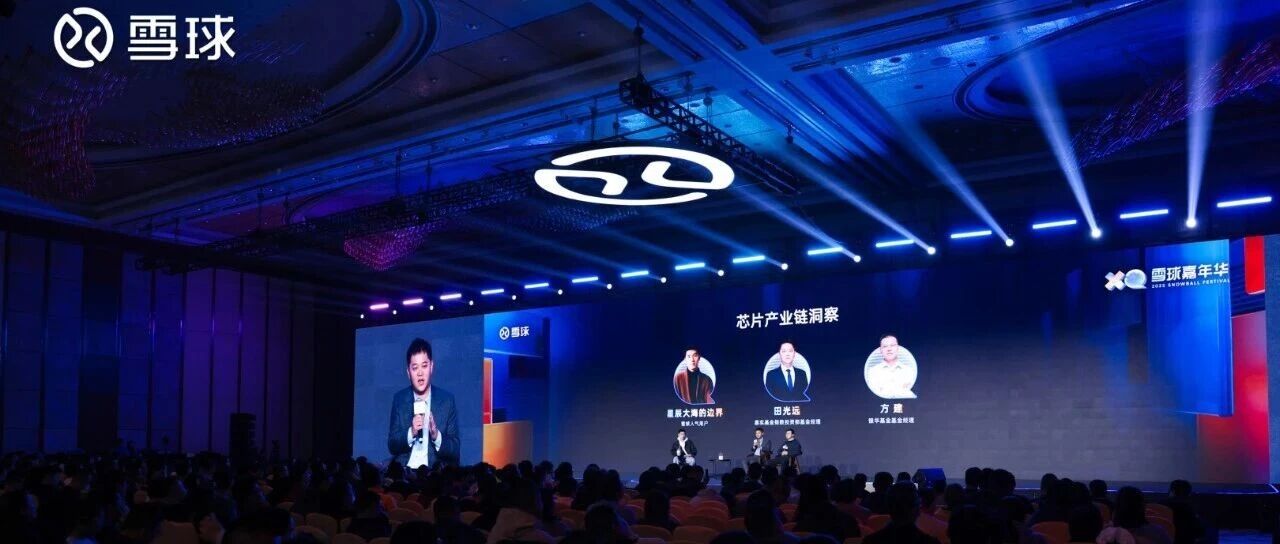
Core Insights - The 2025 Xueqiu Carnival highlighted "long-termism" and "asset allocation" as key themes, emphasizing the need for diverse and forward-looking strategies for investors in 2026 [1] - AI emerged as a central topic across discussions, indicating its pervasive influence on various sectors and investment strategies [1][17] Macroeconomic Trends - China's economic positioning is seen as a "fast variable" and "stabilizer" in the global economy, with a systematic comparative advantage that suggests a value reassessment of Chinese assets [3] - The ongoing "East rises, West declines" trend is expected to continue, with a focus on the integration of investment in both material and human capital as a core strategy for understanding Chinese modernization and future investment opportunities [3] Market Structure and Investment Strategies - The Chinese market is characterized by excess liquidity chasing "scarce return assets," with a notable divergence in asset performance despite a bullish market [5] - Credit expansion is identified as a key explanatory factor for market behaviors, influencing the relative performance of tech stocks and global asset flows, providing guidance for 2026 investment directions [5] - A recommendation for 2026 includes pairing AI investments with dividend-paying sectors to optimize returns [6] Diversified Investment Strategies - The rise of passive investment strategies, particularly ETFs, is emphasized as a crucial tool for investors, with China becoming the largest ETF market in Asia [9] - For aggressive investors, equity assets are expected to show significant advantages driven by corporate profit improvements and global liquidity, suggesting a "tech-first, then cyclical" market approach [9] - Conservative investors are advised to adopt a multi-asset, multi-strategy approach to smooth out volatility in their portfolios [9] AI and Technology Investments - AI is anticipated to drive significant changes across various industries, with a focus on long-term investment in companies that can define the future and possess strong competitive advantages [20] - The AI sector is viewed as being in the early to mid-stage of technological explosion, with high certainty for the next few quarters, although caution is advised regarding potential interest rate hikes impacting high-valuation sectors [21] Semiconductor and Robotics - The semiconductor industry is expected to continue benefiting from AI-driven demand, with investment logic not solely based on valuation but also on technological advancements and market dynamics [24] - The robotics sector is predicted to enter a critical industrialization phase, with significant investment opportunities arising from mass production and application scenarios [27] Thematic Investment Opportunities - Gold is highlighted as a long-term structural investment, influenced by monetary policy and geopolitical factors, with a recommendation for a balanced approach between safety and growth [30] - The consumer sector is undergoing industrialization, with opportunities emerging from new demand and international expansion strategies [30] - The healthcare sector, particularly innovative pharmaceuticals, is seen as a key area for investment, with a focus on companies that can leverage technological breakthroughs for growth [31]
118股股东户数连降 筹码持续集中
Zheng Quan Shi Bao Wang· 2025-12-23 08:26
Core Viewpoint - The continuous decline in the number of shareholders for several companies indicates a trend of increasing concentration of shares, with 118 companies experiencing a decrease for more than three consecutive periods, and some like Yihau New Materials seeing a drop for 12 periods [1] Group 1: Shareholder Trends - A total of 513 companies reported their latest shareholder numbers as of December 20, with 118 companies showing a continuous decline in shareholder numbers for over three periods [1] - Yihau New Materials has the lowest shareholder count at 14,402, down 37.94% over 12 periods, while Kute Intelligent has 32,185 shareholders, down 20.89% over 11 periods [1] - Other companies with significant declines include Dalian Heavy Industry and Jinshi Technology, with respective decreases of 11.90% and 13.33% [1] Group 2: Market Performance - Among the companies with declining shareholder numbers, 27 saw their stock prices increase, while 91 experienced declines, with notable gainers including Shibu Testing (up 64.58%), Guoji Precision Engineering (up 45.98%), and Xianglu Tungsten (up 30.68%) [2] - 29 companies outperformed the Shanghai Composite Index, with Shibu Testing, Guoji Precision Engineering, and Xianglu Tungsten achieving relative returns of 65.46%, 48.43%, and 30.96% respectively [2] Group 3: Industry Distribution - The industries with the highest concentration of companies experiencing declining shareholder numbers include basic chemicals (17 companies), machinery and equipment (14 companies), and pharmaceutical biology (12 companies) [2] - The main board has 74 companies with declining shareholder numbers, while the ChiNext board has 44 [2] Group 4: Institutional Interest - In the past month, 17 companies with declining shareholder numbers were investigated by institutions, with Guoji Precision Engineering, Baowu Magnesium, and Shenzhen Huqiang receiving the most attention, with 6, 4, and 2 investigations respectively [2] - The companies with the highest number of institutional participants in their investigations include Yahua Group (61 institutions), Igor (46 institutions), and Sanyuan Biological (32 institutions) [2]




中证1000ETF(159845)盘中成交超8亿元 未来市场仍有望维持偏暖轮动走势
Mei Ri Jing Ji Xin Wen· 2025-12-23 07:06
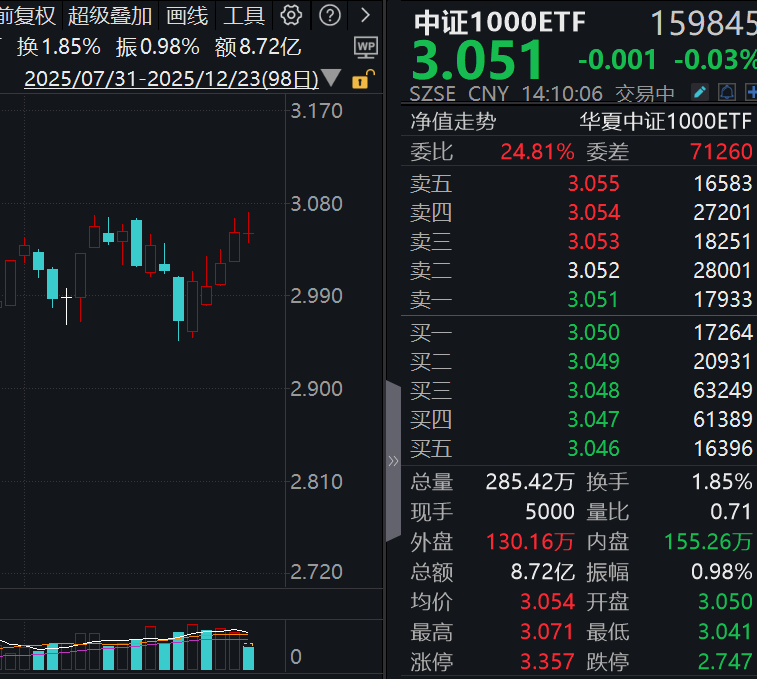
Market Performance - On December 23, A-shares saw a collective rise in the three major indices, with the Shanghai Composite Index increasing by 0.10% [1] - As of 14:09, the CSI 1000 ETF (159845) experienced a slight decline of 0.03% [1] ETF and Trading Data - The CSI 1000 ETF had a trading volume of 285.42 million, with a turnover rate of 1.85% and a fluctuation of 0.98% [2] - The total transaction amount for the day was 8.72 billion, with an average price of 3.054 [2] - The ETF's latest scale reached 470.39 billion, with a growth of 30.58 billion over the past month [3] Sector Performance - Among the top sectors in the CSI 1000 ETF, electronics rose by 0.85%, and power equipment increased by 1.11%, while the pharmaceutical and computer sectors saw declines of 0.31% and 0.86%, respectively [3] Fund Flow - The CSI 1000 ETF saw a net inflow of 8.14 billion over the last five trading days and 13.4 billion over the last ten days [3] - The liquidity of the ETF is leading among similar index funds, with an average daily trading volume of 15.16 billion over the past week [3] Market Outlook - The market is expected to maintain a warm rotational trend, with a recommendation to monitor the sustainability of trading volume [3] - If the market transaction can stabilize above 2 trillion, the profit effect may further amplify [3]
夯实发展质量,增强投资回报,深市“质量回报双提升”行动取得积极成效
Mei Ri Jing Ji Xin Wen· 2025-12-23 06:29
Group 1 - The core initiative "Quality Return Dual Improvement" launched by the Shenzhen Stock Exchange aims to enhance the development quality and investment value return capability of listed companies, with 471 companies already disclosing their action plans by November 2025 [1] - These 471 companies represent significant market influence, with 293 being part of the Shenzhen Component Index and 88 part of the CSI 300 Index, collectively accounting for approximately 50% of the total market capitalization of the Shenzhen market [1] - The initiative has seen active participation from private enterprises, which make up nearly 70% of the companies involved, demonstrating a strong commitment to quality and return [1] Group 2 - Companies are focusing on core business development, with examples like Mindray Medical investing heavily in R&D for product upgrades and Shenghong Technology enhancing global competitiveness through acquisitions [2] - There is a strong emphasis on technological innovation, with BYD's R&D expenditure reaching 54.2 billion yuan in 2024, and Guoli Micro's R&D investment exceeding 50% of its revenue [2] - Companies are also improving governance and information disclosure, with Anker Innovations enhancing its governance structure and Xiandai Intelligent increasing the transparency of its disclosures [2] Group 3 - Companies are increasing their dividend and share repurchase efforts, with BOE Technology Group and others disclosing future shareholder return plans, and Anke Bio achieving a cumulative dividend amounting to 63% of its net profit since listing [3] - Key stakeholders are actively increasing their holdings, with major shareholders of GoerTek purchasing 47.44 million shares for approximately 1 billion yuan, reflecting confidence in the company's value [3] - Companies are enhancing communication with investors through various channels, with ZTE maintaining regular contact and providing updates on financial performance [3] Group 4 - ESG practices are being integrated into business strategies, with Longyuan Power linking ESG performance to management incentives and continuously upgrading its ESG disclosure systems [4] - The overall quality of companies is improving, with the "dual improvement" companies achieving a total revenue of 9.8 trillion yuan in 2024, a 3.6% increase year-on-year, and a net profit of 743.39 billion yuan [4] - In the first three quarters of 2025, these companies reported a revenue of 7.5 trillion yuan, reflecting a 6.9% year-on-year growth [4] Group 5 - R&D investment among "dual improvement" companies accounted for 4.3% of their revenue in the first half of 2025, with a total R&D expenditure representing 59.5% of the Shenzhen market [5] - The number of R&D personnel increased by 4.6% in 2024, averaging 1,944 employees, which constitutes 19.4% of the workforce [5] - The effectiveness of information disclosure has improved, with 58.6% of "dual improvement" companies receiving an A rating in 2024, an increase of 11.3 percentage points from before the initiative [5] Group 6 - The level of returns to investors has significantly increased, with a compound annual growth rate of 10.0% in total dividends from 2022 to 2024, and dividends in 2024 accounting for 43.6% of net profits [6] - Approximately 80% of the companies have maintained consistent dividends over the past three years, enhancing market confidence [6] - The average number of investor engagements per company was 9.0 in 2024, with an average of 134 institutional investors participating in research [6] Group 7 - The market response has been positive, with an average stock price increase of 77.2% for the 471 "dual improvement" companies from February 2024 to November 2025, outperforming the Shenzhen Component Index [7] - The total market capitalization of these companies reached 21.2 trillion yuan by November 2025, an increase of 8.1 trillion yuan since the initiative began, representing 50% of the total market capitalization of the Shenzhen market [7] - The number of companies with market capitalizations exceeding 100 billion yuan increased by 80, while those exceeding 1 trillion yuan increased by 21 since the initiative's launch [7]

20cm速递|科创综指ETF国泰(589630)盘中涨超1.2%,科技板块活跃度受政策与IPO提振
Mei Ri Jing Ji Xin Wen· 2025-12-23 06:22
Group 1 - The central economic work conference emphasizes the importance of "deepening and expanding artificial intelligence" and "technological self-reliance," indicating that the logic of substitution in fields like commercial aerospace remains unchanged [1] - The technology sector is showing active performance, driven by the listing of "domestic GPU second stock" Muxi Co., which has boosted the performance of the communication and electronics sectors [1] - The policy's strong focus on domestic demand may further enhance market funds' attention to the consumer sector, potentially maintaining a balanced allocation in technology and consumption areas [1] Group 2 - The Guotai Science and Technology Innovation Index ETF (589630) tracks the Science and Technology Innovation Index (000680), achieving a daily fluctuation of 20%, covering 97% of the listed companies on the Science and Technology Innovation Board [1] - The index includes over 560 constituent stocks, encompassing hard technology fields such as electronics and biomedicine, reflecting a balanced industry allocation [1] - The Science and Technology Innovation Index aims to represent the overall performance of the Science and Technology Innovation Board, with a particular focus on the growth and innovation of technology-driven enterprises [1]
24家公司预告2025年业绩 18家预增
Zheng Quan Shi Bao Wang· 2025-12-23 02:12
Group 1 - 24 companies have announced their annual performance forecasts, with 18 companies expecting profit increases, accounting for 75.00% of the total [1] - Among the companies expecting profit increases, one company anticipates a net profit growth exceeding 100%, while another company expects a growth between 50% and 100% [1] - Bai Ao Sai Tu is projected to have the highest net profit growth, with a median increase of 303.57%, followed by C Mu Xi and N Xi Hua with expected growths of 54.22% and 48.25% respectively [1] Group 2 - The average decline for companies expecting a doubling of profits this year is 21.52%, underperforming compared to the Shanghai Composite Index [2] - The list of companies with expected significant profit increases includes Bai Ao Sai Tu with a median net profit growth of 303.57% and C Mu Xi with a growth of 54.22% [2] - Bai Ao Sai Tu's latest closing price is 51.64 yuan, while C Mu Xi's is 703.35 yuan, with respective year-to-date declines of 21.52% and 15.25% [2]