石化

Search documents
750家中企先行,IPO数量与外资流入创新高,沙特正成为中国资本新绿洲
Xin Lang Zheng Quan· 2025-11-11 06:35
Group 1 - The core viewpoint of the article highlights the strengthening economic partnership between China and Saudi Arabia, with bilateral trade exceeding 1 trillion Saudi Riyals and significant Chinese investments in high-value sectors [1][2] - The Saudi capital market is the largest in the MENA region, with a total market capitalization exceeding $2.5 trillion, and is recognized as one of the fastest-growing capital markets globally [2] - In the past year, Saudi Arabia completed 44 IPOs, with 50 companies planning to go public by 2025, covering various cutting-edge industries such as technology and healthcare [2] Group 2 - The participation of foreign capital in the Saudi capital market has surged to $108 billion, marking a 140% increase and maintaining a growth trend for five consecutive years [2] - The Saudi Capital Market Authority plans to promote the first offshore securities business license to enhance cross-border exchanges [2]
“十四五”高质量发展卷,古雷石化这样答
Zhong Guo Hua Gong Bao· 2025-11-11 05:36
四季轮转,秋已满仓。当时间的指针划过充实丰盈的5年时,福建古雷石化有限公司"十四五"规划迎来 收官。 这5年,是古雷石化砥砺奋进的5年。从培育壮大新质生产力,到推动数智化技术革新;从建立安全环保 长效机制,到构建全员参与、全程管控的安全管理体系,古雷石化上下勠力,同心推进规划落地成真, 交出了一份高质量发展的过硬答卷,为下一个5年发展奠定了坚实根基。 新质生产力不断培育壮大 5年来,古雷石化始终将高质量发展作为首要任务,优化产业布局。2021年8月18日,历经1438个日夜的 连续奋战,该公司乙烯等8套装置顺利产出合格产品,创下行业内从装置中交到投料、从投料到产品合 格的最短时间纪录,古雷石化由此驶入发展快车道。 5年来,古雷石化积极开发新产品,持续优化产品结构,全力打造具有竞争力的"拳头"产品。截至目 前,该公司已开发聚丙烯、热塑性弹性体等近20种产品,销往华南、华东等地区,且打通园区下游产品 销售渠道。 在此基础上,古雷石化还逐步实现了从保产稳产到提质增效的转变。乙烯—醋酸乙烯共聚物(EVA)装置 通过专项攻关、优化工艺参数、改进引发剂配方等措施,不断提升运行水平。2025年,该装置创下连续 稳定运行10 ...
“十四五”高质量发展卷,古雷石化这样答
Zhong Guo Hua Gong Bao· 2025-11-11 03:03
Core Viewpoint - Fujian Gulei Petrochemical Co., Ltd. has successfully implemented its "14th Five-Year Plan," achieving high-quality development through innovation, digital transformation, and a strong focus on safety and environmental sustainability [1][6]. Group 1: New Product Development - Over the past five years, the company has prioritized high-quality development and optimized its industrial layout, achieving a record for the shortest time from feed to qualified product for its ethylene and other facilities [2]. - The company has developed nearly 20 new products, including polypropylene and thermoplastic elastomers, and has established sales channels in South China and East China [2]. - The EVA facility achieved a record of 102 days of continuous stable operation in 2025, increasing daily production by over 50 tons and reducing energy consumption by 20 kg of standard oil per ton of product [2]. Group 2: Digital Transformation - The company has focused on digital and intelligent upgrades, achieving a transition from standardized to refined management through the integration of over 40 business operations on an industrial internet platform [4]. - The establishment of a 5G private network has enabled full-process digital management, significantly improving operational efficiency and real-time monitoring of key production data [4][5]. - Compared to traditional petrochemical enterprises, the company has reduced labor costs by over 30% and overall operating costs by more than 20% [4]. Group 3: Safety and Environmental Sustainability - The company has invested 1.875 billion yuan in environmental protection during the "14th Five-Year Plan," ensuring emissions are below the latest national standards [7]. - The company has implemented a comprehensive safety management system, achieving zero safety incidents reported to stakeholders over the past five years [8]. - The wastewater reuse rate has reached 76.18%, placing the company among the industry leaders in sustainability practices [7].
连云港纳维石化有限公司成立 注册资本500万人民币
Sou Hu Cai Jing· 2025-11-11 02:49
Core Viewpoint - Lianyungang Navi Petrochemical Co., Ltd. has been established with a registered capital of 5 million RMB, focusing on various sectors including petroleum products sales and chemical production equipment sales [1] Company Overview - The company is legally represented by Li Yanhui and has a registered capital of 5 million RMB [1] - The business scope includes general projects such as sales of petroleum products (excluding hazardous chemicals) and sales of specialized equipment for refining and chemical production [1] Business Activities - The company engages in a wide range of sales activities including: - Sales of communication equipment, household appliances, and internet sales (excluding licensed goods) [1] - Sales of plastic products, non-metallic minerals, and various metal alloys [1] - Sales of construction materials, metal ores, and machinery equipment [1] - Sales of synthetic materials, coatings (excluding hazardous chemicals), and metal structures [1] - Sales of rubber products, metal tools, and refrigeration and air conditioning equipment [1] - Sales of gas compression machinery, electrical equipment, and instruments [1] Research and Development - The company is involved in engineering and technical research and experimental development, as well as new energy technology research and development [1] - It also focuses on biochemistry product technology research and development [1] Trade and Services - The company provides domestic trade agency services and supply chain management services [1] - It is engaged in the sales of special equipment and offers information technology consulting services [1]

江苏南京:“质造”为城市发展筑基
Ke Ji Ri Bao· 2025-11-10 08:51
Group 1: Quality and Innovation in Nanjing - Nanjing has become a significant player in the global wind turbine gearbox market, with one out of every three new gearboxes coming from the city [1] - The city has been recognized for ten consecutive years with the highest quality assessment rating in Jiangsu Province, emphasizing a development path that promotes innovation through quality [1] - The establishment of the "Zijin Mountain Triangular" technology transfer system accelerates the cultivation of new productive forces, integrating communication and sensing capabilities in 6G technology [2][3] Group 2: Robotics and Industrial Development - Nanjing is home to nearly 200 robotics-related companies, with Estun Robotics leading in industrial robot installations [3] - The city showcased over ten robotics companies at the 2025 World Robot Conference, highlighting its role as a hub for robotics innovation [3] - Nanjing has developed a comprehensive quality service model covering 15 high-tech parks and key industrial chains, contributing to the enhancement of core competitiveness in various sectors [3] Group 3: Low-Carbon Transformation - Traditional industries in Nanjing, such as steel and petrochemicals, are undergoing a green transformation, with significant investments in environmental projects [4][5] - Nanjing Steel has implemented a smart energy management platform, improving resource efficiency and integrating industrial production with ecological tourism [4][5] - China Petrochemical's photovoltaic project has transformed a former waste site into a solar power station, generating significant energy savings and emissions reductions [5] Group 4: Quality Improvement in Daily Life - Nanjing's quality improvements extend to consumer products, with companies like Weigang Dairy utilizing advanced technologies to enhance product safety and nutrition [6] - The city has established multiple quality-focused projects in urban construction, agriculture, and elder care, enhancing the quality of life for residents [6] - Initiatives such as the "Ning Rest Assured" consumption platform aim to create a safe and reliable consumer environment, reflecting the city's commitment to quality [6]



从121.9到126:上海重点产业国际竞争力指数六年间持续提升
Xin Hua Cai Jing· 2025-11-10 07:29
Core Insights - The "2024-2025 Shanghai Key Industries International Competitiveness Index Report" indicates that Shanghai's key industries competitiveness index increased from 121.9 in 2019 to 126 in 2024, reflecting a cumulative growth of 4.1 over six years, transitioning from "speed chasing" to "quality leading" in strategy [1][2]. Industry Analysis - The report highlights that in 2024, industries such as new energy vehicles, biomedicine, integrated circuits, and shipbuilding and marine engineering are the primary contributors to the competitiveness index, forming the "first tier" of Shanghai's key industries [2]. - Advanced materials, artificial intelligence, and civil aviation are identified as "frontier fields" in a critical phase of technological accumulation and market expansion, expected to become new growth points for Shanghai's industrial competitiveness [2]. - Traditional industries like petrochemicals and steel are undergoing transformation and upgrading, with a reduction in output value but still maintaining large scale, potentially reshaping competitive advantages through integration with emerging industries [2]. Sector-Specific Insights - The competitiveness of the new energy vehicle industry reflects Shanghai's early advantages in green and low-carbon transformation, with recommendations to deepen smart factory construction and supply chain collaboration to enhance industrial efficiency [2]. - The integrated circuit sector has seen the largest competitiveness increase in both international and domestic markets, attributed to its comprehensive industry chain layout and large-scale production of high-end equipment, with a call for continued investment in cutting-edge fields to overcome key technological bottlenecks [2][3]. Strategic Recommendations - The report suggests that global industrial competition has shifted from relying on scale, cost, and single-point technological advantages to focusing on rule systems, technological innovation, green compliance, digital operations, and regional collaboration [3]. - It emphasizes the need for Shanghai's industrial policies to transition from "factor aggregation" to "system capability," forming a systemic competitiveness structure centered on technology, institutions, and ecology [3].
恒逸石化20251107
2025-11-10 03:34
Summary of Hengyi Petrochemical Conference Call Company Overview - **Company**: Hengyi Petrochemical - **Date**: Q3 2025 Conference Call Key Points Financial Performance - In Q3 2025, Hengyi Petrochemical achieved a near breakeven point with a total profit of 230 million yuan for the first three quarters [2][4] - The polyester segment was the largest contributor, generating 800 million yuan in revenue, with 120 million yuan in Q3 alone [2][4] - The company earned 130 million yuan from its stake in China Merchants Bank [2][4] - Losses were reported in the caprolactam, PTA, and refining segments, with PTA losing 160 million yuan in Q3 and refining losing over 30 million yuan [2][4] Market Dynamics - The average price differential for diesel in October reached 24 USD, up from 14 USD in the same period last year, while gasoline price differential doubled to 12 USD [2][4] - Styrene price differential fell to 100 USD, down from last year's peak of 200-300 USD, influenced by adjustments in European facilities [2][4] - The operating rate of Hengyi Petrochemical is approximately 80%, consistent with the industry average [2][3] Supply and Demand - The bottle chip production has been reduced by 10-20% due to new capacity leading to supply-demand imbalance [2][3] - The nylon market is experiencing cash flow and profit declines due to increased supply, with an additional 770,000 tons entering the market, representing about 10% of total market volume [2][6] - Future production plans are expected to decrease over the next two years, which may help absorb excess supply [2][6] Strategic Initiatives - Hengyi Petrochemical is focusing on research breakthroughs and differentiated products, avoiding further investments in redundant capacity [3][13] - The company has signed a 1 million-ton agreement with the Jingzhou government, but actual implementation volume remains uncertain [3][13] - The Brunei project is progressing, with a total investment of 5 billion USD for the second phase, where Hengyi holds a 70% stake [3][11][13] Collaboration and Industry Position - Hengyi maintains a collaborative approach with Rongsheng Petrochemical in PTA and bottle chip sectors, supporting industry price maintenance and joint production cuts [3][16] - The company is actively participating in discussions regarding production cuts in the PTA sector, although no agreements have been reached yet [3][5] Future Outlook - The company anticipates improved profitability from the Guangxi project, which is currently in trial production, with expectations of becoming a leading player in the nylon sector [2][12] - The Brunei project is expected to enhance cost advantages once the second phase is operational, optimizing material balance and increasing the proportion of profitable products [3][20] - The Southeast Asian market is characterized by a supply-demand gap, with Hengyi positioned to benefit from regional growth and proximity to key markets [3][18][19] Risks and Challenges - The company faces pressure on profitability from the Brunei project, despite some revenue from refined oil products [3][11] - The nylon market's cash flow is currently negative, and the company is implementing production cuts to stabilize prices [2][6][10] Conclusion - Hengyi Petrochemical is navigating a challenging market environment with strategic initiatives aimed at enhancing profitability and maintaining competitive positioning in the polyester and refining sectors while addressing supply-demand imbalances and collaborating with industry peers for sustainable growth [2][3][4][5][6][11][12][13][20]

华锦股份:公司业绩不会触发退市风险警示
Zheng Quan Shi Bao Wang· 2025-11-10 03:01
Core Viewpoint - The company, Huajin Co., stated during its performance briefing on November 7 that it will not trigger a delisting risk warning according to relevant regulations, despite consecutive losses [1] Group 1: Financial Performance - The company's continuous losses are attributed to fluctuations in international oil prices, but this is not the sole reason [1] - Other contributing factors include insufficient downstream demand in the petrochemical industry, oversupply, and the accelerated replacement by new energy vehicles [1] Group 2: Strategic Response - The company has recognized these issues and is actively taking measures to address them [1] - Strategies include optimizing procurement strategies, exploring new channels, and enhancing marketing and operational levels to mitigate the adverse effects of raw material price fluctuations [1]

湖南石化降本挖潜显成效
Zhong Guo Hua Gong Bao· 2025-11-10 03:01
Core Viewpoint - Hunan Petrochemical is implementing comprehensive cost control measures to improve profitability amid challenging operational conditions, achieving cost reductions ahead of schedule in the first three quarters [1] Group 1: Cost Control Measures - Hunan Petrochemical is focusing on a dual approach of "management + technology" to enhance cost control across various product chains [1] - The company has successfully implemented cost reduction initiatives that are yielding tangible results [1] Group 2: Technological Innovations - The epoxy propane department has undertaken a technical transformation project for condensate recovery, establishing a closed-loop recycling system [1] - This project provides a stable heat source for key instruments and equipment while enabling the recovery of condensate water, reducing the need for fresh steam or other external heat sources [1] - The initiative results in a reduction of 2 tons of waste hot water discharged into the wastewater treatment system per hour, leading to a decrease in operating costs by nearly 100,000 yuan [1]
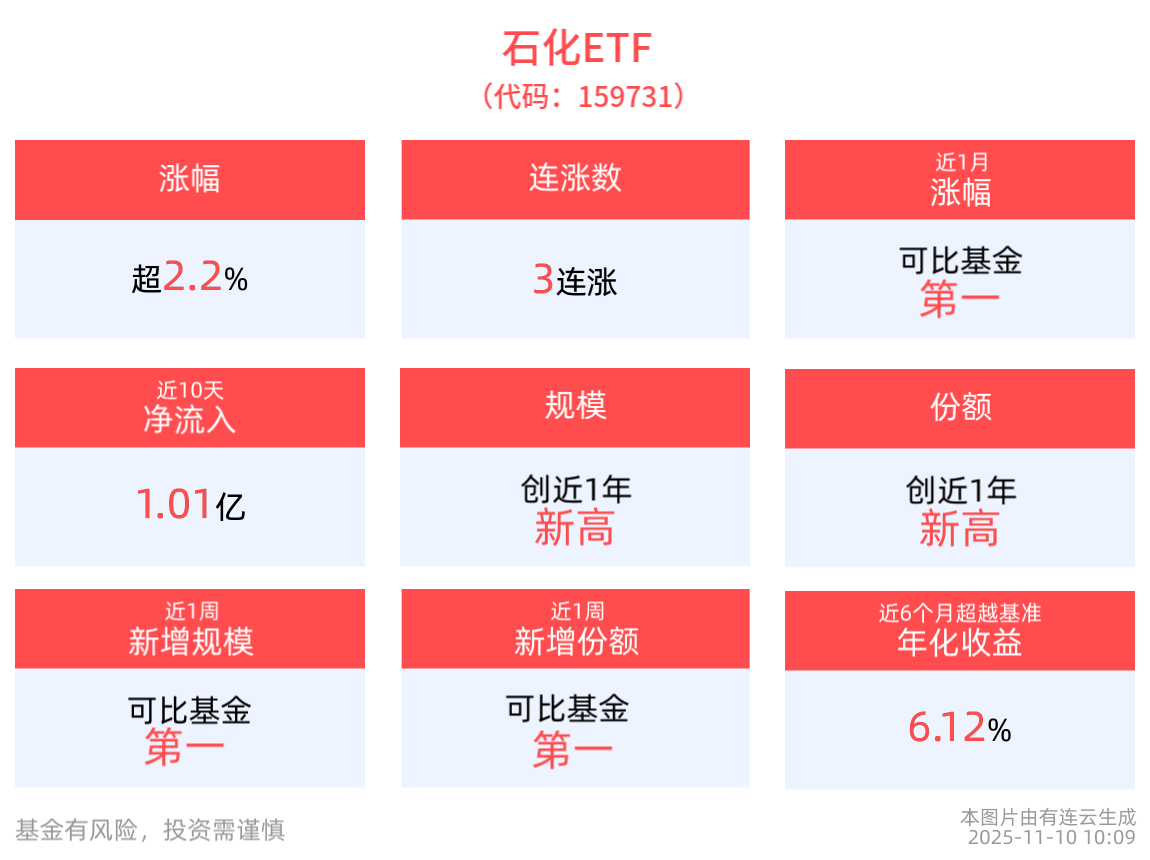
涨超2.2%,石化ETF(159731)冲击3连涨
Xin Lang Cai Jing· 2025-11-10 02:37
Core Viewpoint - The petrochemical sector is experiencing significant growth, with the China Securities Petrochemical Industry Index rising by 2.3% and notable gains in individual stocks, indicating strong investor interest and capital inflow into the sector [1][3]. Group 1: Market Performance - As of November 10, 2025, the China Securities Petrochemical Industry Index has increased by 2.3%, with stocks like Luxi Chemical hitting the daily limit and Hualu Hengsheng rising by 9.63% [1]. - The Petrochemical ETF (159731) has also seen a rise of 2.29%, marking its third consecutive increase, with the latest price at 0.85 yuan [1]. - Over the past 10 trading days, the Petrochemical ETF has recorded net inflows on 9 days, totaling 101 million yuan, with its latest share count reaching 193 million and total assets at 160 million yuan, both hitting a one-year high [1]. Group 2: ETF Performance Metrics - As of November 7, 2025, the Petrochemical ETF has achieved a net value increase of 25.33% over the past six months [3]. - The ETF's highest single-month return since inception was 15.86%, with the longest streak of consecutive monthly gains being 6 months and a maximum increase of 23.51% [3]. - The average monthly return during the rising months is 5.06%, and the ETF has outperformed its benchmark with an annualized excess return of 6.12% over the last six months [3]. Group 3: Risk and Tracking Precision - The maximum drawdown for the Petrochemical ETF over the past six months is 6.47%, with a relative benchmark drawdown of 0.14%, indicating the lowest drawdown among comparable funds [3]. - The recovery time after drawdown is 21 days, showcasing the ETF's resilience [3]. - The tracking error for the ETF over the past month is 0.034%, which is the highest tracking precision among comparable funds [3]. Group 4: Top Holdings - As of October 31, 2025, the top ten weighted stocks in the China Securities Petrochemical Industry Index account for 56.05% of the index, with Wanhua Chemical, China Petroleum, and Salt Lake Industry being the top three [3]. - The weightings and recent performance of key stocks include Wanhua Chemical at 10.47% with a 4.40% increase, China Petroleum at 7.63% with a 1.54% increase, and Salt Lake Industry at 6.44% with a 2.01% increase [5].