
美妆

Search documents
收购Rhode驱动营收增长,关税与投资加大致短期利润承压
Haitong Securities International· 2025-11-20 14:34
Revenue Performance - e.l.f. Beauty reported a 14% year-over-year increase in net sales for FY26Q2, reaching $344 million, driven by the Rhode brand acquisition contributing approximately $52 million (about 17 percentage points) to sales growth[2][9] - Excluding Rhode, comparable sales decreased by approximately 3% due to a temporary halt in shipments to some retailers following a price increase effective August 1[2][9] Profitability and Margins - Gross margin for the quarter was 69%, down 190 basis points year-over-year, primarily impacted by increased tariffs on imported goods from China[2][9] - Adjusted EBITDA was $66.2 million, with a margin of 19%, reflecting a 4% decline year-over-year; adjusted net income was $41.7 million, with diluted earnings per share at $0.68, down from $0.77 in the same period last year[2][9] Full-Year Guidance - For FY26, the company projects net sales between $1.55 billion and $1.57 billion, representing an 18%-20% year-over-year growth, with Rhode expected to contribute approximately $200 million[3][10] - Management anticipates gross margin improvement to approximately 71% in the second half, up roughly 200 basis points sequentially, driven by pricing adjustments and Rhode's contribution[3][10] Tariff and Supply Chain Challenges - Approximately 75% of products sourced from China are subject to a 45% tariff rate, with each 10-percentage-point increase in tariffs estimated to impact annual gross profit by about $17 million[4][11] - Despite facing significant tariff headwinds, the company expects full-year gross margin to decline by only about 100 basis points due to price increases and product mix optimization[4][11] Market Position and Brand Growth - The core e.l.f. brand continues to gain market share, with consumption growth of 7% in Q2, approximately three times the category growth rate, and a market share increase of 140 basis points[5][12] - e.l.f. ranked as the top favorite teen makeup brand for the eighth consecutive time in Piper Sandler's survey, indicating strong brand recognition and loyalty[5][12] International Expansion - International sales grew by 2% year-over-year in Q2, with plans to launch in new markets including Rossmann Poland and Sephora in GCC countries[5][12] - Current international sales account for approximately 20% of total sales, suggesting significant growth potential compared to peers[5][12] Brand Building and Operational Efficiency - e.l.f. has enhanced brand influence through a "disruptive marketing engine," with unaided brand awareness increasing significantly over the past five years[6][13] - The successful transition to a new SAP system is expected to improve operational efficiency and support future scaling[6][13]

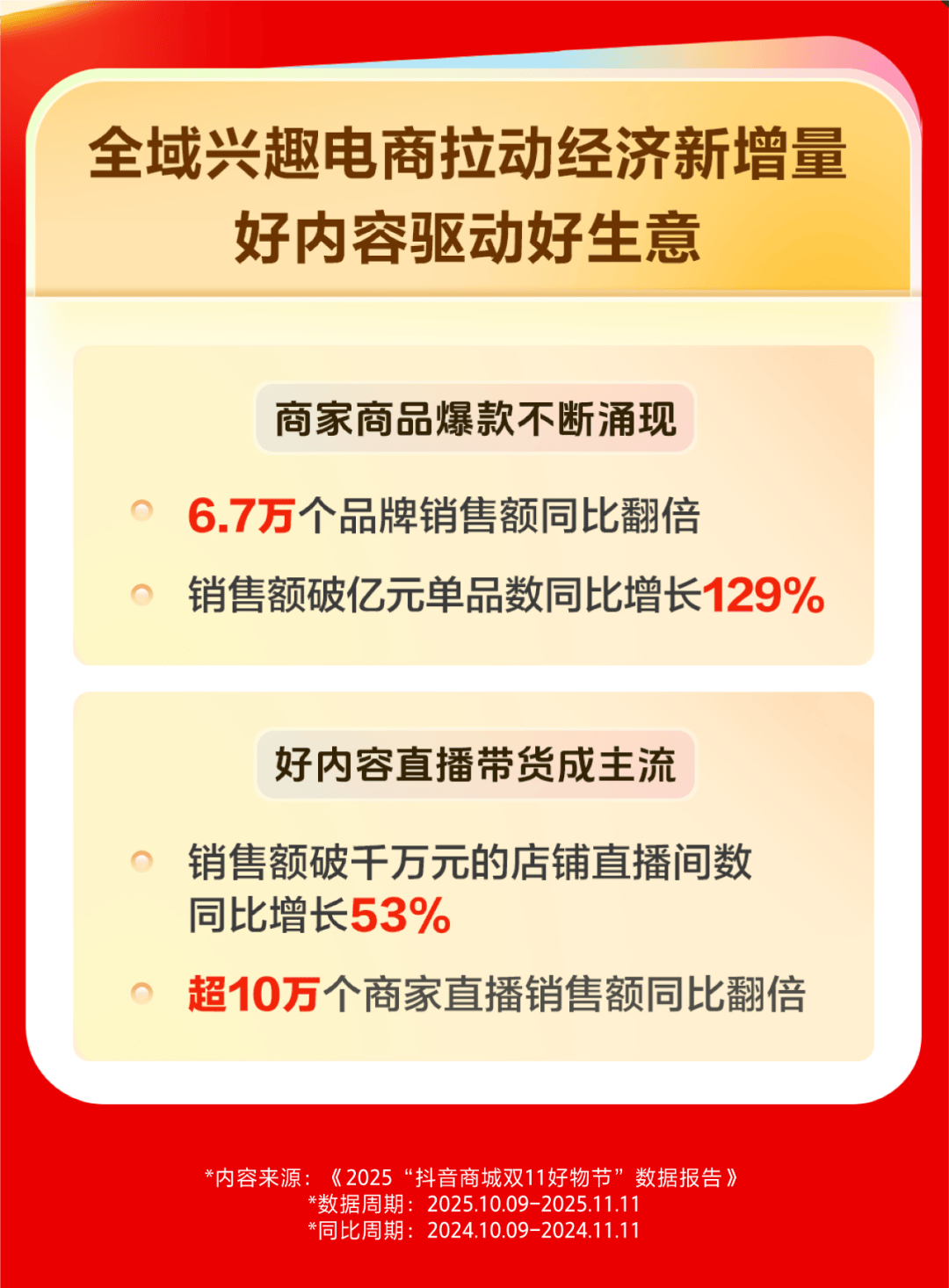
超过10万商家直播销售额同比翻倍,直播电商成“双11”市场增长重要引擎
Sou Hu Cai Jing· 2025-11-20 10:27
Core Insights - The "Double 11" shopping festival has seen a significant transformation in consumer behavior, shifting from a need-based purchasing approach to an interest-driven one, driven by content and live streaming [1][5][12] - The live commerce sector has emerged as a crucial engine for stimulating consumption and expanding market opportunities, with over 10,000 merchants doubling their sales during the event [1][4] Group 1: Performance Metrics - During the "Double 11" period, 67,000 brands on the platform saw their sales double year-on-year, with the number of products achieving over 100 million yuan in sales increasing by 129% [4] - The number of live streaming stores generating over 10 million yuan in sales grew by 53% [4] - Cultural consumption has become a highlight, with over 12,000 intangible cultural heritage-related merchants experiencing a 200% increase in sales [5] Group 2: Market Trends - The market is witnessing a diversification and upgrade towards quality and personalization, with traditional crafts gaining popularity through live streaming [5][13] - Domestic brands are rising collectively, with the beauty sector seeing a 313% increase in brands achieving over 10 million yuan in sales [6] - The "trade-in" initiative has led to a 486% increase in sales for participating merchants, with specific product categories like washing machines and cameras seeing sales growth of 813% and 591% respectively [6] Group 3: Knowledge-Driven Commerce - The "knowledge-driven commerce" trend has gained traction, with significant participation from knowledge influencers leading to a 19-fold increase in short video traffic efficiency [9] - The integration of quality content and intelligent algorithms has transformed consumer behavior from traditional search-based shopping to interest-based discovery [9][10] Group 4: Economic Impact - Live commerce is becoming a vital force in stimulating consumption and empowering industrial upgrades, particularly benefiting traditional manufacturing and small enterprises [12] - The platform's support has enabled traditional businesses to transition successfully to digital sales, exemplified by a high-end cashmere factory achieving 3 million yuan in sales on the first day of "Double 11" [12][13] - Local specialty products have gained national exposure, with sales of traditional items like iron pots and blueberries seeing substantial year-on-year growth [13]

丸美创始人孙怀庆:被超越不代表 “变差了” | 36氪专访
3 6 Ke· 2025-11-20 08:13
Core Insights - The article discusses the transformation of Marubi, a 23-year-old beauty brand, from a primarily offline sales model to an online-focused strategy due to the pandemic's impact on consumer behavior and retail channels [1][2][3] Group 1: Strategic Transformation - Marubi initiated a strategic shift in 2021, moving from a 70% offline and 30% online sales model to an 80% online and 20% offline model, which has revitalized the company's growth [2][3] - The company set a performance target of 4 billion yuan for the current year, which is seen as achievable based on past growth rates of approximately 30% year-on-year over the last ten quarters [2][3] Group 2: Market Position and Consumer Base - The pandemic led to a significant change in consumer habits, making it difficult for offline retail to recover, prompting Marubi to adapt to the new market dynamics [2][4] - The user base has expanded significantly post-transformation, retaining older offline customers while attracting younger online consumers, thus broadening the overall market reach [9][12] Group 3: Brand Strategy and Product Development - Marubi's approach emphasizes profitability and sustainable growth, focusing on product quality, user experience, and brand trust rather than merely chasing online traffic [10][15] - The company has invested in research and development, holding over 600 patents, with a focus on effective and continuous investment rather than just high spending [14][16] Group 4: Challenges and Future Outlook - The transition has not been without challenges, as the company faced a 30% decline in performance, which necessitated a reevaluation of its strategies and priorities [7][8][20] - Marubi aims to reduce reliance on single online channels and is aware of the competitive pressures in the beauty industry, indicating a long-term focus on sustainable growth rather than short-term gains [19][22]

东方证券:美容护理业双11稳态与新变并存 头部品牌表现亮眼
Zhi Tong Cai Jing· 2025-11-20 07:22
Core Insights - The report from Dongfang Securities highlights the transition in the beauty industry from "functional consumption" to "composite efficacy + emotional consumption," indicating increased consumer resilience [1] - The beauty sector is diversifying its sales channels, moving away from reliance on a single traffic window, which is enhancing channel efficiency [1] - Leading brands are demonstrating stronger resilience, with a focus on companies with robust brand assets that can capitalize on channel and product cycles [1] Group 1: Sales Performance - During the Double 11 shopping festival (October 7 - November 11), total e-commerce sales reached 16,950 billion yuan, reflecting a year-on-year growth of 14.2% [1] - The top five categories in e-commerce sales were home appliances, mobile digital products, clothing, beauty and personal care, and shoes/bags, with respective market shares of 16.5%, 14.6%, 14%, 8.2%, and 6.5% [1] - Beauty subcategories saw significant sales, with skincare products generating 991 billion yuan (+11.65%), hair care and cleaning products at 444 billion yuan (+13.54%), and perfumes and cosmetics at 334 billion yuan (+13.52%) [1] - Instant retail sales reached 670 billion yuan, showcasing a remarkable growth of 138.4% [1] Group 2: Brand Performance - Tmall's beauty rankings show Proya leading for three consecutive years, followed by Estee Lauder, Lancôme, L'Oréal, and SkinCeuticals, indicating a stable top five [2] - Douyin's beauty rankings are led by Han Shu, with Proya, L'Oréal, Helena Rubinstein, and Gu Yu following, highlighting Douyin as a key platform for domestic beauty brands seeking growth [2] - The sales of composite efficacy skincare products accounted for 47.1% of the top 50 best-selling skincare items on Tmall, with anti-aging products being the most popular [2] - Brands like Han Shu and New Page reported significant sales growth across multiple channels, with New Page achieving a 145% increase in total sales [3] - The overall performance of leading brands like Proya and Weinuo demonstrated strong growth, reinforcing the notion of enhanced brand momentum in a stable market environment [3]

巨子生物跌超3%刷新年内新低 股价较5月高点已腰斩 可复美双十一排名下滑
Zhi Tong Cai Jing· 2025-11-20 06:55
Group 1 - The core viewpoint of the article highlights that the stock price of Giant Bio (02367) has dropped over 3%, reaching a new low of 35.54 HKD, which is a significant decline from its peak in May [1] - The stock price has halved since its high point in May, indicating a severe downturn influenced by public opinion regarding collagen ingredients [1] - As of the report, the stock is down 3.46%, trading at 35.68 HKD with a transaction volume of 199 million HKD [1] Group 2 - According to Qingyan Intelligence, domestic brands secured 5 spots in the top 10 of the Douyin beauty list for this year's Double Eleven, while Giant Bio's brand, Kefu Mei, has fallen out of the top 10 [1] - On the Tmall beauty list for Double Eleven, Kefu Mei ranked 18th, a drop of 5 places compared to last year [1] - Reports indicate that Kefu Mei has consistently fallen out of the top 20 on the Douyin beauty list since June of this year [1] Group 3 - Jianghai Securities suggests that the increasing number of players in the collagen industry warrants attention on Giant Bio's future marketing strategies and sales performance for their products [1]
港股异动 | 巨子生物(02367)跌超3%刷新年内新低 股价较5月高点已腰斩 可复美双十一排名下滑
智通财经网· 2025-11-20 06:52
Core Viewpoint - The stock price of Giant Bio (02367) has dropped over 3%, reaching a new low of 35.54 HKD, reflecting a significant decline since May due to controversies surrounding collagen protein components [1] Company Summary - The stock price has halved since its peak in May, currently trading at 35.68 HKD with a trading volume of 199 million HKD [1] - The brand's product, Kefu Mei, has fallen out of the top 10 in the Douyin beauty rankings for this year's Double Eleven, and ranked 18th in the Tmall beauty rankings, a drop of 5 places from last year [1] - Kefu Mei has consistently dropped out of the top 20 in Douyin beauty rankings since June [1] Industry Summary - Domestic brands secured 5 out of the top 10 spots in the Douyin beauty rankings for this year's Double Eleven, indicating increased competition in the collagen protein market [1] - Jianghai Securities suggests monitoring Giant Bio's future marketing strategies and sales performance in response to the growing number of players in the collagen protein industry [1]
婚礼,美妆品牌的下一个“心”战场
Xin Lang Cai Jing· 2025-11-20 05:39
Core Insights - The beauty industry is shifting focus from broad traffic strategies to niche, high-certainty consumption scenarios, particularly weddings, which represent significant emotional and financial investment for consumers [1][2][3] Group 1: Market Dynamics - The beauty industry has experienced a decline in broad traffic opportunities, necessitating brands to explore smaller, targeted "pools" of consumer engagement [2] - Weddings are emerging as a high-value niche market, characterized by high budgets and emotional significance, making them a strategic battleground for beauty brands [3][4] Group 2: Consumer Behavior - Consumers are willing to pay premium prices for beauty products that ensure long-lasting performance on their wedding day, reflecting a zero-tolerance approach to mistakes [4] - The wedding context creates heightened consumer demand for beauty products, as every moment is meticulously documented and shared on social media [7][10] Group 3: Marketing Strategies - Brands are increasingly developing comprehensive "beauty + happiness solutions" that cover the entire wedding experience, moving beyond just bridal makeup to include pre-wedding skincare and post-wedding products [11][14] - Collaborations between beauty brands and other wedding-related industries (e.g., bridal wear, photography) are becoming common, creating an ecosystem that enhances the overall wedding experience [14][17] Group 4: Emotional Connection - Weddings are moments of peak emotional intensity, leading to a strong consumer attachment to brands that enhance their experience, fostering long-term loyalty [10][20] - The concept of "node marketing" is gaining traction, where brands target significant life events, such as weddings, to create lasting emotional connections with consumers [22][24]
双11收官,李佳琦直播间爆款频出
2 1 Shi Ji Jing Ji Bao Dao· 2025-11-19 09:36
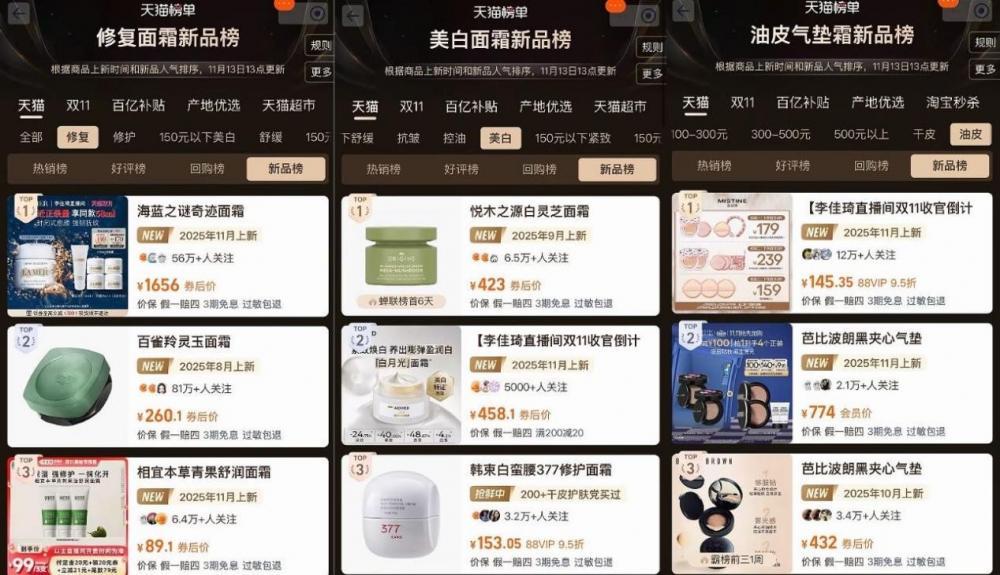
Group 1 - The core viewpoint of the articles highlights the significant performance of new products during this year's Double Eleven shopping festival, with many brands experiencing explosive growth in sales [1][2]. - Consumers are shifting their skincare preferences from "large sets" to "single products," favoring personalized combinations, particularly focusing on moisturizing and repairing products during the seasonal transition [2][4]. - Natural skincare brand Chando launched a new oil mask priced at 99 yuan for 12 pieces, which sold over 100,000 units on the first day of Double Eleven, showcasing a nearly 30% year-on-year increase in GMV from the previous year [4][6]. Group 2 - The new oral care brand Beisi achieved remarkable success with its newly launched blue light toothbrush, selling out at a price of 999 yuan during the Double Eleven promotion [5][6]. - Beisi's overall sales on Tmall increased by over 70% compared to last year's Double Eleven, attributed to effective product differentiation and the strategic use of content marketing through Li Jiaqi's livestream [6][11]. - The brand implemented a trade-in program to encourage consumers to try their higher-priced electric toothbrushes, which typically have a market share of only 5% for products priced above 900 yuan [9][10].
央视网和新华社为何同期专访丸美?答案藏在重组胶原里
FBeauty未来迹· 2025-11-19 09:30
Core Viewpoint - The article highlights the emergence of recombinant collagen as a significant anti-aging ingredient developed in China, marking a shift in the beauty industry where domestic brands gain authority in core raw materials, moving from a follower to a leader position in the global market [3][4][5]. Group 1: Company Overview - Marubi Biotech is one of the few companies in China that has achieved full-chain self-research and production of recombinant collagen, positioning itself as a representative of high-end beauty technology in the country [5][6]. - The company has played a crucial role in establishing national industry standards for recombinant collagen, transitioning from an industry participant to a standard setter, which signifies its technical authority [6][7]. Group 2: Technological Advancements - Marubi has developed a comprehensive research and production chain in the functional protein field, including gene editing, fermentation expression, structural verification, separation purification, and formula application [7][11]. - The establishment of the "National Recombinant Functional Protein Technology Research Center" under Marubi indicates its capability to not only serve its product development but also provide technical output to the industry [11][12]. Group 3: Product Development and Efficacy - Marubi's products, such as the "Recombinant Double Collagen," have achieved significant breakthroughs, including the first global production of high-activity recombinant human collagen through self-research and the use of translation pause technology [13][14]. - Clinical trials have shown that Marubi's products can effectively reduce wrinkle volume, with a reported 56.83% reduction in under-eye wrinkles and 13.18% in nasolabial folds after seven days of use [17][20]. Group 4: Market Strategy and Future Outlook - Marubi aims to establish a global presence by setting up research centers abroad and forming joint ventures, reflecting a shift from merely exporting products to a more comprehensive output of technology, standards, and brand culture [28][29]. - The company's vision includes creating a beauty standard that transcends cultural boundaries, emphasizing the importance of scientific research and long-term commitment to quality over short-term gains [28][30].

广州玛佑美妆有限公司成立 注册资本0.1万人民币
Sou Hu Cai Jing· 2025-11-19 07:34
天眼查App显示,近日,广州玛佑美妆有限公司成立,注册资本0.1万人民币,经营范围为技术服务、技 术开发、技术咨询、技术交流、技术转让、技术推广;信息咨询服务(不含许可类信息咨询服务);信息 技术咨询服务;贸易经纪;国内贸易代理;货物进出口;技术进出口;数字文化创意软件开发;市场营销策划;电 影制片;广告设计、代理;广告制作;广告发布;专业设计服务;图文设计制作;平面设计;包装服务;企业形象 策划;文艺创作;咨询策划服务;会议及展览服务;照相机及器材销售;电影摄制服务;摄像及视频制作服务;摄 影扩印服务;组织文化艺术交流活动;卫生用品和一次性使用医疗用品销售;个人卫生用品销售;珠宝首饰 零售;卫生洁具销售;美发饰品销售;日用品销售;成人情趣用品销售(不含药品、医疗器械);互联网销售 (除销售需要许可的商品);服装服饰零售;服装服饰批发;母婴用品销售;日用百货销售;日用口罩(非医 用)销售;化妆品批发;化妆品零售;玩具、动漫及游艺用品销售;电子产品销售。 ...