计算机通信和其他电子设备制造业

Search documents
工业延续增长 消费持续回暖
Xin Hua Ri Bao· 2025-11-23 22:02
Economic Overview - The overall economic operation in the province has been stable and progressing steadily in the first ten months of the year, with key sectors such as industry, consumption, and services showing positive developments [1][2]. Industrial Performance - The industrial economy has maintained a robust growth trend, with the industrial added value of large-scale enterprises increasing by 6.8% year-on-year from January to October. In October alone, the growth rate was 5.8%, with high-end manufacturing sectors like equipment manufacturing, high-tech manufacturing, and digital core product manufacturing growing by 8.0%, 11.7%, and 9.4% respectively, outpacing the overall growth [1]. Consumption Market - The consumption market has shown signs of recovery, with the total retail sales of social consumer goods reaching 38,816.8 billion yuan, a year-on-year increase of 4.0% from January to October. In October, retail sales of household appliances and audio-visual equipment rose by 7.4%, while sales of computers and related products surged by 48%, indicating strong demand for upgraded and digital products [2]. Service Sector - The service sector has maintained a stable development trend, with revenue from large-scale service industries increasing by 7.2% year-on-year from January to September. Notable growth was observed in resident services, rental and business services, and water, environment, and public facility management, with respective increases of 14.2%, 12.7%, and 9.7% [2]. Fixed Asset Investment - Fixed asset investment in the province has decreased by 8.7% year-on-year from January to October, but the investment structure has been optimized. Significant growth was noted in infrastructure investments, particularly in the electricity and heat production and supply industry, which grew by 22.9%, and in loading, unloading, and warehousing, which increased by 27.2% [3].
杭州1—10月经济运行态势良好
Mei Ri Shang Bao· 2025-11-20 05:32
Economic Overview - Hangzhou's economy showed a stable and progressive trend from January to October 2025, driven by continuous policy incentives and significant improvements in new productive forces [1][6] Industrial Growth - The industrial economy in Hangzhou performed well, with a total industrial added value of 378.7 billion yuan, representing a year-on-year growth of 6.2% [2] - Key industries such as automobile manufacturing, computer communication, and electrical machinery saw substantial growth rates of 34.7%, 13.3%, and 5.2% respectively [2] - Emerging industries played a leading role, with high-tech industries, strategic emerging industries, and equipment manufacturing all growing by 7.3%, 9.1%, and 9.1% respectively, outpacing the overall industrial growth [2] - The digital economy's core manufacturing sector experienced a remarkable growth of 10.5% [2] - Production of industrial robots, 3D printing equipment, and new energy vehicles surged by 26.0%, 28.9%, and 293.4% respectively [2] Service Sector Performance - The service sector continued to recover, becoming the main engine of economic growth, with total revenue reaching 1,672.4 billion yuan, a year-on-year increase of 9.4% [3] - Key sectors such as information transmission, software, and IT services saw revenue growth of 14.2%, while scientific research and technical services grew by 7.9% [3] - Emerging service industries, including digital economy core services and high-tech services, reported revenue growth of 13.8% and 13.3%, respectively, indicating strong momentum for high-quality development [3] Consumer Market Trends - The retail sales of consumer goods reached 773.7 billion yuan, with a year-on-year growth of 4.8%, reflecting a significant upgrade in consumption structure [4] - Retail sales of household appliances and audio-visual equipment surged by 50.8%, while communication equipment sales increased by 37.1% [4] - New energy vehicle sales grew by 11.2%, and basic living consumption, including grain and food, also saw an increase of 11.2% [4] - Smart consumer products like smartphones and wearable devices experienced rapid growth, with sales increasing by 44.5% and 91.2% respectively [4] Investment and Trade - Fixed asset investment structure continued to optimize, with industrial investment growing by 7.3%, particularly in automobile manufacturing and general equipment manufacturing, which saw increases of 39.5% and 21.2% respectively [5] - Infrastructure investment also showed significant growth of 16.2% [5] - Total import and export value reached 743.6 billion yuan, with a year-on-year increase of 5.7%, highlighting resilience in foreign trade [5] - Exports of mechanical and electrical products and high-tech products were strong, amounting to 254.9 billion yuan and 81.7 billion yuan respectively [5] - Exports to countries involved in the Belt and Road Initiative reached 261.4 billion yuan, growing by 14.2%, which is higher than the overall export growth rate [5]
1至9月成都市规上工业增加值同比增长7.5%
Xin Hua Cai Jing· 2025-11-19 12:58
Core Insights - Chengdu's industrial added value increased by 7.5% year-on-year from January to September this year [1] Industry Performance - Out of 37 major industrial sectors in Chengdu, 24 sectors achieved positive growth, with 11 sectors maintaining double-digit growth [1] - The top ten industries contributed 5.8 percentage points to the overall industrial growth [1] - The three fastest-growing sectors were general equipment manufacturing (28.5%), automobile manufacturing (20.2%), and computer communication and other electronic equipment manufacturing (14.1%) [1] High-tech Manufacturing - High-tech manufacturing in Chengdu saw an added value growth of 11.2% year-on-year [1] - The electronic and communication equipment manufacturing sector grew by 29.8%, while the aerospace equipment manufacturing sector grew by 29.2% [1] Advanced Manufacturing - The five major advanced manufacturing sectors experienced an added value growth of 8.9% year-on-year [1] - The equipment manufacturing industry and electronic information industry grew by 17.0% and 12.9%, respectively [1] Emerging Products - Emerging products showed significant growth, with solar cells increasing by 247.1%, new energy vehicles by 238.0%, smartwatches by 54.4%, and industrial robots by 39.0% [1]
前10月江西省经济运行保持平稳
Sou Hu Cai Jing· 2025-11-19 00:42
Economic Overview - The economic operation of the province has remained stable in the first ten months of the year, with major economic indicators showing steady growth [1][2] - The province has focused on stabilizing employment, enterprises, markets, and expectations, contributing to the overall economic stability [1] Industrial Performance - The industrial economy is highlighted as a key driver of growth, with a year-on-year increase of 7.7% in the added value of industrial enterprises above a designated size [1] - Key sectors such as automobile manufacturing, computer, communication, and other electronic equipment manufacturing, as well as non-ferrous metal smelting and rolling, have achieved double-digit growth [1] - High-tech manufacturing added value increased by 12.5%, surpassing the provincial average by 4.8 percentage points, indicating strong performance in emerging sectors [1] Profitability - From January to September, the total profit of industrial enterprises above a designated size reached 137.8 billion yuan, reflecting a year-on-year growth of 7.6% [1] Consumer Market - The retail sales of social consumer goods totaled 1,070.13 billion yuan, with a year-on-year growth of 5.0%, slightly accelerating from the previous year [2] - The accommodation and catering industries saw significant growth, with revenues increasing by 10.0% and 10.7% respectively [2] - New retail formats, such as collective stores and unmanned stores, have shown robust performance, with double-digit growth in sales [2] Investment Trends - Fixed asset investment in the province grew by 2.2% year-on-year, with 23 out of 31 manufacturing investment sectors reporting positive growth [2] - Private investment increased by 2.5%, contributing 60.9% to the overall investment growth [2] - There are 8,093 construction projects valued over 100 million yuan, with a year-on-year investment increase of 5.3%, contributing 3.7 percentage points to total investment growth [2]
肇庆前三季GDP增长4.6%,先进制造业增速近三成领跑
Nan Fang Du Shi Bao· 2025-11-18 12:28
Economic Overview - The GDP of Zhaoqing reached 212.48 billion yuan in the first three quarters of 2025, reflecting a year-on-year growth of 4.6%, indicating robust economic performance and structural optimization [2] Agriculture Sector - The total output value of agriculture, forestry, animal husbandry, and fishery reached 51.226 billion yuan, with a year-on-year growth of 5.5%, showcasing a solid agricultural foundation [3] - Major agricultural products such as vegetables, pigs, and aquatic products saw stable growth, ensuring sufficient supply for residents [3] - Agricultural professional and auxiliary activities grew by 11.5%, indicating improvements in socialized services and professional management in agriculture [3] Industrial Sector - The industrial economy showed a stable overall performance with a year-on-year increase of 4.0% in the added value of industrial enterprises above designated size [4] - Advanced manufacturing, particularly in the automotive sector, grew by 17.8%, while electrical machinery and equipment manufacturing increased by 15.2% [4] - The added value of advanced manufacturing rose by 15.9%, and advanced equipment manufacturing surged by 27.3%, highlighting strong industrial upgrading [4] Consumer Market - The total retail sales of consumer goods reached 92.179 billion yuan, with a year-on-year growth of 2.7%, indicating a steady recovery in the consumer market [5] - Sales of upgraded consumer goods, such as home appliances and audio-visual equipment, saw significant increases of 74.8% and 63.0%, respectively, reflecting a growing demand for quality living [5] - Online consumption remained active, with retail sales through public networks growing by 8.2% [5] Financial Support and Price Stability - The balance of various loans in the city grew by 7.2% by the end of September, outpacing deposit growth, indicating strong financial support for the real economy [6] - The Consumer Price Index (CPI) decreased by 0.5% year-on-year, with notable declines in food prices, helping to lower living costs for residents [7] Economic Resilience - Despite challenges in fixed asset investment, positive trends are emerging, such as a narrowing decline in commodity housing sales by 4.8 percentage points compared to the first half of the year [8] - Overall, Zhaoqing's economy is enhancing its internal driving force amid structural adjustments, with expectations for sustainable and high-quality development as growth policies take effect [8]


积极发挥票据功能作用,助力“十五五”制造业发展
Zheng Quan Shi Bao Wang· 2025-11-14 13:23
Group 1 - The manufacturing industry is the foundation of the national economy, and China has become the world's largest manufacturing country, but it still faces challenges in independent innovation and reliance on foreign technology [1][2] - The "14th Five-Year Plan" emphasizes high-quality development of the manufacturing sector, focusing on transformation towards high-end, intelligent, and green manufacturing [2][3] - Acceptance bills are a crucial financing tool for manufacturing enterprises, with over 30% of the total bill issuance in 2024 coming from the manufacturing sector [2][3] Group 2 - In 2024, the total amount of acceptance bills issued reached 38 trillion yuan, with the manufacturing sector accounting for 11.7 trillion yuan, indicating a continuous upward trend [3] - Small and medium-sized enterprises (SMEs) are significantly benefiting from the acceptance bill market, with 93.2% of bill issuers being SMEs [3][4] - Acceptance bills provide a flexible financing option for SMEs, which often struggle to access traditional financing methods [4][5] Group 3 - The twelve major manufacturing industries in China include electronics, machinery, automotive, and chemical manufacturing, all of which are adapting to new business models and enhancing their digital capabilities [7][8] - Acceptance bills can effectively match the cash flow cycles of these industries, reducing capital occupation and expanding commercial credit [7][8] Group 4 - The promotion of receivables bill financing is essential for alleviating liquidity pressures faced by manufacturing enterprises, especially SMEs [8][9] - The integration of technology, such as big data and AI, into the bill financing process can enhance service efficiency and reduce transaction costs for manufacturing enterprises [15][16] Group 5 - The development of green bills is aligned with China's carbon neutrality goals, providing financial support for green projects within the manufacturing sector [10][11] - Financial institutions are encouraged to support the acceptance, discounting, and re-discounting of green bills to facilitate the transition towards sustainable manufacturing practices [11][12] Group 6 - The current macroeconomic environment presents challenges for credit access among SMEs, necessitating a focus on enhancing the efficiency of bill financing processes [13][14] - The central bank's re-discount policy can be leveraged to support manufacturing enterprises, particularly those with strong credit profiles [14][16]
通达电气:何俊华累计减持公司股票10万股,减持公司股份计划完成
Mei Ri Jing Ji Xin Wen· 2025-11-14 08:50
Group 1 - The core point of the article is that Tongda Electric has completed a share reduction plan, with a total of 100,000 shares sold, representing approximately 0.028% of the company's total share capital [1] - As of the announcement date, Tongda Electric's market capitalization is 4.5 billion yuan [1] - For the year 2024, the revenue composition of Tongda Electric is primarily from the computer communication and other electronic equipment manufacturing industry, accounting for 96.02%, while other businesses contribute 3.98% [1]

通达电气:毛祥波累计减持公司股票约21万股,减持计划实施完毕
Mei Ri Jing Ji Xin Wen· 2025-11-06 09:45
Group 1 - The company Tongda Electric (SH 603390) announced on November 6 that as of the date of the notice, Mr. Mao Xiangbo has reduced his shareholding by approximately 210,000 shares, accounting for about 0.06% of the company's total share capital [1] - The company's revenue composition for the year 2024 is as follows: 96.02% from the manufacturing of computer communication and other electronic equipment, and 3.98% from other businesses [1] - As of the report date, Tongda Electric has a market capitalization of 4.6 billion yuan [1]
前三季度坪山区GDP同比增长6.5% 汽车制造业贡献突出
Nan Fang Du Shi Bao· 2025-11-05 03:11
Economic Overview - The GDP of Pingshan District reached 107.423 billion yuan in the first three quarters of 2025, with a year-on-year growth of 6.5% [2] - The primary industry saw a decrease in value added by 4.9%, while the secondary industry increased by 8.5% and the tertiary industry grew by 2.3% [2] Industrial Performance - The industrial output value above designated size grew by 9.8%, with manufacturing increasing by 9.9% [2] - Notable growth was observed in the automotive manufacturing sector, which surged by 21.5%, general equipment manufacturing by 15.0%, and computer, communication, and other electronic equipment manufacturing by 12.6% [2] Investment Trends - Fixed asset investment in Pingshan District decreased by 31.1%, with industrial investment dropping by 52.4% [3] - Infrastructure investment, however, saw a significant increase of 101.6%, and industrial technological transformation investment skyrocketed by 190.6% [3] - Specific sectors such as electricity, heat, gas, and water production and supply saw an investment increase of 311.6%, while transportation, warehousing, and postal services grew by 216.9% [3] Consumer Market - The total retail sales of consumer goods reached 19.563 billion yuan, reflecting a year-on-year growth of 9.1% [3] - The effects of the "old for new" policy were evident, with retail sales of cultural and office supplies increasing by 8.4%, and significant growth in home appliances and communication equipment sales [3]

刚刚,武汉2025年前三季度GDP公布
Chang Jiang Ri Bao· 2025-10-29 08:20
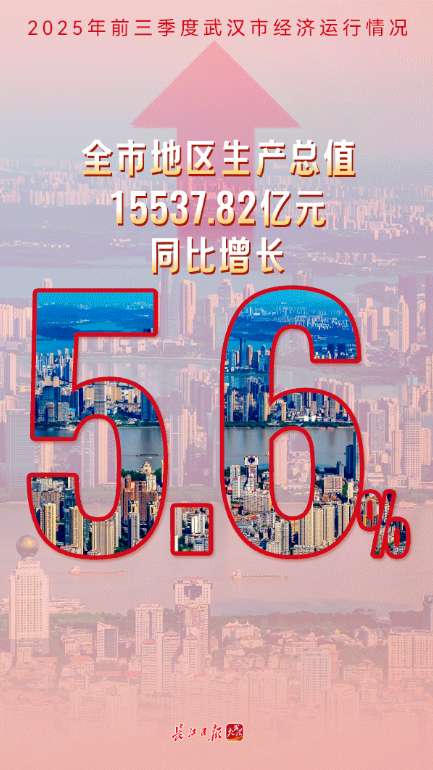
Economic Overview - Wuhan's GDP for the first three quarters of 2025 reached 15,537.82 billion yuan, reflecting a year-on-year growth of 5.6% at constant prices [3] - The primary industry added value was 370.81 billion yuan, growing by 3.7%; the secondary industry added value was 5,068.39 billion yuan, growing by 4.8%; and the tertiary industry added value was 10,098.62 billion yuan, growing by 6.0% [4] Agricultural Sector - The total output value of agriculture, forestry, animal husbandry, and fishery reached 608.38 billion yuan, with a year-on-year growth of 3.9% [11] - Major agricultural products saw production increases, with summer grain and early rice totaling 120,500 tons, up by 0.6% from the previous year [11] Industrial Sector - The industrial added value for large-scale enterprises grew by 5.4%, accelerating by 0.3 percentage points compared to the first half of the year [13] - High-tech manufacturing added value increased by 16.3%, accounting for 25.2% of the total industrial added value [13] - Notable growth was observed in the computer, communication, and other electronic equipment manufacturing sector, which grew by 18.0% [13] Service Sector - The service industry added value increased by 6.0%, with transportation, warehousing, and postal services growing by 10.8% [15] - Revenue from large-scale service enterprises rose by 11.6%, with significant increases in various service sectors [15] Investment Trends - Fixed asset investment grew by 2.0%, with industrial investment increasing by 12.0% and infrastructure investment by 6.2% [17] - High-tech industry investment rose by 2.9%, with high-tech service and manufacturing investments growing by 13.2% and 0.4%, respectively [17] Consumer Market - The total retail sales of consumer goods reached 6,299.74 billion yuan, with a year-on-year growth of 5.5% [19] - The "old for new" policy positively impacted retail sales in home appliances and building materials, with increases of 28.6% and 21.0%, respectively [20] Trade and Finance - The total import and export volume was 3,369.6 billion yuan, growing by 15.8% year-on-year [22] - Financial institutions reported a deposit balance of 42,864.83 billion yuan, with a year-on-year growth of 5.1% [22] Income and Prices - Per capita disposable income reached 46,107 yuan, with urban and rural incomes growing by 4.6% and 5.9%, respectively [24] - The consumer price index rose by 0.3% year-on-year, with various categories showing different price trends [24] Conclusion - Overall, Wuhan's economy showed stable growth in the first three quarters of 2025, with a focus on consolidating the recovery and addressing external uncertainties [25]