
跨境电商

Search documents
深圳跨境电商“大卖”一万亿!
Shen Zhen Shang Bao· 2026-01-01 21:50
Core Insights - Shenzhen's cross-border e-commerce is positioned as a significant player in China's foreign trade transformation, with a projected GMV of 1 trillion RMB by 2025, up from 900 billion RMB in 2024 [2] - The city hosts 120,000 sellers and 100,000 service providers, representing a substantial portion of the national market, and is recognized as a "super hub" for cross-border e-commerce [3] - The shift from "product export" to "brand export" and now to "ecosystem export" illustrates Shenzhen's evolution in global trade [8] Group 1: Industry Growth and Performance - Shenzhen's cross-border e-commerce has established a "sunshine" regulatory service model, leading to a continuous top ranking in import and export scale for four consecutive years [3] - Notable companies like Anker Innovations and Ugreen Technology have reported significant revenue growth, with Anker achieving a revenue of 21.02 billion RMB in the first three quarters of 2025, a 27.79% increase year-on-year [3][4] - Ugreen Technology also demonstrated strong performance with a revenue of 6.364 billion RMB, reflecting a 47.80% year-on-year growth [5] Group 2: Emerging Brands and Market Dynamics - A new wave of "dark horse" sellers has emerged, with companies achieving annual sales of over 1 billion RMB in niche markets, contributing to the diversity of Shenzhen's cross-border e-commerce landscape [5] - The collaboration between cross-border e-commerce and traditional manufacturing is driving digital transformation and brand development, exemplified by companies like Saiwei Times, which has launched over 70 self-owned brands [6] Group 3: Policy Support and Future Directions - The Shenzhen government has implemented policies to support independent brand development, offering financial incentives for companies to establish their own platforms [9] - The transition to "ecosystem export" is characterized by companies integrating supply chains and retail, enhancing their global competitiveness [9] - Experts predict that Shenzhen's cross-border e-commerce will evolve from merely selling products to offering standards, models, and comprehensive outputs of technology and management [9]




凝心聚力抓经济 奋楫争先开新局
Xin Lang Cai Jing· 2026-01-01 18:45
Core Viewpoint - The article emphasizes the strategic direction for high-quality economic development in Xinmin City, aligning with the national and provincial economic work meetings, focusing on optimizing the business environment, project-driven growth, technological innovation, reform, and improving people's livelihoods [1]. Group 1: Optimizing Business Environment - The city plans to enhance the business environment by breaking down the World Bank's 10 indicators and relevant laws into actionable items, identifying gaps, and improving them [1]. - A QR code system for enterprise inspections will be implemented to clarify inspection processes and responsibilities, ensuring better compliance and efficiency [1]. - The city aims to secure essential production factors such as electricity, gas, water, and logistics, while also addressing financing challenges for businesses through targeted financial platforms [1]. Group 2: Project Construction - The focus will be on identifying and planning projects in urban construction and public welfare, ensuring they are well-prepared for funding and execution [2]. - A project task force will expedite approval processes during winter downtime, aiming for the early completion of key projects like a 100MW energy storage facility and smart cold chain logistics [2]. - Local enterprises are encouraged to increase investment and production, with specific projects like the pharmaceutical chemical park and innovative drug development being prioritized [2]. Group 3: Technological Empowerment - Collaboration with local universities and research institutions will be strengthened to promote technology transfer and new product development in sectors like vegetable cultivation and aquaculture [2]. - The manufacturing sector will undergo digital transformation to enhance quality and competitiveness, particularly in high-end equipment manufacturing [2]. - The city aims to capitalize on artificial intelligence opportunities by advancing the establishment of an intelligent computing center in the Shenyang metropolitan area [2]. Group 4: Reform and Opening Up - The city will implement reforms in development zones, focusing on institutional adjustments and land use efficiency to stimulate economic activity [3]. - Cross-border e-commerce will be promoted, leveraging local supply chain platforms to enhance exports, particularly to South Korea [3]. Group 5: Improving Livelihoods - Employment support policies will be enhanced to ensure job security for key demographics [3]. - Upgrades to elderly and childcare services will be prioritized, alongside urban renewal projects to address community issues like waste management and parking [3]. - The city will explore new models for rural revitalization, focusing on comprehensive development and safety in infrastructure [3].
安克创新回应“裁员30%”:不属实
Xin Lang Cai Jing· 2026-01-01 08:53
2025年末,多个社交平台上就出现了安克创新"裁员30%"的传闻,原因是季度末位淘汰。而如此大幅的 裁员比例,也引发了跨境电商行业地震。安克创新方面回应称:"这是公司基于战略升级和效率提升做 的正常人员调整,网传30%比例严重不属实。"不过,公司并没有公布具体的调整比例。一位安克员工 表示,裁员属实,但30%实属夸张,更多偏向业务线整合。其中,涉及员工多为外包,以及部分绩效较 低的正职员工,同时提供了内部转岗机会。目前,安克创新员工规模在5000人上下。(智通财经) ...
重磅会议部署!
Jin Rong Shi Bao· 2026-01-01 02:43
Core Viewpoint - The State Council's recent meeting led by Premier Li Qiang on December 31 outlines a pragmatic policy framework aimed at promoting cross-border trade facilitation, setting the stage for high-level opening-up in the new year amidst complex global trade dynamics [1] Group 1: Cross-Border Trade Challenges and Opportunities - The global trade landscape is undergoing significant adjustments due to geopolitical conflicts and rising protectionism, presenting dual challenges for China's cross-border trade [1] - The integration of digital economy with the real economy and the emergence of green trade trends, along with benefits from agreements like RCEP, provide new growth avenues for cross-border trade [1] Group 2: Logistics and Transportation - The new policy emphasizes the importance of efficient logistics systems, addressing key pain points such as high costs and unstable timeliness in cross-border logistics [2] - Successful models like the China-Europe Railway Express and the Western Land-Sea New Corridor are highlighted, showcasing improved speed and reduced costs through multi-modal transport [2] Group 3: New Business Models and Regulatory Optimization - The meeting stresses the development of new business models such as green trade and cross-border e-commerce, which are crucial for trade growth [3] - In the first three quarters of 2025, China's cross-border e-commerce imports and exports reached approximately 2.06 trillion yuan, marking a 6.4% year-on-year increase [3] Group 4: Smart Regulation and Efficiency - Enhancements in smart regulatory services are identified as key to overcoming traditional regulatory challenges, with a focus on building smart customs and ports [4] - The "single window" for international trade has achieved deep integration with 30 departmental systems, significantly improving customs efficiency and reducing communication costs [4] Group 5: Systematic Policy Integration - The cross-border trade facilitation measures represent a systematic upgrade rather than isolated breakthroughs, aiming to transform localized pilot experiences into nationwide practices [5] - The facilitation of cross-border trade is directly linked to the stability and competitiveness of China's industrial and supply chains, as well as the efficiency of domestic and international market connectivity [5]
弱复苏低通胀强补贴下的内需主线
2025-12-31 16:02
Summary of Key Points from Conference Call Records Industry Overview - The focus is on the domestic consumption sector, with policies aimed at boosting consumer spending through increased household income, including minimum wage hikes and corporate salary increases [1][4][5] - The service consumption sector is expected to benefit from reforms in pricing mechanisms, particularly in healthcare, transportation, and public utilities [1][6] - The retail sector, especially offline retail, is seen as a crucial driver for domestic demand, supported by policies for updating commercial facilities [1][12] Core Insights and Arguments - **Consumer Policy Effectiveness**: The effectiveness of consumer promotion policies is anticipated to exceed market expectations, with significant increases in minimum wage across provinces, averaging over 8% [4][5] - **Service Sector Reforms**: Reforms in service pricing, particularly in healthcare, are expected to enhance the income of service providers while controlling costs for consumers [6] - **Product Innovation**: In the goods consumption sector, companies that excel in innovation and new supply offerings are likely to thrive, moving away from traditional consumer upgrade logic [7] - **Tourism and Local Policies**: Local government competition is expected to stimulate tourism, benefiting cultural and agricultural sectors [1][7] Important but Overlooked Content - **Retail Performance**: The first quarter of 2026 is projected to be crucial for leading regional retail companies, with expectations of strong performance during the extended Spring Festival [12] - **Cross-Border E-commerce**: Currency fluctuations have a limited impact on leading cross-border e-commerce companies, with exchange rate losses being a minor portion of profits [13] - **Household Appliances and Smart Hardware**: The government has initiated a subsidy plan for key household appliance categories, with a total subsidy of approximately 250 billion for 2026, focusing on six core categories [19][20] - **Food and Beverage Sector**: The food and beverage sector is expected to hit a performance bottom in Q1 2026, with a gradual recovery anticipated in Q2 [22] Future Outlook - **Economic Rebalancing**: The macroeconomic narrative is shifting towards economic rebalancing, with a cautious optimism for 2026 as supply-demand dynamics are expected to improve [8][9] - **Investment Opportunities**: Key investment opportunities are identified in sectors benefiting from government support, particularly in smart home and wearable technology, with a focus on companies like Midea, Haier, and TCL [20][21] - **Pork Market Expectations**: The pork market is showing signs of recovery, with prices expected to stabilize and improve, leading to a more optimistic outlook for the industry [16] This summary encapsulates the essential insights and projections from the conference call records, highlighting the key themes and potential investment opportunities across various sectors.
电商出海2025-直面挑战-保持韧性
2025-12-31 16:02
Summary of Key Points from the Conference Call Industry Overview - The cross-border e-commerce industry is projected to achieve a GMV growth rate of 12% in 2025, surpassing both global and domestic e-commerce growth rates of 8% and 11% respectively [1][4] - Major platforms such as Temu, Shein, TikTok Shop, and AliExpress are expected to see a GMV growth rate of 25% [1][4] - The compound annual growth rate (CAGR) for cross-border e-commerce from 2024 to 2027 is estimated at 11%, with the four major platforms achieving a CAGR of 23% [1][4] Core Insights and Arguments - Localization strategies are crucial for creating jobs, increasing tax revenue, and enhancing consumer retention through improved fulfillment and after-sales efficiency [1][2][5] - Challenges include homogenization of product offerings, diminishing price advantages, and complexities in managing overseas teams [1][2][5] - The Latin American market shows significant growth potential with an expected GMV growth rate exceeding 10% due to weak local manufacturing [1][7] - The European market remains fragmented, providing opportunities for Chinese companies like Temu and Shein, with market share expected to exceed 10% by 2026 [1][7] - U.S. tariffs are driving platforms to expand into emerging markets in Southeast Asia [1][2] Performance and Profitability Outlook - Major cross-border e-commerce platforms are anticipated to achieve profitability by 2026, with limited impact from tariffs on profit margins [2][10] - Temu is projected to incur losses of approximately $1 billion in 2024 and over $2 billion in 2025, but may reach breakeven in 2026 as GMV recovers [2][10][11] - Alibaba's international digital commerce aims for profitability improvement, expecting to maintain overall profitability by 2026 [2][11] Market Dynamics - The Southeast Asian e-commerce market is dominated by Shopee and TikTok Shop, with expectations of further market share concentration [2][9] - The competitive landscape in Southeast Asia is characterized by high growth rates but low entry barriers for new players [9] - Cross-border e-commerce platforms are outperforming domestic and global averages due to advantages in the Chinese supply chain, demand for cost-effective products, and improved logistics and payment infrastructure [8][19] Challenges and Strategic Responses - Platforms face regulatory challenges, particularly regarding tariff changes in key markets like the U.S. and Brazil [2][3] - Localization efforts are essential for mitigating risks associated with tax, legal, and regulatory changes [2][5] - Temu's strategy includes transitioning to a semi-managed model to improve supply chain efficiency and customer experience [13][14] Future Growth Potential - The overall cross-border e-commerce market is expected to reach approximately $680 billion by 2025 and $840 billion by 2027, with a growth rate exceeding 10% [22] - Temu's GMV is projected to grow from under $65 billion to over $90 billion by 2026, with a potential for quarterly breakeven [16][25] Additional Considerations - The impact of currency fluctuations, such as the appreciation of the RMB, is expected to be limited on cross-border e-commerce platforms due to their increasing local presence [22] - The evolving regulatory landscape in Europe regarding small package tariffs may complicate tax handling for platforms like Temu and Shein [17][18] This summary encapsulates the key insights and projections regarding the cross-border e-commerce industry and specific platforms, highlighting both opportunities and challenges ahead.
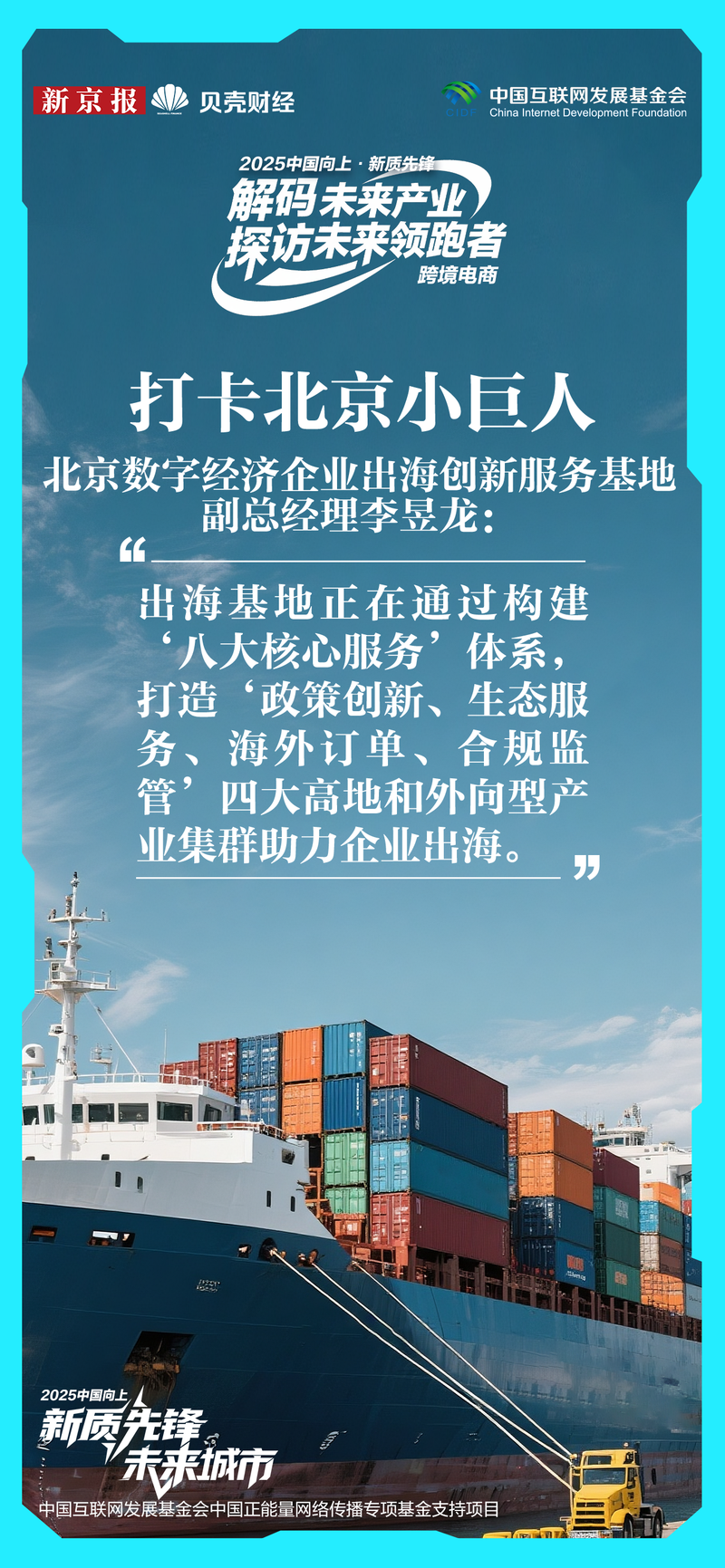
打卡北京小巨人|新质动能加持,北京外贸突围全球市场
Bei Ke Cai Jing· 2025-12-31 11:44
Group 1 - The core viewpoint emphasizes that Beijing's foreign trade is leveraging innovation as a key to navigate global trade changes, aligning with the "14th Five-Year Plan" for trade power deployment [6] - Companies like JD.com, Douyin, and Zhidema Technology are actively engaging in cross-border e-commerce, utilizing AI and content ecosystems to optimize the entire outbound process [6] - The Beijing Digital Economy Outbound Innovation Service Base is establishing a "1+3+N" ecosystem to provide comprehensive support for companies going abroad [6] Group 2 - Enterprises are deepening the integration of domestic and foreign trade through initiatives like "export to domestic sales," reinforcing their development resilience [6] - The combination of policy support and digital empowerment is facilitating Beijing's transition from traditional OEM to "independent R&D + global branding," becoming a crucial pillar for high-quality development in the dual circulation pattern [6]
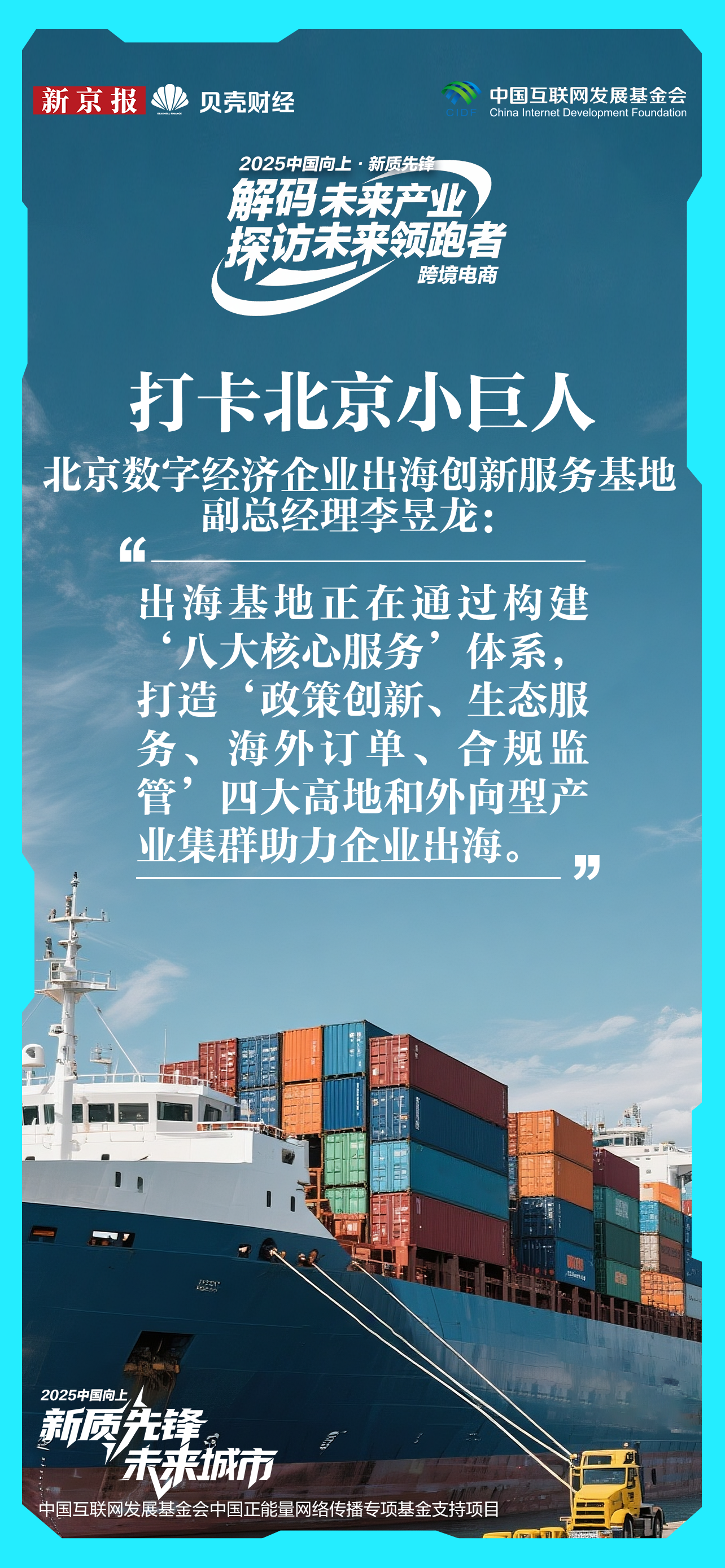
新质动能加持,北京外贸突围全球市场
Xin Jing Bao· 2025-12-31 11:37
Group 1 - The core viewpoint emphasizes that Beijing's foreign trade is leveraging innovation as a key to navigate global trade changes, aligning with the "14th Five-Year" plan for trade strength [3] - Companies like JD.com, Douyin, and Zhidema are actively engaging in cross-border e-commerce, utilizing AI and content ecosystems to optimize the entire outbound process [3] - The Beijing Digital Economy Outbound Innovation Service Base is establishing a "1+3+N" ecosystem to provide comprehensive support for companies going abroad [3] Group 2 - Enterprises are deepening the integration of domestic and foreign trade, implementing plans such as "export to domestic sales" to strengthen their development resilience [3] - Policy support and digital empowerment are facilitating Beijing's transition from traditional OEM to "independent R&D + global branding," becoming a crucial pillar for high-quality development in the dual circulation context [3]
安克创新回应“裁员30%”:员工多为外包
Xin Lang Cai Jing· 2025-12-31 09:57
Core Viewpoint - Anker Innovations is rumored to be undergoing a significant workforce reduction of 30%, which the company denies, stating that any adjustments are part of a strategic upgrade and efficiency improvement [1]. Group 1: Workforce Adjustments - Anker Innovations has not confirmed the exact percentage of layoffs, but an employee indicated that the layoffs are real, primarily affecting outsourced staff and some underperforming full-time employees, with opportunities for internal transfers [1]. - The company is preparing for a secondary listing on the Hong Kong Stock Exchange, aiming to enhance its global strategy and competitiveness [1]. Group 2: Business Challenges - Anker faced a major recall of over 1.158 million power banks due to safety hazards, leading to a trust crisis in the charging industry [2]. - Despite challenges in the power bank segment, Anker's energy storage business is rapidly growing, with projected annual revenue of 6 billion yuan, nearly doubling year-on-year [4]. Group 3: Financial Performance - Anker's revenue for the first three quarters exceeded 21 billion yuan, with a net profit nearing 2 billion yuan, reflecting a year-on-year growth of 31.34% [4]. - However, the company is experiencing increased inventory levels, leading to negative operating cash flow, indicating short-term liquidity pressures [4]. Group 4: Strategic Direction - Anker's CEO has indicated a more cautious approach to new product categories, limiting expansions to 2-3 new categories per year, contrasting with previous aggressive strategies [5][6]. - The company is also focusing on establishing a global direct sales network to reduce reliance on Amazon, which has contributed over 50% of its revenue in recent years [7].

如何应对意大利税号(VAT)要求:跨境电商的合规指南
Sou Hu Cai Jing· 2025-12-31 08:59
Core Viewpoint - The article emphasizes the necessity for businesses to register for a VAT number in Italy to engage in cross-border e-commerce and comply with EU tax regulations, highlighting the implications of non-compliance on competitiveness and legal standing [1][6]. Group 1: Importance of VAT Registration - All companies conducting local sales in Italy must possess a valid VAT number to benefit from the EU's VAT exemption policy for B2B transactions, which is crucial for pricing and competitiveness, especially for cross-border e-commerce businesses [2][3]. - Without an Italian VAT number, businesses cannot participate in the 0% VAT benefit for cross-border B2B transactions, leading to increased product prices and reduced competitiveness in the European market [3][6]. Group 2: Impact on FBA Warehousing - For businesses using Amazon's FBA service, registering for an Italian VAT number is critical. Failure to do so may result in tax compliance issues, including potential fines and legal consequences [4]. - Italian VAT regulations mandate that businesses storing goods in Italy must register for tax purposes, regardless of whether they sell directly in the Italian market [4][6]. Group 3: VAT Registration Process - To successfully apply for an Italian VAT number, businesses must prepare necessary documents, including company registration information and proof of business activities in Italy [7]. - Applications can be submitted online through the Italian Revenue Agency or via a professional tax agent, as the process may involve complexities [7]. - After application, the Italian Revenue Agency issues the VAT number, allowing businesses to commence transactions in compliance with local tax requirements [7]. Group 4: Compliance and Management - Once registered, businesses must regularly file tax returns and ensure compliance with Italian tax regulations, including accurate VAT calculations and handling cross-border sales tax matters [5][6]. - Staying informed about changes in tax regulations in Italy and other EU countries is essential to avoid legal risks and ensure smooth business operations [5][6].
