
量子科技

Search documents
科创板三季报多点开花,关注科创板50ETF(588080)等产品投资价值
Mei Ri Jing Ji Xin Wen· 2025-10-23 09:48
Core Insights - The Sci-Tech Innovation Board (STAR Market) is showcasing strong performance from companies in AI computing power, optical communication, quantum technology, and new energy sectors, reflecting the robust vitality of emerging industries [1] - Companies such as Haiguang Information, Cambricon, Shijia Photon, and Tengjing Technology have reported both revenue and profit growth, indicating accelerated commercialization of cutting-edge technologies [1] - Galaxy Securities maintains a positive outlook on the computing power sector, highlighting its current performance realization phase and relatively moderate valuation levels, with continued optimism for the second half of the year [1] Industry Overview - The STAR 50 Index consists of 50 securities with large market capitalization and good liquidity, representing the most market-representative group of Sci-Tech enterprises, with the top five constituents accounting for approximately 45% of the index [1] - The STAR 50 ETF (588080) has a latest scale exceeding 72 billion yuan, ranking first among all ETFs on the STAR Market, and features the lowest management fee rate of 0.15% per year, facilitating low-cost investment in frontier technology sectors [1]
量子科技概念上涨1.96% 5股主力资金净流入超亿元
Zheng Quan Shi Bao Wang· 2025-10-23 09:43
Core Insights - The quantum technology sector saw a rise of 1.96%, ranking sixth among concept sectors, with 58 stocks increasing in value, including Keda Guokuan which hit a 20% limit up [1][2] Group 1: Sector Performance - The quantum technology sector had a net outflow of 1.243 billion yuan, with 39 stocks experiencing net inflows, and five stocks exceeding 100 million yuan in net inflows [2] - Keda Guokuan led the net inflow with 373.34 million yuan, followed by Geer Software and GuoDun Quantum with 245.49 million yuan and 152.30 million yuan respectively [2][3] Group 2: Individual Stock Performance - Keda Guokuan achieved a daily increase of 20.01% with a turnover rate of 25.76% and a net inflow ratio of 17.78% [3] - Geer Software and GuoDun Quantum also performed well, with increases of 10.03% and 9.06% respectively, and net inflow ratios of 37.59% and 6.51% [3][4] - Dahua Intelligent and Shenzhou Information both saw increases of around 10% with net inflow ratios of 43.48% and 29.87% respectively [3][4] Group 3: Comparative Sector Analysis - Other notable sectors included Shenzhen State-Owned Enterprise Reform with a rise of 6.62% and MLOps concept with a rise of 2.41%, while the breeding diamond sector saw a decline of 2.94% [2]




国盾量子:已深度参与多个量子产业联盟
Mei Ri Jing Ji Xin Wen· 2025-10-23 09:41
Group 1 - The company, Guodun Quantum, is actively involved in the construction of strategic alliances within the quantum technology sector [1] - Guodun Quantum has participated in various industry organizations, including the Quantum Technology Industry-Academia-Research Innovation Alliance and the Quantum Information Branch of the China Information Association [1] - The company has led and participated in the formulation of over 100 international, national, and industry standards [1]
尾盘突发!多只A股,直拉涨停
证券时报· 2025-10-23 09:39
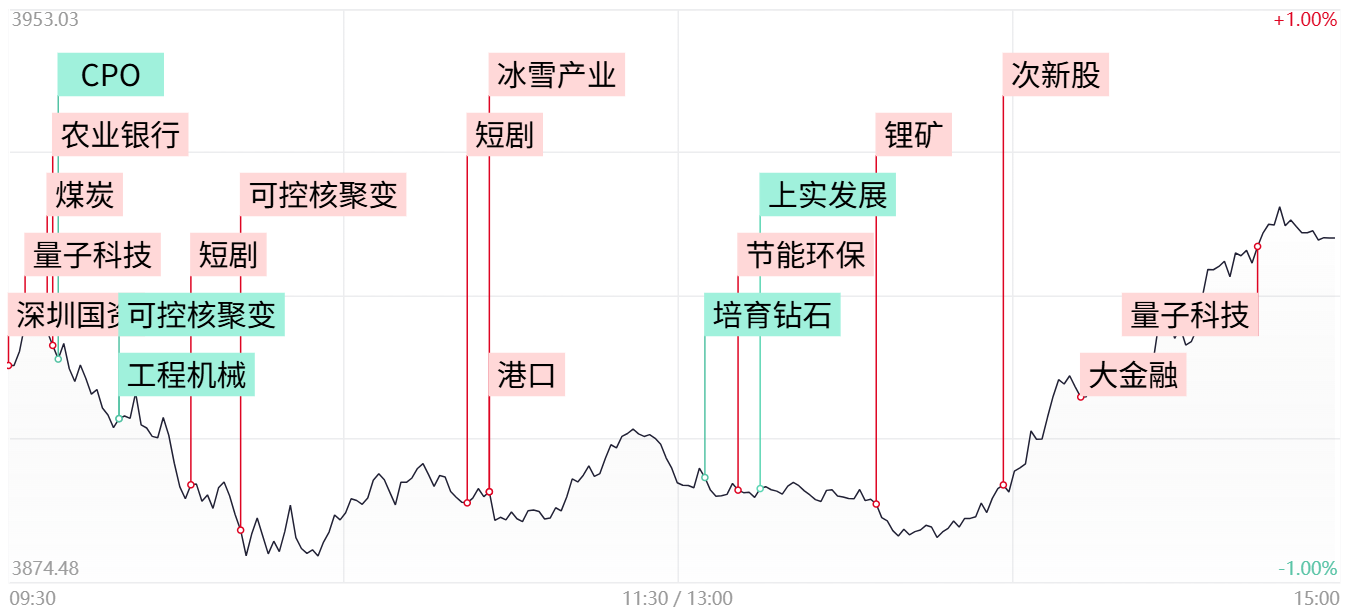
Market Overview - A-shares experienced a weak downward trend in the morning but stabilized and rebounded in the afternoon, with all three major indices turning positive by the end of the day. The Shanghai Composite Index closed up 0.22% at 3922.41 points, while the Shenzhen Component Index also rose 0.22% to 13025.45 points. The ChiNext Index saw a slight increase of 0.09% to 3062.16 points [1][2]. Quantum Technology Sector - The quantum technology sector saw significant gains, with stocks like Keda Guochuang and Dahua Intelligent reaching their daily limit of 20% increase. Other companies such as Dipu Technology and Guandun Quantum also experienced substantial rises, with Dipu Technology increasing over 14% [3][4][5]. - Recent advancements in quantum communication technology, including a successful experiment by China Telecom's Quantum Research Institute, have bolstered confidence in the sector. The experiment achieved a transmission rate exceeding 10Tb/s over a distance of more than 80 kilometers [5]. Coal Sector - The coal sector experienced a surge, with several stocks hitting their daily limit. Notable performers included Daya Energy, which has seen a cumulative increase of nearly 150% over the past ten trading days, and other companies like Shanxi Coking Coal and Yunnan Coal Energy also reached their limits [14][16]. - Analysts predict that coal prices may continue to rise due to a combination of supply constraints and increased demand during the winter heating season. The supply-demand relationship is expected to shift from structural surplus to a tighter balance [16]. Shenzhen State-Owned Enterprises - Shenzhen state-owned enterprises saw a collective surge, with stocks like Jian Ke Yuan and Te Fa Information reaching their daily limit. This follows the release of a new action plan aimed at promoting high-quality development in mergers and acquisitions within the region [17][18].



【每日收评】三大指数探底回升集体收红!深圳本地股全天领涨,锂矿板块午后异动走强
Xin Lang Cai Jing· 2025-10-23 08:52
Core Viewpoint - The market shows signs of recovery with all three major indices closing in the green, driven by strong performances in local Shenzhen stocks, coal, lithium mining, and quantum technology sectors [1][2][3][4]. Sector Summary Shenzhen Local Stocks - Shenzhen local stocks led the market gains, with companies like Teli A, Deep Seige, and others hitting the daily limit up. The Shenzhen government has announced a plan to promote high-quality mergers and acquisitions, aiming for a total market value of listed companies to exceed 20 trillion yuan by the end of 2027 [2][6]. Coal Sector - The coal sector experienced a collective surge, with Dayou Energy achieving an eight-day limit up. Demand remains strong due to high consumption levels since September and low inventory levels, while supply is constrained by a year-on-year decline in production [3][4]. Lithium Mining Sector - Lithium mining stocks saw a strong afternoon performance, with Shengxin Lithium Energy hitting the limit up. The Ministry of Industry and Information Technology reported that Chinese companies hold six of the top ten global battery manufacturers, accounting for 69% of total shipments [4][6]. Quantum Technology Sector - The quantum technology sector showed active performance towards the end of the trading day, with several stocks hitting the limit up. Recent advancements in quantum key distribution technology were reported, indicating a growing market for integrated solution providers in this field [4][6]. Individual Stock Performance - High-profile stocks showed increased volatility, with Dayou Energy leading the market with an eight-day limit up. However, the overall success rate for stocks achieving consecutive limit ups remains below 30% [6][8].


中美经贸传来利好消息!尾盘大逆转!量子科技概念股爆发
Zhong Guo Ji Jin Bao· 2025-10-23 08:52
Market Performance - The market experienced dramatic fluctuations, with a significant drop throughout the day followed by a recovery in the last hour, resulting in a positive close for the three major indices. The Shanghai Composite Index rose by 0.22%, the Shenzhen Component Index increased by 0.22%, and the ChiNext Index gained 0.09% [1] Stock Movements - A total of 2,994 stocks rose, with 72 hitting the daily limit up, while 2,302 stocks declined. Quantum technology stocks surged, with companies like Keda Guokuan and Shenzhou Information reaching their daily limit up. This surge was driven by Google's announcement of a breakthrough in quantum computing, which could pave the way for practical applications in the next five years [2] - The coal sector showed strength, with companies such as Dayou Energy and Shanxi Coking Coal hitting their daily limit up [3] - Local stocks in Shenzhen performed strongly, with nearly 20 stocks, including TeFa Information and Lihe Science and Technology, reaching their daily limit up [4] - On the downside, computing hardware stocks like CPO fell, with Dongtian Microelectronics dropping over 10% [5] Economic News - The market's late reversal was attributed to positive news regarding Sino-U.S. trade relations. The Ministry of Commerce confirmed that Vice Premier He Lifeng will lead a delegation to Malaysia for trade negotiations with the U.S. from October 24 to 27, focusing on important issues in Sino-U.S. economic relations [6] - The Ministry of Foreign Affairs emphasized the importance of Sino-U.S. relations and confirmed participation in the ASEAN summit, indicating a commitment to regional cooperation [7]
A股尾盘大逆转,发生了什么?
天天基金网· 2025-10-23 08:14
Market Performance - On October 23, the market experienced a dramatic performance with a full-day decline followed by a recovery in the last hour, resulting in a slight increase in major indices: Shanghai Composite Index rose by 0.22%, Shenzhen Component Index rose by 0.22%, and ChiNext Index rose by 0.09% [3] - A total of 2,994 stocks rose, with 72 stocks hitting the daily limit, while 2,302 stocks declined [4] Stock Movements - Quantum technology stocks surged, with companies like Keda Guochuang and Shenzhou Information hitting the daily limit. This was driven by news that Google's algorithm "Quantum Echoes" achieved a significant milestone in quantum computing, indicating practical applications within the next five years [5] - The coal sector also showed strength, with stocks like Dayou Energy and Shanxi Coking hitting the daily limit [6] Notable Stock Performances - Keda Guochuang saw a rise of 20.01% to a price of 32.69, while other notable gainers included Chuangxin Medical (+16.01%) and Dipu Technology (+14.86%) [6] - In the coal sector, Shaanxi Black Cat and Shanxi Meizhou both rose by over 10% [7] Market Sentiment and Economic News - The market's late reversal was attributed to positive news regarding Sino-U.S. trade negotiations, with a new round of talks scheduled in Malaysia from October 24 to 27 [10][12] - The Chinese Ministry of Commerce confirmed that Vice Premier He Lifeng will lead a delegation to discuss important issues in Sino-U.S. economic relations [13]



重大利好!尾盘,大逆转!
中国基金报· 2025-10-23 07:59
Market Performance - The market experienced a dramatic turnaround, with major indices closing higher after a day of declines. The Shanghai Composite Index rose by 0.22%, the Shenzhen Component Index increased by 0.22%, and the ChiNext Index gained 0.09% [1][2]. Stock Movement - A total of 2,994 stocks rose, with 72 hitting the daily limit up, while 2,302 stocks declined. The total trading volume reached 16,607.09 billion [2][3]. - Quantum technology stocks surged, with companies like Keda Guokuan and Shenzhou Information hitting the daily limit up. This was driven by Google's announcement of a breakthrough in quantum computing, which is expected to pave the way for practical applications in the next five years [3][4]. Sector Performance - The coal sector showed strength, with companies such as Dayou Energy and Shanxi Coking Coal hitting the daily limit up. Local Shenzhen stocks also performed well, with nearly 20 stocks reaching the daily limit up [4]. - Conversely, computing hardware stocks like CPO saw declines, with Dongtian falling over 10% [5][6]. Economic News - Positive news regarding Sino-U.S. trade relations contributed to the market's late rally. Chinese Vice Premier He Lifeng is set to lead a delegation to Malaysia for trade negotiations with U.S. officials from October 24 to 27 [6][7][10].

【A股收评】三大指数震荡上扬,煤炭、锂电齐上涨!
Sou Hu Cai Jing· 2025-10-23 07:49
Market Overview - On October 23, major indices experienced fluctuations, with the Shanghai Composite Index rising by 0.22%, the Shenzhen Component Index also up by 0.22%, and the ChiNext Index increasing by 0.09%. The Sci-Tech Innovation 50 Index fell by 0.3%. Over 2900 stocks in the two markets rose, with a total trading volume of approximately 1.64 trillion yuan [2]. State-Owned Enterprise Reform - The concept of state-owned enterprise reform gained strength, with notable stock increases: JianKaoYuan (300675.SZ) surged by 20%, while TeFa Information (000070.SZ), TeLi A (000025.SZ), ShenSaiGe (000058.SZ), ShenFangZhi A (000045.SZ), and Shenzhen Energy (000027.SZ) rose by 10% [2]. Coal Sector Performance - The coal sector also showed strong performance, with DaYou Energy (600403.SH), YunMei Energy (600792.SH), and Shanxi Black Cat (601015.SH) each rising by 10%. ZhongMei Energy (601898.SH) and YanKuan Energy (600188.SH) also saw increases [3]. Lithium Battery Sector Activity - The lithium battery sector was active, with ShengXin Lithium Energy (002240.SZ) increasing by 10%, and RongJie Shares (002192.SZ) rising by 7.52%. Other companies like Tibet Mining (000762.SZ) and GanFeng Lithium (002460.SZ) experienced significant gains. The main contract for lithium carbonate futures rose by over 4%, with expectations of increased production in October due to new production lines coming online [4]. Quantum Technology Sector - The quantum technology sector performed well, with KeDa GuoChuang (300520.SZ) rising by 20%. Other companies such as DiPu Technology (300768.SZ), DaHua Intelligent (002512.SZ), ShenZhou Information (000555.SZ), and GuoDun Quantum (688027.SH) also saw substantial increases. This surge was driven by Google's announcement of a breakthrough in quantum algorithms, achieving a speed 13,000 times faster than the best supercomputers [4]. Declining Sectors - The oil and gas, as well as engineering machinery sectors, showed weakness, with companies like JianShe Machinery (600984.SH), LiuGong (000528.SZ), HengLi Hydraulic (601100.SH), and Sany Heavy Industry (600031.SH) experiencing declines. The pharmaceutical and semiconductor sectors also weakened, with Canxin Shares (688691.SH) dropping over 11%, alongside RongChang Bio (688331.SH) and Maiwei Bio (688062.SH) [5].


A股收评:沪指探底回升涨0.22%,量子科技、深圳本地股集体爆发
Ge Long Hui· 2025-10-23 07:28
10月23日,A股三大指数早盘震荡走低,尾盘拉升集体翻红。截至收盘,沪指涨0.22%,深证成指涨0.22%,创业板指涨0.09%。全市场成交额 1.66万亿元,较前一交易日缩量295亿元,近3000股上涨。 | 代码 | 名称 | 现价 | 涨跌 | 涨幅 | | --- | --- | --- | --- | --- | | 000001 | 上证指数 | 3922.41 | +8.65 | +0.22% | | 399001 | 深证成指 | 13025.45 | +28.84 | +0.22% | | 399006 | 创业板指 | 3062.16 | +2.84 | +0.09% | 盘面上,深圳印发并购重组高质量发展行动方案,深圳本地股走高,深赛格、深水规院等多股涨停;煤炭板块爆发,山西焦煤、大有能源等多 股涨停;谷歌量子计算再现重大突破,量子锂科技板块走强,科大国创20CM涨停;锂矿概念、影视院线、文化传媒等概念涨幅居前。另一方 面,超硬材料、培育钻石板块下挫,惠丰钻石跌逾13%;工程机械板块走低,建设机械跌超8%;CPO概念、创新药、油气等板块下跌。 消息面上,10月22日,Alphabet旗下 ...
