啤酒

Search documents
晨星:下调华润啤酒(00291)公允值预测3% 认为估值仍被低估
智通财经网· 2026-01-06 03:39
Core Viewpoint - Morningstar has downgraded the fair value estimate of China Resources Beer (00291) by 3% to HKD 37.5, while also reducing the profit forecast for 2025-2029 by 4-5% [1] Group 1: Financial Estimates - The company is still considered undervalued, with a projected dividend yield of 4.4% in 2025 supporting this view [1] - Sales growth forecast for the company's liquor business has been reduced from 7% to 3% over the next five years, reflecting weak industry demand [1] - Sales and net profit expectations for 2025 have been lowered by 0.2% and 4% respectively, due to rising operational costs and declining profitability in the liquor segment [1] Group 2: Market Challenges - The performance of the "Jinsha Liquor" brand portfolio in the high-end liquor market is expected to lag behind other brands [1] - The beer and liquor businesses will continue to face challenges in consumer channels in the second half of 2025, with consumer confidence remaining weak [1] - Price growth expectations for 2026 have been reduced by 2 percentage points due to pressure on low-end beer prices [1] Group 3: Growth Drivers - Heineken's channel expansion remains the main driver for volume growth in the beer business [1]

华润啤酒20260105
2026-01-05 15:42
Summary of China Resources Beer Conference Call Company Overview - **Company**: China Resources Beer - **Industry**: Beverage (Beer and Liquor) Key Points and Arguments Revenue and Sales Outlook - China Resources Beer expects stable revenue and sales in 2026, consistent with 2024 and 2025, with no significant growth anticipated [2][4] - The company aims to maintain overall revenue stability by focusing on market trends towards premium and niche products [2][7] Profitability and Cost Management - Gross margin improved in the first half of 2025 due to lower procurement costs, but decreased in the second half due to reduced benefits [2][5] - The anticipated rise in aluminum can prices in 2026 is expected to have a limited impact on gross margins, with the company confident in managing costs effectively [2][5][17] - China Resources Beer plans to continue cautious expense control and efficiency improvements to counter rising material costs [2][6] Market Dynamics - The restaurant channel is expected to gradually recover, supported by national policies encouraging consumption, which is projected to positively impact the company [2][8] - The liquor business faces impairment issues, with the amount yet to be determined, reflecting significant changes in the market that require a redefinition of development strategies [2][9] Business Performance Expectations - For 2025 and 2026, the company anticipates stable business performance with slight revenue growth and profit growth potentially exceeding revenue growth, reaching mid to high single-digit levels, assuming no major economic changes [2][10] Strategic Planning - The "15th Five-Year Plan" includes promoting premium product development, expanding in South China (especially Guangdong), and enhancing cost efficiency to achieve profit growth faster than revenue growth [2][11] - The company has seen success in the South China market, benefiting from competitors facing inventory pressures [2][12] Sales Channels and Partnerships - Instant retail channels significantly contribute to sales, accounting for a mid-single-digit percentage of overall sales [3][14] - Collaborations with partners like Wanma Delivery have deepened, allowing for better understanding of customer needs and the introduction of differentiated products [3][13] Cost and Pricing Strategy - Barley and aluminum can prices are largely locked in, with manageable pressure on barley prices and slight increases in aluminum can prices expected [16][18] - The company has effective measures in place to address future uncertainties regarding costs [16] Regional Focus and Product Growth - In 2026, the company will focus on East and South China markets, with supermarkets as key development areas [19] - China Resources Beer aims for double-digit growth in 2026, while maintaining stable performance for its core products [20] Brand Development - The Chaoyong brand has significant market potential within the 8-10 RMB price range, although achieving large-scale sales remains challenging [21] - The company will adopt a multi-faceted strategy to adjust development directions based on market conditions [21] Dividend Policy - China Resources Beer plans to gradually increase its dividend payout ratio, targeting 60% in 2025 and aiming for over 70% in the next two to three years [22]
重庆啤酒20260105
2026-01-05 15:42
Summary of the Conference Call for Chongqing Beer (2025) Industry Overview - The beer industry is experiencing a shift towards non-consumption channels, with companies actively developing these avenues due to weak performance in on-premise sales [2][3][4]. Key Points Company Initiatives - Carlsberg China is launching new products in 2025, including special packaging for the Spring Festival and commemorative cans for Liverpool's UEFA Champions League victory [2][3]. - The company is exploring new product categories beyond beer, such as energy drinks and carbonated beverages [2][3]. - The non-consumption channel is projected to account for approximately 56%-57% of overall sales in 2025, maintaining a stable share compared to previous years [2][6]. Sales Performance - In the first three quarters of 2025, premium product sales showed growth, with Carlsberg and Fenghua Xueyue brands achieving double-digit growth [2][5]. - The company’s filling rate is expected to increase from 18%-19% in 2023 to around 29% by the end of 2025, with a target to reach the industry average of 35%-40% in the future [2][7]. Regional Market Insights - The Xinjiang market is performing well, driven by tourism and optimized brand structure for the Wusu brand [2][10]. - However, the Chongqing and Yunnan regions have seen a decline due to external environmental factors, although the Fenghua Xueyue brand has performed well in traditional and low-alcohol beer segments [2][10][11]. Cost and Profitability - The company anticipates a cautious outlook for gross margins due to rising aluminum can prices and a slower decline in raw material costs [3][18]. - The effective tax rate has increased from 19-20% in 2024 to nearly 24% in the first three quarters of 2025, with expectations to maintain this level in 2025 and 2026 [3][17]. Future Outlook - The company plans to continue focusing on non-consumption channels and product innovation, with collaborations with platforms like JD.com and Waimai Songjiu for customized products [3][14][15]. - A stable high dividend policy will be maintained, reflecting the company's commitment to shareholder returns [3][19]. Additional Considerations - The company is not considering outsourcing production but prefers to maintain brand integrity through customized product offerings [3][15]. - The impact of a one-time litigation cost from the previous year is expected to affect net profit by approximately 10 million to over 9 million [3][16]. - Preparations for the Spring Festival include launching new promotional products and marketing campaigns [3][20].

武汉市人大代表:建现代啤酒文化体验中心,留住年轻游客促消费
Chang Jiang Ri Bao· 2026-01-05 14:30
"这是一个'小切口、大文章'的举措。"江建荣表示,通过这一沉浸式体验中心,能将沉睡的工业历 史转化为消费与社交体验,为武汉创建国际消费中心城市增添一个特色文化地标。 "单一商业引入,难以释放其独特的文化价值。"江建荣说,武汉市"皮子街片"城市更新核心项目 的"南洋1916"园区,前身是1910年法国人创办的康成酒厂,可在此地规划建设一座集历史展示、工艺科 普、沉浸体验、社交消费于一体的现代啤酒文化体验中心。 江建荣建议,在园区内专项规划建设"武汉近代酿酒工业文化体验中心",其核心功能应超越传统博 物馆,既能系统展示武汉近代酿酒历史,也能通过透明生产线、沉浸式互动等方式生动科普酿造工艺, 让游客在专业指导下,亲手参与酿造步骤,设计并封装一款专属自己口味的"汉口特酿"。 市人大代表江建荣:建现代啤酒文化体验中心,留住年轻游客促消费 【中国国际啤酒网】1月5日讯 "依托老酒厂的旧址,打造'武汉啤酒交易所',加入酿酒体验环节, 年轻游客们喜欢。"1月5日,武汉市人大代表、武汉市永兴副食品有限责任公司董事长江建荣,到武汉 市第十五届人民代表大会第六次会议驻地报到。今年,她建议在武汉打造"武汉啤酒交易所",利用沉浸 式体 ...
年度投资策略报告:底部向阳,寻找结构性亮点-20260105
Tai Ping Yang Zheng Quan· 2026-01-05 14:15
Overall Industry Review - The food and beverage sector significantly underperformed the market, with a year-to-date decline of -0.62%, lagging behind the Shanghai Composite Index by 15.0 percentage points [7][11] - The snack sector showed strong performance with a year-to-date increase of 28.88%, driven by channel expansion and a total revenue growth of 30.97% in the first three quarters of 2025 [11] - The beverage sector, particularly soft drinks, benefited from travel demand and low-price, high-frequency consumption, achieving a revenue and profit growth in double digits [11][14] Alcoholic Beverages - The liquor sector exhibited weak performance, with a decline in sales and prices, particularly for white liquor, which saw a year-on-year revenue drop of -5.83% and a net profit decline of -6.93% in the first three quarters of 2025 [11][44] - The overall white liquor sector's revenue decreased by -5.8% and net profit by -6.9% in the first three quarters of 2025, with a significant drop in Q3, where total revenue fell by -18.4% [44] - The report indicates that the white liquor industry is in a prolonged adjustment phase, with the current downturn lasting 57 months, marking the longest adjustment period in history [35][40] Future Outlook - The central economic work conference emphasized the importance of boosting domestic demand in 2026, with expectations for policy support to stimulate recovery [3] - The report suggests focusing on sectors with low bases for recovery, such as frozen foods and beverages, which are expected to benefit from demand recovery and new product opportunities [3][4] - The report highlights the potential for structural opportunities in the food and beverage sector, particularly in overseas markets and cost improvements, recommending companies like Anqi Yeast and Mijiu Group for their overseas expansion strategies [4][34] Investment Strategies - The report identifies four key investment themes for 2026: opportunities in overseas markets, cost benefits, new product launches, and value-for-money consumption [4] - Companies with strong platform capabilities and innovative products, such as Dongpeng Beverage and Wancheng Group, are recommended for their potential in the beverage sector [4] - The report also emphasizes the importance of identifying companies that can adapt to a low-inflation, low-confidence environment by offering high-value products [14]






中国必选消费26年1月投资策略:欲买必选消费,先买乳业中游
Haitong Securities International· 2026-01-05 13:31
Investment Focus - The report emphasizes prioritizing midstream dairy companies for consumer staples exposure in China, suggesting that this sector is expected to recover first in terms of performance and valuation [1][6]. Industry Overview - In December 2025, among the eight tracked essential consumer sectors, four showed positive growth while four experienced declines. The growing sectors included condiments, frozen foods, soft drinks, and dining, while the declining sectors were premium and mass-market baijiu, dairy products, and beer [3][9]. - The report indicates that the overall demand in most sectors remains subdued, with traditional categories like baijiu, beer, and dairy under pressure due to weakened consumer sentiment and competition from substitutes [3][9]. Price Trends - Baijiu wholesale prices mostly stabilized in December, with notable price changes for various brands. For instance, the price for Moutai (飞天) was reported at 1600 RMB for a full box, down 50 RMB from the previous month [4][22]. - Discounts on liquid milk and convenience foods increased significantly, reflecting a lack of demand, while discounts on condiments and soft drinks decreased [4][36]. Cost Analysis - The cost index for six categories of consumer goods showed mixed results in December, with soft drinks and instant noodles experiencing slight increases, while dairy products and beer saw modest declines [4][5]. - The prices of raw materials such as aluminum cans and paper increased year-on-year, impacting overall production costs [4]. Market Capitalization and Valuation - As of the end of December, net inflows into Hong Kong Stock Connect amounted to 20.825 billion RMB, with the consumer staples sector's market capitalization share rising to 5.61% [5]. - The report notes that the historical PE ratio for A-share food and beverage companies was at 16% (20.3x), indicating a decrease of 5 percentage points from the previous month [5]. Recommendations - The report suggests a two-pronged investment strategy for January: focusing on high-risk preference stocks like Luzhou Laojiao and Wuliangye, and on stocks with improving fundamentals and dividend yields such as Yili and Mengniu [6].


重庆啤酒最新公告,达成和解
21世纪经济报道· 2026-01-05 10:45
Core Viewpoint - The long-standing legal dispute between Chongqing Beer and Chongqing Jiawei Beer has been resolved through a mediation agreement, marking the end of their court conflicts [1][4]. Summary by Sections Legal Dispute Background - Chongqing Beer and Chongqing Jiawei entered into a 20-year exclusive sales agreement in 2009, which was later supplemented by various agreements to clarify terms regarding sales price differences and other brands [2]. - In recent years, Chongqing Jiawei raised multiple objections regarding the sales cooperation, claiming losses due to Chongqing Beer's avoidance of obligations, leading to litigation [2]. Mediation Agreement Details - The mediation agreement stipulates that Chongqing Beer will pay Chongqing Jiawei a one-time cash settlement of 100 million yuan to resolve all disputes related to the sales agreement by December 31, 2025 [2][4]. - From 2026 to 2028, Chongqing Beer will purchase 142,600 hectoliters of beer annually from Chongqing Jiawei at a price of 4,000 yuan per hectoliter, with annual adjustments for any discrepancies [3]. Financial Implications - The resolution of this dispute is expected to enhance Chongqing Beer's profits for the fiscal year 2025, with an estimated increase in total profit by 37.11 million yuan and net profit attributable to shareholders by 19.08 million yuan [4]. - Chongqing Jiawei will no longer incur transportation or sales costs related to the beer sales from January 1, 2026, and has outlined conditions for volume adjustments based on actual sales performance [5]. Future Cooperation and Termination - The sales agreement will terminate on December 31, 2028, after which there will be no further cooperation between the two companies [4][5].


2025年主动权益产品排名出炉,广发基金6只产品年度跌幅超过10%
Xin Lang Cai Jing· 2026-01-05 10:38
Core Insights - In 2025, approximately 75 actively managed equity funds achieved a net value increase of over 100%, but there was significant disparity, with several funds reporting negative returns exceeding 10% [2][8] - Among the underperformers, six funds from GF Fund were highlighted, all managed by Wang Mingxu, indicating a potential issue with his management strategy [2][8] Fund Performance Analysis - Wang Mingxu managed a total of eight funds, with six showing negative annual returns, including the flagship fund, GF Domestic Demand Growth, which reported a -16.31% return for the year [10] - The fund underwent a significant style shift in its holdings throughout 2025, moving from a focus on real estate, liquor, and banking stocks in Q1 to a more diversified approach in Q2, yet the results remained unsatisfactory [3][11] Managerial Challenges - Wang Mingxu's management faced criticism as his long-held fund, GF Domestic Demand Growth, became a significant underperformer despite his overall fund management experience and a reported best-term return of 115.25% [10] - The fund's quarterly reports indicated attempts to adjust the portfolio by selling overvalued stocks and increasing positions in high-end liquor and IT services, but these adjustments did not yield the desired improvement in performance [4][11] Performance of Other Managers - Zheng Chengran, another manager at GF Fund, also faced challenges, with his funds showing a wide performance range; one fund achieved over 70% returns while five others fell below 20% [5][12] - His investment strategy included a mix of sectors that did not align with his expertise, leading to underwhelming results, particularly in the healthcare and steel sectors [12]
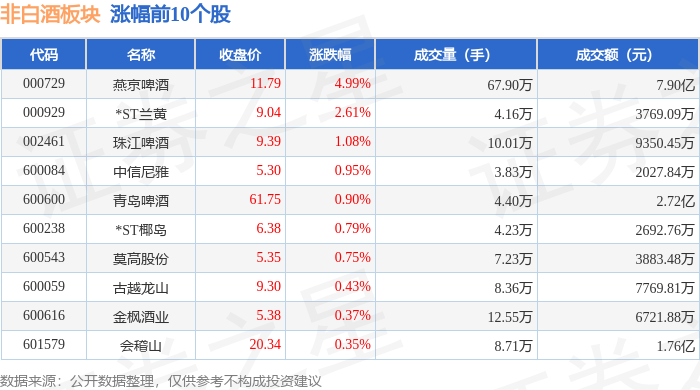
非白酒板块1月5日涨1.26%,燕京啤酒领涨,主力资金净流出5761.27万元
Zheng Xing Xing Ye Ri Bao· 2026-01-05 08:59
Market Overview - The non-liquor sector increased by 1.26% on January 5, with Yanjing Beer leading the gains [1] - The Shanghai Composite Index closed at 4023.42, up 1.38%, while the Shenzhen Component Index closed at 13828.63, up 2.24% [1] Stock Performance - Wujing Beer (000729) closed at 11.79, up 4.99% with a trading volume of 679,000 shares and a transaction value of 790 million yuan [1] - ST Lanhua (000929) closed at 9.04, up 2.61% with a trading volume of 41,600 shares and a transaction value of 37.69 million yuan [1] - Zhujiang Beer (002461) closed at 9.39, up 1.08% with a trading volume of 100,100 shares and a transaction value of 93.50 million yuan [1] - Other notable stocks include Chongqing Beer (600132) at 52.39, up 0.29%, and Huichuan Beer (600573) at 11.92, down 0.08% [2] Capital Flow - The non-liquor sector experienced a net outflow of 57.61 million yuan from institutional investors, while retail investors saw a net inflow of 86.47 million yuan [2] - The main capital inflow and outflow for specific stocks include: - Huichuan Beer had a net inflow of 14.29 million yuan from institutional investors [3] - Kuaijishan (601579) saw a net outflow of 22.50 million yuan from speculative funds but a net inflow of 17.31 million yuan from retail investors [3] - Zhujiang Beer had a net inflow of 4.08 million yuan from institutional investors [3]


开年重返4000点!盘点名私募们的慢牛共识,如何挖掘“不拥挤的成长”和抓住仍然“低垂的果实”
聪明投资者· 2026-01-05 07:08
Core Viewpoint - The consensus among investment managers is not whether a bull market will occur, but how a slow bull market will unfold, with a reminder to lower return expectations due to fewer "low-hanging fruits" compared to previous years [2] Group 1: Market Performance and Trends - The Shanghai Composite Index and CSI 300 Index saw annual gains of 18.41% and 17.66% respectively in 2025, while the Hang Seng Index rose by 27.77%, and the ChiNext Index surged by 49.57%, indicating strong profitability growth and valuation increases in high-growth sectors [2] - Notable private equity firms achieved impressive annual returns exceeding 50%, with some even doubling their investments, highlighting the potential for high returns in the current market [3] - Many investment managers have maintained above-average performance, focusing on risk management and capital preservation strategies [4] Group 2: Investment Outlook for 2026 - The first key theme for 2026 is AI, with a shift in focus towards the economic feasibility of applications rather than just increased computing power [5][6] - The second theme involves the repricing of dividend assets in a low-interest-rate environment, with many managers believing that the lack of significant price increases has made these assets more attractive [6][7] - The third theme is the structural recovery of consumption, with managers looking for undervalued assets in traditional consumption sectors and recognizing the re-emergence of price advantages in new consumption [7][8] - The fourth theme is the "anti-involution" trend, which has begun to show signs of improving price order in certain industries, such as automotive and aviation [8][9] - The fifth theme focuses on high-quality globalization, with a consensus on the importance of companies that can establish localized ecosystems abroad [9] Group 3: Key Insights from Investment Managers - Investment managers emphasize the importance of understanding macroeconomic trends and the need for a cautious approach to AI investments due to potential bubbles [10][16] - The outlook for consumer wealth is optimistic, with expectations for a recovery in consumer spending driven by a stabilization of household wealth [21][22] - The "anti-involution" strategy is seen as having strategic significance, with varying short-term effects across different industries [23] - The transition from "global pricing and safe outbound" to "global investment and local service" reflects the evolving landscape of Chinese manufacturing and its competitive advantages [24] Group 4: Macroeconomic Context - The performance of non-financial real estate companies in A-shares shows limited revenue growth compared to 2023, indicating a trend of declining demand against expanding capacity [26] - The downward trend in prices is expected to continue, supported by fiscal data showing stable tax revenues [27] - Interest rates are projected to remain low, with implications for investment strategies favoring stable, well-governed companies [28][29] - The overall market is anticipated to enter a prolonged slow bull phase, with a focus on sectors that can adapt to changing economic conditions [39]