
金融租赁

Search documents
江苏连续出台财政贴息新政支持企业大规模设备更新
Sou Hu Cai Jing· 2025-07-24 23:18
Group 1 - Jiangsu has introduced new fiscal interest subsidy policies to support large-scale equipment upgrades for enterprises, enhancing the "financing + leasing" financial service model to reduce costs and improve efficiency [1][2] - The new policies aim to alleviate the financial burden on enterprises by providing a 1.5% interest subsidy for eligible financing leasing projects in the transportation sector, encouraging faster and broader implementation of equipment upgrades and technological transformations [2][3] - The government has also launched the "Manufacturing Industry Financing Leasing Fiscal Subsidy Implementation Plan (2025)", which offers a 2% annual interest subsidy for enterprises leasing equipment through financing leasing companies, further expanding the coverage of financial support [2][4] Group 2 - The financing leasing model allows enterprises to avoid large upfront capital expenditures, enabling them to pay rent in installments, thus freeing up cash flow for core business operations [3][5] - The new fiscal policies are part of a broader strategy to support equipment upgrades across various sectors, including urban renewal and municipal infrastructure, with the "City Renewal Loan" policy receiving an interest subsidy increase from 1% to 1.5% [4][5] - The push for large-scale equipment upgrades is seen as a critical need for high-quality economic development in Jiangsu, addressing issues of aging equipment and outdated technology in the manufacturing sector [5]
赛福天: 关于控股公司办理融资租赁售后回租业务并为其提供担保的公告
Zheng Quan Zhi Xing· 2025-07-23 09:06
Core Viewpoint - Jiangsu Saifutian Group Co., Ltd. has announced that its subsidiary, Anhui Meidalen Photovoltaic Technology Co., Ltd., will engage in a financing lease back transaction with Bangyin Financial Leasing Co., Ltd., with a financing amount not exceeding RMB 50 million [1][2] Financing Lease Business Overview - Anhui Meidalen aims to optimize its capital structure and improve asset utilization by using its own equipment as collateral for the financing lease back transaction, with a total financing amount of up to RMB 50 million and a term not exceeding 21 months [2] - The company will provide a joint liability guarantee for this financing lease back transaction, with the guarantee amount also capped at RMB 50 million [2] Internal Decision-Making Process - The financing lease transaction was approved by the company's fifth board of directors at its 14th meeting on May 15, 2025, and the external guarantee was approved at the 13th meeting and the 2024 annual general meeting [2] Basic Information of the Transaction Party - Bangyin Financial Leasing Co., Ltd. has a registered capital of RMB 3 billion and was established on August 16, 2013, with a business scope that includes financing leasing and related financial services [3] Basic Information of the Financing Lease Assets - The assets involved in the financing lease are the existing equipment of Anhui Meidalen, which are free from any pledges or disputes [4] Purpose and Impact of the Financing Lease - The financing lease back transaction is expected to enhance the company's asset liquidity, broaden financing channels, and optimize the capital structure without affecting the company's daily operations [5] Necessity and Reasonableness of the Guarantee - The guarantee provided by the company for Anhui Meidalen's financing lease back transaction is deemed necessary to support its business development, with the company maintaining control over the subsidiary's major operational and financial decisions [5] Cumulative External Guarantee Amount - As of the announcement date, the total external guarantee amount after this new guarantee will be RMB 667 million, which represents 130.51% of the company's latest audited net assets [6]

永赢金融租赁有限公司2025年金融债券(第三期)获“AAA”评级
Sou Hu Cai Jing· 2025-07-23 06:23
中诚信国际认为,永赢金融租赁有限公司信用水平在未来12~18个月内将保持稳定。 来源:金融界 2025年6月13日,中诚信国际公布评级报告,永赢金融租赁有限公司2025年金融债券(第三期) 获"AAA"评级。 中诚信国际肯定了永赢金融租赁有限公司(以下称"永赢金租"、"公司"或"发行人")较强的股东背景、 较为明确的市场定位、持续优化的业务结构、多渠道的融资体系以及良好的资产质量等正面因素对公司 业务发展及信用水平具有的良好支撑作用;同时,中诚信国际关注到,宏观经济底部运行对公司资产质 量及盈利水平产生不利影响、资产负债存在一定期限错配、行业和客户集中度较高以及业务扩展对风险 管理能力提出更高要求等因素对公司经营及信用状况形成的影响。 资料显示,2015年5月,永赢金租经原银监会批准,由宁波银行全额出资设立,初始注册资本为10.00亿 元,宁波银行持股比例为100.00%。宁波银行分别于2017年12月、2018年11月、2019年9月、2020年9 月、2021年6月和2023年3月向永赢金租进行增资,截至2023年末,公司注册资本增加至60.00亿元,宁 波银行持股比例100.00%,为公司实际控制人。2 ...

金租行业,大规模增资频现!
券商中国· 2025-07-22 23:22
Core Viewpoint - The article highlights the recent trend of capital increases among financial leasing companies in China, driven by regulatory requirements and business needs, with several companies successfully obtaining approval for capital increases in 2024 [5][7]. Group 1: Capital Increases - Huaxia Financial Leasing has received approval to increase its registered capital by 3 billion yuan, bringing its total registered capital to 13 billion yuan [1]. - CITIC Financial Leasing also increased its registered capital by 3 billion yuan, resulting in a total of 10 billion yuan, with half of the new capital subscribed by CITIC Bank [2]. - A total of seven financial leasing companies have been approved for capital increases in 2024, with three companies already approved this year [4]. Group 2: Regulatory Context - The increase in capital is closely related to the implementation of the "Financial Leasing Company Management Measures," which set new regulatory requirements for capital adequacy and ownership structure [5][6]. - The new regulations require a minimum registered capital of 1 billion yuan and a major shareholder's ownership ratio of at least 51% [6]. - Existing companies are adjusting their capital structures to comply with the new regulations, with several major shareholders increasing their stakes through capital increases [6]. Group 3: Company Performance - Huaxia Financial Leasing reported total assets of nearly 190 billion yuan at the end of last year, with performance metrics such as ROA and ROE exceeding industry averages [2]. - Jiangsu Financial Leasing, the only A-share listed leasing company, increased its registered capital from 4.245 billion yuan to 5.793 billion yuan through convertible bonds [3]. Group 4: Unique Cases - Some companies, like China Financial Leasing, have opted for capital reduction, decreasing their registered capital from 3 billion yuan to 2 billion yuan [8]. - The article also mentions that Wanjing Financial Leasing completed a capital reduction from 4.6 billion yuan to 3.9 billion yuan in September 2024 [9].



业务需求与监管要求双轮驱动金租公司大规模增资接二连三
Zheng Quan Shi Bao· 2025-07-22 18:52
Core Viewpoint - The financial leasing industry in China is experiencing a wave of capital increases, with multiple companies receiving approval for capital expansion, driven by business demand and regulatory requirements [1][4]. Group 1: Capital Increases - Huaxia Financial Leasing has received approval to increase its registered capital by 3 billion yuan, bringing its total to 13 billion yuan [1]. - CITIC Financial Leasing also increased its registered capital by 3 billion yuan, resulting in a total of 10 billion yuan [1]. - A total of 7 financial leasing companies have been approved for capital increases in 2024, with 3 companies approved since the beginning of the year [1][4]. Group 2: Company Performance - Huaxia Financial Leasing, established in 2013, has total assets nearing 190 billion yuan and outperforms its peers in key financial metrics [2]. - After the recent capital increase, Huaxia Financial Leasing will rank fourth in the domestic financial leasing industry [2]. - CITIC Financial Leasing remains fully controlled by CITIC Bank after its capital increase [2]. Group 3: Regulatory Impact - The new "Financial Leasing Company Management Measures" set to be implemented in November 2024 has influenced many companies to adjust their capital structures and ownership ratios [4][5]. - The minimum registered capital requirement for financial leasing companies has been raised to 1 billion yuan, and the major shareholder's holding requirement has increased from 30% to at least 51% [4]. Group 4: Other Developments - Some companies, like Jiangsu Financial Leasing, have opted for capital increases through convertible bonds rather than direct shareholder contributions [3]. - Individual companies, such as China Financial Leasing, have chosen to reduce their registered capital, indicating a diverse range of strategies within the industry [6][7].
谁在对卫星收“租金”
Jin Rong Shi Bao· 2025-07-22 03:43
Group 1 - The successful launch of the Tianzhou-9 cargo spacecraft has been followed by a significant satellite leasing project in the commercial aerospace sector, marking a milestone in financial leasing for satellites in China [1] - On July 21, 2023, the Tianjin Binhai New Area government announced that China’s first SPV satellite leasing business was completed by China Merchants Jinling Leasing Co., with an asset scale of 30 million yuan [1] - This satellite leasing project involves a collaboration with a domestic commercial aerospace company to support the operation of China's first low-orbit satellite IoT constellation [1] Group 2 - Several financial leasing companies, including Pudong Development Bank Leasing, Bank of Communications Leasing, and Aerospace Leasing, have also made strides in satellite leasing, indicating a growing trend in the industry [1] - In 2019, Jiuyin Leasing initiated the satellite leasing market by partnering with Changguang Satellite Technology Co., leasing 10 out of 12 commercial remote sensing satellites [1][2] - In 2023, Pudong Development Bank Leasing successfully launched the "Pudong No. 1" remote sensing satellite in collaboration with Changguang Satellite, while Huishan Leasing completed its first satellite sale-leaseback transaction [2] Group 3 - Satellite leasing is defined as the process where a party owning satellite assets leases the usage rights to satellite operating companies, often through sale-leaseback arrangements [3] - This leasing model allows satellite companies to sell existing satellites to financial leasing firms and then lease them back, providing liquidity while maintaining operational capabilities [3] - The synergy between financial leasing and commercial aerospace is expected to strengthen, driven by policy support and market demand, facilitating faster market competitiveness for aerospace technologies [3]
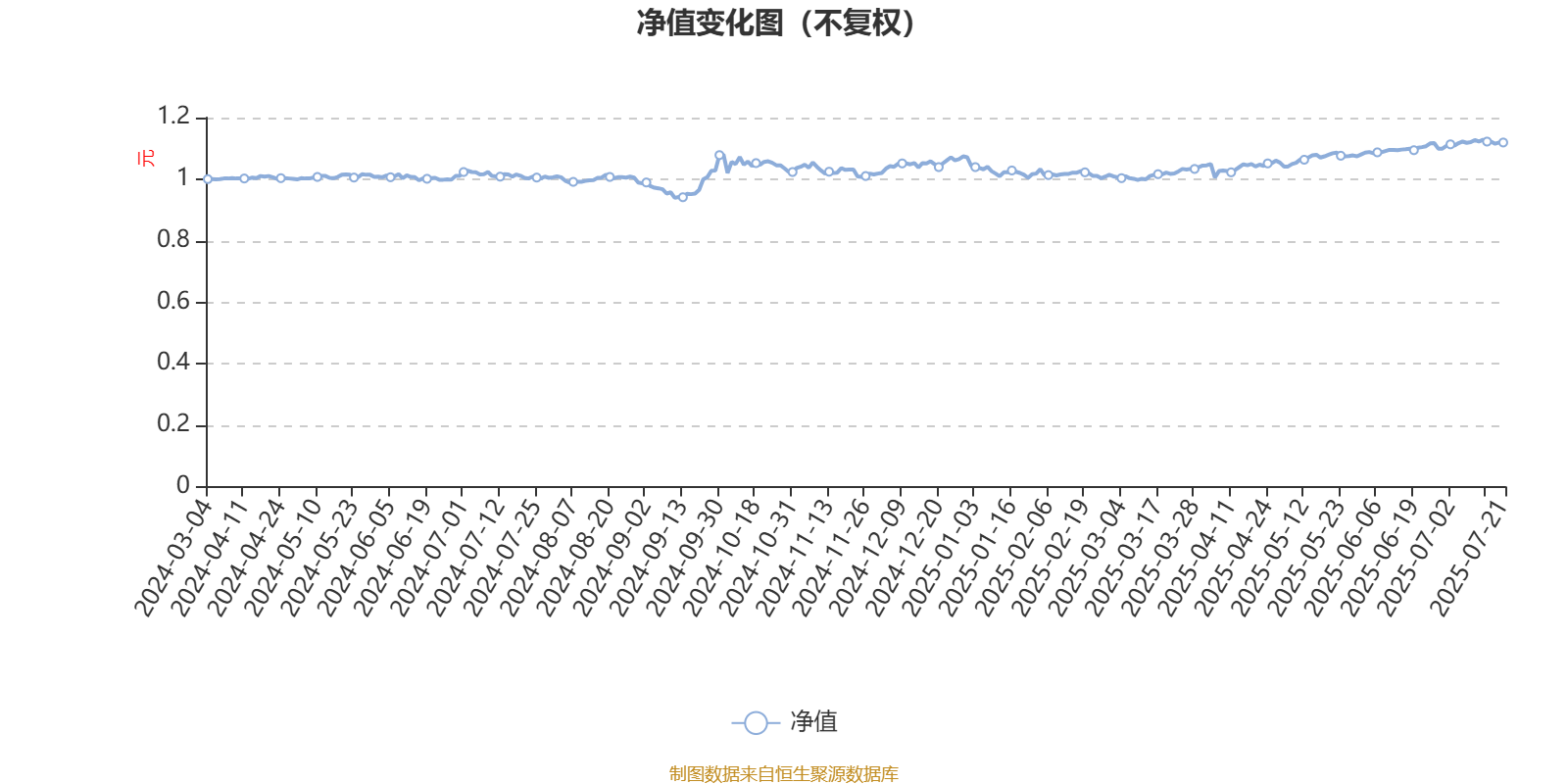
上银国企红利混合发起式A:2025年第二季度利润86.68万元 净值增长率5.85%
Sou Hu Cai Jing· 2025-07-22 02:22
Core Insights - The AI Fund Shangyin State-Owned Enterprise Dividend Mixed Initiation A (020186) reported a profit of 866,800 yuan for Q2 2025, with a weighted average profit per fund share of 0.0601 yuan [3] - The fund's net asset value (NAV) growth rate for the reporting period was 5.85%, and as of the end of Q2, the fund size was 16.8178 million yuan [3] - The fund focuses on equity mixed investments, particularly in cyclical stocks, and aims to create stable long-term returns for investors [3] Fund Performance - As of July 21, the unit NAV was 1.119 yuan, with the fund manager, Chen Bo, overseeing six funds that have all yielded positive returns over the past year [3] - The highest one-year cumulative growth rate among the funds managed is 37.55% for Shangyin Future Life Flexible Configuration Mixed A, while the lowest is 4.44% for Shangyin Huishang 6-Month Holding Period Mixed A [3] - The fund's performance over the last three months shows a cumulative growth rate of 7.49%, ranking 52 out of 82 comparable funds; over the last six months, the growth rate was 10.44%, ranking 38 out of 82; and over the last year, it was 10.78%, ranking 42 out of 77 [3] Risk and Return Metrics - As of June 27, the fund's Sharpe ratio since inception was 0.8025, indicating a favorable risk-adjusted return [7] - The maximum drawdown since inception was 8.58%, with the largest quarterly drawdown occurring in Q1 2025 at 4.41% [10] Investment Strategy - The fund has maintained an average stock position of 84.68% since inception, slightly below the industry average of 84.87% [14] - The fund reached its highest stock position of 91.1% by the end of 2024 and its lowest of 70.76% by mid-2024 [14] Top Holdings - As of the end of Q2 2025, the fund's top ten holdings included major companies such as Industrial and Commercial Bank of China, Agricultural Bank of China, Poly Property, China Pacific Insurance, and China Mobile [18]
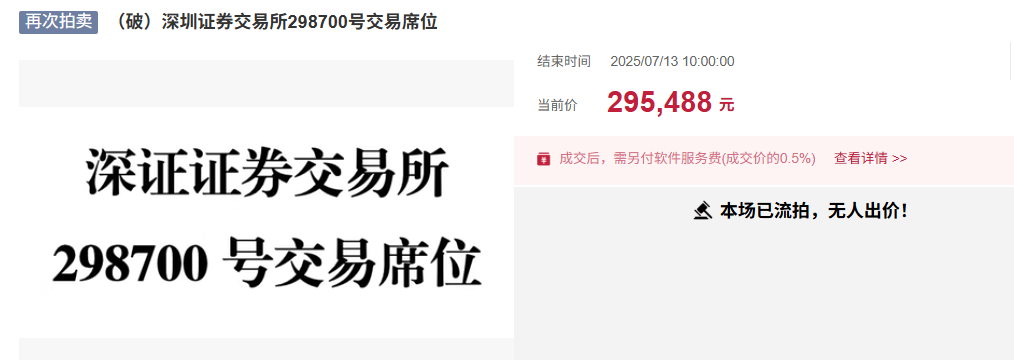
60万元降至29.55万元,深交所交易席位“半价”起拍仍遭流拍,市场为何不买账?
Mei Ri Jing Ji Xin Wen· 2025-07-18 15:51
Core Viewpoint - The auction of four trading seats on the Alibaba asset platform by the Shenzhen Stock Exchange failed to attract any bids, despite a significantly reduced starting price of 29.55 million yuan, down from an initial price of 60 million yuan in 2020, indicating a lack of interest in these trading seats [1][5][6]. Group 1: Auction Details - The four trading seats were auctioned with a starting price of 29.55 million yuan each, but all went unsold due to no bids [1][5]. - The trading seats are owned by Sichuan Financial Leasing Co., Ltd., and were originally awarded to Zhuhai Zhongye Trust Investment Co., Ltd. as compensation in a civil ruling by the Chengdu Intermediate People's Court in September 2009 [5][6]. - The auction process has seen multiple price reductions, with the next auction scheduled for August 3, where the starting price will drop further to 23.6 million yuan per seat [5][6]. Group 2: Market Context - Trading seats are essentially "entry credentials" for members to participate in trading activities on the exchange, but with the shift to electronic trading, physical seats have become less relevant [6][7]. - The Shenzhen Stock Exchange currently charges 60 million yuan for a new trading seat, making the auction price of 29.55 million yuan appear attractive, yet it still failed to generate interest [6][7]. - Securities firms typically have sufficient trading seats, as they apply for them through designated channels, and advancements in technology have reduced the reliance on the number of physical seats for trading efficiency [6][7].
临港试点金融租赁SPV扩围 纳入新能源、动力电池、智能制造、工业母机等四个领域设备资产
Jie Fang Ri Bao· 2025-07-18 01:43
Core Insights - The new policy in Lingang New Area expands the scope of financial leasing project companies to include four key sectors: new energy, power batteries, intelligent manufacturing, and industrial mother machines, providing targeted financial support for cutting-edge industries [1][2] - Financial leasing services allow companies to acquire the use of large equipment or assets without immediate full payment, easing cash flow and balance sheet pressures [1] - The expansion of leasing objects to include integrated circuit equipment and computing power center equipment aims to support sustainable development in the industry [2] Summary by Sections Financial Leasing Policy - The new policy allows financial leasing companies to establish Special Purpose Vehicles (SPVs) in Lingang, broadening the leasing object range beyond traditional assets to include advanced manufacturing equipment [1][2] - Since the pilot program began, over 160 financial leasing companies have participated, with more than 50% establishing SPVs in the area, and six companies have completed pilot projects with total assets nearing 4 billion yuan [2] Cross-Border Leasing Opportunities - The policy is expected to significantly increase the scale of cross-border leasing business, particularly in computing power and new energy equipment, leading to heightened demand for cross-border guarantees and asset valuation [3] - Future plans include attracting more legal, evaluation, and tax service institutions to provide specialized services through a one-stop financial leasing service platform [3]
金融租赁SPV试点再扩围!临港新增新能源、动力电池等四类租赁物
Di Yi Cai Jing· 2025-07-17 13:41
Group 1 - The pilot program for financial leasing companies is not limited to local institutions in Shanghai, allowing qualified companies nationwide to conduct business in the Lingang New Area [1] - The scope of leasing objects has been expanded to include new energy, power batteries, intelligent manufacturing, and industrial mother machines, with business entities now including special purpose vehicles (SPVs) established by financial leasing companies across the country [1] - As of the end of 2024, there are 42 financial leasing companies registered in the Lingang New Area, with total assets exceeding 50 billion yuan, and 180 project companies with total assets over 36 billion yuan [2] Group 2 - The Lingang New Area has become a testing ground for innovative financial leasing practices, having launched several "firsts" in the industry, including the first cross-border leasing of domestically produced aircraft settled in RMB [2] - In June 2023, the Lingang New Area initiated a pilot for leasing integrated circuit equipment, with three financial leasing companies having invested a total of 8.87 million yuan in nine integrated circuit enterprises [3] - The first batch of pilot enterprises includes six financial leasing companies, which have established 17 SPVs in the Lingang area, focusing on the entire industrial chain of integrated circuits [3][4] Group 3 - Agricultural Bank of China Financial Leasing plans to increase asset investment in the Lingang area over the next three years, focusing on new energy and power battery equipment [4] - The company aims to enhance its service capabilities and expand its asset investment scale while supporting the entire industrial chain of domestically produced aircraft [5] - The strategy includes deepening cooperation with international shipping companies and leveraging the advantages of the Yangtze River Delta region's technology innovation and high-end manufacturing [5]