跨境金融创新

Search documents
跨境金融创新赋能民营企业汇率风险管理升级
Sou Hu Cai Jing· 2026-02-04 03:26
Core Insights - The value of private enterprises' foreign trade strategies in China is increasingly highlighted amid global economic uncertainties, while they face significant exchange rate risk challenges [1] - Cross-border finance is providing crucial support for private enterprises' exchange rate risk management through policy empowerment, technological enhancement, product upgrades, and ecosystem building [1] Group 1: Current Status of Private Enterprises in Foreign Trade - Private enterprises in China are projected to achieve a total import and export value of 26.04 trillion yuan by 2025, with a year-on-year growth of 7.1%, accounting for 57.3% of the national total [2] - The growth rate of private enterprises' foreign trade exceeds the national average by 3.3 percentage points, showcasing their resilience in the international market [2] - The cross-border financial innovation wave, characterized by policy optimization and technological empowerment, is modernizing the exchange rate risk management system for private enterprises [2] Group 2: New Patterns of Cross-Border Financial Innovation - Trade foreign exchange revenue and expenditure facilitation policies have significantly reduced operational costs for enterprises, with a scale of over 700 billion USD in facilitation business in the first half of 2025, marking an 11% year-on-year increase [3] - The macro-prudential management of cross-border financing has been optimized, allowing banks to design integrated cross-border financing and hedging solutions, expanding enterprises' financing space [3] - Pilot regions like Shanghai and the Guangdong-Hong Kong-Macao Greater Bay Area are implementing innovative policies that enhance flexibility and efficiency in cross-border financial services [4] Group 3: Enhancements in Service Efficiency through Technology - AI technology enables banks to create precise customer profiles and make intelligent decisions, significantly reducing the time and errors in risk assessment [5] - Blockchain technology enhances information sharing and verification efficiency, allowing for real-time checks and reducing settlement times from 1-2 days to 1-2 hours [5] - Big data technology helps banks identify high-risk enterprises and streamline processes for quality clients, improving risk management [5] Group 4: Upgrading Demand Adaptation through Product Innovation - Innovative credit products are being developed to address the "collateral dilemma" faced by asset-light enterprises, allowing for financing based on actual operational data without collateral [6] - Banks are promoting combination tools to meet enterprises' needs for both risk hedging and profit sharing, helping to reduce foreign exchange costs [6] - Scenario-based solutions are being introduced to cater to the unique characteristics of cross-border e-commerce, significantly lowering transaction costs [6] Group 5: Challenges in Exchange Rate Risk Management Services - There is a structural mismatch between the supply of exchange rate hedging products and the diverse needs of enterprises, particularly in sectors with unique risk exposures [8] - The effectiveness of policy execution is hindered by inadequate understanding and over-cautious tendencies among some banks, leading to incomplete realization of policy benefits [10] - A significant gap exists in professional service capabilities, with a shortage of skilled personnel who can navigate complex international financial markets and regulatory environments [11] Group 6: Pathways to Enhance Exchange Rate Risk Management Services - There is a need to deepen product innovation to create a dynamic and layered product system that meets the diverse needs of large and small enterprises [12] - Banks should focus on building intelligent service platforms that integrate risk assessment, transaction management, and real-time data sharing [13] - Optimizing policy execution and establishing clear guidelines can help unlock the potential of existing policies and improve service delivery [14] - Building a professional ecosystem that includes collaboration with external agencies can enhance the overall service offering for enterprises [15]


这支母基金,一举出资17家GP | 科促会母基金分会参会机构一周资讯(1.21-1.27)
母基金研究中心· 2026-01-27 04:14
Group 1 - The establishment of the "China International Science and Technology Promotion Association Mother Fund Branch" aims to enhance the role of mother funds in China's capital market, promoting the flow of social capital towards innovative and entrepreneurial enterprises [1][22]. - The mother fund has invested in 17 General Partners (GPs) as part of its strategy to support key industries in Shanghai, including integrated circuits [2][3]. - The National New Fund's investment matrix is diversified, focusing on advancing domestic packaging core equipment, with a recent investment in Shenzhen Matrix Multidimensional Technology Co., Ltd. [8][9]. Group 2 - Fuyuan Capital's cooperative fund has successfully incubated Shenzhen Hengtai Biotechnology Co., Ltd., which has entered into a global exclusive authorization partnership with Insilico Medicine [10][11]. - Shenzhen Capital Group has signed a comprehensive strategic cooperation agreement with China Resources Financial Holdings to deepen collaboration in capital operations and project incubation [12]. - China Merchants Capital and HSBC China have signed a cooperation agreement to promote cross-border financial innovation [14]. Group 3 - The Shenzhen Technology Innovation Seed Fund Co-investment Conference successfully took place, aiming to systematically explore and invest in innovative projects [15][16]. - Financial cooperation discussions were held between Caixin Financial Holdings and Minsheng Bank to enhance collaboration in serving the economic development of Hunan Province [20][21].

跨境赋能 金融筑桥!狮桥以创新实践助力丝路物流升级
Sou Hu Cai Jing· 2026-01-26 09:21
Group 1 - The company leverages the "Belt and Road" initiative to create an integrated cross-border financial corridor focusing on logistics financial services, which has been recognized by the Ministry of Commerce as an innovative case for foreign investment cooperation [1] - In the China-Europe Railway Express sector, the company leads globally in cross-border financing services, holding a 28% market share of the total national volume, and has provided financing support for 1,872 train trips [3] - The company has introduced a financing model that allows businesses to obtain loans of up to 80% of the value of compliant railway bills, significantly reducing financing cycles and alleviating financial pressure on cross-border logistics companies [3] Group 2 - The company is enhancing cross-border logistics in the RCEP region by optimizing logistics routes and implementing smart monitoring technology, reducing average port stay time from 54 hours to 5 hours [5] - The company has deployed 200 electric heavy trucks in key logistics hubs in Thailand, capturing 65% of the local cross-border electric truck market, thus leading the green transformation of regional logistics [5] - A blockchain cross-border settlement platform has been launched to streamline the settlement process, ensuring real-time fund availability upon order confirmation, and the company has secured a $300 million loan from the Asian Infrastructure Investment Bank for building a cross-border electric vehicle fleet in Central Asia [5][6] Group 3 - The company addresses funding, efficiency, and capacity bottlenecks in the Silk Road logistics through comprehensive cross-border financial innovations, supporting high-quality development of cross-border logistics under the "Belt and Road" initiative [6]

【商道论衡】商业银行如何服务海南自贸港建设
Zheng Quan Shi Bao· 2025-12-29 19:30
Core Viewpoint - The construction of Hainan Free Trade Port is a significant national strategic deployment and a landmark project of China's reform and opening up in the new era, presenting unprecedented development opportunities for Hainan as it approaches the full island closure operation on December 18, 2025 [1] Financial Service Demand - The construction of the free trade port brings multidimensional demands for financial services, including the need for diversified and long-term financing support for infrastructure projects such as ports, airports, and information networks, particularly in the context of upgrading the "Five Networks" and building a smart Hainan [1] - With the implementation of "zero tariffs, low tax rates, and simplified tax systems," there will be explosive growth in enterprises' needs for cross-border settlement, exchange rate hedging, trade financing, and cross-border investment financing, necessitating efficient and low-cost cross-border financial services from commercial banks [1] Industry-Specific Financial Services - Financial services must match the characteristics of the "3+1" modern industrial system, with tourism requiring support for scenic area development and consumer finance, high-tech industries needing intellectual property pledges and venture capital, and tropical agriculture requiring supply chain finance and agricultural insurance [2] Strategic Transformation of Commercial Banks - Commercial banks need to adjust their strategic positioning from traditional credit providers to comprehensive financial service providers, integrating various financial tools to offer comprehensive financial solutions throughout the entire lifecycle and industry chain [3] - There is a shift from a domestic-focused business model to a collaborative development of both onshore and offshore services, enhancing capabilities in offshore financial services while serving local enterprises and residents [3] Focus Areas for Commercial Banks - Commercial banks can focus on five key areas: 1. Cross-border financial innovation, utilizing tools like EF accounts to create integrated account service systems and promote products such as electronic documents and supply chain finance [4] 2. Industry-specific financial services, providing differentiated support systems tailored to the needs of the "3+1" modern industrial system [5] 3. Offshore financial breakthroughs, developing a multi-tiered service system for offshore banking and asset management [5] 4. Green finance development, creating blue bonds and funds to support clean energy and green building projects [5] 5. Digital finance empowerment, advancing digital RMB trials and building a financial ecosystem through open banking and big data [5] Risk Management and Compliance - In supporting the construction of Hainan Free Trade Port, commercial banks must strengthen risk management and compliance, establishing a comprehensive risk management system that addresses the unique risks associated with the free trade port [6] - There is a need for specialized compliance management teams to ensure that business innovations proceed within the regulatory framework while participating in regulatory sandbox trials for testing innovative products and services [6]
双向开放 首单启航:浦发银行助力海南自贸港搭建跨境投资新桥梁
Sou Hu Cai Jing· 2025-12-24 02:33
Core Insights - The cross-border asset management pilot program in Hainan Free Trade Port has made significant progress with the successful launch of the first pilot product by SPDB in collaboration with Wanhua Securities, marking a substantial operational phase for the policy [1][2] Group 1: Business Development - Wanhua Securities, registered in Hainan, is the issuer and designer of the product, while SPDB provides sales and custody services, creating a closed-loop management mechanism for "cross-border fundraising - domestic investment" [1] - The pilot program is one of the first practical implementations following the release of the "Implementation Rules for Cross-Border Asset Management Pilot Business in Hainan Free Trade Port" by the People's Bank of China and other departments in July [1] Group 2: Financial Innovation - This initiative represents SPDB's proactive exploration in the field of cross-border financial innovation and is a significant step in supporting the construction of Hainan Free Trade Port [2] - The business expands the asset allocation channels for foreign investors and injects new vitality into the two-way opening of the capital market [2] - SPDB plans to deepen cooperation with various asset management institutions, focusing on cross-border asset management and offshore investment financing, to contribute to the high-level opening of Hainan Free Trade Port [2]

横琴粤澳深度合作区金融产业政策焕新发布
Zhong Guo Xin Wen Wang· 2025-12-19 00:18
Core Viewpoint - The revised "Support Measures for Promoting High-Quality Development of the Financial Industry in the Hengqin Guangdong-Macao Deep Cooperation Zone" aims to enhance financial support for Macao's economic diversification and promote cross-border financial innovation [1][2]. Group 1: Financial Support Measures - The Support Measures encourage banks and local financial organizations in the cooperation zone to increase financing support for Macao-funded enterprises [1]. - Insurance companies are encouraged to provide various insurance services for Macao-funded enterprises and develop products specifically for Macao residents [1]. - The measures support the expansion of digital RMB and future cross-border applications with a digital Macao dollar [1]. Group 2: Cross-Border Financial Innovation - The Support Measures focus on promoting cross-border business scenarios, including multi-functional free trade accounts, asset cross-border transfers, cross-border guarantees, and international factoring [2]. - Financial enterprises are encouraged to gather and enhance business quality, with specific support for leasing and purchasing office space [2]. - The measures aim to establish the cooperation zone as a competitive international cross-border financial cooperation demonstration area [2]. Group 3: Policy Implementation - The revision of the Support Measures is seen as a significant step in optimizing the financial policy system and deepening financial cooperation between Hengqin and Macao [2]. - The financial development bureau will continue to promote the implementation of support measures to improve the financial ecosystem [2].
多重金融工具注入强劲动能 筑牢海南自贸港资本根基丨决胜“十四五” 擘画“十五五”·地方资本市场高质量发展之海南篇
Zheng Quan Shi Bao Wang· 2025-12-18 00:14
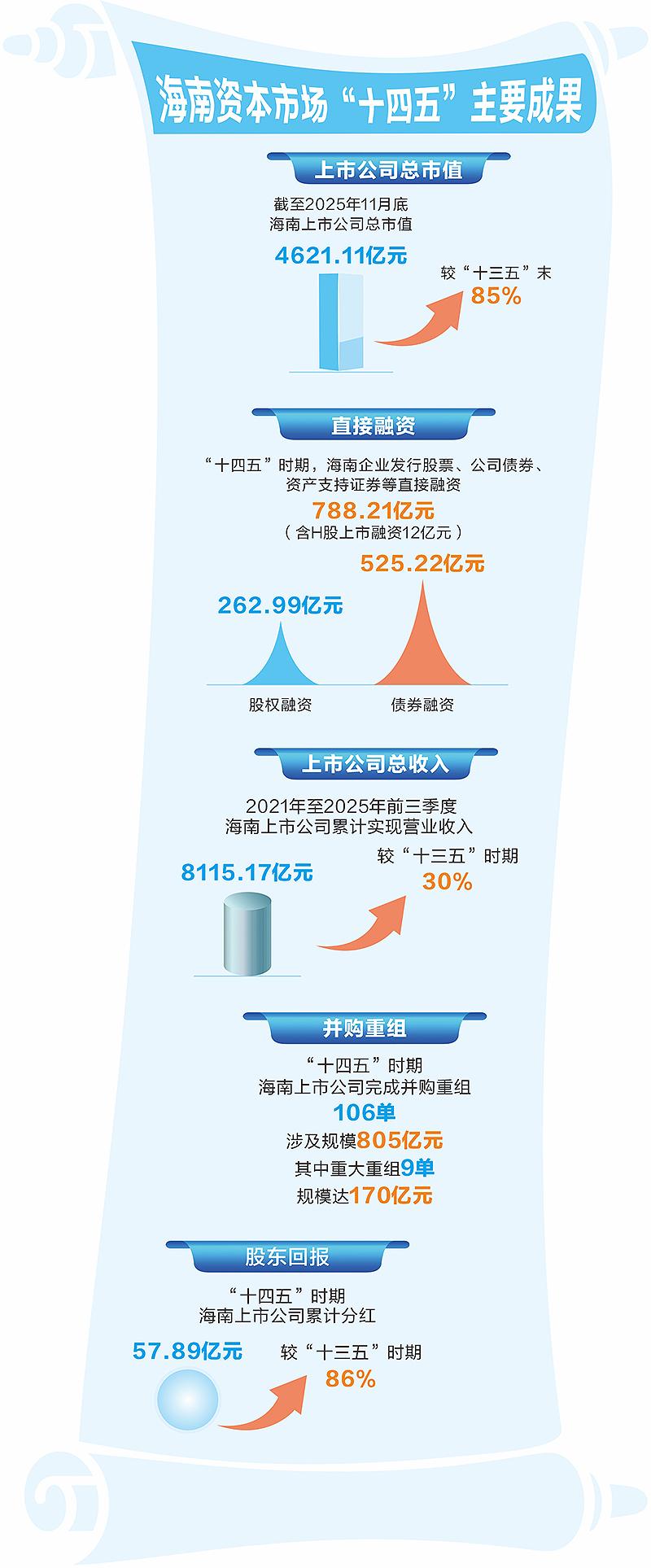
Core Viewpoint - The construction of Hainan Free Trade Port has transitioned from initial stages to a significant development phase, with a historic milestone of full island closure operations expected by December 18, 2025, driven by policy benefits and capital market reforms [1][11] Group 1: Capital Market Growth - Hainan's capital market has achieved a remarkable direct financing total of 78.821 billion yuan over five years, with a total market capitalization of 462.111 billion yuan, reflecting an 85% increase since the end of the 13th Five-Year Plan [1][5] - The number of companies with a market capitalization exceeding 10 billion yuan has expanded to 14, and the scale of mergers and acquisitions has surpassed 80 billion yuan, with cumulative dividends increasing by 86% [1][5] Group 2: Financial Support for Industry - The capital market has effectively supported the optimization and upgrading of industrial structures through diverse financial tools, injecting substantial funds into key sectors [4][5] - Direct financing has included 26.299 billion yuan from equity financing and 52.522 billion yuan from bond financing, significantly aiding corporate transformation and international development [4][5] Group 3: Investor Returns and Protection - Hainan's listed companies have enhanced their return on investment strategies, with cumulative dividends reaching 5.789 billion yuan, an 86% increase compared to the previous five-year period [6] - The establishment of a robust investor protection mechanism has improved channels for investor rights, with over 5,000 educational activities reaching more than 10 million investors [6][10] Group 4: Financial Innovation and Cross-Border Investment - The capital market has seen the introduction of innovative financial products, including the first green rural revitalization bonds and clean energy asset-backed securities, supporting sustainable development [7][8] - Cross-border financial innovations have been implemented, allowing foreign investors to access various financial products within the free trade port, enhancing the attractiveness of Hainan as a financial hub [8] Group 5: Regulatory Framework and Risk Management - The Hainan Securities Regulatory Bureau has strengthened regulatory measures, taking actions against 137 entities and imposing fines totaling nearly 150 million yuan to maintain market integrity [10] - Risk monitoring and assessment mechanisms have been enhanced, with proactive measures taken to address potential risks in key sectors, including the restructuring of four listed companies facing operational crises [10]
跨境金融创新,迎来又一重要突破!
券商中国· 2025-12-06 12:06
Core Viewpoint - The implementation of the "Shanghai Free Trade Zone Free Trade Account Function Upgrade Implementation Measures (Trial)" on December 5 marks a significant enhancement in the level of cross-border trade and investment liberalization and facilitation in Shanghai [1][2]. Group 1: Financial Institutions Involvement - Chinese and foreign financial institutions, including Bank of Communications and Agricultural Bank of China, as well as HSBC China and Citibank China, have initiated the first batch of pilot work under the new regulations [2][3]. - The pilot banks successfully completed the upgrade of free trade account functions for multiple enterprises on the first day of the new policy's implementation [3][4]. - HSBC China and Citibank China have also opened upgraded free trade accounts for several corporate clients, demonstrating their active participation in the pilot program [4][5]. Group 2: Policy Background and Objectives - The upgrade of free trade account functions is part of a broader initiative to enhance cross-border financial services and is aligned with the Shanghai International Financial Center's development goals [6][7]. - The People's Bank of China aims to facilitate the free flow of cross-border funds and support the new development needs of real enterprises through this policy [7][8]. Group 3: Operational Details of the New Measures - The new measures allow banks to directly process fund transfers between upgraded accounts and various types of offshore accounts without prior registration or approval from foreign exchange authorities [8]. - The policy specifies that capital item businesses, excluding securities investments, will not be subject to external debt limits or approval restrictions, significantly simplifying the process for enterprises [8][9]. Group 4: Expected Impact and Future Developments - The upgrade is expected to enhance the efficiency and convenience of cross-border financial services, providing a multiplier effect for the liberalization of cross-border trade and investment [9][10]. - As of April 2025, Shanghai has opened a total of 177,400 free trade accounts, with an annual average growth rate of over 30% in cross-border receipts and payments in RMB [9].

外资金融机构掘金海南自贸港开放红利
Zheng Quan Ri Bao· 2025-11-19 16:08
Group 1 - The core viewpoint emphasizes the importance of foreign financial institutions in supporting Hainan's integration into the "Belt and Road" initiative and global supply chains, particularly as the Hainan Free Trade Port approaches its final month before full closure [1] - Foreign financial institutions are seen as crucial bridges connecting China with the global economy, leveraging their global networks and professional advantages to enhance cross-border financial services in Hainan [1][2] - The introduction of foreign financial institutions is expected to provide low-cost financing channels for key industries in Hainan, such as technology, green finance, and healthcare, while also addressing the need for professionals familiar with international financial regulations [1][2] Group 2 - The recent meeting highlighted the need for more financial reform and opening-up measures to be piloted in Hainan, with foreign financial institutions playing a key role in this process [2] - Foreign financial institutions can contribute to Hainan's financial reform by proposing innovative systems for cross-border capital flow and capital account openness, as well as introducing new products and services [2] - The "14th Five-Year Plan" suggests that Hainan Free Trade Port will expand policies facilitating cross-border capital flow, attracting more financial institutions and enhancing the convenience of international trade settlements [3] Group 3 - The application of emerging technologies such as artificial intelligence, blockchain, cloud computing, and big data in the financial sector is encouraged to foster innovation in Hainan's financial landscape [3] - Financial support for Hainan's development should focus on serving the real economy, deepening cross-border financial innovation, and enhancing the financial business environment [3]
绝不是消费这么简单,港人为何开始北上买社保
Di Yi Cai Jing Zi Xun· 2025-11-18 14:48
Core Insights - The article discusses the increasing financial needs of Hong Kong residents moving to mainland China, particularly in the Greater Bay Area, leading to a rise in demand for loans and social security services [2][4][6]. Group 1: Loan Demand - There is a notable increase in loan demand from Hong Kong residents who are transitioning from short-term consumption to long-term living in mainland cities [3][4]. - The demand for credit cards among Hong Kong residents in mainland China is growing, as having a local credit card significantly enhances their daily payment convenience [4][5]. - The interest rates for loans in both regions are comparable, with major banks in Hong Kong and mainland China offering similar rates around 3% to 3.5% [4][5]. Group 2: Social Security Participation - The trend of "buying social security" in mainland China is gaining popularity among Hong Kong residents, with a significant increase in participation in pension, work injury, and unemployment insurance [6][7]. - As of August 2024, 332,800 Hong Kong and Macau residents have participated in social security in Guangdong, marking a 118.93% increase since the launch of the "Bay Area Social Security Pass" [7]. - The cost-effectiveness and quality of medical services in mainland China are major factors attracting Hong Kong residents to participate in social security [8][9]. Group 3: Challenges and Solutions - There are significant challenges in cross-border data transmission and financial compliance, which hinder the approval of loans for Hong Kong residents in mainland banks [9][10]. - The lack of a unified credit verification system between Hong Kong and mainland China complicates the loan application process for Hong Kong residents, as banks require extensive credit data from Hong Kong [9][10]. - Proposed solutions include establishing a cross-border credit cooperation mechanism and utilizing blockchain technology for secure data verification [11][12].