Funds

Search documents
北信瑞丰基金更名华银基金,银行系资源助力规模逆袭
Guan Cha Zhe Wang· 2025-11-19 13:41
Core Viewpoint - The recent renaming of Beixin Ruifeng Fund Management Co., Ltd. to Huayin Fund Management Co., Ltd. is interpreted as a move towards aligning with "bank-affiliated" fund companies, following significant challenges including management turnover, scale reduction, and talent loss [1][2] Company Overview - Huayin Fund, formerly known as Beixin Ruifeng Fund, was established on March 17, 2014, with a registered capital of 170 million yuan, co-founded by Beijing International Trust Co., Ltd. and Laizhou Ruihai Investment Co., Ltd. [2] - The company experienced a dramatic turnaround in 2025, with public fund management scale increasing from 2.706 billion yuan at the end of Q2 to over 20 billion yuan by the end of Q3, marking an increase of nearly 800% [1][2] Challenges Faced - The company faced significant challenges, including a reduction in public fund management scale from a peak of 13 billion yuan in 2020 to 2.706 billion yuan by mid-2025, ranking low among licensed institutions [2][3] - Employee numbers dropped from 88 in July 2024 to 52 in 2025, indicating a personnel loss rate exceeding 40% [3] - A collective departure of fund managers occurred in October 2024, further destabilizing the company [3] Product Line Issues - The company has a limited product line, primarily consisting of fixed-income products, lacking impactful equity or mixed-asset products, which weakens its market position and risk resilience [4] - The lack of standout products and managers led to a decline in investor interest, particularly during the volatile equity market from 2021 to 2024 [4] Industry Context - The challenges faced by Huayin Fund reflect broader issues within the industry, where smaller fund companies struggle to survive amid increasing market concentration, with the top 20 firms controlling about 70% of the market [4] - The growth of Huayin Fund is seen as part of a trend where bank-affiliated fund companies leverage parent bank resources to rapidly scale, though this often leads to over-reliance on shareholder support and insufficient market competitiveness [5][6] Growth Drivers - The significant growth in fund scale is primarily driven by the Beixin Ruifeng Ding Sheng Short-Duration Bond Fund, which dominates the company's total scale [5] - Support from the parent company, Huaxia Bank, has been crucial, with enhanced management and resource allocation contributing to the rapid scale increase [5][6] Future Outlook - The company is undergoing systematic governance adjustments, with a focus on internal governance and product line restructuring, aiming to strengthen its position in the fixed-income sector [6] - The case of Huayin Fund highlights the importance of leadership with resource integration capabilities for small fund companies, raising questions about the sustainability and replicability of its growth model [6]


ETF爆发年:发行规模突破2400亿份,“科创”主题成黑马
2 1 Shi Ji Jing Ji Bao Dao· 2025-11-19 11:40
Core Insights - The domestic ETF market is experiencing a record issuance scale, indicating a comprehensive arrival of index investment trends [1][2] - The market is witnessing profound changes in ETF product structures, with thematic ETFs like those focused on technology and free cash flow becoming focal points for investors [1][4] - The competitive landscape is solidifying, with leading institutions establishing strong moats through brand, product lines, and scale effects, suggesting a potential increase in market concentration [1][8] Issuance Scale - As of November 18, 2025, a total of 322 ETFs have been issued this year, with a combined issuance of 2446.44 billion shares, surpassing last year's figures of 179 ETFs and 1275.31 billion shares [2] - The number of new ETFs has increased by 79.89% and the issuance volume has grown by 91.83% compared to the entire year of 2024 [2] - This year's issuance scale has significantly exceeded the previous historical peak in 2021, which saw 310 ETFs issued with a total of 1933.56 billion shares [2] Product Types - Stock ETFs remain the backbone of the issuance market, with 283 stock ETFs issued this year, accounting for 87.89% of total issuance and 1493.95 billion shares, representing 61.07% of total shares [3] - There are 32 bond ETFs issued this year, making up 9.94% of total issuance, with a total issuance of 914.83 billion shares, which is 37.39% of total shares [3] - The bond ETFs show a trend of "hot issuance, cold fundraising," with only 37.25 billion shares remaining from the issued bond ETFs as of November 18 [3] Thematic ETFs - Thematic ETFs focusing on technology and free cash flow have gained significant attention, with 66 ETFs containing "technology" in their names, accounting for 20.50% of total issuance and 501.78 billion shares [4] - ETFs related to free cash flow total 29, representing 9.01% of total issuance with 167.71 billion shares [4] Market Concentration - The top institutions dominate the ETF issuance market, with 45 public fund institutions issuing the 322 ETFs this year [5] - E Fund leads with 26 ETFs issued, followed by China Universal Fund with 25, and Huaxia Fund with 23 [5] - The top 10 ETF providers hold a combined market share of 78%, indicating a significant concentration in the market [6] Competitive Landscape - The competitive environment is expected to intensify, with leading providers leveraging brand strength, comprehensive product lines, and resource availability to capture market share [8][9] - Smaller fund companies face challenges in product competitiveness due to limitations in funding, channels, and research capabilities, which may lead to increased market concentration [8][10] - Fund companies must innovate and manage costs effectively to remain competitive, particularly in niche markets to avoid overcrowding in traditional broad-based ETFs [9][10]
PHK: High Premiums, Low Spreads (NYSE:PHK)
Seeking Alpha· 2025-11-19 11:29
PIMCO High Income Fund ( PHK ) is a closed-end fund (CEF) that aims to generate an annual return of around 12%, paid monthly, by investing in the riskiest tranche of credit globally. When you invest inAnalyst’s Disclosure:I/we have no stock, option or similar derivative position in any of the companies mentioned, and no plans to initiate any such positions within the next 72 hours. I wrote this article myself, and it expresses my own opinions. I am not receiving compensation for it (other than from Seeking ...

Dual Share Classes Are Here, But There’s an ‘Apollo 13’ Problem
Yahoo Finance· 2025-11-19 11:00
Core Viewpoint - The approval of dual share classes represents a significant change in the fund industry, but it faces challenges due to incompatible settlement processes established at different times [1][2][3]. Group 1: Dual Share Classes Approval - The Securities and Exchange Commission has approved dual share classes for Dimensional Fund Advisors, with other companies likely to follow suit [4]. - This approval allows some mutual funds to add ETF share classes, enabling investors to exchange shares between the two types [4]. Group 2: Settlement Process Challenges - The settlement processes for mutual funds and ETFs were not designed to work together, complicating trades for intermediaries [2][3]. - An analogy is drawn to the Apollo 13 mission, highlighting the difficulties of integrating systems built by different manufacturers [2][3]. Group 3: Considerations for Intermediaries - Intermediaries must consider how dual share classes will impact investor suitability and fiduciary responsibilities under Regulation Best Interest [4]. - There are implications for compensation structures, including revenue sharing and 12b-1 payments, as well as the integration of dual share class funds into product lineups [4].
中证港股通50指数ETF今日合计成交额1.31亿元,环比增加30.50%
Zheng Quan Shi Bao Wang· 2025-11-19 09:26
Core Insights - The total trading volume of the CSI Hong Kong Stock Connect 50 Index ETF reached 131 million yuan today, an increase of 30.50% compared to the previous trading day, with an increase of 30.71 million yuan [1] Trading Performance - The Hong Kong Stock Connect 50 ETF (513550) had a trading volume of 121 million yuan today, up by 34.13 million yuan, reflecting a 39.17% increase from the previous day [1] - The Southern CSI Hong Kong Stock Connect 50 ETF (159126) recorded a trading volume of 6.2445 million yuan, an increase of 115,600 yuan, with a growth rate of 1.89% [1] - The average decline for ETFs tracking the CSI Hong Kong Stock Connect 50 Index was 0.47% at market close, with both the Hong Kong Stock Connect 50 ETF (513550) and Southern CSI Hong Kong Stock Connect 50 ETF (159126) dropping by 0.51% [1] Detailed Trading Data - Fund Code: 513550, Fund Name: Hong Kong Stock Connect 50, Today's Change: -0.51%, Today's Trading Volume: 121 million yuan, Increase from Previous Day: 34.13 million yuan, Percentage Increase: 39.17% [1] - Fund Code: 159126, Fund Name: Southern CSI Hong Kong Stock Connect 50 ETF, Today's Change: -0.51%, Today's Trading Volume: 6.2445 million yuan, Increase from Previous Day: 115,600 yuan, Percentage Increase: 1.89% [1] - Fund Code: 159711, Fund Name: Huaxia CSI Hong Kong Stock Connect 50 ETF, Today's Change: -0.50%, Today's Trading Volume: 2.501 million yuan, Decrease from Previous Day: -1.5366 million yuan, Percentage Decrease: -38.06% [1] - Fund Code: 159712, Fund Name: Guotai CSI Hong Kong Stock Connect 50 ETF, Today's Change: -0.38%, Today's Trading Volume: 1.3846 million yuan, Decrease from Previous Day: -2.0001 million yuan, Percentage Decrease: -59.09% [1]
“515问问投资人”系列活动走进东莞城市学院:探索“校企协同”投教,构建金融素养提升生态
2 1 Shi Ji Jing Ji Bao Dao· 2025-11-19 09:25
Core Viewpoint - The event "515 Ask Investors" focuses on enhancing financial literacy and investor protection among students, aligning with China's comprehensive registration system reform and the need for rational decision-making in capital markets [3][4]. Group 1: Event Overview - The event was held at Dongguan City College, attracting over 100 students, and aimed to improve their understanding of financial products and investment concepts [3]. - It was organized by Southern Finance Media Group, 21st Century Business Herald, China Merchants Fund, and Dongguan Securities, with support from the college [3][4]. - The initiative is part of a broader "National Financial Literacy Improvement Plan" guided by the Guangdong-Hong Kong-Macao Greater Bay Area Development Plan [4]. Group 2: Educational Focus - The event featured expert discussions and interactive Q&A sessions to bridge the gap between theory and practice in financial education [4][5]. - Topics included macroeconomic analysis, investment strategies, and the impact of macro indicators on the stock market, aimed at helping students develop a rational investment mindset [6][7]. - The event emphasized the importance of risk awareness and self-responsibility in investment decisions [6]. Group 3: Institutional Collaboration - The collaboration between Southern Finance Media Group and financial institutions aims to create a sustainable ecosystem for enhancing financial literacy [7]. - Future initiatives will include course development, internships, and community outreach to further promote financial education [7].
北京公募基金行业高质量发展 倡议书
Zhong Guo Zheng Quan Bao· 2025-11-19 08:09
Core Viewpoint - The Central Financial Work Conference has outlined the direction for financial development in the new era, emphasizing the acceleration of building a strong financial nation. The "Action Plan for Promoting High-Quality Development of Public Funds" serves as a guide for deepening reforms and enhancing efficiency in the industry [1] Group 1: Mission and Responsibility - Financial institutions are urged to integrate into the national development framework, prioritizing service to the real economy and focusing on five key areas: technology finance, green finance, inclusive finance, pension finance, and digital finance [1] - A collaborative market structure is encouraged to achieve high-quality development while serving national strategies [1] Group 2: Service Quality and Investor Focus - The industry is called to shift from a focus on scale to a focus on returns, enhancing the investment experience for investors [2] - A comprehensive investment research system is to be established, ensuring alignment with investor interests through fee reforms and long-term assessment mechanisms [2] Group 3: Investment Strategy - There is a push to enhance equity investment capabilities and develop a robust asset allocation system, focusing on long-term and value investment principles [3] - The industry is encouraged to innovate equity fund products that align with national strategic directions, such as thematic and index funds [3] Group 4: Compliance and Risk Management - Emphasis is placed on compliance as a value creator, with a focus on governance and internal control to balance business growth and risk prevention [4] - A robust risk monitoring and emergency response mechanism is to be established to ensure the industry's stable development [4] Group 5: Financial Culture and Industry Ecology - The promotion of a distinctive financial culture is essential for sustainable industry development, with a focus on talent development and ethical standards [5] - Social responsibility and a positive industry image are highlighted as key components for enhancing public trust and recognition [5] Group 6: Institutional Development and Competitiveness - The goal is to build modern, first-class investment institutions with improved governance and decision-making processes [6] - Digital transformation and differentiated development strategies are emphasized to enhance operational efficiency and market competitiveness [6] Group 7: Industry Collaboration and Development - Fund managers are encouraged to lead the industry towards a cooperative and win-win development model, while sales and custodial institutions must adhere to investor suitability and asset safety [7] - A long-term evaluation system is to be established to promote a culture of long-term investment [7] - Media institutions are tasked with positive promotion and market confidence building [8]
这家小公募更名惹出小轰动,华银基金名字和谁太像了?
Xin Lang Cai Jing· 2025-11-19 04:33
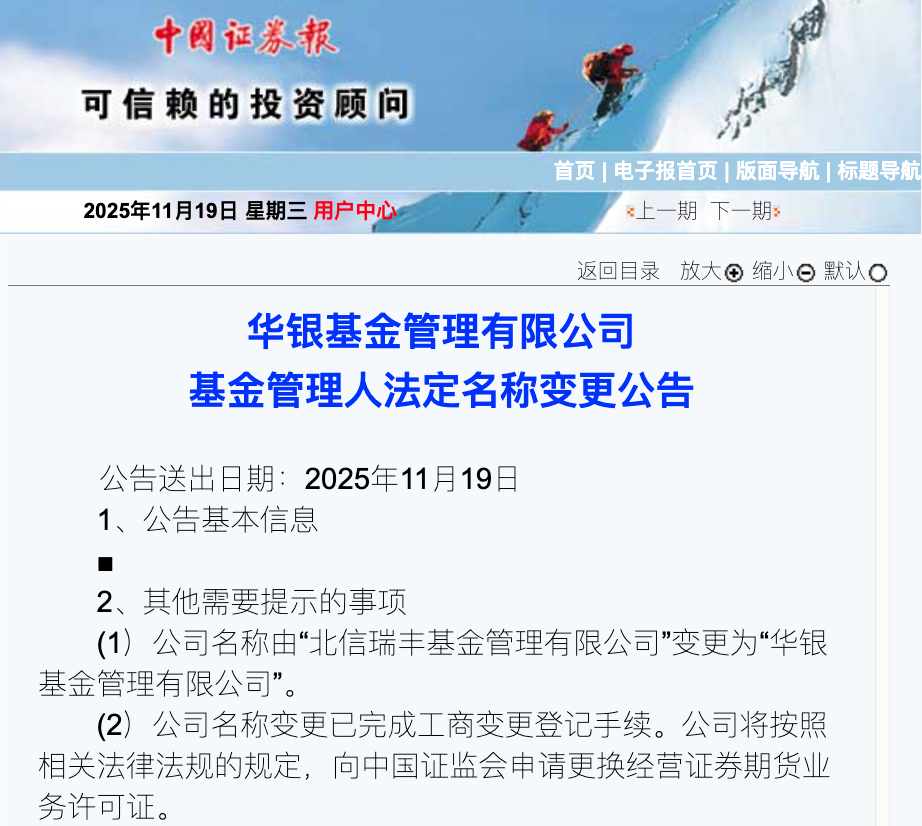
智通财经11月19日讯(记者 李迪)北信瑞丰基金再度引发广泛讨论,这次是因为公司更名和管理层大换血。 近日,北信瑞丰基金正式更名为华银基金,这也意味着意向股东华夏银行谋求入主该公司的计划,又迈出了关键一步。不过,该公司的新名称因与华夏基 金、银华基金、兴银基金等高度相似,引发网友"傻傻分不清楚"的调侃。 与更名同步落地的还有管理层大换血:11月17日,赵伟婧新任督察长、王博担任首席信息官,原首席信息官魏红生、副总经理王乃力离职。近几年,该公司 高管变更频繁,董事长、总经理已历经多次调整。 此外,该公司在意向股东华夏银行的资源帮扶下,在三季度实现规模猛增。截至今年三季度末,北信瑞丰基金的管理规模约为207.90亿元,与今年二季度末 的27.06亿元相比猛增180.84亿元,增幅达6.68倍。 不过目前该公司股东仍为北京国际信托和莱州瑞海投资,华夏银行正式入主尚需时日。业内人士指出,引入优质股东是中小公募的重要发展路径之一,但仅 靠外部输血并不能实现持久发展,能否长远发展还是要看公司的人才实力和投研实力。 北信瑞丰基金更名为华银基金 11月19日,华银基金发布《基金管理人法定名称变更公告》。公告显示,北信瑞丰基金 ...
华银基金来了!规模突增上百亿
Zhong Guo Zheng Quan Bao - Zhong Zheng Wang· 2025-11-19 04:20
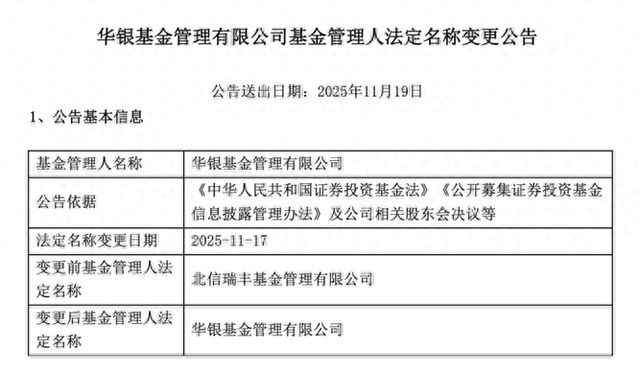
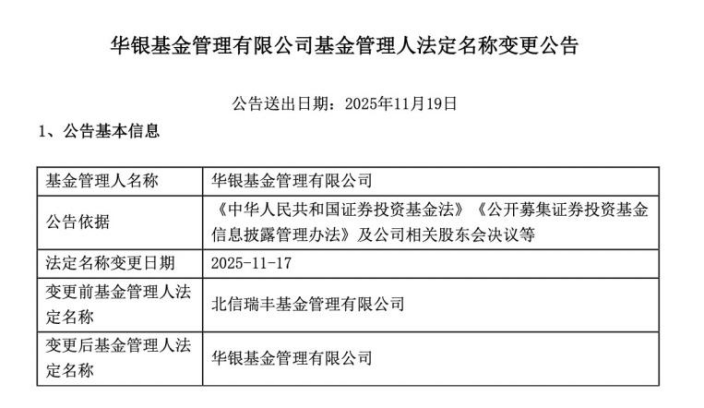
Core Viewpoint - The company formerly known as Beixin Ruifeng Fund has officially changed its name to Huayin Fund Management Co., Ltd. primarily for brand upgrading and positioning needs [1][4]. Company Name Change - The name change was announced on November 19, with the new name being "Huayin Fund Management Co., Ltd." [2]. - The change has completed the necessary business registration procedures and will apply to the China Securities Regulatory Commission for a new securities and futures business license [3]. - The legal entity and external legal relationships remain unchanged, and existing contracts signed under the previous name will still be valid [3]. Management Changes - Prior to the name change, the company underwent a management reshuffle, with several key positions, including Vice General Manager and Chief Information Officer, being adjusted [1][5]. - New management aims to focus on four core development directions: boutique, market-oriented, digitalization, and compliance [5]. Shareholding Structure - Currently, there is no equity relationship between Huayin Fund and Huaxia Bank, although Huaxia Bank provides significant support in business development and research cooperation [4]. - The largest shareholder remains Beijing International Trust Co., Ltd., holding 60%, followed by Laizhou Ruihai Investment Co., Ltd. with 40% [4]. Fund Growth - The fund's management scale saw a significant increase, growing from 2.7 billion yuan at the end of the first half to 20.79 billion yuan by the end of the third quarter, with a total of 22 funds managed [6]. - The Huayin Ding Sheng Short-term Bond Fund contributed 17.112 billion yuan to this growth, with nearly 100% of its shares held by individual investors [6]. - The Huayin Stable Income Fund also contributed 2.951 billion yuan to the overall scale, managed by the same fund manager [7].
投资观察|更名引发猜测,华银基金变身华夏银行系? 回应来了……
Feng Huang Wang Cai Jing· 2025-11-19 04:08
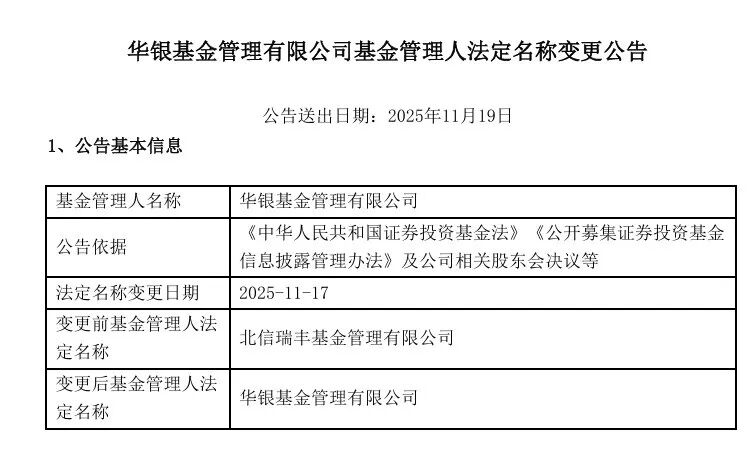
Core Viewpoint - The company formerly known as Beixin Ruifeng Fund Management Co., Ltd. has officially changed its name to Huayin Fund Management Co., Ltd., marking a significant rebranding effort aimed at enhancing its market presence and service capabilities [1][4]. Group 1: Name Change Announcement - The name change has been officially registered with the relevant authorities, and the company is in the process of applying for a new securities and futures business license from the China Securities Regulatory Commission [1]. - Prior to the announcement, a "Huayin Fund" verified account appeared on online platforms, confirming rumors of the name change [3]. Group 2: Reasons for Rebranding - The rebranding is primarily driven by the need for brand upgrading and precise brand positioning, with the goal of better serving investors and enhancing overall service capabilities [4]. - The new logo of Huayin Fund is similar to that of Huaxia Bank, leading to speculation that Huayin Fund may evolve into a "bank-affiliated" fund company [4]. Group 3: Shareholder Structure and Future Prospects - Currently, Huayin Fund has two shareholders: Beijing Trust holds a 60% stake, while Laizhou Ruihai Investment Co., Ltd. owns 40% [4]. - The company has stated that there are no current changes in shareholding, but any future developments will be announced promptly [4]. Group 4: Management Changes - On the day before the name change, Huayin Fund announced three personnel changes, including the departure of Deputy General Manager Wang Naili and Chief Information Officer Wei Hongsheng for personal reasons [4]. - Wang Bo has been appointed as the new Chief Information Officer, bringing extensive experience in information technology governance and digital transformation [4][5]. - Zhao Weijing has been appointed as the new Inspector General, with a background in risk control and legal compliance [5]. Group 5: Leadership Changes - In August, the chairman of Beixin Ruifeng was changed to Liu Yanlei, following the previous chairman's removal due to regulatory concerns [6]. - Liu Yanlei has a strong background in banking and has held various significant positions within Beijing Bank [6]. - The former general manager, Liu Xiaoling, also left the company, and the new successor, Xuan Xuezh柱, comes from Huaxia Bank [6].