
铁路建设

Search documents
大基建爆发 西藏经济狂飙
Di Yi Cai Jing· 2025-08-12 13:56
Core Insights - The establishment of multiple super projects in Tibet, including the new Xinjiang-Tibet Railway, is expected to drive rapid economic growth in the region [1][5][6] - Tibet's GDP growth has consistently ranked first in the nation, with a reported GDP of 2,392.67 billion yuan in 2023, reflecting a 9.5% increase from the previous year [2][3] - Significant investment in fixed assets has been a major contributor to Tibet's economic growth, with a 24.8% year-on-year increase in the first half of the year [2][3] Economic Growth - Tibet's GDP for the first half of 2025 is projected to reach 1,382.72 billion yuan, with a year-on-year growth rate of 7.2% [1] - The region's GDP growth rate has improved significantly post-pandemic, with a notable increase of 8.3 percentage points in 2023 compared to the previous year [2] - The fixed asset investment in Tibet has shown remarkable growth, with a 35.1% increase in 2023, particularly in the second industry, which grew by 47.7% [3][4] Investment Trends - The fixed asset investment in Tibet is expected to grow by 19.6% in 2024, with significant increases in private investment, which rose by 52.9% [3][4] - The number of private enterprises and individual businesses in Tibet has reached 143,200 and 414,800 respectively, indicating a robust growth in the private sector [4] - The contribution of private investment to the region's economy is highlighted by a 46.4% year-on-year increase in the first quarter of the year [4] Infrastructure Development - Major infrastructure projects, including the Sichuan-Tibet Railway and the Yarlung Tsangpo River hydropower project, are set to enhance connectivity and energy supply in Tibet [5][6] - The total investment for the Sichuan-Tibet Railway exceeds 300 billion yuan, with the Xinjiang-Tibet Railway expected to have a similar investment scale [6] - These infrastructure developments are anticipated to not only boost Tibet's economy but also contribute positively to the broader Chinese economy by stimulating related industries [6][7]
大基建爆发,西藏经济狂飙
Di Yi Cai Jing· 2025-08-12 12:17
Core Viewpoint - The announcement of multiple super projects in Tibet has drawn attention to the region's investment construction and economic growth, with significant contributions from infrastructure projects [2][6]. Economic Growth - Tibet's GDP reached 138.27 billion yuan in the first half of 2025, showing a year-on-year growth of 7.2% [2]. - In 2023, Tibet's GDP was 239.27 billion yuan, growing by 9.5% compared to the previous year, marking an increase of 8.3 percentage points [3]. - The GDP for 2024 is projected to be 276.49 billion yuan, with a year-on-year growth of 6.3% [3]. Investment Trends - Fixed asset investment in Tibet grew by 24.8% year-on-year in the first half of 2023 [3]. - In 2023, fixed asset investment increased by 35.1%, with the second industry growing by 47.7% and the third industry by 35.4% [4]. - In 2024, fixed asset investment is expected to grow by 19.6%, with projects over 50 million yuan seeing a 39.7% increase [4]. Private Sector Growth - As of this year, Tibet has 143,200 private enterprises and 414,800 individual businesses, with a year-on-year increase in private investment of 46.4% [5]. - The tax revenue from the private economy reached 8.41 billion yuan, accounting for 79.3% of the total tax revenue in the region, with a year-on-year growth of 15.9% [5]. Infrastructure Projects - The establishment of the New Tibet Railway Company aims to advance the construction of the Xinjiang-Tibet railway, connecting key regions [2][8]. - Major projects include the ongoing construction of the Sichuan-Tibet Railway and the Yarlung Tsangpo River hydropower project, with total investments expected to exceed 1.2 trillion yuan [8]. - These infrastructure developments are anticipated to significantly boost Tibet's economy and enhance its connectivity with other regions [8][9].
炸裂!3500亿寒王,爆拉20CM涨停板!股价突破800元,创历史新高!彻底沸腾了...
雪球· 2025-08-12 08:42
Market Overview - The A-share market saw all three major indices rise, with the Shanghai Composite Index up 0.50%, continuing to set new highs for the year, while the Shenzhen Component Index rose 0.53% and the ChiNext Index increased by 1.24% [1] - The total trading volume in the Shanghai and Shenzhen markets reached 1,905.2 billion yuan, an increase of 55.3 billion yuan compared to the previous day, with over 2,000 stocks rising across the market [1] Key Stocks and Sectors - Cambricon Technologies (寒武纪) experienced a significant surge, hitting the daily limit of 20% and reaching a historical high above 800 yuan, with a trading volume exceeding 11 billion yuan and a net inflow of 2.016 billion yuan from major investors [3][6] - The energy metals and military equipment sectors faced adjustments, while the computing power and photolithography sectors strengthened in the afternoon [1] AI and Semiconductor Developments - Huawei is set to release AI inference innovation technology UCM, which is expected to reduce China's reliance on high-bandwidth memory (HBM) technology and enhance the performance of domestic AI large model inference [6] - A recent agreement between U.S. chip manufacturers Nvidia and AMD with the Trump administration requires them to pay 15% of their revenue from chip sales to China to obtain export licenses [8][9] - The semiconductor market is projected to reach a scale of 1 trillion dollars by 2030, driven by AI, with HPC/AI terminal markets expected to account for 45% of the semiconductor market by that time [15] Regional Developments - Stocks related to Xinjiang saw a resurgence, with Hongtong Gas achieving five consecutive trading limits, and several other local stocks also performing well [12][17] - The establishment of the Xinjiang Railway Company, with a registered capital of 95 billion yuan, indicates continued investment in major projects in the region, with total project investments potentially reaching 400 billion yuan [17]


广发证券:重申建筑业共同富裕投资主线 重视相关省区基建等工程服务标的
智通财经网· 2025-08-12 07:46
Group 1: Infrastructure Investment - The report emphasizes the importance of infrastructure investment in regions such as Xinjiang, Tibet, and Sichuan-Chongqing as part of the new era of western development [1] - In Xinjiang, railway investment is expected to remain strong, with significant projects like the New Tibet Railway and Yining-Aksu Railway set to commence this year [2] - The planned public road investment in Xinjiang for 2025 is projected at 80 billion yuan, reflecting a year-on-year increase of 13.5% [3] Group 2: Coal Chemical Industry - The coal chemical industry in Xinjiang is accelerating, with a projected coal output of 541 million tons in 2024, marking a year-on-year growth of 17.5% [4] - The coal consumption for thermal power generation in Xinjiang is expected to reach 195 million tons in 2024, accounting for approximately 36% of the total coal production [4] Group 3: Mining Development and Services - The acceleration of resource exploration and development in Xinjiang is highlighted, with the region set to add six large resource bases during the 14th Five-Year Plan [5] - Xinjiang has led the nation in the number of mining rights granted, with 146, 227, and 558 rights issued from 2022 to 2024 respectively [5]

西安至十堰高铁全线隧道顺利贯通
Xin Hua Wang· 2025-08-12 06:08
Core Viewpoint - The successful completion of the Hujiayuan Tunnel on July 30 marks a significant milestone for the Xi'an to Shiyan high-speed railway, with all 42 tunnels now completed, laying a solid foundation for the construction of ballastless track and the eventual operation of the railway [1] Group 1 - The Hujiayuan Tunnel is a key control project for the Xi'an to Shiyan high-speed railway [1] - The completion of all 42 tunnels is crucial for the overall progress of the railway project [1] - The successful tunneling supports the future construction and operation of the Xi'an to Shiyan high-speed railway [1]
午评:创业板指涨0.91% AI硬件股再度大涨
Xin Hua Cai Jing· 2025-08-12 04:16
Market Overview - The market showed a slight upward trend with the three major indices rising, led by the ChiNext Index, which increased by 0.91% to 2401.52 points, with a trading volume of 351.1 billion [1] - The Shanghai Composite Index rose by 0.51% to 3666.33 points, with a trading volume of 489.2 billion, while the Shenzhen Component Index increased by 0.34% to 11330.34 points, with a trading volume of 705.4 billion [1] Sector Performance - Sectors such as brain-computer interfaces, ports, Xinjiang-related stocks, and liquid-cooled servers saw significant gains, while lithium mining, military industry, rare earth permanent magnets, and photovoltaic sectors experienced declines [1][2] - AI hardware stocks surged again, with companies like Shenghong Technology reaching new historical highs and Cambrian Technologies rising over 15% [2] Institutional Insights - Furu Rong Fund maintains a bullish outlook on the market, citing upcoming events such as the "15th Five-Year Plan" and a global interest rate cut cycle as positive indicators, while suggesting a cautious approach due to the proximity to previous highs and the upcoming disclosure of half-year reports [4] - CITIC Construction expresses optimism about the robotics sector, highlighting various local government support policies and the ongoing World Robot Conference, which may catalyze advancements in the industry [4] Investment Opportunities - Huatai Securities notes the establishment of a new company for the Xinjiang Railway project, with total investment expected between 200 billion and 500 billion, indicating a strong focus on regional development and infrastructure [5] - The China Nonferrous Metals Industry Association's lithium division calls for a fair and orderly market environment, urging companies to collaborate and avoid harmful competition, which may impact the lithium industry positively [7][8]

南凭高铁崇凭段全线接触网送电成功 将于年内通车
Zhong Guo Xin Wen Wang· 2025-08-12 03:21
Core Points - The successful electrification of the Nanning-Pingxiang high-speed railway's Chongzuo-Pingxiang section marks a significant step towards the goal of opening the line within the year [1][2] - The electrification process involves converting 220 kV three-phase AC from the local power grid to 27.5 kV single-phase AC, which is essential for train operations [1] - The project is expected to reduce travel time between Nanning and Pingxiang from over 4 hours to just over 1 hour, enhancing connectivity between China and ASEAN [2] Company Involvement - The project is financed by Guangxi Transportation Investment Group and constructed by China Railway Nanning Bureau Group Co., Ltd., with the electrification work undertaken by China Railway Electrification Bureau [1] - Various units, including Guangxi Transportation Investment's Nanchong Company and Nanning Railway Engineering Construction Command, collaborated to ensure the successful electrification [1] Technical Details - The electrification process is a critical step before the line can undergo joint debugging and testing, ensuring that all systems meet safety standards [1] - Following the electrification, tests will be conducted to assess the relationship between the contact network and the pantograph under live conditions [2] - The total length of the Chongzuo-Pingxiang section is 81.522 kilometers, designed for a speed of 250 km/h [2]
新藏铁路最快今年开工,单公里投资或高达2亿元
Sou Hu Cai Jing· 2025-08-12 02:06
Group 1 - The core viewpoint of the article highlights the shift in infrastructure investment from local to central government initiatives, with a focus on the New Tibet Railway as a key project [2][11][12] - The New Tibet Railway, with a total length of approximately 2000 kilometers, aims to connect the largest provinces in China, Xinjiang and Tibet, for the first time [4][7] - The total investment for the New Tibet Railway is estimated to reach 400 billion yuan, with a per-kilometer cost of about 20 million yuan, reflecting the high construction difficulty due to extreme environmental conditions [4][5][6] Group 2 - The establishment of the New Tibet Railway Company, fully owned by China National Railway Group, indicates a significant central government investment in western infrastructure [10][11] - The project is expected to create substantial demand for construction materials, particularly cement, with an estimated annual requirement of 5 million tons [6][14] - The construction of the New Tibet Railway is anticipated to take about 10 years, with the Xinjiang section expected to start in November 2025 [8][9] Group 3 - The central government's focus on major infrastructure projects in western regions, such as Tibet and Xinjiang, is part of a broader strategy to enhance regional development and economic growth [3][12][14] - The New Tibet Railway is part of a larger plan to improve the railway network in Tibet, which currently has a low density compared to the national average [13][14] - The ongoing investment in infrastructure is expected to boost the economic growth of Tibet, which has already shown a significant increase in fixed asset investment [15]
又一个千亿级工程,落地西藏
3 6 Ke· 2025-08-12 02:05
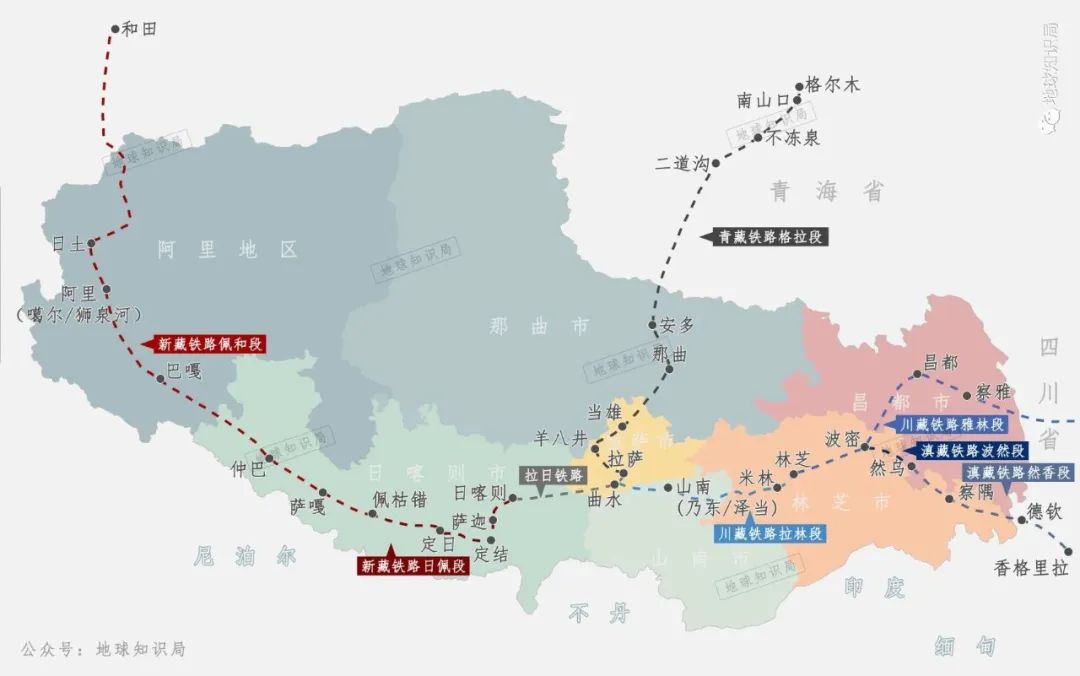
Core Insights - Two major infrastructure projects have commenced in Tibet within a month, highlighting the region's strategic importance as a national defense barrier and a key water resource [1][2] Group 1: New Tibet Railway - The New Tibet Railway Company was established on August 7, with a registered capital of 95 billion RMB, fully owned by China National Railway Group [3] - The railway will connect Xinjiang Hotan to Tibet Lhasa, spanning 1980 kilometers and is considered the fourth railway into Tibet [4][7] - The project has a long planning history, with initial proposals dating back to 2004, and aims to start construction by 2025 with an estimated investment of around 400 billion RMB [5][8] Group 2: Yarlung Tsangpo River Hydropower Project - The Yarlung Tsangpo River downstream hydropower project officially broke ground on July 19, with a total investment of approximately 1.2 trillion RMB, planning to construct five hydropower stations [10] - The project is expected to have an installed capacity of 60 million kilowatts and an annual power generation of about 300 billion kilowatt-hours, equivalent to three Three Gorges dams [11] - The hydropower project is strategically significant for controlling water resources, supporting China's dual carbon goals, and enhancing regional economic cooperation with South Asian countries [12][13] Group 3: Economic Impact - The Yarlung Tsangpo hydropower project is projected to generate over 20 billion RMB in annual fiscal revenue for Tibet, reducing reliance on transfer payments [14] - The projects are expected to stimulate economic growth, expand domestic demand, and develop upstream and downstream industries, with a total investment exceeding one trillion RMB [14]
华泰证券:建议关注新疆板块投资机会
Zheng Quan Shi Bao Wang· 2025-08-11 23:41
Core Viewpoint - The establishment of the new Xinjiang Railway Company with a registered capital of 95 billion yuan signifies the steady progress of the Xinjiang railway project, which is expected to involve total investments ranging from 200 billion to 500 billion yuan [1] Investment Opportunities - The construction of the railway from Hotan to the provincial border has commenced with earthwork bidding starting in May 2025, indicating a significant advancement in infrastructure development [1] - The strategic position of Xinjiang is highlighted due to its energy, resource, and geopolitical advantages, which are expected to attract heightened policy attention and regional development [1] - The upcoming 70th anniversary of the establishment of the autonomous region may serve as a catalyst for market interest, suggesting potential investment opportunities in the Xinjiang sector [1]
