
石化

Search documents
环保税扩围加快推进
第一财经· 2025-10-28 03:20
Core Viewpoint - The article discusses the upcoming expansion of the Environmental Protection Tax in China, particularly focusing on volatile organic compounds (VOCs), which are significant contributors to air pollution. The revision of the Environmental Protection Tax Law aims to enhance air quality and increase local government revenue through taxation on a broader range of VOCs [3][4]. Group 1: Legislative Changes - The draft amendment of the Environmental Protection Tax Law has been submitted for a second review, emphasizing the need for the State Council to establish a reasonable tax scope for VOCs and improve monitoring and emission calculation methods [3]. - The first draft of the amendment included all VOCs in the tax scope, with a focus on pilot programs before full implementation, indicating a strategic approach to environmental taxation [4]. Group 2: Industry Impact - Key industries such as petrochemicals, chemicals, industrial coatings, packaging printing, and oil storage and transportation are identified as major sources of VOC emissions in China. The inclusion of all VOCs in the tax will compel these industries to undergo transformation and cleaner production processes [4]. - The amendment allows the State Council to conduct pilot tax collection on VOCs not listed in the current tax table, with a five-year reporting requirement to the National People's Congress on the pilot's outcomes [4]. Group 3: Financial Implications - Environmental Protection Tax revenue has fluctuated around 20 billion yuan in recent years, with a projected increase to 24.6 billion yuan in 2024, representing a year-on-year growth of 19.7%. The first three quarters of 2025 saw revenues of 20.8 billion yuan, up 13.8% compared to the previous year, significantly outpacing the overall national tax revenue growth of 0.7% [4].

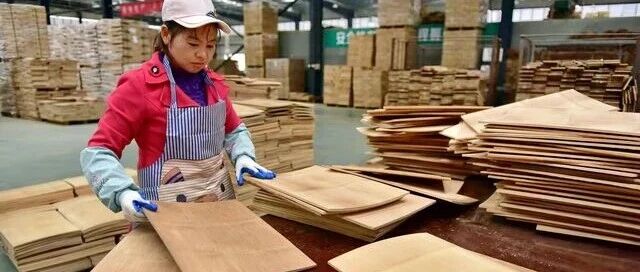
欧洲仍是SABIC塑料业务创新中心
Zhong Guo Hua Gong Bao· 2025-10-28 03:09
Core Viewpoint - SABIC remains optimistic about the growth opportunities in sustainable and circular plastic demand in Europe despite current challenges in the petrochemical market [1] Group 1: Market Outlook - SABIC's Polymer Executive Vice President, Sami Osama, highlighted Europe as an innovation center, particularly in sectors like automotive, mobility, and healthcare, where there is significant focus on developing circular solutions [1] - The global chemical industry is currently facing a difficult period with fluctuating demand [1] Group 2: Strategic Actions - To address market downturns and competitiveness issues, SABIC plans to permanently close several petrochemical facilities in Europe over an 18-month period from January 2024 to June 2025 [1] - The company is open to further optimizing its European asset portfolio and will continue to assess operations and business for efficiency improvements [1] Group 3: Recent Developments - In August, SABIC established a joint venture with Plastic Energy in Herne, which has produced its first batch of pyrolysis oil [1] - The facility is designed to process 20,000 tons of mixed waste plastic annually and is expected to begin commercial production by the end of this year, integrating the pyrolysis oil as a substitute for traditional naphtha in polymer production [1]
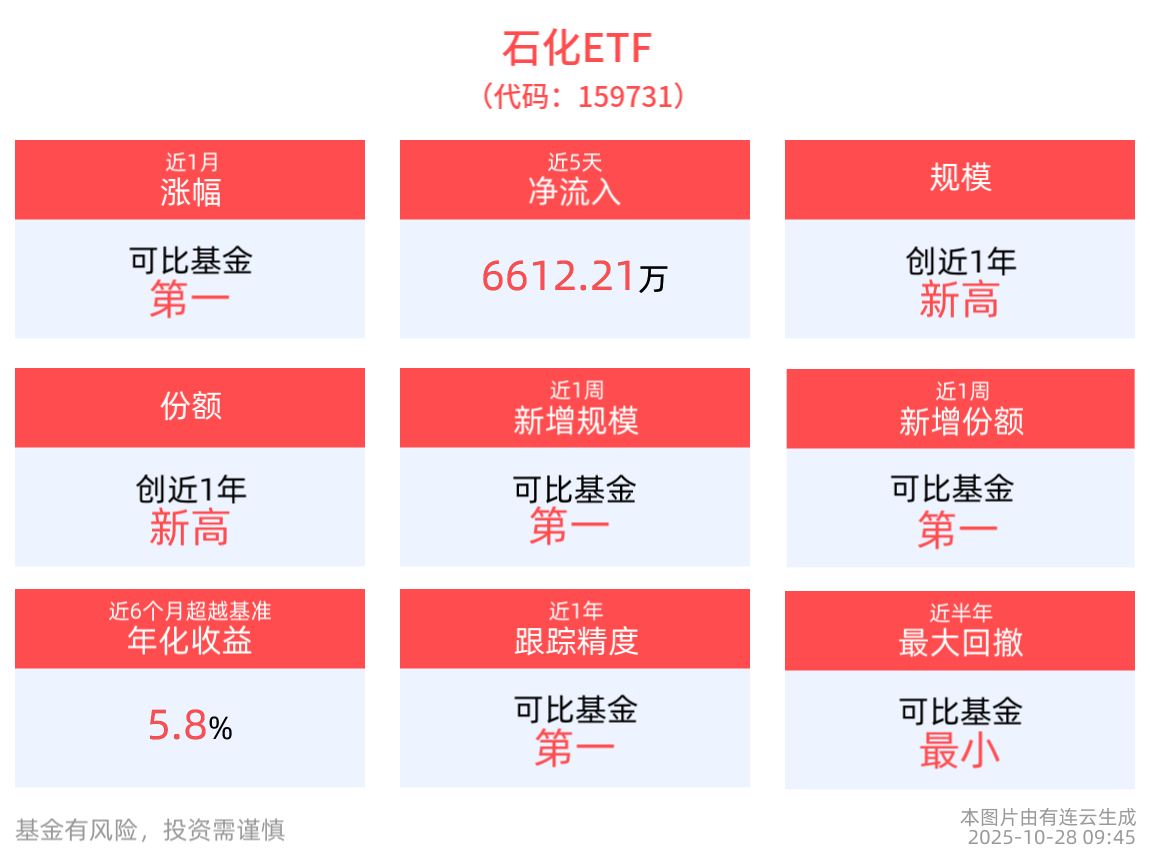
资金抢筹!石化ETF(159731))最新资金净流入超6000万元
Sou Hu Cai Jing· 2025-10-28 02:10
Core Insights - The Zhongzheng Petrochemical Industry Index increased by 0.16% as of October 28, 2025, with leading stocks including Hengli Petrochemical, Hangyang Co., Jinfa Technology, Yara International, and Xingfa Group [1] - The Petrochemical ETF (159731) saw a significant net inflow of 61.39 million yuan, indicating strong capital inflow [1] - The Petrochemical ETF reached a new high in both share count (14.3 million shares) and total scale (114 million yuan), ranking first among comparable funds [1] Performance Summary - As of October 27, 2025, the Petrochemical ETF's net value increased by 22.08% over the past six months [3] - The ETF achieved a maximum monthly return of 15.86% since its inception, with the longest consecutive monthly gains being five months and a maximum cumulative gain of 22.33% [3] - The average return during the rising months was 5.27% [3] - The ETF outperformed its benchmark with an annualized excess return of 5.8% over the last six months [3] - The maximum drawdown over the past six months was 6.47%, with a relative benchmark drawdown of 0.14%, marking the smallest drawdown among comparable funds [3] - The tracking error for the Petrochemical ETF over the past year was 0.037%, indicating the highest tracking precision among comparable funds [3] Index Composition - As of September 30, 2025, the top ten weighted stocks in the Zhongzheng Petrochemical Industry Index included Wanhua Chemical, China Petroleum, Salt Lake Industry, Sinopec, CNOOC, Juhua Co., Zangge Mining, Jinfa Technology, Hualu Hengsheng, and Baofeng Energy, collectively accounting for 55.12% of the index [3]
环保税扩围加快推进
Di Yi Cai Jing· 2025-10-28 02:08
Core Points - The draft amendment to the Environmental Protection Tax Law is under review, aiming to expand the tax base to include all volatile organic compounds (VOCs) [1][2] - The amendment emphasizes accelerating pilot programs for VOC taxation, indicating imminent implementation [1] - The goal of the tax expansion is to improve air quality and enhance ecological protection while increasing local government revenue [1][2] Industry Impact - Key industries such as petrochemicals, chemicals, industrial coatings, packaging printing, and oil storage and transportation are major sources of VOC emissions in China [2] - The inclusion of all VOCs in the environmental tax will compel these industries to undergo transformation and cleaner production processes [2] - The Environmental Protection Tax is classified as a local tax, with all revenue allocated to local governments, which is expected to incentivize pollution control efforts [2] Financial Implications - Recent data indicates that environmental tax revenue has fluctuated around 20 billion yuan, with projections for 2024 at 24.6 billion yuan, reflecting a year-on-year increase of 19.7% [2] - For the first three quarters of 2025, environmental tax revenue reached 20.8 billion yuan, showing a year-on-year growth of 13.8%, significantly outpacing the national tax revenue growth rate of 0.7% [2]
国内高频 | 生产边际改善,需求保持韧性(申万宏观·赵伟团队)
申万宏源研究· 2025-10-28 01:36
Core Viewpoint - The article highlights the overall improvement in industrial production, with specific sectors showing varying performance, particularly in steel and construction industries [1][11][21]. Industrial Production - The blast furnace operating rate increased by 0.5% week-on-week to 84.7%, remaining stable year-on-year [1][4]. - Apparent steel consumption rose by 2% week-on-week, with a narrowing year-on-year decline of 3.8 percentage points to -0.1% [1][6]. - Social inventory continued to decline, down 2.3% week-on-week [1]. Chemical and Textile Industries - The soda ash operating rate remained stable at 84.9%, with a year-on-year decline narrowing to -2.2% [11][12]. - PTA operating rate increased by 0.4% week-on-week to 76.0%, with a year-on-year improvement of 1.3 percentage points to -4.8% [11][14]. - The operating rate for polyester filament remained stable at 91%, with a year-on-year increase of 1.7% [11]. Construction Industry - Cement production and demand were below last year's levels, with the nationwide grinding operating rate increasing by 1.6% week-on-week to 45.4% [21][22]. - Cement shipment rates remained stable at 44.8%, with a year-on-year decline of 9.3% [21][24]. - Cement inventory ratio slightly increased, up 1.2% week-on-week [21]. Glass and Asphalt Production - Glass production remained stable week-on-week, with a year-on-year decline of 0.6% [31]. - Asphalt operating rate increased by 1.5% week-on-week [31]. Demand Tracking - National commodity housing transactions decreased, primarily due to significant declines in second-tier cities, with a daily average transaction area down 5.7% week-on-week [40]. - National road freight volume increased year-on-year, with rail freight volume up 1.8 percentage points to 1.5% [44][49]. - Passenger car retail sales decreased by 0.5% week-on-week, with a year-on-year decline of 0.7% to 25.4% [59]. Price Tracking - Agricultural product prices generally fell, with vegetable prices rising by 4.3% week-on-week [74]. - Industrial product prices showed an overall upward trend, with the South China Industrial Price Index increasing by 0.4% week-on-week [82][83].
五年纳税超430亿 中国石化为福建发展添“油”加劲
Zhong Guo Jing Ji Wang· 2025-10-28 00:10
Core Points - China Petroleum's initiatives in Fujian province reflect its commitment to supporting local economies and enhancing the welfare of outdoor workers through the establishment of "Driver's Homes" and "Love Stations" [1][2] - The company has developed significant refining and chemical production capabilities in Fujian, with major facilities in Quanzhou and Zhangzhou, contributing to the province's energy supply and economic stability [2][3] - The ongoing construction of the Gulei integrated refining project, with a total investment of 71.1 billion yuan, is a key part of China's energy cooperation with Saudi Arabia and aims to enhance the local petrochemical industry [3] - China Petroleum is also expanding into new energy sectors, collaborating with companies like CATL and Huawei to establish charging and battery swap stations across the province [3][4] - The company is committed to green transformation, achieving significant reductions in carbon emissions and energy consumption through various projects, including solar power generation [4] - China Petroleum's social responsibility efforts include supporting local agriculture and contributing to rural revitalization through donations and community projects [5][6] Summary by Sections Company Initiatives - China Petroleum has established 137 "Driver's Homes" and 313 "Love Stations" in Fujian to provide essential services for outdoor workers [1] - The company operates over 1,100 service stations in Fujian, accounting for nearly 40% of the province's total, with annual sales exceeding 5.3 million tons [2] Industrial Development - The Gulei integrated refining project is expected to balance the upstream and downstream petrochemical industry, contributing to the establishment of a world-class petrochemical base [3] - The company has achieved 17 patents and 238 innovations in the past five years, showcasing its commitment to industrial excellence [2] Green Transformation - Fujian United Petrochemical has been recognized as a "Green Factory," implementing projects that save 93,000 tons of standard coal and reduce carbon emissions by 232,000 tons annually [4] - The company has built 296 charging stations and 158 solar power sites, significantly contributing to carbon reduction efforts [4] Social Responsibility - China Petroleum has donated over 20 million yuan to support local rural revitalization and education initiatives [5] - The company has facilitated the sale of local agricultural products exceeding 100 million yuan through its convenience stores [5]

恒力石化第三季度盈利 同比增长逾八成
Sou Hu Cai Jing· 2025-10-27 22:23
Core Viewpoint - Hengli Petrochemical reported strong financial performance in Q3 2025, achieving a net profit of 1.972 billion yuan, marking an 81.47% year-on-year increase despite a weak macroeconomic environment [1] Financial Performance - For the first three quarters of the year, the company generated operating revenue of 157.384 billion yuan and a net profit attributable to shareholders of 5.023 billion yuan [1] - The operating cash flow for the same period was 20.134 billion yuan [1] - The Q3 profit showed significant improvement compared to Q2, indicating effective management strategies [1] Strategic Adjustments - Hengli Petrochemical has adapted its product structure and strengthened cost control to respond to market changes and cost fluctuations, maintaining a leading position in the industry [1] Shareholder Returns - The company is noted for its high cash dividend payout ratio, having implemented its first "annual + interim" dividend this year to enhance returns to investors [1] - Since its listing in 2016, Hengli Petrochemical has distributed a total of 26.1 billion yuan in cash dividends, which accounts for 40.43% of the cumulative net profit attributable to shareholders during the dividend period [1] - The company aims to continue improving its long-term, stable, and sustainable shareholder value return mechanism as profitability and cash dividend capacity enhance [1]

恒力石化第三季度盈利同比增长逾八成
Zheng Quan Shi Bao· 2025-10-27 18:15
"后续随着企业盈利能力加快修复和现金分红能力持续增强,公司也将持续完善'长期、稳定、可持 续'的股东价值回报机制,让股东长期分享公司的发展成果。"恒力石化表示。 (文章来源:证券时报) 尽管面临外部宏观需求整体偏弱的环境,但恒力石化通过灵活调整产品结构,持续强化成本管控,积极 应对市场变化与成本波动,令业绩保持在同行业领先水平。 值得一提的是,恒力石化也是国内资本市场上少有的一直坚持高比例现金分红回报投资者的上市公司, 公司在今年还实施了首次"年度+中期"分红,加大回报投资者力度。2016年上市后,恒力石化已累计实 现现金分红261亿元,占分红期间累计归母净利润的40.43%,大幅超过了公司同期从资本市场所募集的 资金。 恒力石化(600346)10月27日晚间披露2025年第三季度报告,今年前三季度,公司实现营业收入1573.84亿 元,归母净利润50.23亿元,实现经营性现金流201.34亿元。其中,第三季度单季度盈利19.72亿元,同 比增长81.47%,相比二季度,盈利也实现环比大幅改善。 ...
国内高频 | 生产边际改善,需求保持韧性(申万宏观·赵伟团队)
赵伟宏观探索· 2025-10-27 16:03
Core Viewpoint - The article highlights the overall improvement in industrial production, with specific sectors showing varying performance, particularly in steel and construction industries. Industrial Production - The blast furnace operating rate increased by 0.5% week-on-week to 84.7%, remaining stable year-on-year with a 2.6% increase compared to the previous week [4][5] - Steel apparent consumption rose by 2% week-on-week, with a narrowing year-on-year decline of 3.8 percentage points to -0.1% [6][11] - Social inventory continued to decline, down 2.3% week-on-week [11] Sector Performance - The petrochemical and consumer sectors showed improvement, with soda ash operating rates stable at 84.9%, and a year-on-year decline narrowing to -2.2% [11] - PTA operating rate increased by 0.4% to 76.0%, with a year-on-year improvement of 1.3 percentage points to -4.8% [11][14] - The automotive semi-steel tire operating rate improved by 1% to 73.7%, with a year-on-year increase of 1 percentage point to -5.7% [11] Construction Industry - Cement production and demand were below last year's levels, with grinding operating rates up 1.6% week-on-week to 45.4%, and a year-on-year increase of 3.8 percentage points to -4.8% [21][22] - Cement shipment rates remained stable at 44.8%, with a year-on-year increase of 0.8 percentage points to -9.3% [21][24] - Cement inventory ratio slightly increased by 1.2% week-on-week, with a year-on-year decrease of 1.2 percentage points to 0.7% [21] Demand Tracking - National commodity housing transactions decreased, primarily due to significant declines in second-tier cities, with a 5.7% week-on-week drop in average daily transaction area [40] - National road freight volume increased year-on-year, with a 19.6% rise in truck traffic [44][49] - Passenger car retail sales remained high, with a slight week-on-week decrease of 0.5% and a year-on-year decline of 0.7% to 25.4% [59] Price Tracking - Agricultural product prices generally fell, with vegetable prices rising by 4.3% week-on-week, while fruit, pork, and egg prices decreased [74] - Industrial product prices showed an overall upward trend, with the South China industrial price index rising by 0.4% week-on-week [82][83]
恒力石化第三季度净利润19.72亿元 同比增长81.47%
Zhong Guo Jing Ying Bao· 2025-10-27 14:48
从单季度表现来看,第三季度恒力石化实现营业收入534.96亿元,归母净利润19.72亿元,同比增长 81.47%。 (编辑:董曙光 审核:吴可仲 校对:颜京宁) 中经记者 陈家运 北京报道 恒力石化方面表示,业绩变动原因主要为去年同期原油价格下行导致毛利率压缩,而今年整体价格走势 平稳,带动毛利率较去年同期稳步改善。 10月27日,恒力石化(600346.SH)公告披露,其在2025年前三季度实现营业收入1573.84亿元,归母净 利润50.23亿元。 ...