稀土

Search documents
特朗普弄巧成拙,稀土价飙6000%,美国满世界扫货,8万零件断供
Sou Hu Cai Jing· 2025-12-31 07:01
Core Viewpoint - The "Pax Silica Declaration" aims to break China's monopoly in the rare earth sector, but the U.S. remains heavily dependent on Chinese supplies, particularly for yttrium oxide, with a reliance rate of 93% [1][3]. Group 1: U.S. Strategy and Actions - The U.S. government has initiated a multi-national agreement to reshape global supply chains, emphasizing that it will no longer worry about being dependent on critical minerals [3]. - In October 2025, the U.S. secured a multi-billion dollar rare earth mining agreement with Australia, followed by technology sharing with Japan and processing responsibilities assigned to South Korea, aiming for a closed-loop supply chain [5]. - The U.S. Department of Defense invested $400 million in MP Materials, the only domestic rare earth miner, promising to purchase neodymium and praseodymium at a guaranteed price of $110 per kilogram, double the market rate [5]. Group 2: Challenges in U.S. Rare Earth Industry - The U.S. lacks refining capabilities, with two-thirds of raw ore still needing to be sent to China for purification, and establishing a new refinery takes 7-10 years and costs three times more than in China [7]. - China's export controls on heavy rare earths, implemented in April 2025, require companies to submit end-use certifications, limiting military-related exports and tightening supply [7][12]. Group 3: Impact of Supply Shortages - The price of yttrium oxide skyrocketed from $6 per kilogram at the beginning of the year to $320 by mid-year, a 53-fold increase due to reduced Chinese exports [10]. - The U.S. automotive industry is facing severe disruptions, with major manufacturers warning of potential shutdowns of assembly lines due to rare earth shortages [16]. - The military sector is also affected, with Lockheed Martin notifying the Pentagon of slowed production for the F-35 fighter jet due to rare earth material shortages [18][20]. Group 4: Global Market Reactions - European countries, which rely on China for 82% of their yttrium oxide imports, are experiencing production halts in major automotive companies due to supply shortages [14]. - The semiconductor industry is also under pressure, with companies like Intel and TSMC reporting reduced production capacity due to the scarcity of rare earth materials [23]. Group 5: Long-term Implications - The U.S. government has initiated the Defense Production Act to prioritize 35 rare earth materials, aiming for "decoupling" from China by 2027, but industry experts believe this goal is nearly impossible without processing capabilities [25]. - The crisis highlights the risks of over-reliance on a single supply source and the consequences of politicizing resource issues, which could lead to significant costs for the U.S. manufacturing sector [27].

中国稀土(000831.SZ):目前暂不涉及镝铁合金的生产
Ge Long Hui· 2025-12-31 06:46
Group 1 - The company currently does not engage in the production of dysprosium iron alloy [1]

盛和资源股价跌1.01%,富国基金旗下1只基金重仓,持有258.96万股浮亏损失56.97万元
Xin Lang Cai Jing· 2025-12-31 03:09
Group 1 - The core point of the news is that Shenghe Resources experienced a decline of 1.01% in stock price, reaching 21.46 CNY per share, with a trading volume of 366 million CNY and a turnover rate of 0.96%, resulting in a total market capitalization of 37.616 billion CNY [1] - Shenghe Resources Holdings Co., Ltd. is located in Chengdu, Sichuan Province, established on July 1, 1998, and listed on May 29, 2003. The company's main business involves rare earth smelting, separation, deep processing, and trading, as well as zirconium-titanium mining and processing [1] Group 2 - From the perspective of major fund holdings, data shows that one fund under the Fortune Fund has a significant position in Shenghe Resources. The Fortune CSI Rare Earth Industry ETF (159713) increased its holdings by 151.89 thousand shares in the third quarter, totaling 258.96 thousand shares, which accounts for 4.54% of the fund's net value, ranking as the fifth-largest holding [2] - The Fortune CSI Rare Earth Industry ETF (159713) was established on August 5, 2021, with a latest scale of 1.315 billion CNY. Year-to-date, it has achieved a return of 79.19%, ranking 149 out of 4189 in its category; over the past year, it has returned 73.29%, ranking 151 out of 4188; and since inception, it has returned 31.32% [2]

北方稀土股价涨1.07%,南方基金旗下1只基金重仓,持有2059.64万股浮盈赚取1009.22万元
Xin Lang Cai Jing· 2025-12-31 02:00
Core Viewpoint - Northern Rare Earth's stock price increased by 1.07% to 46.46 CNY per share, with a trading volume of 808 million CNY and a market capitalization of 167.96 billion CNY as of December 31 [1] Company Overview - Northern Rare Earth (Group) High-Tech Co., Ltd. is located in Baotou, Inner Mongolia, and was established on September 12, 1997, with its stock listed on September 24, 1997 [1] - The company's main business includes rare earth raw materials, functional materials, and some terminal application products [1] - Revenue composition: Production business segment 132.93%, functional materials and application products segment 31.31%, trading business segment 27.24%, and environmental industry and others 4.01% [1] Shareholder Insights - Southern Fund's Southern CSI Shenwan Nonferrous Metals ETF (004432) is among the top ten circulating shareholders of Northern Rare Earth, having increased its holdings by 10.71 million shares in Q3, totaling 20.60 million shares, representing 0.57% of circulating shares [2] - The fund has achieved a return of 91.65% this year, ranking 60 out of 4189 in its category [2] Fund Performance - The Southern CSI Shenwan Nonferrous Metals ETF (512400) also increased its holdings in Northern Rare Earth by 10.71 million shares, making it the second-largest holding in the fund, accounting for 6.95% of the fund's net value [4] - The fund has a year-to-date return of 98.26%, ranking 34 out of 4189 in its category [4]

中国稀土12月29日获融资买入1.28亿元,融资余额20.14亿元
Xin Lang Cai Jing· 2025-12-30 06:56
来源:新浪证券-红岸工作室 资料显示,中国稀土集团资源科技股份有限公司位于江西省赣州市章贡区章江南大道18号豪德银座A栋 14、15层,成立日期1998年6月17日,上市日期1998年9月11日,公司主营业务涉及稀土冶炼分离及稀土 技术研发及服务。主营业务收入构成为:稀土氧化物63.51%,稀土金属及合金35.95%,其他(补 充)0.35%,技术服务收入0.18%。 截至12月10日,中国稀土股东户数23.79万,较上期增加0.01%;人均流通股4460股,较上期减少 0.01%。2025年1月-9月,中国稀土实现营业收入24.94亿元,同比增长27.73%;归母净利润1.92亿元,同 比增长194.67%。 分红方面,中国稀土A股上市后累计派现3.46亿元。近三年,累计派现1.24亿元。 机构持仓方面,截止2025年9月30日,中国稀土十大流通股东中,香港中央结算有限公司位居第四大流 通股东,持股2906.94万股,相比上期增加946.69万股。南方中证500ETF(510500)位居第五大流通股 东,持股1079.60万股,相比上期减少27.03万股。嘉实中证稀土产业ETF(516150)位居第六大流通 ...
手握“王牌”却打不出去?印度稀土储量全球第三,为何产量上不去?
Sou Hu Cai Jing· 2025-12-30 06:46
Core Insights - India's rare earth reserves rank third globally at approximately 6.9 million tons of rare earth oxides (REO), yet its actual production ranks seventh, highlighting a significant gap between resource potential and actual output [1][3]. Group 1: Resource and Production Comparison - India's rare earth reserves account for 6-7% of global totals, but in 2024, the country produced only 2,900 tons, contributing less than 1% to global production [4]. - In contrast, China, the largest producer, achieved a production of 270,000 tons in 2024, which is 93 times that of India [4]. Group 2: Challenges in the Industry - The core issues facing India's rare earth sector are not due to a lack of resources but stem from deficiencies in execution, processing capabilities, and value chain integration [3]. - Mining structure is complex, as most of India's rare earth reserves are found in monazite sands containing radioactive thorium, leading to strict regulatory and environmental challenges [4]. - India's processing capacity is severely limited, with China controlling about 90% of global refining capacity, particularly for heavy rare earth elements, making it difficult for India to convert raw ore into high-value products [4]. - The lack of integration in the value chain means India plays a minimal role in global rare earth trade, with annual production only in the thousands of tons, failing to achieve economies of scale or market influence [4].
谁也别想一招制敌!中美互相掐住命门,稀土与芯片的终极制衡
Sou Hu Cai Jing· 2025-12-30 03:42
这并非单方面的压迫,而是双方之间的相互制衡。美国掌握着关键技术和设备,每次施压时,中国的高科技产业就必须咬牙承受,不断补课、攻关。而当中 国收紧稀土供应,尤其是重稀土时,美欧的多条生产线将受到影响,排产表也会因此乱套。如此恐怖的平衡反而成为了中美关系中的压舱石,因为双方都不 愿意让这艘船倾覆。那么接下来该怎么走呢?杨荣文认为,接下来的发展将是贸易战争。他指出,美国的国内政治因素不可忽视,特朗普对选民的考量、对 中期选举的关注以及对国会控制权的担忧,比外交言辞更加重要。如果对抗中国导致通货膨胀失控、供应链中断、经济下滑,选民就不会买账。为了保住自 己的地位,维持一种表面稳定且可控的对华关系,变得更加现实。由此也可以理解,为什么美国最近在某些问题上嘴上说得多,行动却收敛了。 最近,新加坡前外长杨荣文提出了一个尖锐的比喻:他把美国比作一只爱吵闹的孙悟空,而中国手中则有一项可以驯服它的法宝——稀土。他提醒大家,稀 土这一牌并不是最近才被提出的,早在上世纪九十年代就已经被摆在桌面上了,只是当时很多人选择了忽视。那个时候,美国习惯于制定规则、施加压力, 并认为中国的抗议仅仅是形式,生意最终依旧会继续。美国把中国的克制当作 ...

稀土价格|轻重稀土市场走势分化
Xin Lang Cai Jing· 2025-12-30 03:38
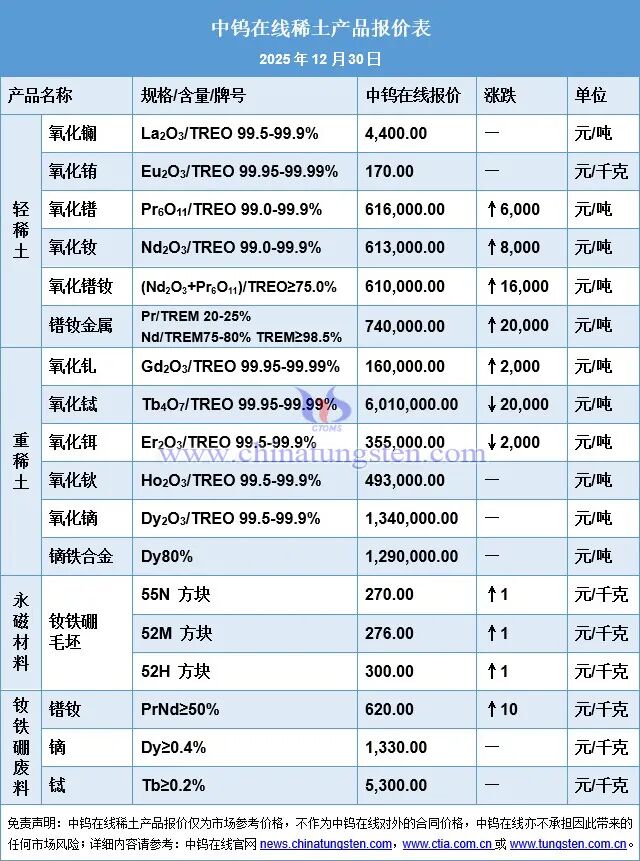
Core Viewpoint - The rare earth market shows mixed performance, with light rare earth prices rising due to supply constraints and strong vendor sentiment, while heavy rare earth prices remain stable but face challenges in price increases due to low downstream demand and production cost pressures [5][6]. Group 1: Rare Earth Prices - The price of Praseodymium Neodymium oxide (PrNd) has significantly increased, with Pr6011 priced at 616,000.00 yuan/ton and Nd2O3 at 613,000.00 yuan/ton, reflecting a rise of 16,000 yuan and 18,000 yuan respectively [4][5]. - Dysprosium and Terbium prices are struggling to rise, with the market showing weak stability and low purchasing enthusiasm from downstream buyers [5][6]. - Some products, like Gadolinium oxide, have seen slight price increases, indicating a mixed market response [5]. Group 2: Tariff Adjustments - The 2026 Tariff Adjustment Plan specifies that starting January 1, 2026, a provisional tax rate of 0% will be applied to various rare earth metals, including Neodymium, Dysprosium, and Terbium, while the Most-Favored-Nation (MFN) rate will be set at 5% [6]. - This adjustment also applies to rare earth compounds such as Cerium oxide and Lanthanum oxide, which will also have a 5% MFN rate and a 0% provisional tax rate [6].
能源金属与小金属-板块汇报和标的更新
2025-12-29 15:51
Summary of Key Points from Conference Call Records Industry Overview Lithium Market - The lithium market is experiencing a second wave of price increases, with futures prices surpassing 120,000 yuan and approaching 130,000 yuan, driven by strong demand and weak supply [1][4] - Short-term supply-demand dynamics indicate weak supply and strong demand, with lithium carbonate prices doubling in less than a quarter [1][4] - By 2026, a significant increase in lithium supply is expected, with conservative estimates of 350,000 to 400,000 tons, while demand growth could exceed 30% [1][4][5] Rare Earth Industry - The rare earth sector is benefiting from the implementation of export policies and fundamental recovery, with overseas end-users able to bear higher prices [1][6] - A positive feedback mechanism may develop between rare earth prices and magnetic material pricing, with 2026 being a critical year for resolving competition among Chinese rare earth groups [1][6][8] Strategic Metals Sector - 2025 is seen as a year of value discovery for the strategic metals sector, with supply constraints due to resource endowments and policy restrictions leading to global raw material supply tightness [1][9] - The market perception of strategic metals has shifted, with companies like Northern Rare Earth and China Europe High-Tech seeing significant valuation increases, reflecting a recognition of these metals as essential under de-globalization trends [1][10] Core Insights and Arguments Lithium Market Insights - Current trading conditions for lithium are characterized by a strong demand that cannot be quickly met by supply, leading to favorable short-term price conditions [4][5] - Upstream companies are opting for futures and spot trading to achieve higher premiums, indicating a bullish sentiment in the market [4][5] Rare Earth Market Insights - The rare earth market has shown significant performance improvements, with export policies enhancing price recovery [6][7] - The upcoming year is expected to see rapid recovery in demand due to inventory buildup driven by limited export licenses [7][8] Strategic Metals Insights - The strategic metals market is experiencing price and valuation breakthroughs, with supply constraints from both resource endowments and policy measures [9][10] - The anticipated resolution of competition among Chinese rare earth companies in 2026 is expected to optimize supply-side dynamics [8][9] Additional Important Content - The small metals market has shown overall positive performance this year, despite recent adjustments due to rapid price increases and heightened sensitivity to negative news [2][3] - Tin prices are projected to have significant upside potential, with a target price of around 450,000 yuan, as current prices are close to cost levels [2][11] - The TT price has been weak due to year-end inventory adjustments and reduced demand following holiday preparations, but long-term supply constraints are expected to support price recovery [13][14] - The overall price performance this year has exceeded expectations, driven by hidden demand not previously observed, indicating a robust price transmission within the industry [14][15] Companies to Watch - Companies such as Zhongwu Gaoxin, Xiamen Property, and Hong Kong Jiaxing International Resources are highlighted as having strong growth prospects in the current market environment [16]
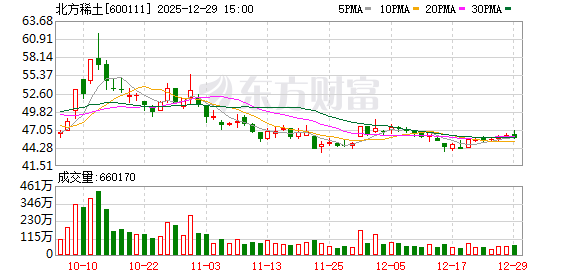
北方稀土12月29日大宗交易成交340.07万元
Zheng Quan Shi Bao Wang· 2025-12-29 15:01
北方稀土12月29日大宗交易平台出现一笔成交,成交量7.43万股,成交金额340.07万元,大宗交易成交 价为45.77元。该笔交易的买方营业部为申万宏源证券有限公司证券投资总部,卖方营业部为国泰海通 证券股份有限公司总部。 进一步统计,近3个月内该股累计发生5笔大宗交易,合计成交金额为4193.59万元。 证券时报·数据宝统计显示,北方稀土今日收盘价为45.77元,下跌0.74%,日换手率为1.83%,成交额为 30.42亿元,全天主力资金净流出2.84亿元,近5日该股累计上涨0.48%,近5日资金合计净流出3.61亿 元。 两融数据显示,该股最新融资余额为67.91亿元,近5日减少5618.84万元,降幅为0.82%。 据天眼查APP显示,中国北方稀土(集团)高科技股份有限公司成立于1997年09月12日,注册资本 361506.5842万人民币。(数据宝) 12月29日北方稀土大宗交易一览 | 成交量 | 成交金额 | 成交价格 | 相对当日收盘折 | 买方营业部 | 卖方营业部 | | --- | --- | --- | --- | --- | --- | | (万股) | (万元) | (元) | ...