港口航运

Search documents
收评:沪指窄幅震荡微涨0.1%,三市成交额不足2万亿元
Xin Lang Cai Jing· 2025-10-16 07:09
Market Performance - The three major A-share indices showed mixed results, with the Shanghai Composite Index up by 0.1%, the Shenzhen Component down by 0.25%, and the ChiNext Index up by 0.38%, while the North China 50 Index fell by 1.3% [1] - The total trading volume in the Shanghai and Shenzhen markets was 19,487 billion yuan, a decrease of 1,417 billion yuan compared to the previous day [1] - Over 4,100 stocks in the market experienced declines [1] Sector Performance - The insurance, coal mining and processing, port shipping, banking, liquor, and traditional Chinese medicine sectors saw the largest gains [1] - Conversely, sectors such as small metals, photolithography machines, steel, wind power equipment, rare earth permanent magnets, and PEEK materials experienced significant declines [1] Notable Stocks - The coal mining and processing sector showed strong performance, with companies like Antai Group, Dayou Energy, and Baotailong hitting the daily limit [1] - The port shipping sector also rose in the afternoon, with Nanjing Port achieving three consecutive trading limits in four days, and companies like Haitong Development, Haixia Shares, and Antong Holdings hitting the daily limit [1] - The banking sector saw a rebound in the afternoon, with Agricultural Bank nearing historical highs [1] - In contrast, the steel sector performed poorly, with Wujin Stainless Steel hitting the daily limit down, followed by Huazhong Steel and Guangdong Mingzhu [1] - Photolithography machine concept stocks faced downward pressure, with United Chemical hitting the daily limit down, and companies like Kaimete Gas, Maolai Optics, and Xinlai Materials showing significant declines [1]
午后异动!002040,直线涨停
Shang Hai Zheng Quan Bao· 2025-10-16 06:31
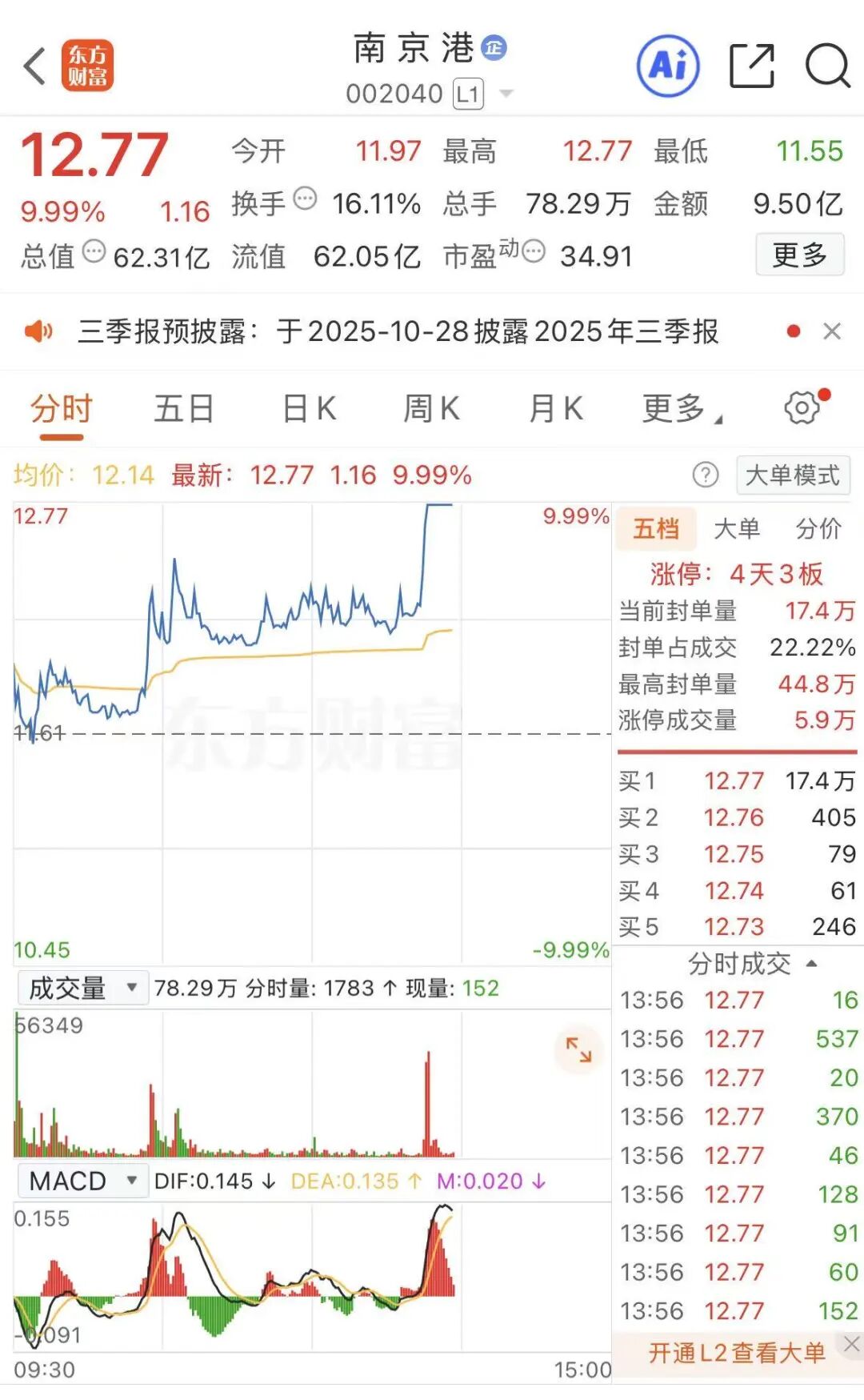
Group 1: Port and Shipping Sector - The port and shipping sector experienced a rapid increase, with Nanjing Port (002040) hitting the daily limit up, achieving a price of 12.77 CNY per share after three consecutive days of gains [1] - Other companies in the sector, such as Haitong Development and Antong Holdings, also saw their stocks rise, with Ningbo Ocean and Ningbo Shipping following suit [1] Group 2: Coal Sector - The coal sector saw a resurgence, with Baotailong hitting the daily limit up, Dayou Energy also reaching the limit up, and Zhongmei Energy increasing by over 7% [3] - Zhengzhou Coal Electricity rose by over 8%, while China Shenhua increased by over 2% [3] Group 3: Banking Sector - The banking sector showed an upward trend, with CITIC Bank and Agricultural Bank both rising by over 3% [6] - Other banks, including Chongqing Bank, Construction Bank, Industrial and Commercial Bank, and Bank of China, all increased by over 2% [6][7]






厦门港务发展股份有限公司 2025年半年度权益分派实施公告
Zhong Guo Zheng Quan Bao - Zhong Zheng Wang· 2025-10-16 04:08
Core Viewpoint - The company has approved a profit distribution plan for the 2025 interim period, which includes a cash dividend distribution to shareholders based on the total share capital as of June 30, 2025 [1][2]. Group 1: Profit Distribution Plan - The company held its annual general meeting on April 18, 2025, where it approved the profit distribution plan for 2024 and the mid-term dividend plan for 2025 [1]. - The board of directors approved a cash dividend of 0.55 RMB per 10 shares, totaling approximately 40.8 million RMB, with no capital reserve conversion or bonus shares issued [2][4]. - The total share capital remained unchanged from the announcement of the distribution plan to its implementation [3]. Group 2: Implementation Details - The cash dividend distribution will be based on a total share capital of 741,809,597 shares as of June 30, 2025 [6]. - The record date for the dividend distribution is set for October 22, 2025, and the ex-dividend date is October 23, 2025 [6]. - The cash dividends will be directly credited to the shareholders' accounts through their custodial securities companies [8]. Group 3: Taxation and Dividend Distribution Method - The cash dividend will be subject to different tax rates based on the holding period of the shares, with specific rates outlined for different categories of investors [6]. - The company will bear the legal responsibilities if there are insufficient funds for the dividend distribution due to a decrease in shareholders' accounts during the application period [10]. Group 4: Consultation and Documentation - The company has provided contact information for inquiries regarding the dividend distribution [10]. - Relevant documents, including resolutions from the board meetings and the annual general meeting, are available for review [10].

午评:两市低开高走创指涨0.69% 保险板块涨幅居前
Zhong Guo Jing Ji Wang· 2025-10-16 03:51
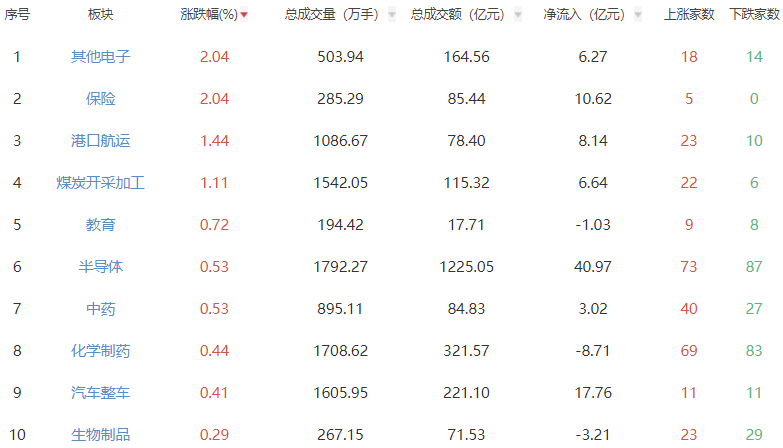
Market Overview - The A-share market opened lower but rebounded in the morning session, with the Shanghai Composite Index closing at 3916.10 points, up 0.10% [1] - The Shenzhen Component Index closed at 13139.00 points, up 0.15%, while the ChiNext Index closed at 3046.68 points, up 0.69% [1] Sector Performance - The leading sectors in terms of gains included insurance, port shipping, and coal mining and processing [1] - Conversely, sectors that experienced declines included gas, steel, and small metals [1] Detailed Sector Rankings - The top-performing sectors included: - Other Electronics: +2.04% with a total trading volume of 503.94 million hands and a net inflow of 6.27 billion [2] - Insurance: +2.04% with a total trading volume of 285.29 million hands and a net inflow of 10.62 billion [2] - Port Shipping: +1.44% with a total trading volume of 1086.67 million hands and a net inflow of 8.14 billion [2] - Coal Mining and Processing: +1.11% with a total trading volume of 1542.05 million hands and a net inflow of 6.64 billion [2] - The sectors that saw the largest declines included: - Gas: -1.97% with a total trading volume of 555.56 million hands and a net outflow of 6.56 billion [2] - Steel: -1.90% with a total trading volume of 2356.80 million hands and a net outflow of 10.41 billion [2] - Small Metals: -1.86% with a total trading volume of 648.70 million hands and a net outflow of 14.78 billion [2]
A股午评:创业板指涨0.69%,存储芯片板块集体爆发
2 1 Shi Ji Jing Ji Bao Dao· 2025-10-16 03:45
Core Points - The three major indices collectively rose in early trading, with the Shanghai Composite Index up by 0.1%, the Shenzhen Component Index up by 0.15%, and the ChiNext Index up by 0.69%, while the North China 50 Index fell by 1.16% [1][1][1] - The total trading volume in the Shanghai, Shenzhen, and Beijing markets reached 12,229 billion yuan, a decrease of 576 billion yuan compared to the previous day [1][1][1] - Over 1,200 stocks in the market experienced gains [1][1][1] Sector Performance - The insurance, storage chip, port shipping, coal mining and processing, education, and traditional Chinese medicine sectors saw the largest gains [1][1][1] - The storage chip sector had a significant breakout, with companies like Yunhan Chip City and Xiangnong Chip Creation hitting the daily limit, while Jiangbolong, Baiwei Storage, and Blue Arrow Electronics rose over 10% [1][1][1] - The port shipping sector was active, with Haitong Development and Antong Holdings both hitting the daily limit [1][1][1] - The traditional Chinese medicine sector also saw a spike, with Guizhou Bailin hitting the daily limit [1][1][1] Declining Sectors - The gas, steel, wind power, rare earth permanent magnet, and controllable nuclear fusion sectors experienced the largest declines [1][1][1] - The controllable nuclear fusion sector faced fluctuations, with Zhongzhou Special Materials and Hezhu Intelligent both dropping over 8% [1][1][1] - The steel sector saw a downward trend, with Wujin Stainless Steel, Guangdong Mingzhu, and Bayi Steel leading the declines [1][1][1] - The rare earth permanent magnet sector also retreated, with Shenghe Resources, Jinli Permanent Magnet, and China Rare Earth all experiencing declines [1][1][1]

市场震荡拉升,创业板指半日涨0.69%,存储芯片持续爆发
Feng Huang Wang Cai Jing· 2025-10-16 03:45
凤凰网财经讯 10月16日,市场早盘震荡拉升,创业板指盘中涨超1%。截至午间收盘,沪指涨0.1%,深 成指涨0.15%,创业板指涨0.69%。沪深两市半日成交额1.21万亿,较上个交易日缩量578亿。 | | | | | | 沪深京重要指数 | | | | | --- | --- | --- | --- | --- | --- | --- | --- | --- | | 名称 | *● | 最新 | 涨幅% | | 涨跌 涨跌家数 | | 总手 | 现手 金额 | | 上证指数 | | 3916.10 | 0.10 | 3.89 | 596/1652 | -0.17 | 3.60 7. | 6 5369.24 7 | | 深证成指 | | 13139.00 | 0.15 | 20.25 | 651/2202 | -0.21 | 3.89 7. | 1356 6752.73 Z | | 北证50 | | 1490.82 | -1.16 | -17.49 | 51/224 | -0.07 | 467 7 | 15 108.50 7. | | 创业板指 | | 3046.68 | 0.69 | 20.81 | 29 ...

存储芯片概念股,大爆发
财联社· 2025-10-16 03:44
Market Overview - A-shares experienced a volatile rise in the morning session, with the ChiNext index rising over 1% at one point [1] - The total trading volume in the Shanghai and Shenzhen markets reached 1.21 trillion yuan, a decrease of 57.8 billion yuan compared to the previous trading day [1] Sector Performance - The semiconductor sector showed strong performance, particularly in the storage chip segment, with companies like ShangNuo Chip reaching a 20% limit up, marking a historical high [1] - The pharmaceutical sector continued its strong trend, with Guizhou Bailin and Luoxin Pharmaceutical both hitting the daily limit [3] - The port and shipping sector was active, with Haitong Development also reaching the daily limit [3] - In contrast, controllable nuclear fusion concept stocks collectively declined, with Zhongzhou Special Materials and Hezhu Intelligent experiencing significant drops [3] Index Performance - By the end of the trading session, the Shanghai Composite Index rose by 0.1%, the Shenzhen Component Index increased by 0.15%, and the ChiNext Index gained 0.69% [3]


沪指收复3900点,汽车整车、机场航运涨幅居前
Guan Cha Zhe Wang· 2025-10-15 08:20
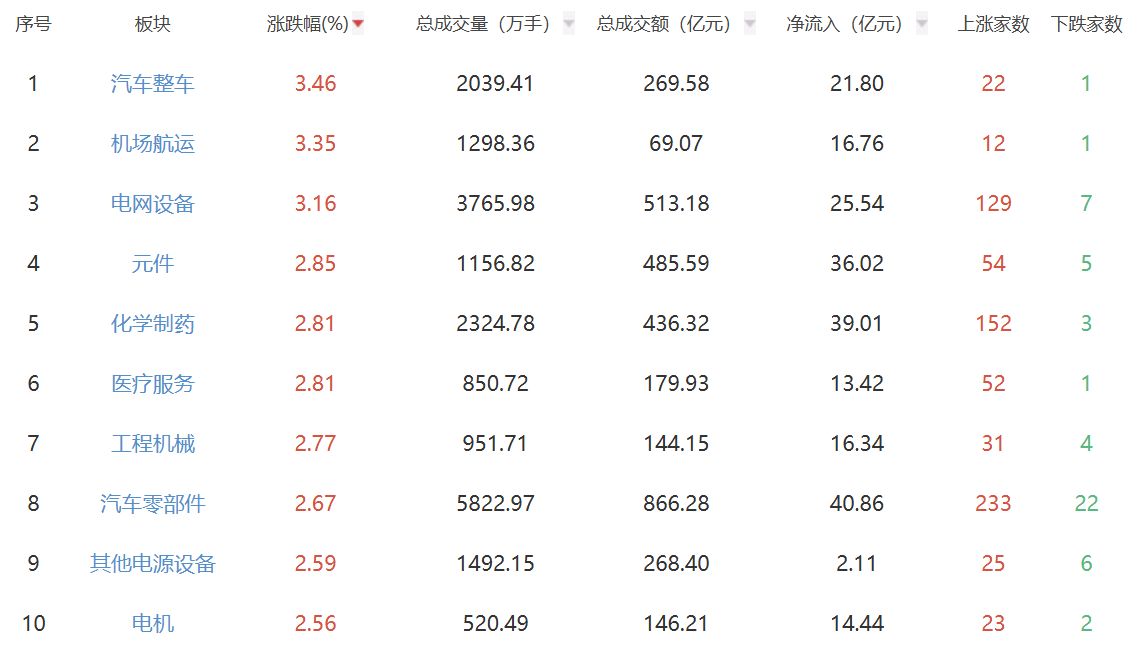
Core Viewpoint - The A-share market experienced a collective rise on October 15, with the Shanghai Composite Index recovering above 3900 points, indicating positive market sentiment and investor confidence [1]. Market Performance - The Shanghai Composite Index increased by 1.22%, closing above 3900 points - The Shenzhen Component Index rose by 1.73% - The ChiNext Index saw a gain of 2.36% - The North China 50 Index climbed by 1.62% - Total trading volume across Shanghai and Shenzhen markets reached 20,904 billion yuan, a decrease of 5,062 billion yuan compared to the previous day - Over 4,300 stocks in the market experienced an increase [1]. Sector Performance - Leading sectors in terms of growth included: - Automotive manufacturing - Airport and shipping - Electric grid equipment - Peek materials - Innovative pharmaceuticals - Automotive parts - Sectors that faced declines included: - Port shipping - Agricultural planting - Lithography machines - Rare earth permanent magnets - Oil and gas extraction [1].
A股收评:沪指重回3900点 全市场超4300只个股上涨
2 1 Shi Ji Jing Ji Bao Dao· 2025-10-15 07:49
Market Overview - The Shanghai Composite Index rose over 1%, reclaiming the 3900-point mark, while the ChiNext Index increased by over 2% [1] - The Shanghai and Shenzhen markets recorded a total trading volume of 2.07 trillion yuan, a decrease of 503.4 billion yuan compared to the previous trading day [1][7] Sector Performance - The robotics sector saw significant activity, with stocks like Wuzhou New Spring and Sanhua Intelligent Control hitting the daily limit [2] - The airport and shipping sector experienced a rebound, with Huaxia Airlines reaching the daily limit [3] - The pharmaceutical sector remained strong throughout the day, with stocks such as Anglikang also hitting the daily limit [4] - The data center power supply concept showed active performance, with Sifang Co. and Jingquanhua achieving two consecutive limits in four days [5] - Conversely, the port and shipping stocks collectively declined, with Nanjing Port and Lianyungang experiencing significant drops [6] Individual Stock Highlights - Northern Rare Earth led in trading volume with 16.62 billion yuan, while other notable stocks included Sunshine Power, Shenghong Technology, Luxshare Precision, and CATL, which also had high trading volumes [8]
收评:创业板指震荡反弹涨2.36% 汽车板块表现强势
Zhong Guo Jing Ji Wang· 2025-10-15 07:29
Core Insights - The A-share market indices collectively rose, with the Shanghai Composite Index closing at 3912.21 points, up 1.22%, and a total trading volume of 961.55 billion yuan [1] - The Shenzhen Component Index closed at 13118.75 points, up 1.73%, with a trading volume of 1111.31 billion yuan [1] - The ChiNext Index closed at 3025.87 points, up 2.36%, with a trading volume of 488.64 billion yuan [1] Sector Performance - The automotive sector led the gains with a rise of 3.46%, total trading volume of 203.94 million hands, and a net inflow of 2.68 billion yuan [2] - The airport and shipping sector increased by 3.35%, with a trading volume of 129.84 million hands and a net inflow of 1.68 billion yuan [2] - The electric grid equipment sector rose by 3.16%, with a trading volume of 376.60 million hands and a net inflow of 5.13 billion yuan [2] - Conversely, the port shipping sector declined by 1.43%, with a trading volume of 172.13 million hands and a net outflow of 1.11 billion yuan [2] - The small metals sector fell by 0.73%, with a trading volume of 137.17 million hands and a net outflow of 1.62 billion yuan [2] - The agriculture and forestry sector decreased by 0.60%, with a trading volume of 72.54 million hands and a net outflow of 0.50 billion yuan [2]