
电子信息

Search documents
内江高新区:练好“内功” 推动“2+1”主导产业建圈强链
Si Chuan Ri Bao· 2025-11-26 22:06
Core Viewpoint - The Neijiang High-tech Zone is entering a new decade of development, focusing on high-quality growth and innovation-driven transformation since its establishment in 2014 [2][3]. Group 1: Economic Development and Industry Growth - The Neijiang High-tech Zone has experienced significant growth, evolving from nothing to a vibrant industrial area with modern industrial parks and a robust transportation network [2]. - In the first three quarters of the year, the zone has held four project signing ceremonies, indicating a strong momentum in attracting investment and fostering industrial integration [3]. - The establishment of the Neijiang Semiconductor Industry Association marks a shift from single-point breakthroughs to collaborative clusters in the semiconductor sector [4]. Group 2: Key Enterprises and Collaborative Development - Ming Tai Microelectronics, a leading enterprise in the region, has been pivotal in driving the development of the semiconductor industry and has attracted other companies to the Neijiang High-tech Zone [4]. - The zone has adopted a business-driven approach to attract investments, successfully forming a closed-loop electronic information industry chain from design to application [4]. Group 3: Infrastructure and Supportive Environment - The launch of the second phase of the Longchuan Technology integrated circuit packaging and testing equipment manufacturing base reflects the successful establishment of the first phase, which generated significant annual output value [6]. - The Neijiang High-tech Zone has implemented a "no disturbance unless necessary" policy to create a favorable business environment, enhancing efficiency in administrative services [7]. Group 4: Cost Reduction and Efficiency Improvement - The Neijiang High-tech Zone has developed a "low-cost, high-efficiency" industrial ecosystem, supporting enterprises with transitional factory space to enable simultaneous production and construction [9][10]. - The zone has dynamically reserved land and constructed specialized factories to provide standard facilities for new enterprises, facilitating rapid market entry [10].

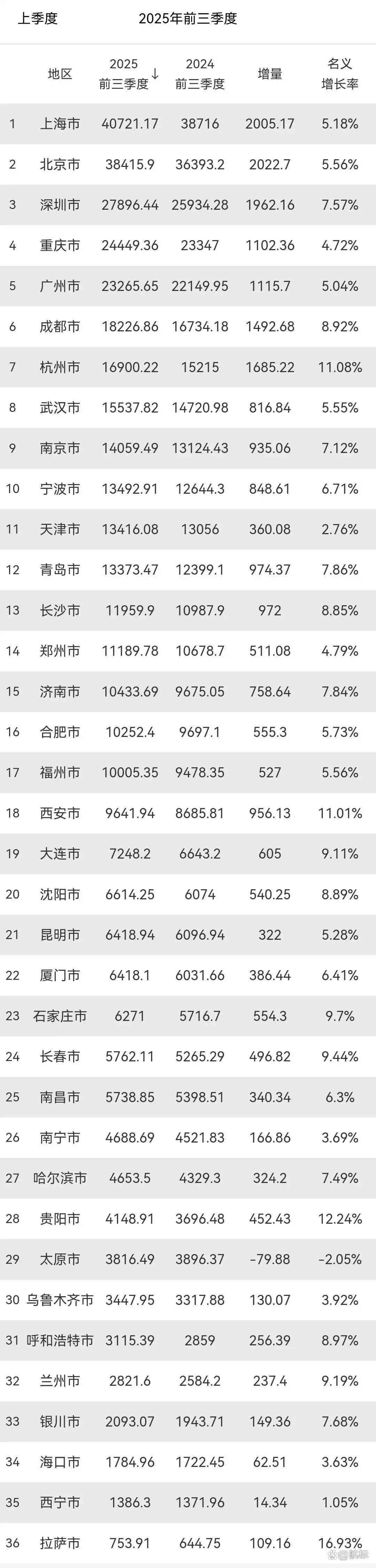
GDP出炉!36个主要城市大洗牌:重庆不负当年,南京逼近武汉,南昌降至第25!
Sou Hu Cai Jing· 2025-11-26 19:09
Core Insights - The GDP rankings of 36 major cities in China for the first three quarters of 2025 reveal a reshaping of urban competition driven by regional strategies and industrial transformation, with Chongqing surpassing Guangzhou to rank fourth [1] - The economic performance of cities like Nanjing and Wuhan indicates a competitive dynamic, where Nanjing's 7.1% growth rate is closing the gap with Wuhan's 5.5% [5] - The data highlights the challenges faced by cities like Nanchang, which has dropped to 25th place, reflecting difficulties in industrial transformation despite emerging growth in new energy sectors [5][7] Economic Performance - Shanghai leads with a GDP of 40,721.17 billion, showing a growth of 5.18% compared to the previous year [2] - Beijing follows with a GDP of 38,415.9 billion and a growth rate of 5.56% [2] - Shenzhen's GDP is not specified but shows a significant growth rate of 7.57% [2] - Chongqing's GDP reached 24,449.36 billion, with a growth rate of 4.72% [4] - Nanjing's GDP is 14,059.49 billion, with a growth rate of 7.12%, indicating strong performance [2] Sectoral Insights - Chongqing's third industry accounts for 59.3% of its GDP, growing by 6.3%, with significant increases in new energy vehicle production and integrated circuits [4] - Nanjing's digital economy now constitutes 38% of its GDP, driven by advancements in 5G technology [5] - Nanchang's traditional manufacturing still dominates, but new energy initiatives are showing promise with a 44% growth in the sector [5] Competitive Dynamics - The competition between cities like Wuhan and Nanjing reflects a strategic battle between leveraging existing strengths and pursuing new growth opportunities [5] - The economic reshuffling among the 36 cities emphasizes the importance of continuous innovation and adaptation in urban development strategies [7]
陕西咸阳:在西咸一体化中取得发展新突破
Xin Hua Cai Jing· 2025-11-26 05:44
Core Viewpoint - The integration of Xi'an and Xianyang is a strategic move to promote regional coordinated development, with Xianyang aiming for a GDP of 300 billion yuan and a growth rate of 6.5% in 2024, leading the province [1] Transportation Integration: Opening Up "Fast Roads" - Transportation connectivity is a key strategy for the Xi'an-Xianyang integration, with a goal for commuting time between the two cities to be under 45 minutes [2] - The opening of the third phase of Xi'an Metro Line 1 in September 2023 has significantly reduced commuting time from 80 minutes to 50 minutes [2] - The new Xianyang Weihe High-tech Bridge, connecting key innovation areas, has shortened travel distance from 12 kilometers to 2 kilometers [3] Scientific Innovation Collaboration: New Base for Results Transformation - Xianyang is leveraging the Xi'an-Xianyang integration to enhance collaboration in technology innovation and results transformation [4] - The establishment of the Qin Chuang Yuan platform in 2021 has accelerated the commercialization of scientific achievements [4] - The Shaanxi Hydrogen Quality Technology Innovation Base aims to become a leading source for hydrogen industry innovation in the province [4] Industrial Integration: Accelerating Development - The China West Electric Group's smart industrial park in Xianyang is set to enhance the high-end manufacturing sector, with an expected annual output value of 1.2 billion yuan [6] - Xianyang is positioning itself as a hub for the transfer of industries from Xi'an, with 216 collaborative projects underway, 84 completed, and an investment of 44.3 billion yuan [7] - The tourism sector is also being integrated, with joint initiatives to promote cultural tourism, resulting in a 5.6% increase in domestic tourist visits in the first three quarters of the year [7]
财政收入20强城市出现大洗牌:杭州太抢眼,重庆略高天津,武汉11
Sou Hu Cai Jing· 2025-11-26 05:14
Core Insights - The fiscal revenue of major Chinese cities has shown significant changes in the first three quarters of 2025, with Shanghai, Beijing, and Shenzhen leading the rankings, reflecting the solid strength of first-tier cities [1][6] - The overall ranking has undergone a reshuffle, with cities like Hangzhou and Chongqing demonstrating new economic vitality, indicating a strong recovery and diversified development in the Chinese economy [1][6] Group 1: Fiscal Revenue Highlights - Shanghai's total revenue reached 655.568 billion yuan, an increase from 649.396 billion yuan in the same period of 2024 [6] - Beijing's revenue was 503.990 billion yuan, up from 486.624 billion yuan year-on-year [6] - Shenzhen reported a revenue of 313.214 billion yuan, compared to 296.800 billion yuan in the previous year [6] Group 2: Emerging Cities and Economic Drivers - Hangzhou ranked 13th with a fiscal revenue of 98.290 billion yuan, driven by its digital economy and significant contributions from leading companies like Alibaba and Hikvision [3] - Chongqing, in 6th place, reported a revenue of 187.800 billion yuan, benefiting from its automotive and electronics industries, with a 25% growth in logistics revenue [4] - Wuhan, ranked 11th with 129.896 billion yuan, showcased a solid industrial upgrade foundation, particularly in the electronics and automotive sectors [5] Group 3: Economic Growth Indicators - The digital trade scale in Hangzhou surpassed 750 billion yuan, with a year-on-year growth of over 15% [3] - Chongqing's industrial added value exceeded 1.2 trillion yuan, with foreign direct investment increasing by 18% [4] - Wuhan's new energy vehicle production grew by 35%, with export values reaching 20 billion USD [5]
我市入选国家级试点名单
Xi An Ri Bao· 2025-11-26 05:09
Core Viewpoint - The Ministry of Human Resources and Social Security has issued a notice to promote the integration of human resources services with the manufacturing industry, with Xi'an being the only city in Shaanxi province selected for the pilot program [1] Group 1: Pilot Program Overview - A total of 39 cities, including Xi'an, will focus on key areas of manufacturing, leveraging local industrial foundations and resources to explore innovative paths for industrial upgrading and employment promotion [1] - The pilot cities aim to address the human resources supply constraints that hinder manufacturing development and enhance the level of human resources development and utilization in the manufacturing sector [1] Group 2: Focus Areas and Initiatives - Xi'an will concentrate on key manufacturing sectors such as intelligent manufacturing, electronic information, new materials and new energy, aerospace, and biotechnology [1] - The city plans to cultivate specialized human resources service institutions dedicated to the manufacturing industry and establish integrated development parks and public service platforms [1] Group 3: Future Goals and Expectations - By the end of 2027, Xi'an aims to form a human resources service alliance targeting 19 key industrial chains in the manufacturing sector and establish over five "advanced manufacturing recruitment unions" covering key industries [2] - The city will set up human resources service liaison stations in more than three key industrial parks to facilitate the efficient integration of resources [2]
文三街区:穿越二十年的数字记忆
Hang Zhou Ri Bao· 2025-11-26 02:13
Core Insights - The Wensan Digital Life Street in Hangzhou has transformed into a technology experience hub, showcasing innovations like brain-machine interfaces and attracting over 60,000 visitors since the opening of the Wensan Future Technology Experience Center in April 2023 [3][6]. Group 1: Historical Context - Wensan Street has been a significant location for digital products since its establishment in 2003, becoming a go-to place for young people in Hangzhou to purchase computers and digital devices [4]. - The area, known as "Hangzhou's Zhongguancun," once housed over 3,000 electronic information companies, reflecting its importance in the digital economy [4]. Group 2: Transformation and Upgrades - In response to the need for industrial upgrades, the Wensan Digital Life Street underwent a transformation starting in 2021, evolving from a marketplace for electronic products to a venue for experiencing "new tech specialties" [5][6]. - The street now features immersive experiences, such as a meditation space and robotic cleaning assistants, and has opened a store showcasing over 300 popular tech products [6]. Group 3: Economic and Cultural Impact - The street serves as a "business scene incubator," linking technology companies with consumers and contributing to Hangzhou's goal of becoming a leading digital economy city [7]. - By integrating technology with cultural tourism, the street aims to create a platform that enhances consumer engagement and stimulates industrial growth [6][7].

第十届“创客中国”大赛总决赛在郑开赛 “创客”论剑 问鼎中原
He Nan Ri Bao· 2025-11-25 23:30
Core Insights - The 10th "Maker China" National Finals for SMEs innovation and entrepreneurship competition is being held in Zhengzhou, showcasing high-tech and innovative projects from various sectors [1][2] - The competition has gathered nearly 240,000 projects over ten years, highlighting the emergence of numerous high-quality innovation and entrepreneurship initiatives [2] - The event serves as a platform for deep integration of industrial, innovation, financial, and talent chains, promoting collaboration among various stakeholders [3] Summary by Categories Event Overview - The finals feature 50 projects from the enterprise group and 10 from the startup group, selected from regional competitions [1] - This is the first time the finals are held in Henan, emphasizing the region's growing role in innovation [1] Project Highlights - Notable projects include advancements in electronic information, renewable energy, smart equipment, and healthcare, demonstrating the strength of SMEs in cutting-edge technology [1] - Specific projects mentioned include "112G high-speed interconnect oDSP chip empowering AI computing clusters" and "high-precision humanoid robots" [1] Participation and Growth - The competition has seen a significant increase in participation, with 37,700 projects registered this year, including 6,461 specialized and innovative enterprises, and 1,259 "little giant" enterprises, marking a year-on-year growth of nearly 28% and 50% respectively [2] - Over the past three years, more than 520 enterprises recognized as "specialized, refined, distinctive, and innovative" have emerged through the competition [2] Supporting Activities - The finals include various supporting activities such as project exchange meetings, industry matchmaking events, and exhibitions of innovative achievements [3] - Representatives from outstanding projects, specialized enterprises, listed companies, universities, research institutions, and financial investment organizations are participating to foster an innovative ecosystem [3]
【西安】入选人力资源服务业与制造业融合发展试点城市
Shan Xi Ri Bao· 2025-11-25 22:58
Core Viewpoint - The Ministry of Human Resources and Social Security has announced a pilot program for the integration of human resources services and manufacturing industries, with Xi'an being the only selected city in Shaanxi Province [1][2] Group 1: Pilot Program Details - A total of 39 cities have been selected for the pilot program, focusing on key areas in manufacturing [1] - The program aims to address the human resources supply shortfall that restricts manufacturing development and enhance the utilization of human resources in the manufacturing sector [1] Group 2: Focus Areas and Goals - Xi'an will concentrate on key manufacturing sectors such as intelligent manufacturing, electronic information, new materials and new energy, aerospace, and biotechnology [1] - The city plans to cultivate specialized human resources service institutions and develop industrial parks and public service platforms that integrate human resources services with manufacturing [1] Group 3: Future Plans - By the end of 2027, Xi'an aims to establish a human resources service alliance targeting 19 key industrial chains in the manufacturing sector [2] - The city plans to create over five "advanced manufacturing recruitment and employment coalitions" covering key industries and set up human resources service liaison stations in more than three major industrial parks [2]
地方政府与城投企业债务风险研究报告:成都篇
Lian He Zi Xin· 2025-11-25 11:37
1. Report Industry Investment Rating No relevant information provided. 2. Core Viewpoints of the Report - Chengdu is a key city in the national regional development strategy, with significant economic scale and fiscal strength. In 2024, its economy steadily improved, and the general public budget revenue slightly increased, but the comprehensive fiscal resources declined due to the decrease in government - funded revenue. With favorable national policies, it aims to build into an influential regional economic and technological innovation center [4]. - Chengdu conducts industrial spatial layout around the principle of "Eastward Expansion, Southward Extension, Westward Control, Northward Reconstruction, and Central Optimization". The economic and fiscal strength shows a decreasing trend from the inner - circle to the outer - circle areas. The government debt level in the main urban area is much lower than that in other districts and counties, and the city is strengthening the resolution of existing debts [4]. - Affected by the implementation of a package of debt - resolution policies, the bond issuance scale in Chengdu decreased significantly in 2025, with net outflows in bond financing. The financing structure of bond - issuing城投 enterprises is mainly bank loans and bond financing. The short - term debt repayment pressure in the near - suburban and far - suburban areas is relatively large [4]. 3. Summary According to Relevant Catalogs 3.1 Chengdu's Economic and Fiscal Strength 3.1.1 Regional Characteristics and Economic Development - Chengdu is a provincial capital, sub - provincial city, and national central city, playing a prominent role in the national regional development strategy. It has obvious locational advantages, with developed aviation transportation and rich water, mineral, and tourism resources. The population shows a continuous net inflow, and the urbanization rate has room for further improvement. In 2024, its GDP exceeded 2.30 trillion yuan, ranking third among sub - provincial cities, with a growth rate of 5.7%. The tertiary industry contributes significantly to the economy, and the city is focusing on cultivating industrial clusters such as electronic information, equipment manufacturing, and aerospace [5][7][8]. - In the future, under the guidance of national policies, Chengdu will build a new urban development pattern of "One Mountain Connecting Two Wings" and adhere to the "One - Game - of - Chess" concept of Sichuan and Chongqing to enhance its international competitiveness and regional radiation ability [11]. 3.1.2 Fiscal Strength and Debt Situation - Chengdu's fiscal strength ranks high among national sub - provincial cities, with strong stability of general public budget revenue and fiscal self - sufficiency. In 2024, the comprehensive fiscal resources declined due to the decrease in government - funded revenue. The government debt level ranked in the upper - middle position among sub - provincial cities in 2024. With large - scale future project investments, the government debt ratio may continue to rise [12][13]. 3.2 Economic and Fiscal Conditions of Each District and County in Chengdu 3.2.1 Economic Strength of Each District and County - Chengdu conducts industrial spatial layout according to the principle of "Eastward Expansion, Southward Extension, Westward Control, Northward Reconstruction, and Central Optimization" to achieve industrial differentiation and clustering. The economic scale of Chengdu High - tech Zone is far ahead, and the economic scale and urbanization rate of other districts and counties decrease layer by layer from the inner - circle to the outer - circle areas. The main urban area has obvious advantages in per - capita GDP and urbanization rate, and the far - suburban areas are relatively weak [16][22]. 3.2.2 Fiscal Strength and Debt Situation of Each District and County - Fiscal Revenue: The fiscal strength of Chengdu High - tech Zone is the strongest, and the fiscal strength of other districts and counties decreases from the main urban area to the outside. The general public budget revenue of Chengdu High - tech Zone, Chengdu Tianfu New Area, and the main urban area is relatively stable, while the comprehensive fiscal resources of the far - suburban areas rely more on superior subsidies. In 2024, the comprehensive fiscal resources of most far - suburban areas increased due to the growth of superior subsidies, while those of other areas declined to varying degrees due to the decrease in government - funded revenue [25][29]. - Debt Situation: The government debt level in the main urban area is much lower than that in other districts and counties. The government debt distribution is related to the industrial layout and development principle. In 2024, the government debt scale of each district and county generally increased. The main urban area had a significant increase in government debt mainly due to the large - scale issuance of refinancing special bonds. The city is strengthening debt management and promoting debt resolution and replacement [32][34]. 3.3 Debt - Repayment Ability of Chengdu's城投 Enterprises 3.3.1 Overview of Chengdu's城投 Enterprises - As of the end of October 2025, there were 106城投 enterprises with outstanding bonds in Chengdu, a decrease of 5 compared with the previous year. Among them, there are 9 municipal - level, 3 park - level, and 94 district - and - county - level城投 enterprises. In terms of grade distribution, there are 10 AAA - rated, 34 AA + - rated, and 57 AA - rated enterprises. Jin tang County has the most bond - issuing城投 enterprises [36]. 3.3.2 Bond Issuance of城投 Enterprises - In 2024, the number and scale of bonds issued by Chengdu's城投 enterprises decreased compared with the previous year. In 2025, from January to October, the bond issuance scale continued to decline, with a year - on - year decrease of about 28%. Most of the bond financing is used for debt rollover, and the overall bond financing shows a net outflow [39][40]. 3.3.3 Debt - Repayment Ability Analysis of Chengdu's城投 Enterprises - The financing structure of Chengdu's城投 enterprises is mainly bank loans and bond financing. Some district - and - county - level城投 enterprises have heavy debt burdens. In the next two years, the bond maturity scale of some districts and counties is relatively large, and the short - term debt - repayment ability of some areas is weak. The refinancing ability of the main urban area and near - suburban areas is significantly stronger than that of the far - suburban areas [45][49][51]. 3.3.4 Support and Guarantee Ability of Fiscal Revenue of Each District and County in Chengdu for the Debt of Bond - Issuing城投 Enterprises - Overall, the debt scale of Chengdu's城投 enterprises is large, and the ratio of "total debt of bond - issuing城投 enterprises + local government debt" to comprehensive fiscal resources in most districts and counties exceeds 500% [53].
稀土 大消息!
Zhong Guo Ji Jin Bao· 2025-11-25 09:44
Core Insights - A groundbreaking research collaboration between Heilongjiang University, Tsinghua University, and the National University of Singapore has successfully addressed the challenge of efficient electroluminescence in insulating rare earth nanocrystals, as published in *Nature* [1][3][5] - This research supports China's strategic shift from "raw material export" to "high value-added technology output" in the rare earth sector [1][5] Industry Overview - Rare earth elements are considered irreplaceable strategic resources, often referred to as "industrial vitamins" [3] - China holds advantages in rare earth resource reserves and smelting but faces bottlenecks in high-end functional materials and devices [3] Technological Breakthrough - The research team introduced an organic semiconductor sensitization strategy, using functionalized organic ligands as a "photoelectric bridge" to efficiently transfer energy to insulating rare earth nanocrystals, enabling current-driven efficient light emission [3][5] - The new technology demonstrates significant application potential, with electroluminescent device efficiency improved by 76 times and the ability to achieve full-spectrum light emission through rare earth ion modulation in a single device [5] Implications for the Rare Earth Industry - This breakthrough paves the way for transforming the properties of rare earth materials into high-end device functionalities, contributing to the enhancement of China's independent innovation capabilities and the added value of end products in the rare earth industry [5]
