贸易

Search documents
贸易板块9月17日跌0.61%,怡 亚 通领跌,主力资金净流出3.5亿元
Zheng Xing Xing Ye Ri Bao· 2025-09-17 08:45
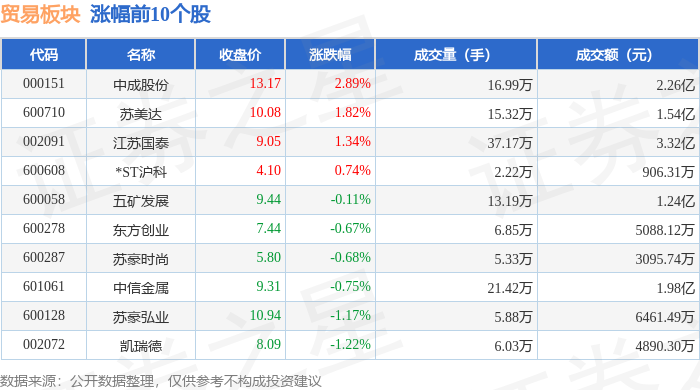
Market Overview - On September 17, the trade sector fell by 0.61%, with Yi Yatong leading the decline [1] - The Shanghai Composite Index closed at 3876.34, up 0.37%, while the Shenzhen Component Index closed at 13215.46, up 1.16% [1] Stock Performance - Notable gainers in the trade sector included: - Zhongcheng Co., Ltd. (Code: 000151) with a closing price of 13.17, up 2.89% and a trading volume of 169,900 shares, totaling 226 million yuan [1] - Sumec Corp. (Code: 600710) closed at 10.08, up 1.82% with a trading volume of 153,200 shares, totaling 154 million yuan [1] - Jiangsu Guotai (Code: 002091) closed at 9.05, up 1.34% with a trading volume of 371,700 shares, totaling 332 million yuan [1] - Yi Yatong (Code: 002183) experienced a significant drop, closing at 5.75, down 4.80% with a trading volume of 4,497,800 shares, totaling 2.652 billion yuan [2] Capital Flow - The trade sector saw a net outflow of 350 million yuan from institutional investors, while retail investors contributed a net inflow of 246 million yuan [2] - The capital flow for key stocks in the trade sector showed mixed results, with Zhongcheng Co., Ltd. experiencing a net outflow of 22.52 million yuan from institutional investors [3] - Sumec Corp. had a net inflow of 16.87 million yuan from institutional investors, indicating positive sentiment [3]


宏观日报:关注下游扩大服务消费政策-20250917
Hua Tai Qi Huo· 2025-09-17 07:56
宏观日报 | 2025-09-17 关注下游扩大服务消费政策 中观事件总览 生产行业: 1)9月16日,2025腾讯全球数字生态大会在深圳举行,会上公布多项AI技术和产品最新进展,并宣布 全面开放腾讯AI落地能力及优势场景。面对各界关注的算力问题,腾讯集团副总裁、腾讯云总裁邱跃鹏宣布,目 前腾讯已经全面适配主流的国产芯片,并积极参与和回馈开源社区。与此同时,软硬件协同全栈优化是腾讯云的 长期战略投入,通过异构计算平台的软件能力,整合不同类型的芯片对外提供高性价比的AI算力。 服务行业: 1)商务部等9部门9月16日对外发布《关于扩大服务消费的若干政策措施》,提出五方面19条举措,包 括开展"服务消费季"系列促消费活动;支持优质消费资源与知名IP跨界合作;因地制宜延长热门文博场馆、景区营 业时间,优化预约方式,鼓励推行免预约;优化学生假期安排,完善配套政策等。增加优质服务供给,更好满足 人民群众多样化服务消费需求。 数据来源:iFind,华泰期货研究院 行业总览 上游:1)黑色:玻璃价格回落,煤炭库存升高。2)农业:鸡蛋价格回升超10%。 中游:1)化工:PX、PTA开工率近期回升。 下游:1)地产:一、二、三 ...

普瑞投资发展(广州)有限公司成立 注册资本1万人民币
Sou Hu Cai Jing· 2025-09-17 06:49
天眼查App显示,近日,普瑞投资发展(广州)有限公司成立,注册资本1万人民币,经营范围为国内 贸易代理;针纺织品及原料销售;塑料包装箱及容器制造;塑料制品制造;五金产品制造;纸和纸板容器制造; 纸制品制造;品牌管理;网络技术服务;以自有资金从事投资活动;创业投资(限投资未上市企业);企业管 理咨询;企业管理;企业形象策划;技术进出口;货物进出口;信息技术咨询服务;社会经济咨询服务;信息咨询 服务(不含许可类信息咨询服务);融资咨询服务;技术服务、技术开发、技术咨询、技术交流、技术转 让、技术推广;咨询策划服务;包装装潢印刷品印刷。 ...
连云港缘生财贸易有限公司成立 注册资本100万人民币
Sou Hu Cai Jing· 2025-09-16 22:15
Core Viewpoint - A new company, Lianyungang Yuanshengcai Trading Co., Ltd., has been established with a registered capital of 1 million RMB, focusing on various aspects of the new energy vehicle industry, including sales, recycling, and technology services [1] Company Overview - The company is legally represented by Li Qipeng and has a registered capital of 1 million RMB [1] - The business scope includes sales of electric vehicle charging, new energy vehicle accessories, and battery recycling [1] Industry Focus - The company operates in the new energy vehicle sector, which includes the sale of electric vehicle charging stations and battery leasing services [1] - It also engages in the recycling and secondary utilization of used power batteries from new energy vehicles [1] Services Offered - The company provides a wide range of services, including technology development, consulting, and information technology services [1] - Additional offerings include sales of electronic components, cloud computing equipment, and digital video monitoring systems [1]

贸易板块9月16日涨1.65%,怡 亚 通领涨,主力资金净流入8094.86万元
Zheng Xing Xing Ye Ri Bao· 2025-09-16 08:46
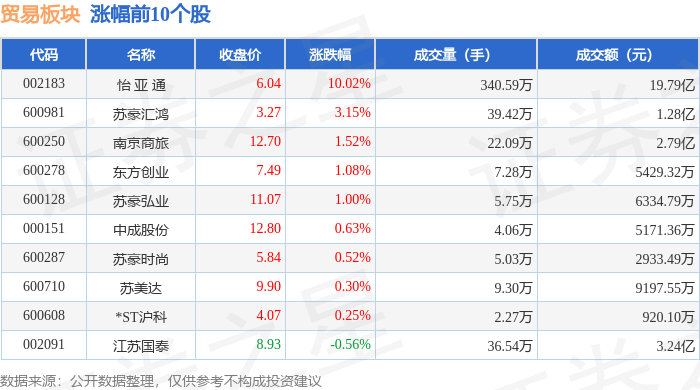
Core Insights - The trade sector experienced a rise of 1.65% on September 16, with Yi Yatong leading the gains [1] - The Shanghai Composite Index closed at 3861.87, up 0.04%, while the Shenzhen Component Index closed at 13063.97, up 0.45% [1] Trade Sector Performance - Yi Yatong (002183) closed at 6.04, with a significant increase of 10.02% and a trading volume of 3.41 million shares, resulting in a transaction value of 1.98 billion [1] - Other notable performers included Yimeng Huihong (600981) with a 3.15% increase, Nanjing Commercial Travel (600250) up by 1.52%, and Dongfang Chuangye (600278) rising by 1.08% [1] Capital Flow Analysis - The trade sector saw a net inflow of 80.95 million in main funds, while retail investors experienced a net outflow of 25.76 million [2] - Main funds showed a significant net inflow into Yi Yatong, amounting to 154 million, while retail investors had a net outflow of 71.63 million [3] - Other companies like Nanjing Commercial Travel and Yimeng Huihong also experienced mixed capital flows, with varying levels of net inflow and outflow [3]
佛山市轻能工贸有限公司成立 注册资本100万人民币
Sou Hu Cai Jing· 2025-09-16 07:23
Core Insights - A new company, Foshan Qinneng Industrial and Trade Co., Ltd., has been established with a registered capital of 1 million RMB [1] Group 1: Company Overview - The company is engaged in a wide range of business activities including wholesale and retail of hardware products, sales of generators and wind turbine equipment, and import-export services [1] - The operational scope includes sales of electrical equipment, household appliances, machinery, pumps, and various consumer goods [1] - The company is authorized to conduct business activities independently as per its business license, excluding projects that require special approval [1]
中联投与阿吉兰国际集团成立3亿美元基金
Sou Hu Cai Jing· 2025-09-16 00:42
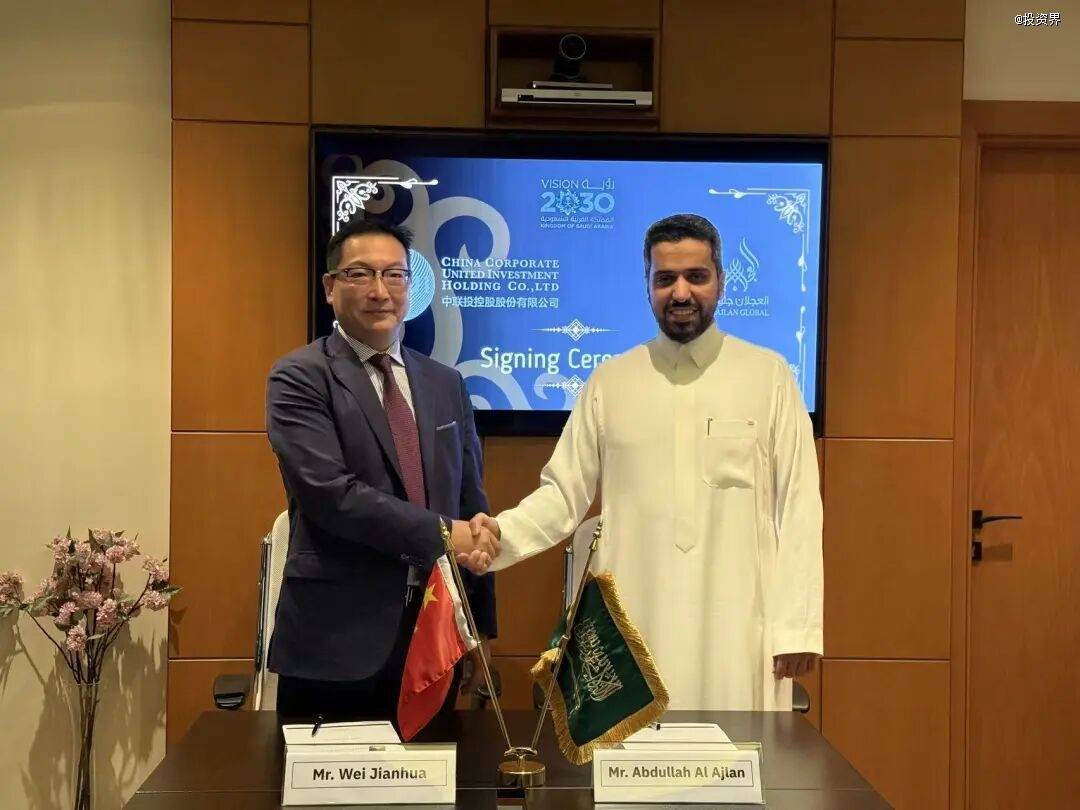
Group 1 - The core agreement involves a $300 million equity investment fund focused on advanced technology sectors such as artificial intelligence, new energy, and semiconductor industries [1] - The meeting prior to the agreement included discussions on industrial cooperation opportunities under Saudi Arabia's Vision 2030, emphasizing the integration of Chinese industries with local upgrades [3] - The collaboration between Zhonglian Investment and Al-Ajlan Global signifies recognition of Zhonglian's capabilities as a fund manager by a major Middle Eastern enterprise, marking an important milestone in the company's internationalization strategy [3] Group 2 - Al-Ajlan Global is one of the largest companies in Saudi Arabia, operating in various sectors including trade, real estate development, industrial, petrochemical, medical, technology, artificial intelligence, and food across more than ten countries [3] - MODON, the Saudi Industrial Cities and Technology Zones Authority, plays a crucial role in the country's economic diversification strategy, managing over 36 industrial cities and fostering ecosystems in strategic industries [3]
日经指数上涨0.3% 受电子制造商和贸易公司推动
Sou Hu Cai Jing· 2025-09-16 00:37
Core Viewpoint - The Japanese stock market rose due to expectations of potential interest rate cuts by the Federal Reserve, which boosted overnight U.S. stocks [1] Group 1: Market Performance - The Nikkei average index increased by 0.3%, closing at 44,916.65 points [1] - Electronic manufacturers and trading companies led the gains in the market [1] Group 2: Notable Stock Movements - Kioxia Holdings saw a rise of 4.3% [1] - Marubeni Corporation increased by 2.5% [1] Group 3: Currency Exchange - The USD/JPY exchange rate was at 147.40, showing little change from 147.38 at 5 PM New York time on Monday [1] Group 4: Political Context - Investors are closely monitoring any developments regarding the ruling Liberal Democratic Party's leadership election in Japan [1]
贸易板块9月15日涨1.2%,怡 亚 通领涨,主力资金净流入1.07亿元
Zheng Xing Xing Ye Ri Bao· 2025-09-15 08:42
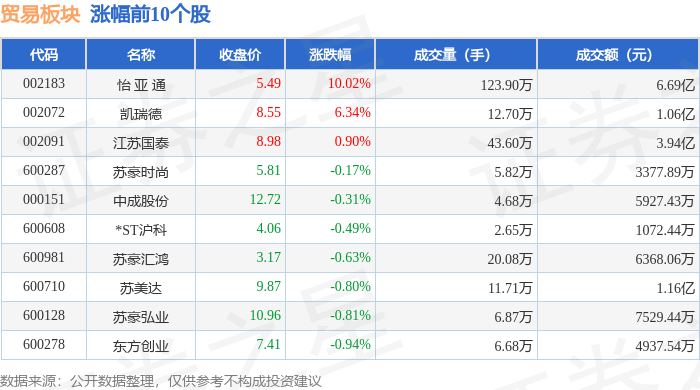
Core Insights - The trade sector experienced a 1.2% increase on September 15, with Yi Yatong leading the gains [1] - The Shanghai Composite Index closed at 3860.5, down 0.26%, while the Shenzhen Component Index closed at 13005.77, up 0.63% [1] Trade Sector Performance - Yi Yatong (002183) closed at 5.49, up 10.02% with a trading volume of 1.239 million shares and a transaction value of 669 million [1] - Kairuide (002072) closed at 8.55, up 6.34% with a trading volume of 127,000 shares and a transaction value of 106 million [1] - Jiangsu Guotai (002091) closed at 86.8, up 0.90% with a trading volume of 436,000 shares and a transaction value of 394 million [1] - Other notable stocks included Shisuo Fashion (600287) down 0.17% and Zhongcheng Co. (000151) down 0.31% [1] Capital Flow Analysis - The trade sector saw a net inflow of 107 million from institutional investors, while retail investors experienced a net outflow of 57.76 million [2] - The main stocks with significant capital flow included Yi Yatong with a net inflow of 174 million, while retail investors had a net outflow of 84.89 million [3] - Other stocks like Zhongxin Metal (601061) and Kairuide (002072) also showed varied capital flows, indicating mixed investor sentiment [3]
中经资料:巴基斯坦证券市场一周回顾(2025.09.08 - 2025.09.12)
Zhong Guo Jing Ji Wang· 2025-09-15 06:56
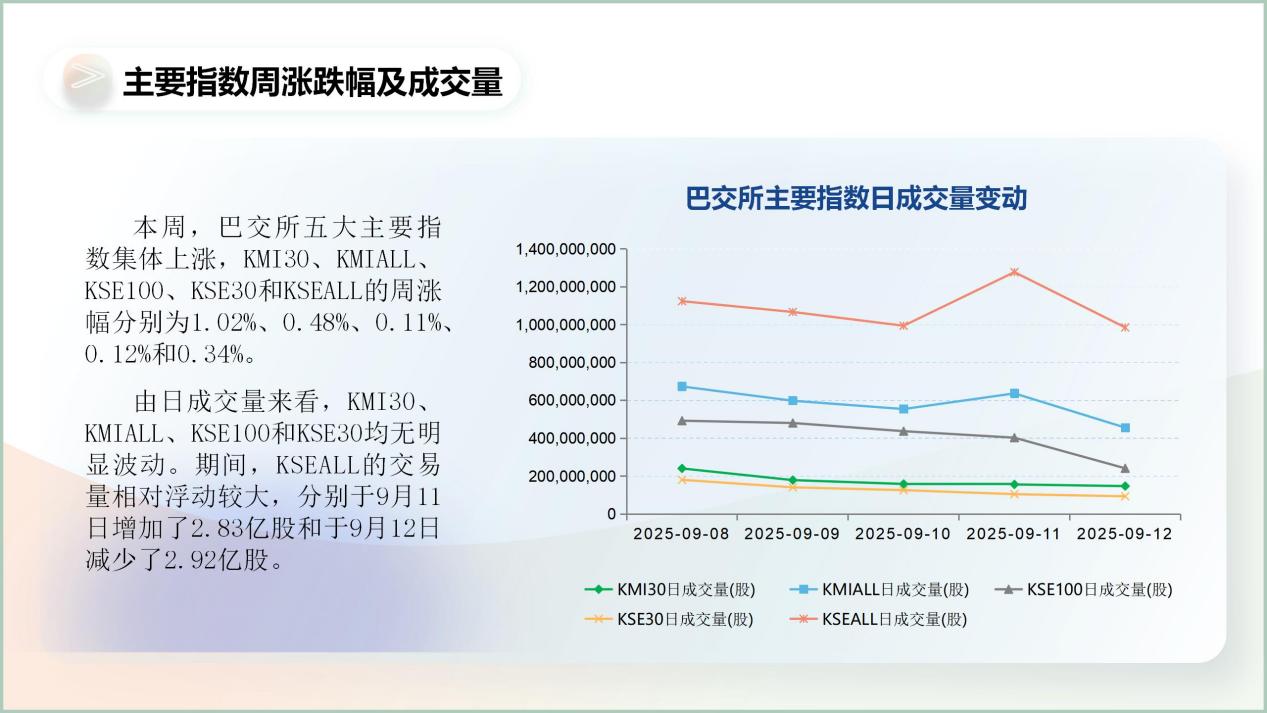
Group 1: Company Registrations and Economic Indicators - In August 2025, Pakistan registered 3,278 new companies, with a total paid-up capital of 7.74 billion PKR, bringing the total number of registered companies to approximately 265,600 [9] - The information technology and e-commerce sector led the new registrations with 670 companies, followed by trade (413), services (394), and real estate and construction (297) [9] - Worker remittances in August 2025 amounted to 3.1 billion USD, showing a 2.38% decline from the previous month but a 6.6% increase year-on-year [9] Group 2: Government Debt and Tax Expenditures - The total government debt for the fiscal year 2024-2025 reached 77.888 trillion PKR, a 13% increase from the previous fiscal year's 68.914 trillion PKR, raising the debt-to-GDP ratio to 73.2% [10] - The Federal Board of Revenue (FBR) estimated tax expenditures for the fiscal year 2023-2024 at 2.43 trillion PKR, which is 26.18% of the total revenue (9.3 trillion PKR) and 2.32% of the GDP (105.14 trillion PKR) [10] Group 3: Banking Sector Performance - The banking sector's asset size grew by 11.0% in the first half of 2025, with deposits increasing by 17.7%, while the ratio of non-performing loans slightly worsened to 7.4% [11] - The banking sector's credit risk remains manageable, with a decrease in non-performing loans reported [11] Group 4: Automotive Industry Growth - In the first two months of the fiscal year 2025-26, automobile sales and production in Pakistan increased by 40.06% and 100.93%, respectively, with sales rising from 12,274 units to 17,192 units [12] - Motorcycle sales also saw significant growth, increasing by 44.06% from 189,227 units to 272,601 units during the same period [12] Group 5: International Financial Support - The Asian Development Bank (ADB) and the Asian Infrastructure Investment Bank (AIIB) agreed to provide a total guarantee of 285 million USD to assist Pakistan in issuing 250 million USD in panda bonds, with commitments to use the funds for green projects [11]