石油和天然气

Search documents
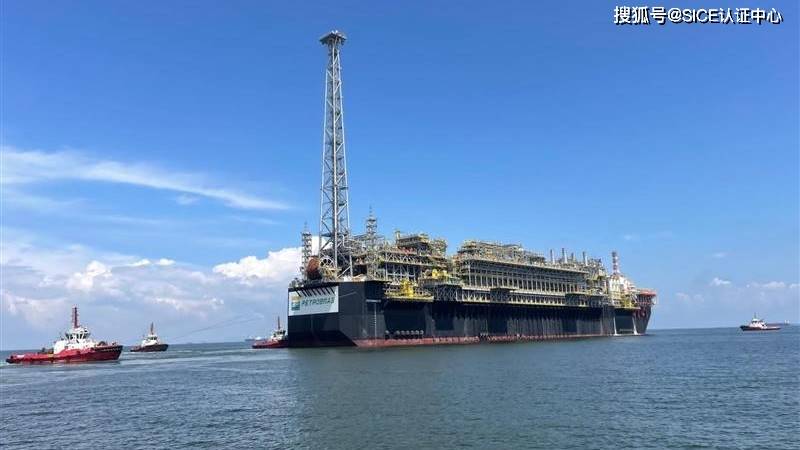
未来6年内,将有哪21座浮式生产储卸油装置(FPSO)在巴西投入运营?
Sou Hu Cai Jing· 2026-01-11 05:08
Core Insights - Petrobras has released its strategic plan for 2026-2030, focusing on updating the next FPSO in the offshore market [1] - The FPSO P-78 is a key project in the Búzios oil field, expected to start production in December 2025, contributing to Petrobras's goal of increasing daily oil production to 1.6 million barrels over the next decade [3][4] - The FPSO P-79, a sister project to P-78, is set to begin operations in early 2026, with similar production capacity and a different construction strategy [6][7] - FPSOs P-80, P-82, and P-83 are planned for 2027, each with a production capacity of 225,000 barrels per day and a focus on reducing carbon emissions [11] - The FPSO Raia project, expected to be operational by 2028, will include a gas export capacity of 16 million cubic meters per day [10][15] - FPSOs P-84 and P-85, scheduled for 2029 and 2030, will be the largest in Petrobras's history, with a daily processing capacity of 225,000 barrels of oil [17][19] - The SEAP FPSOs I and II contracts were officially approved in 2025, marking a significant step in the revitalization of the Sergipe state industrial sector [37][38] Summary by Category FPSO Projects - FPSO P-78 is the sixth project in the Búzios field, with a production capacity of 180,000 barrels per day and gas processing of 7.2 million cubic meters per day [4] - FPSO P-79, a direct sibling to P-78, will also have a capacity of 180,000 barrels per day and is set to sail from Korea in November 2025 [6][7] - FPSOs P-80, P-82, and P-83 are designed for high productivity, each with a capacity of 225,000 barrels per day and a focus on carbon emission reduction [11][12] - FPSO Raia will serve as a floating gas processing platform with a significant gas export capacity [15] - FPSOs P-84 and P-85 will be the largest FPSOs in Petrobras's history, with a focus on gas export capabilities [17][19] Strategic Developments - Petrobras's strategic plan emphasizes the need for innovation and sustainability in its FPSO projects, including the integration of carbon capture and utilization technologies [21][22] - The company is shifting to a BOT (Build-Operate-Transfer) model for new projects to enhance ownership and operational efficiency [26][37] - The SEAP FPSOs represent a significant investment in the Sergipe region, with a focus on local workforce reintegration and economic sustainability [38]


特朗普:美国将控制全球超半数的石油
Zhong Guo Xin Wen Wang· 2026-01-10 05:53
Core Viewpoint - The article discusses President Trump's statement regarding the potential for U.S. companies to regain access to Venezuela's oil industry, which could lead to the U.S. controlling over half of the global oil production [1] Group 1: U.S. Oil Industry Implications - Trump indicated that U.S. energy companies would have the opportunity to "rebuild" Venezuela's oil infrastructure, potentially increasing production to unprecedented levels [1] - The combined oil resources of Venezuela and the U.S. account for 55% of the global oil supply, highlighting the strategic importance of this development [1] Group 2: Oil Supply and Sanctions - Trump mentioned that Venezuela would "immediately" transfer 30 to 50 million barrels of sanctioned high-quality oil to the U.S., indicating a significant shift in oil supply dynamics [1]
今日国际国内财经新闻精华摘要|2026年1月10日
Xin Lang Cai Jing· 2026-01-10 00:12
International News - A U.S. judge has halted Trump's executive order freezing $10 billion in child care and family assistance funds for five states led by Democrats [1][7] - Trump has made several policy statements, including a potential government shutdown on January 30 and actions regarding Greenland, as well as comments on Iran facing significant troubles [1][7] - The U.S. has suspended federal financial aid to Minnesota, and the SEC's power to recover illegal gains is under review by the Supreme Court, which is expected to issue a tariff-related ruling on January 14 [1][7] - U.S. interactions with Venezuela have become a focus in the energy market, with Trump stating that Venezuela has agreed to allow the U.S. to refine up to 50 million barrels of oil, delivering 30 million barrels recently [1][7] Market Reactions - Chevron's stock rose over 1.8%, ExxonMobil increased by over 1%, while ConocoPhillips fell over 1% [2][8] - The U.S. financial markets performed well, with all three major indices closing higher; the Nasdaq rose by 0.81%, the S&P 500 by 0.65%, and the Dow Jones by 0.48%, with both the Dow and S&P 500 reaching record closing highs [2][8] - Intel's stock surged by 11%, marking its largest single-day gain since September, while Google's market cap surpassed $4 trillion with a 1.6% increase [2][8] Commodity Market - Significant volatility in the commodity market was noted, with U.S. natural gas futures dropping over 8% to $3.133 per million British thermal units, while WTI crude oil rose by 3% to $59.37 per barrel [3][9] - Precious metals showed strong performance, with spot gold surpassing $4,510 per ounce and New York futures exceeding $4,520 per ounce, with daily increases of 0.73% and 1.33% respectively; silver also broke the $80 per ounce mark [10] - The CFTC reported a reduction of 2,617 contracts in net long positions for gold speculators, while silver speculators increased their net long positions by 1,063 contracts [10] Domestic News - The domestic futures market saw active trading, with tin futures rising by 4% to 362,990 yuan, and methanol and PTA futures both increasing by 2% to 2,290 yuan and 5,192 yuan respectively [11] - A significant policy change in the photovoltaic industry was announced, with the Ministry of Finance and the State Administration of Taxation canceling export tax rebates for solar products, which is expected to increase costs and reduce price competitiveness for companies [11] - A domestic second-tier solar company indicated it might not take a holiday during the Spring Festival to accelerate exports, while analysts predict that leading and high-tech firms may expand their market share as domestic outdated capacity clears [11]
伊拉克准了:俄资油田,国有化
Guan Cha Zhe Wang· 2026-01-09 15:03
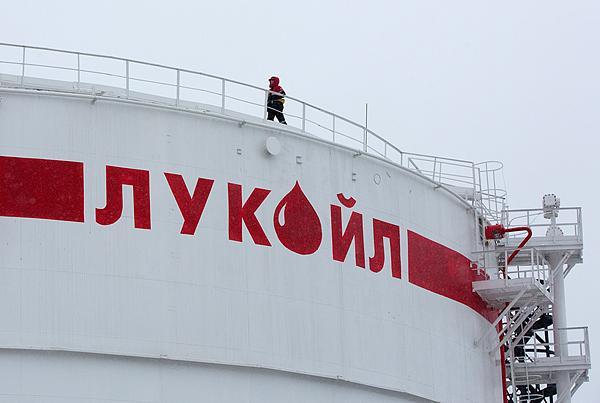
Core Viewpoint - The Iraqi government has approved a plan for the short-term nationalization of the West Qurna-2 oil field to mitigate production disruption risks due to U.S. sanctions on Russian shareholder Lukoil [1][3]. Group 1: Nationalization Plan - The Iraqi cabinet has decided to take over the operation of the West Qurna-2 oil field for 12 months, with funding support from associated accounts of the Majnoon oil field [1][3]. - Basra Oil Company will manage the oil field operations, ensuring stable production amid uncertainties caused by U.S. sanctions [1][3]. Group 2: Oil Field Significance - West Qurna-2 is one of the largest oil fields globally, contributing approximately 0.5% to global oil supply and 9% to Iraq's total oil production, with a daily output of 465,000 to 480,000 barrels [3][4]. - Lukoil holds a 75% operational stake in the West Qurna-2 oil field, which is its largest overseas asset [3][4]. Group 3: Impact of U.S. Sanctions - The U.S. announced comprehensive sanctions against Lukoil and another Russian energy giant, effective November 21, 2025, due to geopolitical tensions [3][4]. - Lukoil has invoked force majeure in its operations at West Qurna-2, citing inability to fulfill contractual obligations due to sanctions [4]. Group 4: Asset Sale and Acquisition Interest - Lukoil must sell its overseas assets by January 17, 2026, with potential buyers including ExxonMobil, Chevron, and Carlyle Group [4]. - Previous attempts to sell Lukoil's assets to Gunvor Group were blocked by the U.S. government, labeling Gunvor as a "puppet of the Kremlin" [4].
特朗普:取消对委第二波打击 油企将投资至少1000亿美元
Xin Hua She· 2026-01-09 11:51
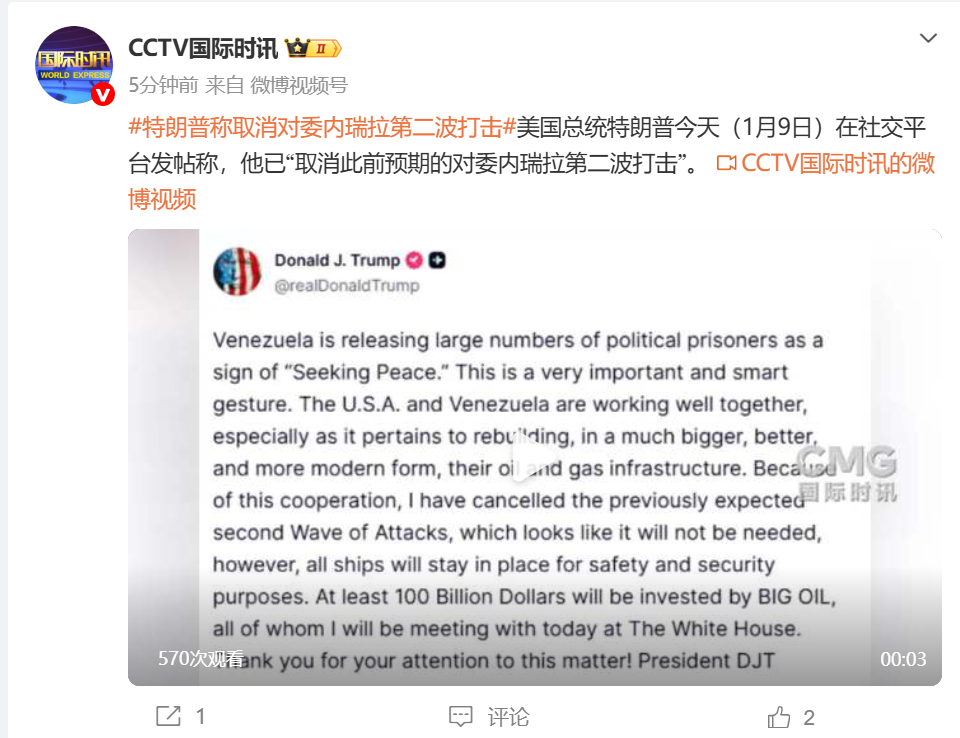
Group 1 - The U.S. President Trump announced the cancellation of the anticipated second wave of military strikes against Venezuela, stating it "does not seem necessary" [1] - All U.S. naval ships will remain on standby for security purposes [1] - Trump mentioned a meeting with executives from major oil companies at the White House, where they are expected to invest at least $100 billion in Venezuela [1] Group 2 - The U.S. is engaging in "good cooperation" with Venezuela, particularly in the modernization and rebuilding of its oil and gas infrastructure [1] - The release of a significant number of political prisoners in Venezuela is viewed as a "sign of seeking peace," which Trump described as an important and wise move [1]
特朗普:取消对委第二波打击,所有舰船都留在原地!美国和委内瑞拉正在密切合作,“尤其是在重建石油和天然气基础设施方面”
Mei Ri Jing Ji Xin Wen· 2026-01-09 09:55
Core Viewpoint - The U.S. President Trump announced the cancellation of the anticipated second wave of actions against Venezuela, citing that it "seems unnecessary" due to ongoing cooperation between the U.S. and Venezuela in rebuilding oil and gas infrastructure [1][3]. Group 1: U.S.-Venezuela Relations - Trump stated that the U.S. and Venezuela are closely collaborating, particularly in the reconstruction of oil and gas infrastructure, which will be conducted on a larger, higher quality, and more modern scale [3]. - All U.S. ships will remain on standby for security and safety reasons despite the cancellation of the second wave of actions [2][3]. Group 2: Investment in Venezuela - Trump mentioned that major U.S. oil companies are set to invest at least $100 billion in Venezuela, with a meeting scheduled at the White House with company representatives [4]. Group 3: Venezuelan Response - As of now, there has been no official response from the Venezuelan government regarding Trump's announcement [5]. - Venezuelan Vice President Rodriguez emphasized that Venezuela will neither be "subservient" to the U.S. nor "yield" to its pressures, highlighting the ongoing tensions in U.S.-Venezuela relations [5][6].
Northern Technologies International (NTIC) - 2026 Q1 - Earnings Call Transcript
2026-01-08 15:02
Financial Data and Key Metrics Changes - For the first quarter of fiscal 2026, total consolidated net sales increased by 9.2% to a record $23.3 million compared to the same period last year [5] - Gross profit as a percentage of net sales was 36% for the first quarter, down from 38.3% in the prior fiscal year, primarily due to a temporary supplier lead time issue [12] - Net income for the first quarter was $238,000 or $0.03 per diluted share, compared to $561,000 or $0.06 per diluted share in the first quarter of fiscal 2025 [12] Business Line Data and Key Metrics Changes - Zerust Oil & Gas net sales increased by 58.1% to $2.4 million, marking a record for the first quarter [7] - Zerust Industrial net sales increased by 6.9% [5] - Natur-Tec product net sales increased by 2.2% to a record $6 million, driven primarily by higher sales in North America [9] Market Data and Key Metrics Changes - NTIC China reported a 23.5% year-over-year increase in net sales to $4.9 million, indicating strong demand in that market [6] - Joint venture sales increased by 2.9% year-over-year to $24.5 million, despite a mid-single-digit decline at the German joint venture [5] Company Strategy and Development Direction - The company is focused on improving profitability by flattening operating expenses and driving sales in higher-margin segments [4] - NTIC plans to enhance operations in China, viewing it as a significant market for industrial and bioplastic segments [6] - The company is investing in its Zerust Oil & Gas business to enhance its sales team and support anticipated future growth [8] Management's Comments on Operating Environment and Future Outlook - Management expressed optimism about the start of fiscal 2026, expecting higher year-over-year sales and profitability as the year progresses [4] - The company anticipates that economic recovery from government stimulus packages in Europe will positively impact joint venture operating income [6] - Management believes that the investments made over the past three years will begin to yield benefits in terms of improved profitability [4] Other Important Information - As of November 30, 2025, working capital was $19.4 million, with outstanding debt slightly reduced to $12 million [13] - The company declared a quarterly cash dividend of $0.01 per common share, payable on November 12, 2025 [14] Q&A Session Summary Question: What are some levers to improve profitability? - Management indicated that driving sales growth is key to increasing gross margin and operating profit, with expectations for significant growth in the latter half of the fiscal year [16][17] Question: Are there opportunities for cost-cutting? - Management noted that while there are some opportunities, the focus is on allowing revenues to catch up to previous expense increases rather than cutting expenses that could hinder long-term growth [19][20] Question: Are you pleased with the sales team's performance in oil and gas? - Management confirmed that the sales team is starting to secure business, particularly with a significant contract in Brazil and growing opportunities in India and the Middle East [21] Question: Are there other major opportunities in oil and gas? - Management acknowledged the ongoing discussions with other oil companies globally, expecting business growth across various regions [26]

深海之下,国运之上:解码巴西石油公司的崛起之路与南美能源新秩序
Sou Hu Cai Jing· 2026-01-08 09:26
Core Insights - The article emphasizes the transformative impact of Brazil's offshore oil discoveries on the country's energy independence and geopolitical standing, particularly through the advancements made by Petrobras in deepwater oil exploration and production [1][3]. Group 1: Petrobras' Strategic Developments - Petrobras has shifted its focus from merely upstream exploration to a comprehensive energy value chain, aiming to reduce reliance on primary resource exports and enhance the production of high-value products [3]. - The company plans to achieve near self-sufficiency in diesel by 2029, currently importing 20%-25% of its diesel, primarily from Russia [3]. - Key projects like the Abreu e Lima Refinery and the Boaventura Energy Complex are central to Petrobras' strategy to increase refining capacity by millions of barrels per day [3]. Group 2: Renewable Energy Initiatives - Petrobras is actively promoting energy transition by increasing its renewable energy share to 8%-11% by 2050, leveraging Brazil's strong hydropower, wind, and solar resources [4]. - The company is enhancing its biofuel production, with ethanol already comprising about 40% of transportation fuel in Brazil, and is integrating agricultural advantages into energy production [4]. Group 3: Financial Resilience - In a volatile global energy market, Petrobras demonstrated financial resilience with a net profit of $4.1 billion in Q2 2025, despite Brent crude prices dropping from $75.7 to $60.7 per barrel [5]. - The company reported a net income of $5.2 billion in Q3 2025, a 28% quarter-on-quarter increase, with operating cash flow reaching $9.9 billion [5]. - Petrobras maintains strict capital discipline, focusing 90% of capital expenditures on exploration and production, with a total debt ceiling of $75 billion to manage financial risks [5]. Group 4: Dual Strategy for Future Growth - Petrobras is pursuing a dual strategy of optimizing its core oil and gas business while aggressively entering the renewable energy sector [6]. - The company plans to invest over $110 billion from 2025 to 2029, primarily to strengthen its deepwater oil and gas position, with an expected increase of 3.2 million barrels of oil equivalent per day [7]. Group 5: Global Ambitions and Partnerships - Brazil's energy strategy aligns with Petrobras' global ambitions, as the country joins the OPEC+ cooperation mechanism and hosts COP30, signaling its intent to play a significant role in global energy governance [7]. - The establishment of the China-Brazil Technology Innovation Center highlights the collaborative efforts between Chinese and Brazilian entities in addressing global energy challenges [8]. Group 6: Market Entry Considerations for Chinese Enterprises - The rise of Petrobras offers valuable lessons for Chinese companies looking to expand globally, particularly in energy and technology sectors [8]. - Successful market entry in Brazil requires understanding local regulations, cultural nuances, and establishing strong relationships with Petrobras and its partners [9].

Norway's oil and gas output will fall towards 2030, regulator says
Reuters· 2026-01-08 09:08
Core Insights - Norway's offshore oil and gas output is expected to remain broadly steady in 2026, indicating stability in production levels [1] - However, investments in the sector are projected to decline by 6.6%, suggesting a slowdown in activity and potential challenges for future production [1] Industry Summary - The offshore oil and gas sector in Norway is facing a period of steady output, which may not translate into increased investment levels [1] - The anticipated 6.6% drop in investments could lead to declining production towards the end of the decade, highlighting a potential shift in industry dynamics [1]
Murphy Oil Corporation (MUR) Presents at Goldman Sachs Energy, CleanTech & Utilities Conference - Slideshow (NYSE:MUR) 2026-01-07
Seeking Alpha· 2026-01-08 03:31
Group 1 - The article does not provide any relevant content regarding company or industry insights [1]