
信托

Search documents
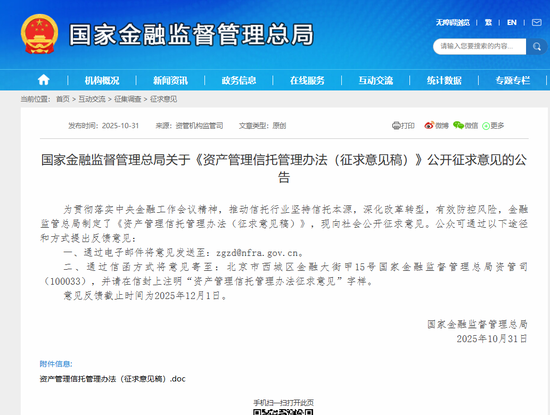
金融监管总局拟加强资产管理信托业务监管
Xin Hua Wang· 2025-10-31 13:19
Core Viewpoint - The Financial Regulatory Bureau has drafted the "Asset Management Trust Management Measures (Draft for Comments)" to standardize the development of asset management trust businesses by trust companies, which is now open for public feedback [1] Group 1: Sales Management - The draft specifies that asset management trusts are private asset management products based on trust legal relationships, aimed at qualified investors with risk identification and bearing capabilities [1] - It outlines management requirements for key sales areas such as trust documents, risk disclosures, investor commitments, and risk assessments, enhancing investor suitability management [1] - The draft aims to regulate the sales behavior of trust companies and their agents, promoting increased investor awareness of the risks associated with trust product investments [1] Group 2: Investment Management - The draft clarifies the requirements for various underlying assets in trust product investments, detailing rules for portfolio investments and regulating related party transactions [1] - It prohibits channel business and fund pool operations, emphasizing the need for transparent management of investments in other asset management products [1] Group 3: Risk Management - The draft strengthens comprehensive risk management requirements, focusing on operational, credit, and liquidity risks, while standardizing information disclosure practices and content [1]
“补血”潮涌,信托机构为何频频增资?
Guo Ji Jin Rong Bao· 2025-10-31 12:46
Core Viewpoint - The trust industry is experiencing a wave of capital increases, driven by regulatory changes, business transformation needs, and risk management pressures. Group 1: Capital Increases - Dongguan Trust recently completed a capital increase from 2.065 billion to 2.220 billion yuan, marking a significant trend as it follows previous increases in 2022 and 2023 [1][2] - Other trust companies, including Tianjin Trust, Jilin Trust, and Northern Trust, have also announced capital increases this year, with Jilin Trust increasing its capital by 1.055 billion yuan and Tianjin Trust by 1.686 billion yuan [1][2] - Central Plains Trust has received regulatory approval for a capital increase of 319 million yuan, raising its registered capital to 5 billion yuan [3] Group 2: Regulatory Impact - The revised Trust Company Management Measures, effective from January 1, 2026, raise the minimum registered capital requirement from 300 million to 500 million yuan, prompting companies to accelerate capital increases [1][4] - Regulatory ratings now assign a 20% weight to capital requirements, influencing business access and encouraging institutions to proactively increase capital [5][6] Group 3: Business Transformation Needs - The trust industry is undergoing a shift towards standardized and family trusts, necessitating significant investments in human resources, systems, and operational costs [4][5] - Companies with weaker capital positions are particularly motivated to increase capital to remain competitive and meet new regulatory standards [6] Group 4: Competitive Landscape - The increasing capital requirements are expected to enhance the competitive landscape, allowing leading trust companies to strengthen their market positions while smaller firms may struggle to keep pace [5][6] - The trend of capital increases is anticipated to continue in the short term, with a gradual slowdown expected post-2026 [5]
金融监管总局有关司局负责人就 《资产管理信托管理办法(征求意见稿)》答记者问
Shang Hai Zheng Quan Bao· 2025-10-31 11:23
Core Viewpoint - The National Financial Supervision Administration has introduced the "Asset Management Trust Management Measures (Draft for Comments)" to enhance regulation and risk prevention in the trust industry, emphasizing the importance of risk disclosure and management in trust product sales [2][3]. Group 1: Background and Purpose - The existing regulations for trust companies have been in place since 2007 and require updates to align with current industry practices and standards [3]. - The new measures aim to strengthen supervision, prevent risks, and establish a solid regulatory foundation for the healthy development of asset management trusts [3]. Group 2: Structure and Content of the Measures - The measures consist of five chapters and eighty-five articles, covering general principles, product establishment and management, operational management, supervision, and definitions [4]. - Asset management trusts are defined as private asset management products based on trust law, with a focus on active management and compliance with market principles [4][5]. Group 3: Sales Requirements for Asset Management Trusts - Trust companies must fully disclose risks to investors and cannot guarantee capital preservation or returns [7]. - Strict risk disclosure requirements mandate that trust documents clearly highlight the nature of risks [7]. - Trust companies are required to assess the risk tolerance of individual investors and match them with appropriate trust products [7]. Group 4: Investment Management Requirements - Trust companies must manage trust assets legally and transparently, adhering to specified investment scopes [8]. - Different asset categories must be managed distinctly, with clear guidelines for investment limits and collaboration with investment partners [8]. Group 5: Risk Management and Information Disclosure - A comprehensive risk management system must be established, covering various types of risks and ensuring compliance with legal and regulatory requirements [8]. - Information disclosure requirements are detailed, ensuring transparency in trust asset management and compliance with regulatory standards [8]. Group 6: Regulation of Key Business Areas - Prohibition of channel business and fund pool operations is emphasized, ensuring trust companies take active management responsibility [9]. - Strict regulations on related party transactions are established to ensure transparency and compliance [9]. Group 7: Rectification of Existing Asset Management Trusts - Trust companies are required to review existing asset management trusts, identify those needing rectification, and develop a plan to address compliance issues [10]. - Progress in rectification will be monitored as part of the regulatory framework [10].
共绘金融新图景!2025年证券时报金融机构年会暨第十九届深圳金博会启幕在即
Zheng Quan Shi Bao Wang· 2025-10-31 09:42
Group 1 - The China Financial Institutions Annual Conference will be held concurrently with the 19th Shenzhen International Financial Expo, showcasing the strategic role of Shenzhen in promoting high-quality financial development [1][4] - The annual conference has evolved since its inception in 2021, becoming a significant event in the financial sector, focusing on key areas such as securities, banking, trust, and insurance [2] - This year's conference will feature an upgraded structure, expanding the award categories to include five major sectors, enhancing its professional depth and broadening its influence [2][3] Group 2 - The Shenzhen International Financial Expo is recognized as one of the largest financial exhibitions in China, with a strong support system from various government and financial institutions [3] - The expo will introduce an innovative framework combining exhibitions, festivals, and conferences, facilitating efficient communication among government, industry, academia, and finance [3] - The independent exhibition area at the expo will serve as a strategic platform for financial institutions to establish their market presence and enhance brand credibility [4]
禁止信托产品保本保息!金融监管总局征求意见
Zhong Guo Zheng Quan Bao· 2025-10-31 09:30
Core Viewpoint - The Financial Regulatory Bureau has released a draft for public consultation regarding the "Asset Management Trust Management Measures," aimed at reforming the trust industry and enhancing risk prevention [1][2]. Group 1: Regulatory Framework - The draft consists of 5 chapters and 85 articles, covering general principles, establishment, modification, termination of trust products, operational management, supervision, and supplementary provisions [1]. - Trust companies, as trustees, manage trust product assets without constituting liabilities to investors, and these assets do not belong to the trust companies' proprietary assets [1][2]. Group 2: Responsibilities and Restrictions - Trust companies must fulfill their duties with diligence, honesty, and effective management to serve the maximum legal interests of investors [2]. - Trust companies are prohibited from promising investors against losses of principal or minimum returns, setting expected yield rates, or engaging in private equity business under the guise of trust products [2]. - Trust companies must adhere to the principles of market and fair trading, avoiding illegal profit transfers between different trusts or between trusts and third parties [2].

企业资产支持证券产品报告(2025年三季度):发行规模同比小幅上升,发行成本持续下行,二级市场交易活跃度显著提升
Zhong Cheng Xin Guo Ji· 2025-10-31 09:23
Group 1: Report's Investment Rating for the Industry - No information provided regarding the report's industry investment rating Group 2: Core Viewpoints of the Report - In Q3 2025, the issuance scale of enterprise asset - backed securities increased by 5.27% year - on - year, with the issuance cost decreasing, and the secondary market trading activity significantly rising [5][35] Group 3: Summary According to the Directory 1. Issuance Situation - In Q3 2025, 437 enterprise asset - backed securities were issued, with a total issuance scale of 410.177 billion yuan, an increase of 33 in quantity and 5.27% in scale compared to the same period last year. September had the highest issuance volume and scale [6] - In terms of issuance venues, the Shanghai Stock Exchange issued 307 products with a scale of 314.119 billion yuan (76.58% of the total), and the Shenzhen Stock Exchange issued 130 products with a scale of 96.058 billion yuan (23.42% of the total) [8] - The top five original equity holders in terms of issuance scale accounted for 20.58% of the total, and the top ten accounted for 31.27% [8] - The top five managers in terms of new management scale accounted for 49.30% of the total, and the top ten accounted for 69.03% [11] - In terms of basic asset categories, the issuance scale of debt - based ABS products was 317.391 billion yuan (77.38% of the total), real - estate ABS was 78.096 billion yuan (19.04% of the total), and revenue - based ABS was 114.65 billion yuan (2.80% of the total) [15] - The basic asset sub - types mainly included personal consumer finance, accounts receivable, enterprise financial leasing, micro - loans, and CMBS [18] - The product with the highest issuance scale was "CITIC Financial Asset Yunfan Phase 1 Entity Empowerment Asset - Backed Special Plan" at 10.01 billion yuan, and the lowest was "CITIC Securities - Shenzhen Guarantee Group - No. 3 Intellectual Property Asset - Backed Special Plan (Hetao Shenzhen - Hong Kong Science and Technology Innovation Cooperation Zone)" at 0.42 billion yuan. The products with a single - issuance scale in the (5, 10] billion yuan range had the highest number and scale [24] - The shortest - term product had a term of 0.48 years, and the longest was 59.97 years. Products with a term in the (1, 3] - year range had the highest number and scale [26] - AAAsf - rated securities accounted for 89.93% of the issuance scale. The median interest rate of 1 - year - old AAAsf - rated securities was 1.81%, a year - on - year decrease of about 33BP and a quarter - on - quarter decrease of about 20BP [29][31] 2. Filing Situation - In Q3 2025, 360 products were filed with the Asset Management Association of China, with a total scale of 328.049 billion yuan. The number of filings decreased by 3, and the scale decreased by 1.67% compared to the same period last year [54] 3. Secondary Market Trading and Position - Holding Situation - In Q3 2025, enterprise asset - backed securities had 11,887 transactions in the exchange market, with a total amount of 286.099 billion yuan, an increase of 3,855 in the number of transactions and 66.88% in the trading scale compared to the same period last year. September had the highest trading scale [57][59] - The basic asset types involved in secondary - market trading mainly included REITs, accounts receivable, CMBS, supply chains, and personal consumer finance [59] - As of the end of Q3 2025, the total position - holding scale of asset - backed securities in the Shanghai and Shenzhen Stock Exchanges was 2,093.452 billion yuan, a 7.26% increase from the end of 2024 [61] 4. Maturity Analysis for Q4 2025 - As of the end of September 2025, 539 outstanding enterprise asset - backed securities were expected to mature in Q4 2025, with a scale of 123.815 billion yuan. Accounts receivable - based products had the highest proportion of maturity scale [66]
国家金融监督管理总局发布《资产管理信托管理办法(公开征求意见稿)》
智通财经网· 2025-10-31 08:07
Core Viewpoint - The National Financial Supervision Administration has released the "Asset Management Trust Management Measures," emphasizing the responsibilities of trust companies to manage trust products with integrity and caution, prohibiting them from promising capital protection or minimum returns [1][5]. Group 1: Regulatory Framework - The measures aim to strengthen regulation, prevent risks, and standardize the operational behavior of trust companies in asset management trust business [3]. - Trust companies must establish a good corporate governance structure and complete internal control, risk management, and compliance management systems [7]. - Trust products must be initiated by trust companies and managed in accordance with the "Guiding Opinions" on asset management products [3][4]. Group 2: Trust Product Management - Trust companies are prohibited from promising investors that their principal will not be lost or guaranteeing minimum returns [5][14]. - Trust products must be managed actively by the trust company and cannot delegate management responsibilities to other entities [5][19]. - Trust companies must ensure that the management of trust products adheres to market trading and fair trading principles, avoiding illegal profit transfers [5][19]. Group 3: Investor Qualifications - Trust products are to be issued to qualified investors through non-public means, with a maximum of 200 investors per product [8][9]. - Qualified investors must meet specific financial criteria, such as having a net asset of at least 3 million RMB or equivalent [9][10]. - Individual investors cannot invest more than 50% of the trust product's actual trust scale, while institutional investors and their affiliates cannot exceed 80% [10]. Group 4: Risk Management and Compliance - Trust companies must establish a risk management system that covers various risks, including credit, market, liquidity, operational, and reputational risks [57]. - Trust companies are required to conduct due diligence on the feasibility, legality, and risk assessment of trust products before establishment [19]. - Trust companies must ensure that the investment of trust product funds complies with legal regulations and does not involve prohibited industries [46].
机构风向标 | 雅戈尔(600177)2025年三季度已披露持股减少机构超10家
Xin Lang Cai Jing· 2025-10-31 02:24
Core Insights - The report indicates that as of October 30, 2025, a total of 39 institutional investors hold shares in Youngor (600177.SH), with a combined holding of 2.844 billion shares, representing 61.52% of the total share capital [1] - The top ten institutional investors account for 61.08% of the total shares, with a slight increase of 0.28 percentage points compared to the previous quarter [1] Institutional Holdings - The top institutional investors include Ningbo Youngor Holdings Co., Ltd., Kunlun Trust Co., Ltd., China Securities Finance Corporation, and several others, indicating a strong institutional interest in Youngor [1] - The report highlights that 13 public funds increased their holdings, with a total increase ratio of 0.51%, while 15 public funds decreased their holdings, with a total decrease ratio of 0.15% [2] - Five new public funds disclosed their holdings during this period, while 335 public funds were not disclosed compared to the previous quarter, indicating a dynamic shift in public fund participation [2]

中油资本:10月29日召开董事会会议
Mei Ri Jing Ji Xin Wen· 2025-10-30 12:50
Group 1 - The core point of the article is the announcement by Zhongyou Capital regarding its board meeting and the composition of its revenue sources for the first half of 2025 [1] - Zhongyou Capital's board meeting took place on October 29, 2025, in Beijing, where they reviewed the proposal for the election of members to the Risk Management Committee [1] - As of the report, Zhongyou Capital has a market capitalization of 132.5 billion yuan [1] Group 2 - For the first half of 2025, Zhongyou Capital's revenue composition is as follows: commercial banks accounted for 47.04%, financial companies for 38.53%, financial leasing for 7.94%, other sources for 5.72%, and trust business for 0.76% [1]

10.30犀牛财经晚报:三季度全球黄金需求总量达1313吨 工商银行第三季度净利润1018亿元
Xi Niu Cai Jing· 2025-10-30 10:32
Group 1: Global Gold Demand - The World Gold Council reported that global gold demand reached 1313 tons in Q3 2025, marking the highest quarterly demand on record [1] - The total demand value amounted to $146 billion, driven primarily by investment demand [1] - Gold investment demand surged to 537 tons, a 47% year-on-year increase, accounting for 55% of total Q3 gold demand [1] Group 2: Storage Chip Market - Storage chip prices began to rise in September 2025, accelerating into Q4 due to supply shortages [2] - Major storage chip manufacturers shifted production capacity towards high-end chips for AI and data centers, leading to a significant reduction in traditional storage chip supply [2] - Current price increases in the spot market range from 60% to 80%, with some popular models seeing price hikes of up to 100% [2] Group 3: Smartphone Market - Global smartphone shipments reached 320.1 million units in Q3 2025, reflecting a 3% year-on-year growth, indicating signs of recovery after a weak first half [2] Group 4: AI Server Market - TrendForce forecasts that AI server shipments will grow by over 20% in 2026, driven by steady demand from cloud service providers and the growth of AI applications [3] Group 5: Financial Performance of Companies - China Duty Free Group reported a 22.13% decline in net profit for the first three quarters of 2025, with revenues down 7.34% [7] - Everbright Securities experienced a 34.55% increase in net profit for the first three quarters of 2025, with revenues up 27.83% [8] - Shanshan Co. reported a staggering 1121.72% increase in net profit for the first three quarters of 2025, with revenues growing by 11.48% [9] - Agricultural Bank of China reported a net profit of 813.49 billion yuan for Q3 2025, a 3.66% year-on-year increase [19] - Industrial and Commercial Bank of China reported a net profit of 1018 billion yuan for Q3 2025, a 3.29% year-on-year increase [18] Group 6: Market Trends - The market experienced a significant downturn, with the ChiNext Index dropping nearly 2% and over 4100 stocks declining [22] - Lithium mining and quantum technology sectors showed strong performance, while gaming and coal sectors faced substantial declines [22]



