
汽车电子

Search documents
天有为:积极开拓海外市场 加速全球化布局
Zheng Quan Shi Bao Wang· 2025-06-05 11:09
Core Viewpoint - The company, Tianyouwei, specializes in the research, design, production, and sales of automotive instruments and is expanding into the smart cockpit sector, with a focus on enhancing its global market presence and product offerings [1][2]. Group 1: Business Overview - Tianyouwei primarily engages in the development and production of electronic combination instruments, full LCD combination instruments, dual-screen instruments, and other automotive electronic products and services [1]. - The company has established long-term partnerships with numerous well-known automotive manufacturers and parts suppliers, including Hyundai Motor Group, BYD, Changan Automobile, and others [1]. Group 2: Market Expansion - The company aims to increase its overseas revenue share from 47.06% in 2022 to 53.60% by 2024, indicating a strategic push for global market expansion [2]. - Tianyouwei is actively developing new products such as curved screen instruments and ultra-thin navigation screens, leveraging its relationships with major automotive manufacturers to enhance its product offerings [2][3]. Group 3: Technological Innovation - The company's core technology, composite screen technology, innovatively combines segment code screens with TFT color screens to achieve near full-color display effects, providing a cost-effective alternative to traditional TFT screens [3]. - This technology allows for customized instrument shapes while maintaining high display quality, thus broadening the product range available to customers [3]. Group 4: International Operations - Tianyouwei's subsidiary in Mexico has generated revenue of 370 million yuan since its establishment in 2022, with plans for a modern, automated factory projected to cost 55 million USD [4]. - The new facility is expected to enhance service capabilities in the Americas and Europe, reduce delivery times, and lower transportation costs, thereby strengthening the company's competitive edge in the global automotive electronics market [4].
弘则研究 :汽车电子架构进展跟踪
2025-06-04 15:25
Summary of Automotive Electronics Architecture Conference Call Industry Overview - The automotive electronics architecture is transitioning from domain controllers to regional computing platforms, integrating central computing platforms with varying degrees of integration, including chassis functions [1][2] - Communication methods are evolving from traditional CAN bus to Ethernet, with companies like Xiaopeng Motors supporting Ethernet communication, while Geely's BEI3.0 domain controller does not [1][3] Key Developments in Automotive Electronics - The distribution method in automotive electronics has shifted from traditional relay-based systems to lightweight ECU-based vehicle mode management, optimizing energy consumption and improving efficiency and reliability [1][4] - Manufacturers are reducing the use of traditional microcontrollers (MCUs); for instance, Lingpao Motors uses only 28 MCUs in its latest model, compared to the typical 40-50 in other vehicles [1][5] - Some features, such as seat heating and massage functions, are not integrated into the domain control unit (DCU) to accommodate different model configurations and reduce costs [1][6] - The integration of more functions into domain controllers allows manufacturers to simplify production processes and reduce costs, with the cost of Lynk & Co's 3.5 generation products decreasing by 30%-40% compared to the previous generation [1][8] Software-Defined Vehicles (SDV) - Software-defined vehicles (SDV) abstract vehicle capabilities and simplify update processes through service-oriented architecture (SOA), enhancing flexibility and efficiency [1][9] - SDV enables the implementation of personalized features, such as electric doors, by abstracting sensor and actuator capabilities [1][10] Changes in Electronic and Electrical Architecture - The current electronic and electrical architecture is characterized by a central plus regional controller structure and SOA, with potential future integration of cockpit, body, gateway, and connectivity modules [1][11] - Integration can potentially eliminate the need for traditional ECUs, significantly reducing hardware costs [1][12] Industry Trends and Challenges - Major companies in the industry are pursuing integration, though the degree of integration varies [1][13] - Traditional fuel vehicles are less likely to adopt advanced electronic architectures due to cost and feasibility concerns [1][14] - New architectures offer significant cost savings and maintenance advantages, enhancing competitiveness against foreign fuel vehicles [1][15][16] Chassis Control Systems - The trend in chassis control systems is towards integration, with many manufacturers moving towards a larger chassis domain controller [1][19] - Challenges in integrating chassis systems include meeting safety requirements, as the integration must satisfy higher safety standards [1][18] Cost Reduction and Market Position - The optimization of electronic architecture and reduction in ECU numbers have led to significant hardware cost reductions, contributing to lower vehicle prices while maintaining competitiveness [1][24] - Domestic companies have made notable progress in automotive electronics architecture, although they still rely on international suppliers for MCU chips [1][25] Domestic Chip Development - Domestic companies are beginning to explore the use of local chips in vehicle computing units, but high-end models remain hesitant due to performance concerns [1][26] - Current integrated structures in vehicle computing units are limited to physical integration rather than full functional integration due to insufficient chip capabilities [1][27] Future Prospects - The application of domestic chips in the automotive industry is gradually increasing, but significant gaps in performance compared to leading manufacturers like NVIDIA and Qualcomm remain [1][29]
制造衬底科创点睛 “苏”绣资本市场高质量发展篇章
Zheng Quan Shi Bao· 2025-06-03 18:41
Core Viewpoint - Jiangsu listed companies have actively announced share buybacks and increases in shareholding to stabilize the market amid global market turmoil caused by U.S. tariffs, showcasing the strength and responsibility of the "Jiangsu Legion" in the A-share market [1] Group 1: Market Stability and Company Actions - Nearly 30 listed companies in Jiangsu announced buyback and increase plans within two days, demonstrating a commitment to market stability [1] - Jiangsu's capital market has a solid foundation with over 700 listed companies, leading the nation in the number of companies on the Sci-Tech Innovation Board and the Beijing Stock Exchange [1][3] Group 2: Industry Development and Innovation - Jiangsu aims to cultivate "unicorns," "gazelles," and specialized "little giant" companies, focusing on high-end equipment, biomedicine, and integrated circuits to support regional economic development [2] - The manufacturing sector in Jiangsu is robust, with a high-quality development index ranking first nationally for four consecutive years, and the province leads in the number of national-level specialized "little giant" companies [3][4] Group 3: Future Growth and Strategic Goals - By the end of 2025, Jiangsu aims to have around 150 listed companies with a market value exceeding 10 billion yuan and 15 companies exceeding 100 billion yuan, with a total of over 250 billion yuan in mergers and acquisitions [8] - Jiangsu is focused on enhancing the core competitiveness of listed companies and promoting mergers and acquisitions to strengthen the modern industrial system [12][13] Group 4: Financial Support and Ecosystem - Jiangsu is building a comprehensive financial service system to support the entire lifecycle of technology-based enterprises, ensuring that innovative companies receive tailored financial solutions [10] - The province's financial institutions have seen a loan growth rate of 10.1%, significantly higher than the national average, indicating strong financial support for local businesses [10] Group 5: Regional Disparities and Development Initiatives - Jiangsu is addressing regional imbalances in company listings, with efforts to increase the number of listed companies in underrepresented areas [7] - The province has established a service mechanism for the precise cultivation of technology enterprises, ensuring a steady supply of high-quality companies to the capital market [4][12]
雷军看好的两兄弟,要IPO了
投中网· 2025-06-03 06:36
Core Viewpoint - The article highlights the growth and potential of Zhejing Electronics in the automotive HUD (Head-Up Display) market, emphasizing its journey from a small startup to a significant player in the industry, backed by substantial investments and partnerships with major automotive manufacturers [4][5][12]. Company Overview - Zhejing Electronics, founded by brothers Zhang Bo and Zhang Tao, has emerged as a key player in the HUD technology sector, challenging international giants like Bosch and Denso [4][7]. - The company has achieved a post-investment valuation exceeding 2.5 billion yuan [5]. Financial Performance - Zhejing Electronics reported a revenue increase from 214 million yuan in 2022 to 549 million yuan in 2023, marking a growth of 156%, and projected revenue of 578 million yuan in 2024, resulting in a compound annual growth rate (CAGR) of 64% [12]. - The company has seen a reduction in cumulative losses from 569 million yuan over three years, with losses decreasing from 256 million yuan in 2022 to 175 million yuan in 2023, and further to 138 million yuan in 2024 [12]. - Gross margin has improved from 22.6% to 27.3% during the same period, surpassing the industry average [12]. Product Development - Zhejing Electronics offers two main products: W-HUD (Windshield HUD) and AR-HUD (Augmented Reality HUD), with W-HUD contributing 82.7% of revenue and AR-HUD accounting for 10.9% [11][12]. - The company has successfully adapted to market demands, exemplified by its rapid development of AR-HUD technology, which enhances the driving experience [14]. Customer Base and Market Position - The customer base has diversified, with the share of the top five customers decreasing from 93.8% to 80.9%, indicating reduced dependency on major clients like NIO and Li Auto [13]. - Zhejing has secured orders from 22 major automotive manufacturers, including NIO, Li Auto, and Xiaomi, with a total delivery of over 1.5 million units [9]. Investment and Financing - The company has undergone multiple financing rounds, attracting significant investments from industry giants such as Geely, BYD, and Xiaomi's Shunwei Capital, with a post-investment valuation reaching 2.585 billion yuan [16][17]. - The funding will be utilized for technological upgrades and expanding production capacity, with plans to increase output by 300% following the completion of a new facility [17]. Industry Trends - The penetration rate of HUD technology in China has surged from 4.7% in 2020 to 13.9% in 2024, with projections indicating a market size of 12.7 million units by 2029 [17]. - The competitive landscape is intensifying, with major players like Huawei and Baidu entering the smart cockpit space, alongside established manufacturers like Huayang and Desay SV [17][18].


蔚来小米都在用,22家车企撑起扬州巨头冲刺IPO
3 6 Ke· 2025-06-03 00:08
Core Viewpoint - Jiangsu Zejing Automotive Electronics Co., Ltd. (Zejing Technology), a leading Chinese HUD manufacturer valued at 2.585 billion RMB, has submitted its IPO application to the Hong Kong Stock Exchange, highlighting the growing demand for HUD solutions in the smart automotive sector [1][30]. Group 1: Company Overview - Zejing Technology has captured approximately 16.2% of the domestic HUD market, ranking second among solution providers [1][15]. - The company has established partnerships with major automotive manufacturers in China, including NIO, Li Auto, Xiaomi, BYD, Chery, Geely, FAW, GAC, BAIC, and Changan [1][12]. - Founded in 2015 by two brothers, Zejing Technology has rapidly grown to become a key player in the HUD industry, leveraging their extensive experience in automotive electronics [24][26]. Group 2: Product and Technology - The primary products offered by Zejing Technology include W-HUD (Windshield HUD) and AR-HUD (Augmented Reality HUD), with the latter being the latest generation of HUD solutions [4][6]. - The company’s HUD solutions are designed to enhance driving safety and convenience by projecting critical information directly into the driver's line of sight [2][6]. - Zejing Technology's CyberLens and CyberVision products have been integrated into various vehicle models, showcasing their adaptability and technological advancements [8][10]. Group 3: Financial Performance - From 2022 to 2024, Zejing Technology's HUD solution sales are projected to grow from 175,700 units to 624,600 units, reflecting a significant increase in demand [13]. - The company's total revenue is expected to rise from 214 million RMB in 2022 to 578 million RMB in 2024, with a compound annual growth rate of 64.3% [15]. - The gross profit margin has improved from 22.6% in 2022 to 27.3% in 2024, driven by effective cost control and increased operational efficiency [20][18]. Group 4: Market Trends - The global automotive HUD market, particularly in China, is experiencing rapid growth, with the market size expected to increase from 1 million units in 2020 to 3.9 million units by 2024, representing a compound annual growth rate of 41.2% [31][32]. - Domestic manufacturers have significantly increased their market share from 16.7% in 2020 to 79.2% in 2024, indicating a shift in the competitive landscape [36]. - The top five suppliers in the Chinese HUD market collectively hold a 66.5% market share, with four of them being domestic companies [37].
车载显示:虚拟全景显示驱动交互革新
2025-06-02 15:44
Summary of Key Points from the Conference Call Industry Overview - The automotive smart cockpit sector is rapidly developing, with increasing penetration of technologies such as DMS (Driver Monitoring System), OMS (Occupant Monitoring System), and HUD (Head-Up Display) [1][3] - Leading domestic automotive TIER one manufacturers are accelerating market share concentration, with top companies outperforming the average market growth [1][3] Core Insights and Arguments - **Virtual Panoramic Display (VPD)**: This innovative technology offers richer information presentation and has the potential to expand imaging space and projection size, possibly replacing existing display solutions in the long term [1][4] - **HUD Market Growth**: The penetration rate of HUD products is rapidly increasing, with an expected 3.56 million units of HUD installed in new domestic passenger cars in 2024, representing a penetration rate of 16%, up from 11% in 2023 [1][6] - **Market Share of Domestic Manufacturers**: By 2024, domestic manufacturers are projected to capture 57% of the HUD market, with Huayang leading at a 22% market share [1][9] - **Challenges in VPD Technology**: The technology faces challenges such as optical design, heat management, and mass production consistency, which are critical for its successful implementation [2][14][15] Competitive Landscape - **Leading Companies**: Huayang Group is positioned as a leader in the VPD field, with rapid sales growth in cockpit domain control products, expecting a net profit of 857 million yuan in 2025 [1][18][20] - **Supplier Advantages**: Suppliers with comprehensive in-car display capabilities, including optical design and mass production experience, are expected to have a competitive edge [2][7][17] - **Emerging Trends**: The market is witnessing a shift towards more integrated display solutions, with companies like Xiaomi showcasing innovative VPD systems that enhance user experience [5][8] Financial Projections - **Huayang Group's Financial Outlook**: The company anticipates a net profit of 857 million yuan in 2025 and 1.076 billion yuan in 2026, indicating a significant growth trajectory [20] - **Market Valuation**: Current stock prices suggest that Huayang Group is undervalued compared to historical valuations and other smart automotive electronic companies, with a PE ratio of 20x for 2025 and 16x for 2026 [20] Additional Important Insights - **Technological Advantages of VPD**: VPD systems can project a wide range of information simultaneously, improving the user experience by reducing the need for frequent screen switching [12][13] - **Collaboration and Client Expansion**: Huayang is actively expanding its client base, collaborating with joint ventures and securing projects with major automotive brands [19] This summary encapsulates the key points discussed in the conference call, highlighting the advancements and challenges within the automotive smart cockpit industry, particularly focusing on virtual panoramic display technology and its market implications.
【私募调研记录】星石投资调研经纬恒润
Zheng Quan Zhi Xing· 2025-06-02 00:09
Group 1 - Star Stone Investment recently conducted research on a listed company, specifically focusing on Jingwei Hengrun, which has a dedicated institution for robot research and is advancing smart robots and smart warehousing [1] - Jingwei Hengrun is collaborating with Baixiniu on Robovan to promote the commercial rollout of unmanned vehicles for last-mile logistics [1] - The company has initiated L4 level fully unmanned driving operations at ports and plans to expand to public road scenarios, including point-to-point unmanned cargo transportation and Robobus microcirculation [1] - The decline in overall gross margin is primarily due to the rapid growth of the automotive electronics business, with new products being mass-produced for companies like Xiaomi, Xpeng, and Geely, driven by trends in the automotive industry [1] Group 2 - Star Stone Investment, established in 2007, is one of the top private equity fund management companies in China and a pioneer in the private equity sector [2] - The company has received numerous awards, including being the first Chinese private equity firm to win the Morningstar China Hedge Fund Award and to be included in the MSCI Global Hedge Fund Index [2] - Star Stone Investment focuses on long/short equity strategies and has built a strong research team of 40 professionals, employing a multi-faceted driving factor investment approach for comprehensive industry coverage [2] - The investment decision-making process is led by a committee, with nine fund managers collaboratively managing all products to identify high-quality investment targets [2] - The firm emphasizes compliance and risk control, establishing a rigorous compliance framework that integrates risk management throughout the investment research process [2]

603023,下周复牌!正式摘星脱帽
第一财经· 2025-05-30 12:47
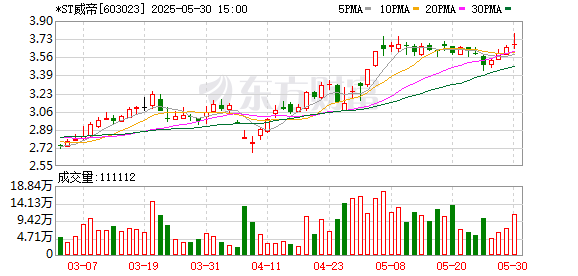
Core Viewpoint - *ST Weidi announced that its stock will be suspended for one day on June 3, 2025, and will resume trading on June 4, 2025, with the removal of the delisting risk warning and a change in its stock name from "*ST Weidi" to "Weidi Co., Ltd." The stock code remains "603023," and the daily price fluctuation limit will increase from 5% to 10% [3][4]. Group 1 - The company reported a turnaround in its performance for 2024, achieving a revenue of 65.2357 million yuan, a year-on-year increase of 23.1%, and a net profit attributable to shareholders of 5.0555 million yuan [4]. - The company completed a significant strategic acquisition in December 2024 by acquiring 51% of Alpha Silicon, becoming its controlling shareholder, marking its entry into the passenger vehicle electronics sector [4][5]. - *ST Weidi is a domestic supplier of automotive electronic control products, producing various electronic components such as automotive combination instruments, CAN bus control systems, smart cockpit systems, and more [5]. Group 2 - The company’s stock was placed under delisting risk warning on May 6, 2024, due to negative net profits and insufficient revenue from core business activities [3]. - The audit reports for 2024 from Lixin Zhonglian Accounting Firm provided standard unqualified opinions on both the internal control report and the financial report, supporting the company's application to remove the delisting risk warning [3]. - The Shanghai Stock Exchange approved the company's application to lift the delisting risk warning on May 30, 2025, confirming that the conditions for removal were met [3].


威帝股份撤销退市风险警示 2024年成功扭亏为盈
Zheng Quan Shi Bao Wang· 2025-05-30 11:41
Core Viewpoint - Weidi Co., Ltd. has successfully removed the delisting risk warning and is set to enter a new development phase following its strategic acquisition of a controlling stake in Alpha Silicon, marking its entry into the passenger vehicle electronics sector [2][3]. Group 1: Delisting Risk and Stock Changes - Weidi Co., Ltd. announced the removal of the delisting risk warning, changing its stock name from "*ST Weidi" to "Weidi Co., Ltd." while retaining the stock code "603023" [2]. - The stock will be suspended for one day on June 3, 2025, and will resume trading on June 4, 2025, with the daily price fluctuation limit increasing from 5% to 10% [2]. - The company has met the criteria for the removal of the delisting risk warning as per the Shanghai Stock Exchange regulations [2]. Group 2: Financial Performance - In the 2024 annual report, Weidi Co., Ltd. reported a turnaround with revenue of 65.2357 million yuan, representing a year-on-year growth of 23.1%, and a net profit attributable to shareholders of 5.0555 million yuan [2]. Group 3: Strategic Acquisition - In December 2024, Weidi Co., Ltd. completed a significant strategic acquisition by acquiring 51% of Alpha Silicon, becoming its controlling shareholder [3]. - This acquisition allows Weidi Co., Ltd. to enter the passenger vehicle electronics market, providing products such as central display screens and instrument panels primarily for Chery New Energy [3]. - The removal of the delisting risk warning, combined with the strategic move into the passenger vehicle sector, positions Weidi Co., Ltd. for a promising growth trajectory in 2025 [3].
天有为: 关于使用自有资金、自有外汇及银行承兑汇票等方式支付募投项目部分款项并以募集资金等额置换的公告
Zheng Quan Zhi Xing· 2025-05-28 12:19
证券代码:603202 证券简称:天有为 公告编号:2025-005 关于使用自有资金、自有外汇及银行承兑汇票 等方式支付募投项目部分款项并以募集资金 等额置换的公告 本公司董事会及全体董事保证本公告内容不存在任何虚假记载、误导性陈述或 者重大遗漏,并对其内容的真实性、准确性和完整性承担法律责任。 (证监许可〔2024〕1900号),公司获准向社会公开 发行人民币普通股(A股)4,000万股,发行价格为93.50元/股,募集资金总额 后,公司本次募集资金净额为3,526,941,817.64元,其中超募资金为522,576,117.64 元。募集资金已全部到位,立信会计师事务所(特殊普通合伙)对上述募集资金 到位情况进行了审验,并出具了《验资报告》(信会师报字【2025】第ZG11555 号)。 为规范募集资金管理和使用,保护投资者权益,公司已对募集资金进行专户 存储,并与募集资金专项账户开户银行、保荐机构签订了《募集资金三方监管协 议》。 二、募集资金投资项目情况 根据《黑龙江天有为电子股份有限公司首次公开发行股票并在主板上市招股 说明书》及《黑龙江天有为电子股份有限公司关于变更部分募投项目暨使用部分 超募 ...