有色金属矿采选业

Search documents
洛阳钼业(603993):动态跟踪点评:金矿业务再获成长,铜金双极格局再提速
Western Securities· 2025-12-16 02:52
Investment Rating - The report maintains a "Buy" rating for Luoyang Molybdenum (603993.SH) [6] Core Views - Luoyang Molybdenum has announced the acquisition of 100% equity in three gold mining assets in Brazil from Equinox Gold for a total consideration of $1.015 billion, expected to close in Q1 2026, pending regulatory approvals [1][6] - The acquisition includes Aurizona, RDM, and Bahia mining complexes, with a total gold resource of 156 tons and an estimated production of approximately 7.7 tons in 2024 [2][3] - The company is accelerating its gold asset layout, aiming for nearly 20 tons of annual gold production post-acquisition, which is expected to initiate a second growth curve for the company [3] Financial Projections - Revenue is projected to grow from 186.27 billion CNY in 2023 to 241.72 billion CNY by 2027, with a compound annual growth rate (CAGR) of approximately 7.7% [4] - Net profit is expected to increase significantly from 8.25 billion CNY in 2023 to 28.08 billion CNY in 2027, reflecting a CAGR of around 36% [4] - Earnings per share (EPS) are forecasted to rise from 0.39 CNY in 2023 to 1.31 CNY in 2027, with a price-to-earnings (P/E) ratio decreasing from 46.5 to 13.7 over the same period [4][10]

港股异动 洛阳钼业(03993)高开近3% 近日斥资收购巴西金矿资产 落实公司“铜金双极”并购战略
Jin Rong Jie· 2025-12-16 02:06
Group 1 - The core viewpoint of the news is that Luoyang Molybdenum (03993) is acquiring 100% equity of Leagold LatAm Holdings B.V. and its subsidiary Luna Gold Corp. for a total of $1.015 billion, which includes $900 million in cash at closing and up to $115 million in contingent cash payments linked to sales [1] - The acquisition aims to enhance the company's gold asset portfolio and is a significant step in implementing its "copper-gold dual" merger strategy, as the company sees long-term market potential in gold assets [1] - The company believes that the Brazilian assets will create synergies with its existing niobium and phosphate assets in Brazil, further strengthening its resource layout in South America [1] Group 2 - Upon completion of the acquisition in Q1 2026, the company's annual gold production is expected to increase by approximately 8 tons, which will enhance its gold resource reserves and overall performance [2] - The acquisition will create a gold resource package with the Ecuadorian gold mine, leveraging synergies between the two projects and further establishing the company as a platform-type resource enterprise [2] - Following the future production of the Ecuadorian Odin mine, the company's annual gold production is anticipated to exceed 20 tons [2]
国城矿业:不存在将控股股东的债务风险向上市公司转移的情形
Xin Lang Cai Jing· 2025-12-15 12:33
Group 1 - The core viewpoint of the announcement is that the transaction will enhance the company's profitability and diversify its resource reserves [1] - The company emphasizes that the transaction will strengthen its sustainable operational capacity and risk resistance [1] - There is a clear statement that the transaction does not involve transferring the controlling shareholder's debt risk to the company [1] Group 2 - The company asserts that there are no issues of related party transactions that could harm the interests of the company or minority shareholders [1]

10亿美元再扩黄金资产版图 洛阳钼业金矿产量或跻身一线梯队
2 1 Shi Ji Jing Ji Bao Dao· 2025-12-15 12:26
Core Viewpoint - Luoyang Molybdenum plans to acquire 100% equity of two subsidiaries of EQX for $1.015 billion, gaining full ownership of four gold mines in Brazil, which is expected to significantly enhance the company's performance in the coming years [2][6]. Financial Performance - The two subsidiaries involved in the acquisition reported a combined revenue of over 4.1 billion yuan and a net profit of 1.013 billion yuan in the first nine months of this year, indicating a scale comparable to a medium-sized mining company [2][6]. - The acquisition is projected to contribute an additional revenue of 5.5 billion yuan and a net profit of 1.35 billion yuan to Luoyang Molybdenum in 2026, based on annualized estimates from the subsidiaries' performance [11]. Mining Assets - The acquired gold assets include Aurizona and RDM gold mines, along with Fazenda and Santa Luz mines, totaling 5.013 million ounces of gold resources with an average grade of 1.88 g/t [7][8]. - The average grade of the acquired gold mines is higher than the global average of 1.06 g/t, suggesting a favorable resource quality for long-term mining [8]. Strategic Importance - Brazil is a key area for Luoyang Molybdenum's overseas resource layout, with significant revenue expected from the region, projected to exceed 6.5 billion yuan in 2024 [4]. - The acquisition is expected to create synergies with existing assets in Ecuador and Brazil, enhancing the company's gold segment and regional resource collaboration [2]. Future Growth - The company has several growth projects lined up, including the KFM Phase II project expected to be operational by 2027 and the Cangrejos gold mine in Ecuador anticipated to start production before 2029 [2][12]. - With the completion of the acquisition, Luoyang Molybdenum's annual gold production is expected to reach approximately 20 tons, positioning it among the top domestic gold mining companies [9].

A股3800亿矿业巨头大涨,狂掷70亿布局南美金矿,江西铜业、紫金矿业也集体出手
2 1 Shi Ji Jing Ji Bao Dao· 2025-12-15 12:12
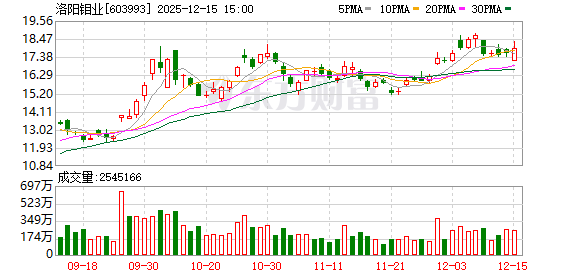
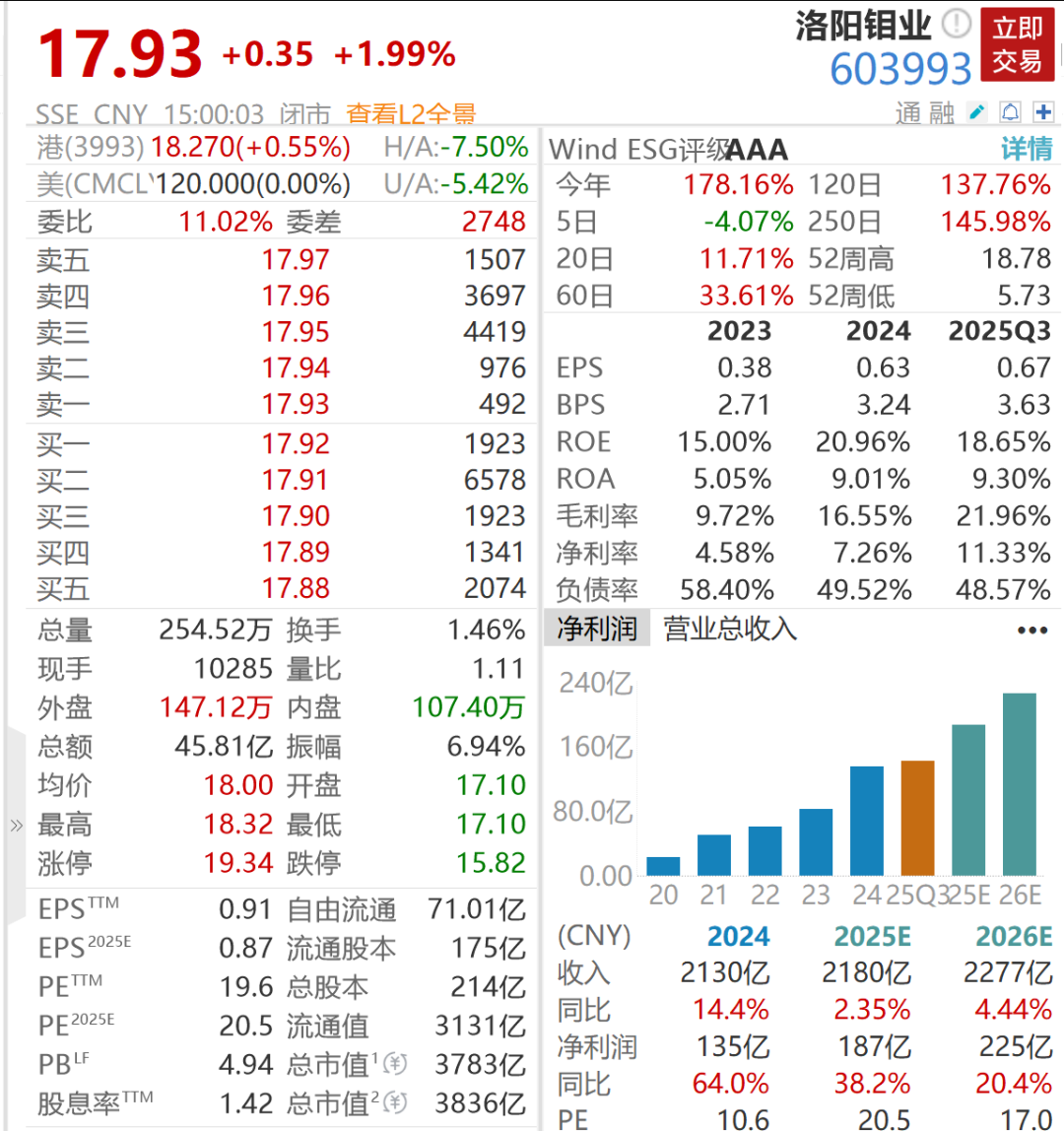
12月12日,江西铜业(600362)(600362.SH)公告将收购索尔黄金100%股份,较上次报价提高2便士/股,修改后的潜在要约价格对索尔黄金已发行及将 发行的全部普通股股本估值约为8.42亿英镑。索尔黄金的核心资产为厄瓜多尔的Cascabel项目,项目主要的Alpala矿床目前拥有探明、控制及推断资源 量:铜1220万吨、金3050万盎司、银1.02亿盎司。 12月15日,矿业巨头洛阳钼业(603993)(603993.SH)开盘后强势拉升翻红,一度涨超4%,随后震荡走低。截至收盘报17.93元/股,涨1.99%,总市值超 3800亿元。或受益于全球贵金属价格飙涨,今年以来,洛阳钼业股价已涨近180%。 值得注意的是,此前受刚果金的钴出口禁令影响,洛阳钼业钴销量大幅下滑。国信证券指出,明年公司钴出口配额为3.2万吨,虽然销量会大幅下滑,但 是钴价上涨弥补了销量下滑的影响。 金价飙升,年内多家矿企掀起并购狂潮 矿企巨头频频"拥"金的背后,是金价的不断攀升。数据显示,截至12月15日,年初至今COMEX黄金累计涨幅超65%,沪金涨幅也达58.14%。 在此背景 下,年内亦有不少矿企选择加码金矿。 金价飙涨 ...
全球基本金属产量增减互现:基本金属中国产量、增速及全球占比
Sou Hu Cai Jing· 2025-12-15 11:36
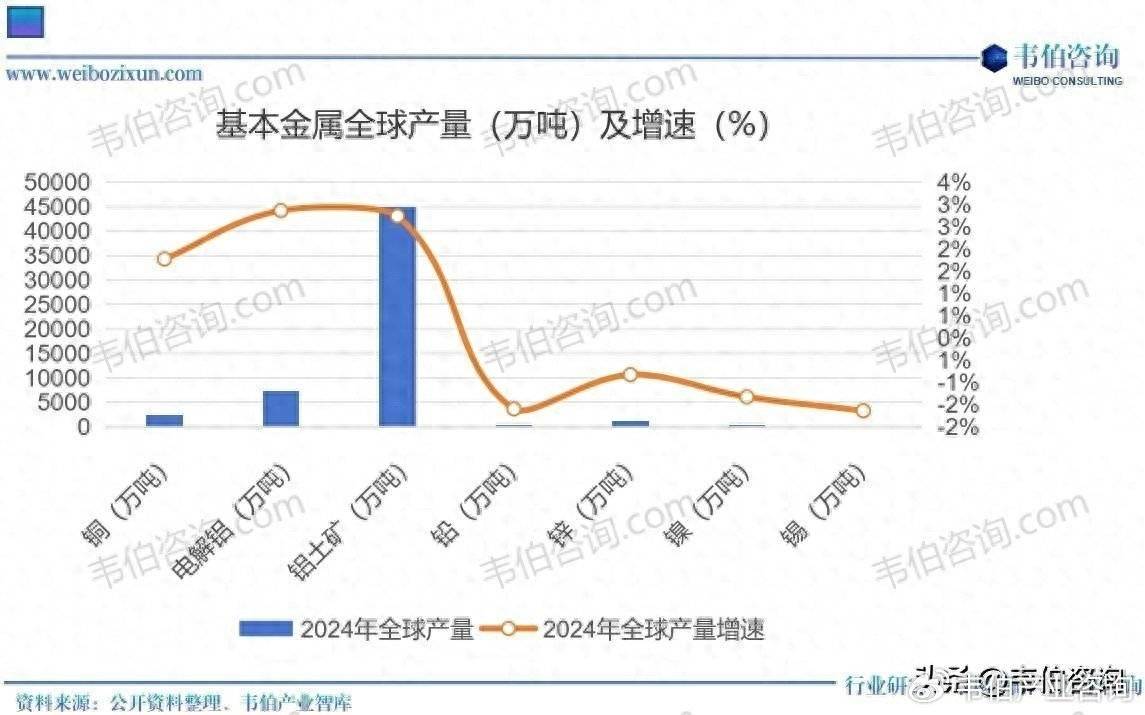
Group 1 - In 2024, global copper production is projected to reach 23 million tons, representing a year-on-year increase of 1.77%, primarily driven by contributions from the Democratic Republic of the Congo and Indonesia [1] - Global electrolytic aluminum production is expected to grow by 2.86% to 72 million tons in 2024, with China being the largest producer at 43 million tons, accounting for 59.72% of the total, an increase of 140,000 tons from 2023 [1] - Global lead ore production is forecasted to decline by 1.60% to 4.3 million tons in 2024, with China's lead ore production at 1.9 million tons, representing 44.19% of the global total [1] Group 2 - Zinc production is anticipated to continue its downward trend, decreasing by 0.83% to 12 million tons in 2024, with China contributing 33.33% of global zinc production [4] - Despite a general growth trend in global nickel production, it is expected to slightly decline by 1.33% to 3.7 million tons in 2024 due to the impact of low-cost nickel products from Indonesia, leading to production cuts in Australia and the Philippines [4] - Global tin production is projected to decrease by 1.64% to 300,000 tons in 2024, with major production concentrated in China, Indonesia, Peru, and Myanmar [4] Group 3 - China's copper, aluminum, lead, and zinc reserve-to-production ratios are significantly lower than the global average, with China's copper reserve-to-production ratio at approximately 22.78 years, compared to the global average of 42.61 years [7] - China's copper reserves account for only 4.18% of global reserves, totaling 41 million tons, with challenges including small ore bodies, low grades, and high extraction costs [7] - The aging of mines and declining ore grades are expected to impact China's copper production, which is projected to decrease by 1.1% to 1.8 million tons in 2024 [7]
华联期货锡年报:需求长期支撑,供给扰动节奏
Hua Lian Qi Huo· 2025-12-15 11:13
Report Summary 1. Report's Industry Investment Rating No information provided. 2. Core Viewpoints - In 2025, the Shanghai tin price fluctuated widely from January to October and reached a three - and - a - half - year high at the end of the year, with an annual increase of about 30%. The year - end rally was driven by the triple factors of supply contraction, loose macro - expectations, and the expected explosion of emerging demand. The global tin supply is tight, while the demand in the new energy and semiconductor industries is growing. The price of tin futures is expected to maintain an upward trend in the long term, with support levels around 260,000 - 280,000 yuan/ton [7]. - The global demand growth rate is expected to be around 3%. The profit will remain low due to tight supply at the mine end and weak processing fees. The LME and SHFE inventories showed a downward trend throughout the year [7]. 3. Summary by Directory Annual Viewpoint and Strategy - **Market**: The Shanghai tin price fluctuated widely from January to October and hit a three - and - a - half - year high at the end of the year, up about 30% year - on - year. The year - end rally was driven by supply contraction, loose macro - expectations, and the expected explosion of emerging demand. In the early part of the year, the price fluctuated widely due to supply disruptions and repeated trade disputes. In the second half of the year, the resumption of tin ore production in the Wa State of Myanmar was significantly slower than expected, and Indonesia's crackdown on illegal mining and the armed conflict in the Bisie tin mine in the DRC further exacerbated the supply shortage. The probability of the Fed cutting interest rates by 25 basis points in December soared to 89.2%, and the semiconductor industry's prosperity continued to recover [7]. - **Supply**: From January to October, the cumulative output of refined tin was 143,000 tons, a year - on - year decrease of 1.25%. It is predicted that the global refined tin output in 2025 will be about 373,000 tons, only a 1.36% increase from 368,000 tons in 2024, with the growth rate significantly lower than the demand growth rate [7]. - **Demand**: From January to October 2025, the cumulative solar energy production was 688.403 million kilowatts, a year - on - year increase of 11.6%; the cumulative integrated circuit production was 386.6 million units, a year - on - year increase of 10.2%; the cumulative automobile production in China was 27.325 million units, a year - on - year increase of 11%. The domestic economy is resilient, and policies continue to support emerging industries. The prosperity of the new energy and semiconductor industries continues to improve. The global demand growth rate is expected to be around 3% [7]. - **Cost and Profit**: The supply at the mine end remains tight, and processing fees continue to decline weakly. Overall, profits will remain low [7]. - **Inventory**: The LME and SHFE inventories showed a downward trend throughout the year [7]. - **Outlook**: Photovoltaic, new energy vehicles, and the semiconductor industry will support marginal demand in the long term. Mine - end disruptions occur from time to time, disturbing the supply of tin, and the futures price shows high elasticity [7]. - **Strategy**: Due to insufficient supply, the domestic economy remains resilient, and the prosperity of the semiconductor and automobile industries generally maintains an upward trend. There are still expectations of interest rate cuts overseas, and the mine end is subject to repeated disruptions. In operation, the long - term upward trend logic remains unchanged, with reference support levels around 260,000 - 280,000 yuan/ton. Later, focus on the implementation of macro - measures, the disturbances of Myanmar and Congo mines, the export speed of Indonesia, and the verification of consumption data [7]. Macroeconomic Situation - **GDP**: China's full - year growth target in 2025 is about 5%, and it is expected to be around 4.6% in the fourth quarter. The annualized quarterly growth rate of the US GDP in the third quarter of 2025 was 3.9%, mainly supported by consumption and AI - related investments. The market generally expects the full - year actual GDP growth rate to be in the range of 2.0% - 2.6% [13]. - **PMI**: In November 2025, China's manufacturing PMI was 49.2%, remaining below the boom - bust line for eight consecutive months with a slight month - on - month recovery. The US ISM manufacturing PMI was 48.6, remaining in the contraction range for 14 consecutive months [17]. - **Monetary Policy**: After the 1 - year and over - 5 - year LPRs were cut by 10 basis points on May 20, 2025, the LPRs have remained unchanged for 6 consecutive months (1 - year LPR: 3.00%; over - 5 - year LPR: 3.50%). China will continue to implement a moderately loose monetary policy. On December 10, 2025, the Fed cut interest rates by 25 basis points, lowering the federal funds rate target range to 3.50% - 3.75% [21]. Technical Analysis Before November, the price fluctuated widely and then broke through. Overall, it showed a bullish trend [29]. Industry Chain and Spot - Futures Market - **Spot - Futures Market**: In 2025, the Shanghai tin price fluctuated widely from January to October and reached a three - and - a - half - year high at the end of the year, up about 30% year - on - year. The year - end rally was driven by the triple factors of supply contraction, loose macro - expectations, and the expected explosion of emerging demand. The basis remained basically stable [40]. Inventory - As of December 5, 2025, the SHFE inventory was 6,683 tons, showing a downward trend throughout the year; the LME total inventory was 3,075 tons, also showing a downward trend throughout the year. The refined tin social inventory was 8,653 tons, with a slight year - on - year increase [49][53]. Cost and Profit As of December 5, 2025, the processing fee for refined tin ore in Yunnan was 11,000 yuan/ton, and in Guangxi it was 7,000 yuan/ton. The processing fees continued to be weak [59]. Supply - **Production**: In October 2025, the output of refined tin was 15,618 tons, returning to normal supply. From January to October, the cumulative output was 143,000 tons, a year - on - year decrease of 1.25%. The domestic tin ore output in September was 6,263.28 tons, with a slight month - on - month decrease. From January to October, the cumulative output was 56,500 tons, a year - on - year increase of 1.8% [66]. - **Capacity Utilization**: In October 2025, the capacity utilization rate of tin enterprises was about 67.05%, returning to normal [71]. - **Overseas Mines**: The tin ore production of PT Timah in Indonesia decreased by 19.8% year - on - year, and the annual output and export were at a near - four - year low. The Bisie tin mine in the DRC was disturbed in March and November. The resumption of tin ore production in the Wa State of Myanmar was slow, and Yunnan Tin Group in China carried out maintenance [74]. Demand - **Automobile and Electronics**: In October 2025, China's automobile production was 3.279 million units, a year - on - year increase of 11.2%. From January to October, the cumulative production was 27.325 million units, a year - on - year increase of 11%. The production of electronic computers in October was 2.5633 million units, a year - on - year decrease of 14.6%. From January to October, the cumulative production was 28.7502 million units, a year - on - year decrease of 1.2%. In the first 10 months of 2025, the production of new energy vehicles in China was 13.015 million units, a year - on - year increase of 33.1%. The penetration rate of new energy vehicles in October and November exceeded 50% and 60% respectively [79]. - **Terminal Consumption**: In November 2025, China's PVC production was 2.1281 million tons, a year - on - year increase of 9.6%. From January to November, the cumulative production was 22.3238 million tons, a year - on - year increase of 4.38%. In October, the production of mobile electronic communications was 14.2735 million units, a year - on - year decrease of 4.2%. From January to October, the cumulative production was 125.1342 million units, a year - on - year decrease of 4.7%. In October 2025, the production of air conditioners was 1.4204 million units, a year - on - year decrease of 13.5%. From January to October, the cumulative production was 23.0344 million units, a year - on - year increase of 3%. The refrigerator production in October was 878,800 units, a year - on - year decrease of 6%. From January to October, the cumulative production was 8.9959 million units, a year - on - year increase of 0.9%. In October 2025, the production of washing machines was 1.1035 million units, a year - on - year decrease of 2%. From January to October, the cumulative production was 10.1078 million units, a year - on - year increase of 6.4%. The production of color televisions in October was 1.804 million units, a year - on - year increase of 1.7%. From January to October, the cumulative production was 16.6176 million units, a year - on - year decrease of 2.3%. In October 2025, the production of solar cells was 6.7938 million kilowatts, a year - on - year decrease of 8.7%. From January to October, the cumulative production was 688.403 million kilowatts, a year - on - year increase of 11.6%. The production of integrated circuits in October was 41.77 million units, a year - on - year increase of 17.7%. From January to October, the cumulative production was 386.6 million units, a year - on - year increase of 10.2% [85][90][94][100]. Import and Export In October 2025, China imported 11,600 tons of tin ore, 526 tons of tin ingots, and exported 1,480 tons of refined tin. In the first 10 months of 2025, China imported a total of 262,000 tons of tin concentrate in physical quantity, equivalent to 43,000 tons of metal, a year - on - year decrease of 0.3%. The cumulative net export of refined tin from January to October was 1,546 tons [106]. Tin Balance Sheet The global tin supply is expected to be 359,500 tons in 2025E and 379,700 tons in 2026E, while the global demand is expected to be 380,000 tons in 2025E and 390,200 tons in 2026E, with supply - demand gaps of 20,500 tons and 10,500 tons respectively [107].
洛阳钼业年内涨近200% 拟10亿美元拿下巴西金矿
Di Yi Cai Jing· 2025-12-15 10:57
Core Viewpoint - Luoyang Molybdenum plans to acquire four gold mines in Brazil for $1 billion, aligning with its strategy focused on copper and gold investments, which is expected to enhance its resource reserves and financial performance [1][2]. Group 1: Acquisition Details - The acquisition involves a total consideration of $1.015 billion for 100% equity in four gold mines owned by Equinox Gold, including Aurizona, RDM, and Bahia [2]. - The payment structure consists of a $900 million upfront payment and up to $115 million contingent payment based on gold sales in the first operational year post-acquisition [2]. - The transaction is expected to be completed by Q1 2026, pending regulatory approvals from Brazilian antitrust authorities and Chinese regulatory bodies [2]. Group 2: Financial Performance - For the first three quarters of 2025, the company reported revenue of 145.485 billion yuan, a year-on-year decrease of 5.99%, while net profit attributable to shareholders was 14.280 billion yuan, an increase of 72.61% [3]. - In Q3 2025, revenue was 50.713 billion yuan, down 2.36% year-on-year but up 3.99% quarter-on-quarter, with net profit reaching 5.608 billion yuan, reflecting a 96.40% year-on-year increase [3]. - The profit growth is attributed to rising product prices and increased copper production and sales [3]. Group 3: Market Context and Strategic Implications - The mining industry is cyclical, and the company emphasizes the importance of accurately grasping market cycles for expansion [3]. - Some industry experts express concerns about the timing of the acquisition, suggesting it may be at a market peak, which could pose risks of "buying at high points" [4][5]. - The acquisition is seen as a strategic move to diversify the company's asset portfolio, particularly as it transitions towards becoming a more diversified mining group [5].
603993,年内涨近200%,拟10亿美元拿下巴西金矿
Di Yi Cai Jing Zi Xun· 2025-12-15 09:26
Core Viewpoint - Luoyang Molybdenum plans to acquire four gold mines in Brazil for a total consideration of $1.015 billion, which aligns with its strategy focused on copper and gold investments, potentially enhancing its resource reserves [2][3]. Group 1: Acquisition Details - The acquisition includes 100% equity of four gold mines owned by Equinox Gold, namely Aurizona, RDM, and Bahia complex (Fazenda and Santa Luz mines), with a payment structure comprising $900 million upfront and up to $115 million contingent on gold sales in the first operational year post-acquisition [3]. - The transaction is expected to be completed by Q1 2026, pending approval from Brazilian antitrust authorities and relevant Chinese regulatory bodies [3]. - Following the acquisition, the annual gold production of the company is projected to reach 8 tons, further solidifying its presence in the South American gold market [3]. Group 2: Financial Performance - For the first three quarters of 2025, the company reported revenues of 145.485 billion yuan, a year-on-year decrease of 5.99%, while net profit attributable to shareholders was 14.280 billion yuan, an increase of 72.61% [4]. - The third quarter saw revenues of 50.713 billion yuan, a year-on-year decline of 2.36%, but a quarter-on-quarter increase of 3.99%, with net profit rising by 96.40% year-on-year [4]. - The profit growth is attributed to increased product prices and higher copper production and sales [4]. Group 3: Market Analysis - Industry experts suggest that while gold prices may still have room for growth, the significant price increases in copper and gold this year pose a risk of "buying at a high point" if market conditions reverse [5][6]. - The acquisition is viewed as a strategic move to diversify the company's asset portfolio and mitigate the volatility of metal prices, with a focus on long-term value enhancement [5]. - Concerns have been raised regarding the timing of the acquisition, as frequent financing and mergers in the mining sector may indicate that the industry is at a peak, reminiscent of past cycles where high prices led to subsequent declines [6].

603993,年内涨近200%,拟10亿美元拿下巴西金矿
第一财经· 2025-12-15 09:10
Core Viewpoint - Luoyang Molybdenum Co., Ltd. announced a $1 billion acquisition of four gold mines in Brazil, aligning with its strategy focused on copper and gold, while benefiting from rising global metal prices [3][4][5]. Group 1: Acquisition Details - The acquisition involves a total consideration of $1.015 billion for 100% equity of four gold mines, including Aurizona, RDM, and Bahia, with $900 million as an upfront payment and up to $115 million contingent on gold sales in the first operational year [5]. - The transaction is expected to increase the company's annual gold production to 8 tons and is anticipated to be completed in Q1 2026, pending regulatory approvals [5][6]. Group 2: Financial Performance - For the first three quarters of 2025, the company reported revenues of 145.485 billion yuan, a year-on-year decrease of 5.99%, while net profit attributable to shareholders was 14.280 billion yuan, an increase of 72.61% [6]. - The third quarter saw revenues of 50.713 billion yuan, a year-on-year decline of 2.36%, but a quarter-on-quarter increase of 3.99%, with net profit rising 96.40% year-on-year [6]. Group 3: Market Context and Risks - Industry experts suggest that while gold prices may still have room to rise, the significant increases in copper and gold prices this year pose a risk of "buying at a high point" if market conditions reverse [3][9]. - The acquisition is viewed as a strategic move to diversify the company's asset portfolio, but concerns exist regarding the timing of such investments in a potentially peaking market [10][11].