
锡现货

Search documents
华联期货宏观周报:高位宽幅震荡-20260316
Hua Lian Qi Huo· 2026-03-16 02:25
1. Report Industry Investment Rating No relevant information provided. 2. Core View of the Report - Last week, Shanghai tin prices fluctuated significantly at high levels. On March 13, 2026, the spot price of Mysteel's comprehensive 1 tin was 387,000 yuan/ton, with large price and basis fluctuations [16]. - In terms of supply, refined tin production in February was 10,613 tons, showing a seasonal decrease. Domestic tin ore production in December was 5,300 tons, with a slight year - on - year decrease. Myanmar is promoting the resumption of tin mining production, and Indonesia's exports continued to decline in January [16]. - Regarding demand, it is expected that the emerging sectors will maintain demand resilience in January - February, while the traditional sectors will see some adjustments. The government's moderately loose policy and support for emerging industries will boost tin demand, but the Middle East conflict may suppress demand. In February, China's automobile sales were 1.805 million, a year - on - year decrease of 15.2%, and new energy vehicle sales were 765,000, a year - on - year decrease of 14.2% [16]. - For cost and profit, the tightness of the ore end has been alleviated, and processing fees have continued to rebound from a low level [16]. - In terms of inventory, LME, SHFE inventories increased slightly week - on - week, and social inventory decreased slightly week - on - week [16]. - The strategy is to trade with a light position due to large market sentiment fluctuations. Consider lightly buying call or put options, with support at 350,000 - 360,000 yuan/ton and resistance at 440,000 - 450,000 yuan/ton. Pay attention to market sentiment, disturbances from Myanmar and Congo mines, and the progress of the Middle East situation [16]. 3. Summary by Directory 3.1 Week - ly View and Strategy - **Week - ly View**: High - level wide - range fluctuations in Shanghai tin prices, with complex supply and demand factors. Supply is affected by production changes and overseas resumption, demand is influenced by emerging and traditional sectors, and cost and inventory also show certain trends [16]. - **Strategy**: Light - position trading, buying call or put options, with reference support and resistance levels, and focus on key influencing factors [16]. 3.2 Industrial Chain Structure No detailed content provided for in - depth summary. 3.3 Futures and Spot Market No detailed analysis content provided, only mentions the presentation of SHFE and LME tin futures and spot prices and basis [23]. 3.4 Inventory - As of March 13, 2026, SHFE inventory was 12,273 tons, increasing week - on - week; as of March 11, 2026, LME total inventory was 8,630 tons, increasing week - on - week; as of March 6, 2026, refined tin social inventory was 13,250 tons, decreasing slightly week - on - week [35][39]. 3.5 Cost and Profit As of March 13, 2026, the processing fee for Yunnan concentrate was 16,000 yuan/ton, and that for Guangxi concentrate was 12,000 yuan/ton, with processing fees continuing to rebound from a low level [46]. 3.6 Supply - In February 2026, refined tin production was 10,613 tons, with a seasonal decrease; domestic tin ore production in December was 5,362.43 tons, with a slight month - on - month increase. In February 2026, the capacity utilization rate of tin enterprises was about 45.57%, dropping significantly month - on - month due to holiday factors [54][59]. 3.7 Demand - In December 2025, China's automobile production was 3.4115 million, a year - on - year decrease of 2.8%; electronic computer production was 31.3956 million, a year - on - year decrease of 12.5%. In February 2026, China's PVC production was 1.9851 million tons, a year - on - year decrease of 5.3%. In December 2025, mobile electronic communication production was 146.5594 million, a year - on - year decrease of 9.5%. In December 2025, air - conditioner production was 21.6289 million, a year - on - year decrease of 9.6%; refrigerator production was 10.0114 million, a year - on - year increase of 5%. In December 2025, washing machine production was 11.975 million, a year - on - year decrease of 4.4%; color TV production was 19.5206 million, a year - on - year decrease of 1.2%. In December 2025, solar cell production was 74.44 million kilowatts, a year - on - year decrease of 9.7% and a month - on - month increase; integrated circuit production was 48.073455 billion pieces, a year - on - year increase of 12.9% [65][72][76][81][85]. 3.8 Import and Export In December 2025, China imported 17,600 tons of tin ore, with a significant month - on - month increase; imported 1,547.7 tons of tin ingots; and exported 2,763 tons of refined tin and alloys [91]. 3.9 Supply - Demand Table - From 2018 to 2026E, China's tin production shows a certain upward trend, while overseas production fluctuates. Global supply and demand are in a state of imbalance, with a supply shortage in most years [94].
宏观周报:高位大幅震荡,交易所降温-20260118
Hua Lian Qi Huo· 2026-01-18 14:37
1. Report Industry Investment Rating No relevant information provided. 2. Core View of the Report - Last week, Shanghai Tin prices broke through significantly at high levels and then fell sharply. On January 16, 2026, the spot price of Mysteel's comprehensive 1 tin was 413,500 yuan/ton, with large price fluctuations and significant changes in the basis. - In November, refined tin production was 15,490 tons, returning to normal both month - on - month and year - on - year. From January to October, the domestic tin ore production was 61,800 tons, with a slight year - on - year increase, and domestic tin ore supply remained stable. Myanmar's repeated progress in mine resumption affected the price range, and Indonesia's exports decreased in December. - In November, the demand growth of integrated circuits, automobiles, and PVC remained strong, while the demand in traditional sectors such as computers and some white goods slowed down. It is expected that in December, the demand in emerging sectors will maintain resilience, and the demand in some traditional sectors will be adjusted. In 2025, China's foreign trade imports and exports reached 45.47 trillion yuan, a year - on - year increase of 3.8%, maintaining growth for 9 consecutive years. China's automobile production and sales both exceeded 34 million units in 2025, reaching a new high and ranking first globally for 17 consecutive years. The domestic economy is resilient, and the prosperity of the new energy and semiconductor industries is rising. Overseas uncertainties remain high, and there is still a high probability of interest rate cuts in the later period. - The mining end remains tight, and processing fees continue to decline weakly. Overall, profits will remain low under the influence of mining end disturbances. - LME inventories increased slightly week - on - week, SHFE inventories increased significantly week - on - week, and social inventories decreased slightly week - on - week. - Due to insufficient supply, the domestic economy still has resilience, and the overall prosperity of semiconductors, automobiles, etc. remains upward. Overseas uncertainties remain high, and there is still an expectation of interest rate cuts in the later period. The mining end situation is volatile. High - price expectations suppress demand and stimulate supply. After the futures price was significantly pulled up by funds and then fell sharply, the industry association called on all parties in the market to maintain a rational and cautious attitude, and the exchange introduced cooling measures. In terms of operation, reduce the holdings of long positions. The weekly reference support level has been raised to around 360,000 - 363,000 yuan/ton. For those who bought put options, they can reduce their positions after the market stabilizes. Later, focus should be on the implementation of macro - measures, the disturbances of Myanmar and Congo mines, the speed of Indonesia's exports, and the verification of consumption data. [14] 3. Summary by Relevant Catalogs 3.1. Week - on - Week View and Strategy - **View**: The impact factors such as output, downstream demand, inventory, imports and exports, market sentiment, cost - profit, and macro environment are all rated as neutral [15]. - **Strategy**: Reduce the holdings of long positions, with the weekly reference support level raised to around 360,000 - 363,000 yuan/ton. For put option buyers, reduce positions after the market stabilizes. Focus on macro - measures, mine disturbances, Indonesia's exports, and consumption data [14]. 3.2. Industrial Chain Structure No specific content provided for in - depth summary. 3.3. Futures and Spot Market No specific content provided for in - depth summary other than the mention of SHFE and LME tin futures - spot prices and basis charts [21]. 3.4. Inventory - As of January 15, 2026, SHFE tin inventory was 9,526 tons, with a significant week - on - week increase. - As of January 14, 2026, LME total tin inventory was 5,925 tons, with a slight week - on - week increase. - As of January 9, 2026, refined tin social inventory was 8,076 tons, with a slight week - on - week decrease [33][37]. 3.5. Cost - Profit As of January 15, 2026, the processing fee of Yunnan concentrate was 11,000 yuan/ton, and that of Guangxi concentrate was 7,000 yuan/ton. Processing fees continued to be weak [42]. 3.6. Supply - In November 2025, refined tin production was 15,490 tons, returning to normal supply. In October 2025, domestic tin ore production was 5,236.8 tons, with a slight month - on - month decrease. - In November 2025, the capacity utilization rate of tin enterprises was about 66.5%, returning to normal [48][52]. 3.7. Demand - In November 2025, China's automobile production was 3.519 million vehicles, a year - on - year increase of 2.4%; China's electronic computer production was 29.028 million units, a year - on - year decrease of 1.4%. - In December 2025, China's PVC production was 2.137 million tons, a year - on - year increase of 8.5%; in November 2025, China's mobile electronic communication production was 142.35 million units, a year - on - year decrease of 11.6%. - In November 2025, China's air - conditioner production was 15.026 million units, a year - on - year decrease of 23.4%; China's refrigerator production was 9.442 million units, a year - on - year increase of 5.6%. - In November 2025, China's washing - machine production was 12.013 million units, a year - on - year increase of 5.5%; China's color television production was 17.449 million units, a year - on - year decrease of 5%. - In November 2025, China's solar energy production was 73.49 million kilowatts, a year - on - year increase of 7.8%; China's integrated circuit production was 43.9 million pieces, a year - on - year increase of 15.6% [59][64][69][74][78]. 3.8. Imports and Exports - In November 2025, China imported 15,000 tons of tin ore, with a significant month - on - month increase; imported 1,194 tons of tin ingots; and exported 2,045 tons of refined tin and alloys [82]. 3.9. Supply - Demand Table | Year/(10,000 tons) | 2018 | 2019 | 2020 | 2021 | 2022 | 2023 | 2024 | 2025E | 2026E | | --- | --- | --- | --- | --- | --- | --- | --- | --- | --- | | China's Production | 18.1 | 15.9 | 18 | 19.8 | 17.9 | 17.4 | 18.1 | 18.45 | 18.67 | | Overseas Production | 17.7 | 19.5 | 14.8 | 15.3 | 20.1 | 19.2 | 17.1 | 17.5 | 19.3 | | Global Supply | 35.8 | 35.4 | 32.8 | 35.1 | 38 | 36.6 | 35.2 | 35.95 | 37.97 | | China's Demand | 14.9 | 14 | 16.4 | 18.4 | 18.1 | 18.75 | 19.1 | 19.3 | 19.87 | | Overseas Demand | 22.3 | 21.9 | 18.8 | 20.5 | 19.9 | 18.2 | 18.1 | 18.7 | 19.15 | | Global Demand | 37.2 | 35.9 | 35.2 | 38.9 | 38 | 36.95 | 37.2 | 38 | 39.02 | | Global Supply - Demand Balance | - 1.4 | - 0.5 | - 2.4 | - 3.8 | 0.05 | - 0.35 | - 2 | - 2.05 | - 1.05 | [85]
华联期货锡年报:需求长期支撑,供给扰动节奏
Hua Lian Qi Huo· 2025-12-15 11:13
Report Summary 1. Report's Industry Investment Rating No information provided. 2. Core Viewpoints - In 2025, the Shanghai tin price fluctuated widely from January to October and reached a three - and - a - half - year high at the end of the year, with an annual increase of about 30%. The year - end rally was driven by the triple factors of supply contraction, loose macro - expectations, and the expected explosion of emerging demand. The global tin supply is tight, while the demand in the new energy and semiconductor industries is growing. The price of tin futures is expected to maintain an upward trend in the long term, with support levels around 260,000 - 280,000 yuan/ton [7]. - The global demand growth rate is expected to be around 3%. The profit will remain low due to tight supply at the mine end and weak processing fees. The LME and SHFE inventories showed a downward trend throughout the year [7]. 3. Summary by Directory Annual Viewpoint and Strategy - **Market**: The Shanghai tin price fluctuated widely from January to October and hit a three - and - a - half - year high at the end of the year, up about 30% year - on - year. The year - end rally was driven by supply contraction, loose macro - expectations, and the expected explosion of emerging demand. In the early part of the year, the price fluctuated widely due to supply disruptions and repeated trade disputes. In the second half of the year, the resumption of tin ore production in the Wa State of Myanmar was significantly slower than expected, and Indonesia's crackdown on illegal mining and the armed conflict in the Bisie tin mine in the DRC further exacerbated the supply shortage. The probability of the Fed cutting interest rates by 25 basis points in December soared to 89.2%, and the semiconductor industry's prosperity continued to recover [7]. - **Supply**: From January to October, the cumulative output of refined tin was 143,000 tons, a year - on - year decrease of 1.25%. It is predicted that the global refined tin output in 2025 will be about 373,000 tons, only a 1.36% increase from 368,000 tons in 2024, with the growth rate significantly lower than the demand growth rate [7]. - **Demand**: From January to October 2025, the cumulative solar energy production was 688.403 million kilowatts, a year - on - year increase of 11.6%; the cumulative integrated circuit production was 386.6 million units, a year - on - year increase of 10.2%; the cumulative automobile production in China was 27.325 million units, a year - on - year increase of 11%. The domestic economy is resilient, and policies continue to support emerging industries. The prosperity of the new energy and semiconductor industries continues to improve. The global demand growth rate is expected to be around 3% [7]. - **Cost and Profit**: The supply at the mine end remains tight, and processing fees continue to decline weakly. Overall, profits will remain low [7]. - **Inventory**: The LME and SHFE inventories showed a downward trend throughout the year [7]. - **Outlook**: Photovoltaic, new energy vehicles, and the semiconductor industry will support marginal demand in the long term. Mine - end disruptions occur from time to time, disturbing the supply of tin, and the futures price shows high elasticity [7]. - **Strategy**: Due to insufficient supply, the domestic economy remains resilient, and the prosperity of the semiconductor and automobile industries generally maintains an upward trend. There are still expectations of interest rate cuts overseas, and the mine end is subject to repeated disruptions. In operation, the long - term upward trend logic remains unchanged, with reference support levels around 260,000 - 280,000 yuan/ton. Later, focus on the implementation of macro - measures, the disturbances of Myanmar and Congo mines, the export speed of Indonesia, and the verification of consumption data [7]. Macroeconomic Situation - **GDP**: China's full - year growth target in 2025 is about 5%, and it is expected to be around 4.6% in the fourth quarter. The annualized quarterly growth rate of the US GDP in the third quarter of 2025 was 3.9%, mainly supported by consumption and AI - related investments. The market generally expects the full - year actual GDP growth rate to be in the range of 2.0% - 2.6% [13]. - **PMI**: In November 2025, China's manufacturing PMI was 49.2%, remaining below the boom - bust line for eight consecutive months with a slight month - on - month recovery. The US ISM manufacturing PMI was 48.6, remaining in the contraction range for 14 consecutive months [17]. - **Monetary Policy**: After the 1 - year and over - 5 - year LPRs were cut by 10 basis points on May 20, 2025, the LPRs have remained unchanged for 6 consecutive months (1 - year LPR: 3.00%; over - 5 - year LPR: 3.50%). China will continue to implement a moderately loose monetary policy. On December 10, 2025, the Fed cut interest rates by 25 basis points, lowering the federal funds rate target range to 3.50% - 3.75% [21]. Technical Analysis Before November, the price fluctuated widely and then broke through. Overall, it showed a bullish trend [29]. Industry Chain and Spot - Futures Market - **Spot - Futures Market**: In 2025, the Shanghai tin price fluctuated widely from January to October and reached a three - and - a - half - year high at the end of the year, up about 30% year - on - year. The year - end rally was driven by the triple factors of supply contraction, loose macro - expectations, and the expected explosion of emerging demand. The basis remained basically stable [40]. Inventory - As of December 5, 2025, the SHFE inventory was 6,683 tons, showing a downward trend throughout the year; the LME total inventory was 3,075 tons, also showing a downward trend throughout the year. The refined tin social inventory was 8,653 tons, with a slight year - on - year increase [49][53]. Cost and Profit As of December 5, 2025, the processing fee for refined tin ore in Yunnan was 11,000 yuan/ton, and in Guangxi it was 7,000 yuan/ton. The processing fees continued to be weak [59]. Supply - **Production**: In October 2025, the output of refined tin was 15,618 tons, returning to normal supply. From January to October, the cumulative output was 143,000 tons, a year - on - year decrease of 1.25%. The domestic tin ore output in September was 6,263.28 tons, with a slight month - on - month decrease. From January to October, the cumulative output was 56,500 tons, a year - on - year increase of 1.8% [66]. - **Capacity Utilization**: In October 2025, the capacity utilization rate of tin enterprises was about 67.05%, returning to normal [71]. - **Overseas Mines**: The tin ore production of PT Timah in Indonesia decreased by 19.8% year - on - year, and the annual output and export were at a near - four - year low. The Bisie tin mine in the DRC was disturbed in March and November. The resumption of tin ore production in the Wa State of Myanmar was slow, and Yunnan Tin Group in China carried out maintenance [74]. Demand - **Automobile and Electronics**: In October 2025, China's automobile production was 3.279 million units, a year - on - year increase of 11.2%. From January to October, the cumulative production was 27.325 million units, a year - on - year increase of 11%. The production of electronic computers in October was 2.5633 million units, a year - on - year decrease of 14.6%. From January to October, the cumulative production was 28.7502 million units, a year - on - year decrease of 1.2%. In the first 10 months of 2025, the production of new energy vehicles in China was 13.015 million units, a year - on - year increase of 33.1%. The penetration rate of new energy vehicles in October and November exceeded 50% and 60% respectively [79]. - **Terminal Consumption**: In November 2025, China's PVC production was 2.1281 million tons, a year - on - year increase of 9.6%. From January to November, the cumulative production was 22.3238 million tons, a year - on - year increase of 4.38%. In October, the production of mobile electronic communications was 14.2735 million units, a year - on - year decrease of 4.2%. From January to October, the cumulative production was 125.1342 million units, a year - on - year decrease of 4.7%. In October 2025, the production of air conditioners was 1.4204 million units, a year - on - year decrease of 13.5%. From January to October, the cumulative production was 23.0344 million units, a year - on - year increase of 3%. The refrigerator production in October was 878,800 units, a year - on - year decrease of 6%. From January to October, the cumulative production was 8.9959 million units, a year - on - year increase of 0.9%. In October 2025, the production of washing machines was 1.1035 million units, a year - on - year decrease of 2%. From January to October, the cumulative production was 10.1078 million units, a year - on - year increase of 6.4%. The production of color televisions in October was 1.804 million units, a year - on - year increase of 1.7%. From January to October, the cumulative production was 16.6176 million units, a year - on - year decrease of 2.3%. In October 2025, the production of solar cells was 6.7938 million kilowatts, a year - on - year decrease of 8.7%. From January to October, the cumulative production was 688.403 million kilowatts, a year - on - year increase of 11.6%. The production of integrated circuits in October was 41.77 million units, a year - on - year increase of 17.7%. From January to October, the cumulative production was 386.6 million units, a year - on - year increase of 10.2% [85][90][94][100]. Import and Export In October 2025, China imported 11,600 tons of tin ore, 526 tons of tin ingots, and exported 1,480 tons of refined tin. In the first 10 months of 2025, China imported a total of 262,000 tons of tin concentrate in physical quantity, equivalent to 43,000 tons of metal, a year - on - year decrease of 0.3%. The cumulative net export of refined tin from January to October was 1,546 tons [106]. Tin Balance Sheet The global tin supply is expected to be 359,500 tons in 2025E and 379,700 tons in 2026E, while the global demand is expected to be 380,000 tons in 2025E and 390,200 tons in 2026E, with supply - demand gaps of 20,500 tons and 10,500 tons respectively [107].
这个赛道多品种走强,两路资金大力加仓(名单)
Zheng Quan Shi Bao Wang· 2025-12-11 01:21
Core Viewpoint - The acquisition of PMG International Co., LTD by Lens Technology (300433) aims to enhance its capabilities in the AI computing hardware sector, leveraging its existing manufacturing strengths and expanding into new markets [1][2]. Group 1: Acquisition Details - Lens Technology signed a letter of intent to acquire 100% equity of PMG International, with specific terms to be negotiated based on due diligence and assessments [1]. - The acquisition is intended to provide Lens Technology with established technology and customer certifications in the server cabinet business, enhancing its competitive edge in AI computing hardware [2]. Group 2: Industry Performance - The small metals sector in A-shares experienced a 0.79% increase on December 10, with significant price rises in tungsten and other metals, indicating strong market demand [3][5]. - Tungsten prices have surged, with black tungsten concentrate reaching 363,000 CNY/ton, a 153.85% increase year-to-date, while ammonium paratungstate (APT) and tungsten powder also saw significant price hikes [3][5]. Group 3: Market Drivers - The price increases in small metals are driven by supply constraints, favorable macroeconomic conditions, and rising downstream demand from industries such as renewable energy and semiconductors [5]. - Expectations of a potential interest rate cut by the Federal Reserve are supporting commodity prices, with an 87.6% probability of a 25 basis point cut in December [5]. Group 4: Capital Inflows - The small metals sector has seen substantial capital inflows, with a net inflow of 1.732 billion CNY on December 10, ranking high among secondary industries [6]. - Notable stocks such as China Uranium Industry and Zhongtung High-tech have attracted significant financing, indicating strong investor interest in the sector [6][7]. Group 5: Company Performance - The small metals sector has shown robust performance, with a total net profit of 13.589 billion CNY in the first three quarters of the year, reflecting a 41.42% year-on-year increase [7]. - Companies like Shenghe Resources and Northern Rare Earth have reported exceptional profit growth, with increases of 748.07% and 280.27% respectively [7].

小金属多品种走强 两大资金加仓热情高涨
Zheng Quan Shi Bao· 2025-12-10 18:49
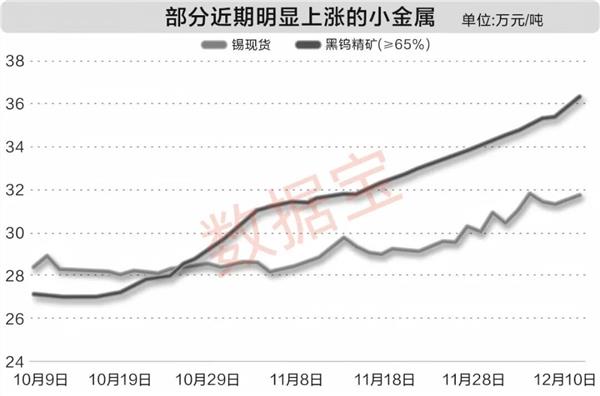
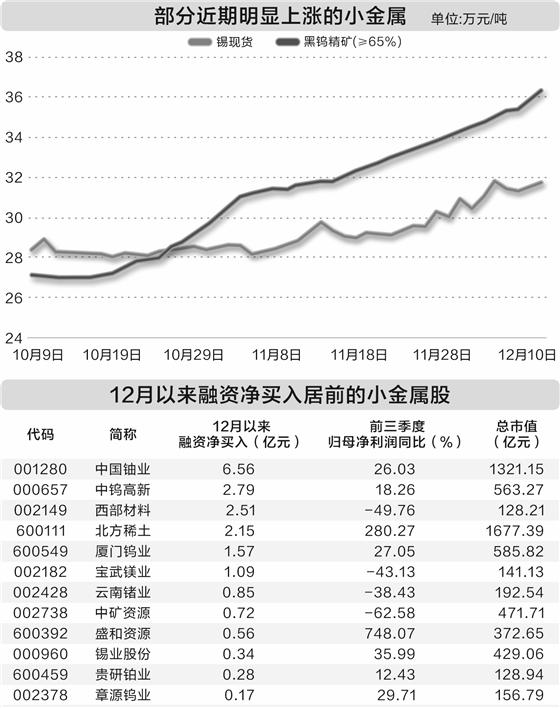
Core Viewpoint - The small metals sector in the A-share market has shown a significant upward trend, driven by multiple factors including supply constraints, favorable macroeconomic conditions, and increasing downstream demand [2][5]. Group 1: Price Movements - The small metals sector has experienced notable price increases, particularly in tungsten, which has reached historical highs. As of December 10, black tungsten concentrate (≥65%) is priced at 363,000 yuan/ton, up 153.85% year-to-date; ammonium paratungstate (APT) is at 535,000 yuan/ton, up 153.55%; and tungsten powder is at 880 yuan/kg, up 178.48% [3][5]. - Other metals such as cobalt and tin have also seen significant price increases, with cobalt averaging 408,000 yuan/ton (up 16.91% since October) and tin rising 13.89% over the same period [3][5]. Group 2: Driving Factors - The price increases are attributed to supply-side constraints, such as strict mining quotas and environmental regulations affecting tungsten, and ongoing export restrictions on cobalt from the Democratic Republic of Congo [5]. - The macroeconomic environment is favorable, with strong expectations for a Federal Reserve interest rate cut, which typically weakens the dollar and supports commodity prices [5]. - Downstream demand from industries like new energy, semiconductors, and defense is rapidly growing, boosting expectations for strategic small metals [5]. Group 3: Capital Inflows - The small metals sector has seen significant capital inflows, with a net inflow of 1.732 billion yuan on December 10, ranking high among secondary industries [6]. - Notably, Western Materials received a net inflow of 1.274 billion yuan, with its stock achieving a strong performance in recent trading sessions [6]. - Financing net purchases in the small metals sector reached 1.879 billion yuan in December, with several stocks, including China Uranium Industry, receiving substantial net purchases [6]. Group 4: Performance Metrics - The small metals sector has shown strong performance in 2023, with a total net profit of 13.589 billion yuan in the first three quarters, reflecting a year-on-year growth of 41.42% [7]. - Companies like Shenghe Resources and Northern Rare Earth have reported significant profit increases of 748.07% and 280.27%, respectively [7]. - Shenghe Resources is expanding its production capacity, with a project expected to be operational by the end of Q1 2026 [7].


有色金属衍生品日报-20251021
Yin He Qi Huo· 2025-10-21 12:00
Group 1: Report General Information - The report is a daily report on non - ferrous metals dated October 21, 2025, focusing on various non - ferrous metals including copper, alumina, electrolytic aluminum, etc. [2] Group 2: Report Industry Investment Rating - Not provided in the content Group 3: Core Views - **Copper**: Macroeconomically, Sino - US trade relations ease, and the 4th Plenary Session of the 20th CPC Central Committee is being watched. Fundamentally, copper mine supply disturbances increase. SMM expects a decrease in electrolytic copper production in October. Consumption shows "peak season without peak". The recommended trading strategies are long on dips, continue to hold inter - market positive spreads, and wait on options [2][4][5]. - **Alumina**: The supply - demand surplus will become more significant after downstream electrolytic aluminum plants complete their stockpiling. Some small - scale production cuts and maintenance have started, and more are expected in November. The price is expected to bottom out around 2800 yuan. Strategies include short - term low - level consolidation and waiting on spreads and options [11][12][13]. - **Electrolytic Aluminum**: Macroeconomic factors will drive the price this week. The consumption resilience in the fundamentals provides support. The strategy is to be bullish on dips and cautious on chasing highs [17][18]. - **Cast Aluminum Alloy**: Macroeconomic factors drive the price. High social inventory and warehouse receipts may limit the upside. The price is expected to be strong in the short - term. Strategies include being bullish on dips and waiting on spreads and options [24][25]. - **Zinc**: The import zinc ore loss widens, and domestic processing fees decline. The supply of refined zinc may increase, and consumption may weaken. The price shows an external - strong and internal - weak pattern. Strategies include waiting on all trading types [27][31][33]. - **Lead**: Downstream lead - storage enterprise orders improve, but production may increase in mid - to - late October, and the price may fall. Strategies include holding short positions and selling out - of - the - money call options [38][39]. - **Nickel**: The macro - environment fluctuates, and there is cost support, but the supply - demand surplus restricts the upside. The price is expected to oscillate widely with a downward center. Strategies include shorting at the upper limit of the oscillation range and selling a wide - straddle combination [43][45][46]. - **Stainless Steel**: The price is below the cost, and the terminal demand is not optimistic. It may keep a weak oscillation pattern. Strategies include weak oscillation and waiting on spreads [51][52]. - **Tin**: Sino - US trade tensions ease, and the Fed may cut interest rates. The supply of tin ore is tight, and demand recovers slowly. The price may oscillate around the integer level. Strategies include waiting on options [58][59][60]. - **Industrial Silicon**: Polysilicon production cuts in November are bearish for demand. The price is under short - term pressure but may not fall deeply. Strategies include waiting for a full correction [63][64][65]. - **Polysilicon**: The supply - demand balance will improve in November. The short - term correction space is limited. Strategies include buying on dips, holding reverse spreads, and adjusting option strategies [70][71][72]. - **Lithium Carbonate**: Inventory and warehouse receipts decrease, indicating strong demand. The price's oscillation center moves up. Strategies include being bullish on the oscillation, waiting on spreads, and selling out - of - the - money put options [74][75]. Group 4: Summary by Metals Copper - **Market Review**: The futures price of Shanghai copper 2512 rose 0.16% to 85400 yuan/ton, and the index position decreased by 2 lots. The spot price showed different trends in different regions [2]. - **Important Information**: The 4th Plenary Session of the 20th CPC Central Committee is held, and Japan, Spain, and South Korea express concerns about copper processing and refining fees [2]. - **Logic Analysis**: Macroeconomic and fundamental factors affect the market, and the export window may open again [2]. - **Trading Strategies**: Long on dips, hold inter - market positive spreads, and wait on options [5]. Alumina - **Market Review**: The futures price of alumina 2601 fell 6 yuan to 2810 yuan/ton, and the position decreased. The spot price decreased in most regions [6]. - **Related Information**: There are procurement, production adjustment, inventory, and import - export data [7][8][9][10]. - **Logic Analysis**: The supply - demand surplus becomes more obvious, and production cuts are expected [11]. - **Trading Strategies**: Short - term low - level consolidation, wait on spreads and options [12][13]. Electrolytic Aluminum - **Market Review**: The futures price of Shanghai aluminum 2512 rose 35 yuan to 20965 yuan/ton, and the position increased. The spot price rose in different regions [15]. - **Related Information**: There are meetings, trade talks, inventory, and economic data [15][16]. - **Trading Logic**: Macroeconomic and fundamental factors support the price [17]. - **Trading Strategies**: Bullish on dips, cautious on chasing highs [18]. Cast Aluminum Alloy - **Market Review**: The futures price of cast aluminum alloy 2512 rose 60 yuan to 20460 yuan/ton. The spot price was stable in most regions [20]. - **Related Information**: There are meetings, trade talks, warehouse receipt, inventory, and import - export data [20][21][23]. - **Trading Logic**: Macroeconomic factors drive the price, and supply - demand factors affect the upside [24]. - **Trading Strategies**: Bullish on dips, wait on spreads and options [24][25]. Zinc - **Market Review**: The futures price of Shanghai zinc 2512 rose 0.39% to 21970 yuan/ton, and the index position decreased. The spot market was weak [26]. - **Related Information**: There are inventory, production, and import - export data of zinc mines and refined zinc [27]. - **Logic Analysis**: The import loss of zinc ore widens, and the supply of refined zinc may increase [31]. - **Trading Strategies**: Wait on all trading types [33]. Lead - **Market Review**: The futures price of Shanghai lead 2512 rose 0.2% to 17155 yuan/ton, and the index position increased. The spot price rose, and downstream procurement was active [35]. - **Related Information**: There are inventory and import - export data [36][37]. - **Logic Analysis**: Downstream demand improves, but production may increase [38]. - **Trading Strategies**: Hold short positions, wait on spreads, and sell out - of - the - money call options [39]. Nickel - **Market Review**: The futures price of Shanghai nickel NI2512 rose 460 to 121380 yuan/ton, and the index position decreased. The spot premium was stable [41]. - **Important Information**: There are import - export, production, and consumption data [42]. - **Logic Analysis**: The macro - environment fluctuates, and the supply - demand surplus restricts the upside [43][45]. - **Trading Strategies**: Short at the upper limit of the oscillation range, wait on spreads, and sell a wide - straddle combination [46][47][48]. Stainless Steel - **Market Review**: The futures price of stainless steel SS2512 rose 55 to 12665 yuan/ton, and the index position decreased. The spot price was in a certain range [50]. - **Important Information**: There are import - export and procurement price data [51]. - **Logic Analysis**: The price is below the cost, and demand is not optimistic [51]. - **Trading Strategies**: Weak oscillation, wait on spreads [52]. Tin - **Market Review**: The futures price of Shanghai tin 2511 rose 1920 yuan/ton or 0.69% to 280870 yuan/ton, and the position increased. The spot price rose, and demand recovery was weak [55]. - **Related Information**: There are meetings, cooperation agreements, and mobile phone market data [56][57]. - **Logic Analysis**: The supply of tin ore is tight, and demand recovers slowly [58]. - **Trading Strategies**: Oscillate around the integer level, wait on options [59][60]. Industrial Silicon - **Important Information**: Polysilicon production cuts are expected in November [63]. - **Logic Analysis**: The price is under short - term pressure but may not fall deeply [64]. - **Strategy Suggestions**: Wait for a full correction, no arbitrage and option strategies for now [65][66][67]. Polysilicon - **Important Information**: Polysilicon production cuts are expected in November [69]. - **Logic Analysis**: The supply - demand balance will improve, and short - term correction space is limited [70]. - **Strategy Suggestions**: Buy on dips, hold reverse spreads, and adjust option strategies [71][72]. Lithium Carbonate - **Market Review**: The futures price of lithium carbonate 2601 fell 200 to 75980 yuan/ton, and the index position decreased. The spot price rose [73]. - **Important Information**: There are production plan changes, import - export, and new energy vehicle production data [74]. - **Logic Analysis**: Inventory and warehouse receipts decrease, indicating strong demand [74]. - **Trading Strategies**: Bullish on the oscillation, wait on spreads, and sell out - of - the - money put options [75]. Group 5: Price and Related Data - There are daily data tables for various non - ferrous metals including copper, alumina, aluminum, zinc, lead, nickel, tin, industrial silicon, polysilicon, and lithium carbonate, showing price, spread, profit, and inventory data [76][77][78][79][80][81][82][83][84][85] - There are also various graphs showing price trends, spreads, and inventory changes of different non - ferrous metals [87][90][94][98][105][107][110][117][119][124][126][130][132][138][142][146][150][154][157][162][165][170][174]
沪锡期货日报-20251009
Guo Jin Qi Huo· 2025-10-09 09:30
1. Report Industry Investment Rating - No relevant information provided 2. Core View of the Report - The current Shanghai tin market is in a situation where macro factors are mixed. The long - term logic of tight supply and demand remains unchanged, but in the short term, due to weak demand before the National Day holiday, profit - taking by funds, and risk - aversion sentiment from trade frictions, the upside potential of prices is limited [11] 3. Summary by Related Catalogs 3.1 Variety Price - The total trading volume of 12 Shanghai tin futures contracts is 84,373 lots, and the total open interest of Shanghai tin contracts is 52,516 lots. Among them, the open interest of the Shanghai tin contract 2511 is 46,590 lots [6][7] - The closing price of the Shanghai tin 2511 contract today is 272,410 yuan/ton, the mainstream market quotation on the day is 271,400 yuan/ton, and the basis is - 1,010 yuan/ton [8] 3.2 Influencing Factors - Supply side: The long - term logic of tight global tin ore supply remains unchanged, but in the short term, the tin inventory on the London Metal Exchange (LME) has slightly accumulated. On September 26, the inventory increased by 35 tons to 2,775 tons compared with the previous day. The inventory change has put some pressure on the spot price and weakened the premium power on the spot side [10] - Demand side: As the National Day holiday approaches, downstream enterprises' stockpiling is coming to an end. The demand in traditional industries such as tin - plated sheets is approaching saturation, and the "new quality requirements" driven by AI and new energy have not yet formed short - term upward - pulling power. The light trading in the spot market has made it difficult for the spot price to rise and keep up with the fluctuating futures price [10]
沪锡市场周报:供应担忧库存增加,预计锡价震荡调整-20250905
Rui Da Qi Huo· 2025-09-05 09:32
1. Report Industry Investment Rating No information provided in the document. 2. Core View of the Report - This week, the main contract of Shanghai Tin fell from a high, with a weekly decline of 2.22% and an amplitude of 2.86%. As of the end of this week, the closing price of the main contract was 272,460 yuan/ton. - Macroeconomically, the expansion speed of the US ISM Services PMI reached the fastest in half a year, with weak employment and high prices. The ADP employment growth in the US in August slowed down significantly to 54,000 people. The number of initial jobless claims in the US last week was 237,000, reaching the highest level since June. - Fundamentally, although Wa State in Myanmar has restarted the approval of mining licenses, actual ore production will not occur until the fourth quarter. The Bisie mine in Congo plans to resume production in phases, and currently, the tin ore processing fee remains at a historical low. - On the smelting side, the increase in production in July was mainly due to multiple factors such as the resumption of production by some enterprises and the cleaning of intermediate products. However, the shortage of raw materials in the Yunnan production area remains severe, and the waste recycling system in the Jiangxi production area is under pressure, with the operating rate remaining at a low level. - On the demand side, downstream processing enterprises are in the recovery period of the peak season, and the recovery of orders is relatively slow. Recently, the tin price has oscillated downward, but most downstream and end - user enterprises still adopt a wait - and - see attitude, and some downstream enterprises make small - scale purchases. The spot premium has rebounded to 200 yuan/ton, and domestic inventories have increased. LME inventories have rebounded, and the spot premium has been adjusted downward. - Technically, as the position decreases and the price falls, the bullish sentiment is cautious. Attention should be paid to the competition around the MA10. - Operationally, it is recommended to wait and see temporarily, and pay attention to the range of 270,000 - 276,000 yuan/ton. [5] 3. Summary According to Relevant Catalogs 3.1 Week - to - Week Summary - **Market Review**: The main contract of Shanghai Tin fell from a high this week, with a weekly decline of 2.22% and an amplitude of 2.86%. The closing price of the main contract was 272,460 yuan/ton [5]. - **Market Outlook**: Macroeconomic data in the US shows mixed signals. Fundamentally, there are issues in both supply and demand. Technically, the market is cautious [5]. - **Strategy Recommendation**: It is recommended to wait and see temporarily and pay attention to the price range of 270,000 - 276,000 yuan/ton [5]. 3.2 Futures and Spot Market - **Price Movement**: As of September 5, 2025, the closing price of Shanghai Tin was 272,030 yuan/ton, a decrease of 6,270 yuan/ton or 2.25% from August 29. As of September 4, 2025, the closing price of LME Tin was 34,425 US dollars/ton, a decrease of 400 US dollars/ton or 1.15% from August 29 [10]. - **Ratio Changes**: As of September 5, 2025, the current ratio of Shanghai Tin to Shanghai Nickel was 2.25, an increase of 0.02 from August 29. As of September 4, 2025, the Shanghai - LME Tin ratio was 7.9, an increase of 0.08 from August 28 [14]. - **Position Changes**: As of September 5, 2025, the net position of the top 20 in Shanghai Tin was - 14 lots, an increase of 1,212 lots from September 1, 2025. The position of Shanghai Tin was 59,035 lots, a decrease of 15,494 lots or 20.79% from August 29 [20]. 3.3 Industrial Chain Supply Side - **Tin Ore Imports and Refined Tin Production**: In July 2025, the import of tin ore concentrates was 10,277.61 tons, a month - on - month decrease of 13.71% and a year - on - year decrease of 31.58%. From January to July, the import of tin ore concentrates was 72,406.18 tons, a year - on - year decrease of 32.15%. In July 2025, the refined tin production was 15,448 tons, a month - on - month increase of 8%. From January to July, the cumulative refined tin production was 87,175 tons, a year - on - year decrease of 1.34% [24][25]. - **Tin Ore Processing Fee**: On September 5, 2025, the processing fee for 60% tin concentrate was 6,500 yuan/ton, the same as on September 4, 2025; the processing fee for 40% tin concentrate was 10,500 yuan/ton, also the same as on September 4, 2025 [30]. - **Refined Tin Import and Export and Profit**: As of September 5, 2025, the tin import profit and loss was - 8,105.64 yuan/ton, a decrease of 12,552.71 yuan/ton from August 29, 2025. In July 2025, the refined tin import volume was 2,166.7 million tons, a month - on - month increase of 21.34% and a year - on - year increase of 157.87%. From January to July, the cumulative refined tin import was 15,110.63 million tons, a year - on - year increase of 47.88%. In July 2025, the refined tin export volume was 1,672.77 million tons, a month - on - month decrease of 15.23% and a year - on - year decrease of 3.76%. From January to July, the cumulative refined tin export was 13,463.29 million tons, a year - on - year increase of 32.99% [34][35]. - **Inventory**: As of September 5, 2025, the total LME tin inventory was 2,230 tons, an increase of 220 tons or 10.95% from August 29. The total tin inventory was 7,773 tons, an increase of 207 tons or 2.74% from last week. The tin futures inventory was 7,397 tons, an increase of 124 tons or 1.7% from August 29 [43]. Demand Side - **Semiconductor Index**: On September 4, 2025, the Philadelphia Semiconductor Index was 5,667.86, a decrease of 156.75 or 2.69% from August 27. From January to July 2025, the integrated circuit production was 29,454,570.7 million pieces, an increase of 5,009,313.4 million pieces or 20.49% compared with the same period last year [46]. - **Tin - Coated Plate**: As of July 2025, the tin - coated plate production was 110,000 tons, the same as in June 2025. The tin - coated plate export volume was 206,020.05 tons, an increase of 73,104.23 tons or 55% from June [49].
南华锡周报:小幅上升,震荡为主-20250811
Nan Hua Qi Huo· 2025-08-11 00:21
1. Report Industry Investment Rating - The report does not explicitly mention an industry investment rating. 2. Core View of the Report - The tin price showed a slight increase during the week and is expected to mainly fluctuate in the future. The price resilience reflects the characteristics of relatively high supply concentration and relatively scattered downstream demand in the tin market. The repeated delay of the full resumption of tin mines in Myanmar has significantly supported the tin price and may have a continuous impact. The expected weekly operating range is between 262,000 - 269,000 yuan per ton [2]. 3. Summary by Relevant Catalogs 3.1. Disk Review - The Shanghai tin main futures contract slightly increased during the week, closing at 267,000 yuan per ton, with a spot premium of 400 yuan per ton on the Shanghai Metal Exchange. The SHFE inventory remained stable at around 7,800 tons, while the LME inventory slightly decreased to 1,710 tons. The tin import loss widened, and the 40% tin ore processing fee remained stable [1]. 3.2. Industrial Performance - According to Antaike's statistics, the total output of refined tin from 18 domestic smelters in July 2025 was 17,899 tons, a month - on - month increase of 3.3% and a year - on - year increase of 16.1%. In the first half of 2025, domestic sample enterprises produced 122,000 tons of refined tin, a year - on - year increase of 6.0%. Regionally, production in the Southwest, East, and Central China increased month - on - month by 3.5%, 6.7%, and 53.2% respectively, while production in South and North China decreased by 17.1% and 42.9% respectively. Year - on - year, production in the Southwest and South China increased by 24.9% and 61.6% respectively, while production in the East, Central, and North China decreased by 4.7%, 17.2%, and 50.0% respectively. Since July, the processing fee for 40 - degree tin concentrate in the mainstream domestic market has remained stable at 10,000 - 10,500 yuan per ton [2]. 3.3. Tin Futures Disk Data (Weekly) | Variety | Unit | Latest Price | Weekly Change | Weekly Change Rate | | --- | --- | --- | --- | --- | | Shanghai Tin Main | Yuan/ton | 267,780 | 2,830 | 1.07% | | Shanghai Tin Continuous 1 | Yuan/ton | 267,780 | 2,830 | 1.07% | | Shanghai Tin Continuous 3 | Yuan/ton | 268,060 | 2,840 | 1.07% | | LME Tin 3M | US dollars/ton | 33,605 | 390 | 1.17% | | Shanghai - London Ratio | Ratio | 7.9 | - 0.22 | - 2.71% | [3] 3.4. Tin Import Profit and Loss and Processing (Weekly) | Item | Unit | Latest Price | Weekly Change | Weekly Change Rate | | --- | --- | --- | --- | --- | | Tin Import Profit and Loss | Yuan/ton | - 16,411.96 | - 2,111.91 | 14.77% | | 40% Tin Ore Processing Fee | Yuan/ton | 12,200 | 0 | 0% | | 60% Tin Ore Processing Fee | Yuan/ton | 10,050 | 0 | 0% | [7] 3.5. Tin Inventory (Weekly) | Inventory Type | Unit | Latest Price | Weekly Change | Weekly Change Rate | | --- | --- | --- | --- | --- | | Shanghai Tin Warehouse Receipts: Total | Tons | 7,469 | 183 | 2.51% | | Shanghai Tin Inventory | Tons | 7,805 | 134 | 1.75% | | LME Tin Registered Warehouse Receipts | Tons | 1,390 | - 25 | - 1.77% | | LME Tin Cancelled Warehouse Receipts | Tons | 320 | - 215 | - 40.19% | | LME Tin Inventory | Tons | 1,710 | - 240 | - 12.31% | | Social Inventory | Tons | 9,644 | - 110 | - 1.13% | [10][12] 3.6. Tin Spot Data (Weekly) | Item | Unit | Latest Price | Weekly Change | Weekly Change Rate | | --- | --- | --- | --- | --- | | Shanghai Non - Ferrous Tin Ingot | Yuan/ton | 268,000 | 3,400 | 1.28% | | 1 Tin Premium | Yuan/ton | 400 | - 100 | - 20% | | 40% Tin Concentrate | Yuan/ton | 256,000 | 3,400 | 1.35% | | 60% Tin Concentrate | Yuan/ton | 260,000 | 3,400 | 1.33% | | Solder Bar (60A) Shanghai Non - Ferrous | Yuan/ton | 173,750 | 1,500 | 0.87% | | Solder Bar (63A) Shanghai Non - Ferrous | Yuan/ton | 181,750 | 2,000 | 1.11% | | Lead - Free Solder | Yuan/ton | 274,250 | 3,500 | 1.29% | [11]
沪锡市场周报:宏观利好需求淡季,预计锡价宽幅调整-20250704
Rui Da Qi Huo· 2025-07-04 09:05
1. Report Industry Investment Rating - No relevant content provided 2. Core Viewpoints of the Report - This week, the main contract of Shanghai Tin fluctuated weakly, with a weekly decline of -0.60% and an amplitude of 2.08%. As of the end of this week, the closing price of the main contract was 267,250 yuan/ton [4]. - Macroscopically, the non - farm payrolls in the US in June exceeded expectations, the unemployment rate unexpectedly dropped, and the Fed's interest - rate cut expectation decreased significantly. Fundamentally, the resumption progress of tin mines in Myanmar's Wa State is uncertain, and Thailand has restricted the import of tin ore. The Bisie mine in Congo plans to resume production in stages, and the tin ore processing fee remains at a historical low. On the smelting side, raw material shortages and cost pressures coexist in Yunnan, and the waste recycling system in Jiangxi is under pressure with a low operating rate. On the demand side, after the rush to install in the photovoltaic industry, the operating rate of some producers has decreased, and the electronics industry has entered the off - season with a strong wait - and - see attitude. Recently, the tin price has corrected, the spot premium has been lowered, and domestic inventories have increased slightly, but overseas inventories continue to decline [4]. - Technically, the positions are stable, and both long and short sides are cautious. Attention should be paid to the adjustment at the 270,000 yuan mark, with the 10 - day moving average providing support [4]. - It is recommended to wait and see for now, with a reference range of 266,000 - 272,000 yuan [4]. 3. Summary by Relevant Catalogs 3.1 Week - on - Week Summary - **Market Review**: The main contract of Shanghai Tin fluctuated weakly this week, with a weekly decline of -0.60% and an amplitude of 2.08%. As of the end of this week, the closing price of the main contract was 267,250 yuan/ton [4]. - **Market Outlook**: Macroeconomic factors include strong US employment data and a decrease in the Fed's interest - rate cut expectation. Fundamental factors involve supply uncertainties from Myanmar and Congo, and weak demand in the photovoltaic and electronics industries. Technically, positions are stable, and attention should be paid to the 270,000 yuan mark [4]. - **Strategy Recommendation**: It is recommended to wait and see, with a reference range of 266,000 - 272,000 yuan [4]. 3.2 Futures and Spot Market - **Price and Premium**: This week, the futures price fluctuated, and the spot premium was lowered. As of July 4, 2025, the closing price of Shanghai Tin was 266,990 yuan/ton, a decrease of 1,560 yuan/ton or 0.58% from June 27. As of July 3, 2025, the closing price of LME Tin was 33,805 US dollars/ton, a decrease of 5 US dollars/ton or 0.01% from June 27 [7]. - **Ratio Changes**: As of July 4, 2025, the current ratio of Shanghai Tin to Shanghai Nickel was 2.19, an increase of 0.05 from June 27. As of July 3, 2025, the Shanghai - LME Tin ratio was 7.94, an increase of 0.03 from June 26 [14]. - **Position Changes**: As of July 4, 2025, the position of Shanghai Tin was 55,224 lots, a decrease of 4,270 lots or 7.18% from June 27. As of June 27, 2025, the net position of the top 20 in Shanghai Tin was -1,309 lots, a decrease of 5,196 lots from June 23 [15][16]. 3.3 Industry Chain 3.3.1 Supply Side - **Tin Ore Import and Refined Tin Production**: In May 2025, the monthly import of tin ore concentrates was 13,448.80 tons, a month - on - month increase of 36.4% and a year - on - year increase of 60.66%. From January to May 2025, the cumulative import was 50,220.48 tons, a year - on - year decrease of 36.41%. In April 2025, the refined tin production was -0.01 million tons, a month - on - month decrease of -0.01%. From January to April 2025, the cumulative refined tin production was 5.98 million tons, a year - on - year increase of 1.7% [21][22]. - **Tin Ore Processing Fee**: On July 4, 2025, the processing fee for 60% tin concentrate was 6,500 yuan/ton, a decrease of 1,000 yuan/ton or 13.33% from June 27. The processing fee for 40% tin concentrate was 10,500 yuan/ton, a decrease of 1,000 yuan/ton or 8.7% from June 27 [25]. - **Refined Tin Import Window**: As of July 4, 2025, the import profit and loss of tin was -6,588 yuan/ton, a decrease of 5,725.45 yuan/ton from June 27. In May 2025, the import volume of refined tin was 2,076.34 million tons, a month - on - month increase of 84.07% and a year - on - year increase of 226.14%. From January to May 2025, the cumulative import was 10,869.42 million tons, a year - on - year increase of 27.52%. In May 2025, the export volume of refined tin was 1,769.65 million tons, a month - on - month increase of 8.12% and a year - on - year increase of 18.01%. From January to May 2025, the cumulative export was 9,739.35 million tons, a year - on - year increase of 39.71% [31][32]. - **Inventory Changes**: As of July 3, 2025, the total LME tin inventory was 2,165 tons, an increase of 50 tons or 2.36% from June 26. As of July 4, 2025, the total tin inventory was 7,198 tons, an increase of 243 tons or 3.49% from last week. As of July 4, 2025, the tin futures inventory was 6,807 tons, an increase of 256 tons or 3.91% from June 27 [38]. 3.3.2 Demand Side - **Philadelphia Semiconductor Index**: From January to May 2025, the integrated circuit production was 193.46 billion pieces, an increase of 23.18 billion pieces or 13.61% compared with the same period last year [41]. - **Domestic Tin - Plated Sheet Export**: As of May 2025, the tin - plated sheet production was 100,000 tons, the same as in April. As of May 2025, the export volume of tin - plated sheets was 173,578.75 tons, an increase of 27,066.23 tons or 18.47% from April [46].