核能

Search documents
多国重新审视核能政策、陆续启动核电项目
Ren Min Ri Bao· 2025-08-07 00:59
Group 1: Global Nuclear Energy Outlook - The International Energy Agency (IEA) projects that global nuclear power generation is expected to reach a historical high by 2026, driven by the restart of nuclear reactors in Japan, strong growth in the US and France, and new nuclear projects in Asia [1] - Nuclear energy currently accounts for nearly 10% of global electricity generation, making it the second-largest low-carbon energy source after hydropower [1] - There are nearly 420 operational nuclear reactors worldwide, with 63 reactors under construction, totaling over 70 gigawatts (GW) of capacity, the highest level since 1990 [1] Group 2: Southeast Asia Nuclear Initiatives - Southeast Asian countries are initiating nuclear power projects, with Vietnam planning to restart a 4 million kilowatt nuclear power plant and Indonesia aiming to build over 20 reactors by 2050 [2] - Thailand plans to introduce two small modular reactors (SMRs) by 2037, while Malaysia has launched a national nuclear technology policy for 2030 [2] - By 2040, Southeast Asia's nuclear power capacity is expected to exceed 7 GW [2] Group 3: European Nuclear Policy Shift - Several European countries are reassessing their nuclear energy policies, with Germany showing signs of easing its opposition to nuclear power amid rising energy prices [2] - Countries like Belgium, the UK, and Italy are also planning to restart or expand their nuclear facilities [2] - A tripartite nuclear declaration signed at the UN Climate Change Conference aims to triple global nuclear power capacity by 2050, contributing to net-zero emissions goals [2] Group 4: Technological Innovations in Nuclear Energy - Technological innovations are transforming the nuclear energy landscape, with multiple small modular reactor designs under development, expected to be operational by around 2030 [3] - The IEA estimates that global SMR capacity could reach 40 GW by 2050, with potential growth to 120 GW under supportive policies [3] - SMRs are attractive to commercial investors due to their smaller scale and shorter return on investment periods, facilitating broader private sector participation in the nuclear industry [3]
Kazatomprom 2025Q2 铀产量(100%基础)环比增加 17%至 6,609 吨 U3O8,2025 年计划产量仍为 25000 - 26500 吨(100%基础)
HUAXI Securities· 2025-08-06 13:34
Investment Rating - The report assigns a "Recommended" investment rating for the industry [6]. Core Insights - In Q2 2025, the uranium production volume reached 6,609 tons U3O8, representing a 17% increase quarter-over-quarter and a 14% increase year-over-year [1]. - The group's uranium sales volume for Q2 2025 was 5,065 tons U3O8, which is a significant 98% increase from the previous quarter and a 1% increase from the same period last year [1]. - The average realized price for the group in Q2 2025 was $60.36 per pound, reflecting a 10% increase from the previous quarter but a 12% decrease year-over-year [1]. - The average spot price at the end of Q2 2025 was $72.59 per pound, which is a 10% increase quarter-over-quarter but a 17% decrease year-over-year [2]. Production and Sales Performance - The uranium production volume for the first half of 2025 was 12,242 tons U3O8, a 13% increase compared to the same period in 2024 [9]. - The attributable uranium production volume for Q2 2025 was 3,467 tons U3O8, marking a 17% increase quarter-over-quarter and a 13% increase year-over-year [1]. - The KAP uranium sales volume for Q2 2025 was 4,429 tons U3O8, which is a 73% increase from the previous quarter and a 1% increase year-over-year [1]. Company Developments - The company has applied for a credit line from the Kazakhstan Development Bank to finance the construction of a sulfuric acid plant, with a total project cost of approximately 113 billion KZT [3]. - A new uranium processing plant operated by the joint venture KATCO has commenced operations, with an annual capacity of 2,000 tons of uranium [4]. - The company is exploring opportunities to expand its sales region into the European Union [5]. Updated Guidance for 2025 - The company maintains its production guidance for 2025 at 25,000 - 26,500 tons U3O8 (100% basis) and 13,000 - 14,000 tons (attributable basis) [8][10]. - The expected sales volume for the group in 2025 is projected to be between 17,500 - 18,500 tons, with KAP sales volume adjusted to 13,500 - 14,500 tons [8][10]. - The revenue from group uranium sales is expected to be between 1,400 - 1,500 billion KZT [10].
全球核能发电量持续增长 在建核反应堆63座,总装机容量超70吉瓦
Ren Min Ri Bao· 2025-08-06 05:47
Group 1 - The International Energy Agency (IEA) projects that global nuclear power generation is expected to reach a historical high by 2026, driven by the restart of nuclear reactors in Japan, strong growth in nuclear power in the US and France, and new nuclear projects in Asia [1] - Nuclear energy currently accounts for nearly 10% of global electricity generation, making it the second-largest low-carbon energy source after hydropower [1] - There are nearly 420 operational nuclear reactors worldwide, with the number of reactors under construction reaching 63, totaling over 70 gigawatts (GW) of installed capacity, the highest level since 1990 [1] Group 2 - Southeast Asia is witnessing a surge in nuclear power projects, with Vietnam planning to restart a 4 million kilowatt nuclear power plant, Indonesia aiming to build over 20 reactors by 2050, and Thailand planning to introduce two small modular reactors by 2037 [2] - Several European countries are reassessing their nuclear energy policies, with Germany's stance on nuclear power beginning to shift, and countries like Belgium, the UK, and Italy planning to restart or expand nuclear facilities [2] - A significant increase in nuclear energy investment is observed, with global nuclear investment reaching approximately $65 billion in 2023, nearly double that of a decade ago [2] Group 3 - Technological innovations are transforming the nuclear energy landscape, with multiple small modular reactor designs under development, expected to be operational by around 2030, primarily for powering data centers [3] - The IEA estimates that the global installed capacity of small modular reactors could reach 40 GW by 2050, with potential growth to 120 GW if supported by targeted nuclear policies and regulatory optimization [3] - Small modular reactors are attractive to commercial investors due to their smaller scale and shorter investment return periods, facilitating broader private sector participation in the nuclear industry [3]
全球核能发电量持续增长
Ren Min Ri Bao· 2025-08-05 22:21
Core Insights - The International Energy Agency (IEA) projects that global nuclear power generation is set to reach a historical high by 2026, driven by the restart of nuclear reactors in Japan, strong growth in the U.S. and France, and new nuclear projects in Asia [1] - Nuclear energy currently accounts for nearly 10% of global electricity generation, making it the second-largest low-carbon energy source after hydropower [1] - Over 40 countries support the expansion of nuclear energy applications in response to rapid electricity demand growth, which is outpacing overall energy demand growth [1] Group 1: Global Nuclear Power Trends - The IEA's report indicates that the global nuclear power generation capacity is expected to reach a historical high by 2025, with nearly 420 operational reactors and 63 reactors under construction, totaling over 70 gigawatts (GW) [1] - The growth in electricity demand is driven by traditional industries and emerging sectors such as electric vehicles, data centers, and artificial intelligence [1] - The past decade has seen global electricity usage grow at twice the rate of overall energy demand, with this trend expected to continue [1] Group 2: Southeast Asia Nuclear Initiatives - Southeast Asian countries are initiating nuclear projects, with Vietnam planning to restart a 4 million kilowatt nuclear power plant and Indonesia aiming to build over 20 reactors by 2050 [2] - Thailand plans to introduce two small modular reactors by 2037, while Malaysia has launched a national nuclear technology policy for 2030 [2] - By 2040, Southeast Asia's nuclear power capacity is expected to exceed 7 GW [2] Group 3: European Nuclear Policy Shifts - Several European countries are reassessing their nuclear energy policies, with Germany's stance on nuclear power becoming more flexible amid rising energy prices [2] - Countries like Belgium, the UK, and Italy are also planning to restart or expand their nuclear facilities [2] - A declaration signed at the UN Climate Change Conference aims to triple global nuclear power capacity by 2050, compared to 2020 levels, contributing to net-zero emissions goals [2] Group 4: Technological Innovations in Nuclear Energy - Technological innovations are reshaping the nuclear energy landscape, with multiple small modular reactor designs under development, expected to be operational by around 2030 [3] - The IEA estimates that global small modular reactor capacity could reach 40 GW by 2050, with potential for growth to 120 GW under supportive policies [3] - Small modular reactors offer shorter investment return periods, making them more attractive to commercial investors and facilitating broader private sector participation in the nuclear industry [3]
全球在建核反应堆六十三座 总装机容量超七十吉瓦 全球核能发电量持续增长
Ren Min Ri Bao· 2025-08-05 22:11
Group 1 - The International Energy Agency (IEA) projects that global nuclear power generation is expected to reach a historical high by 2026, driven by the restart of nuclear reactors in Japan, strong growth in the US and France, and new nuclear projects in Asia [1] - Nuclear energy currently accounts for nearly 10% of global electricity generation, making it the second-largest low-carbon energy source after hydropower [1] - There are nearly 420 operational nuclear reactors worldwide, with 63 reactors under construction, totaling over 70 gigawatts (GW) of installed capacity, the highest level since 1990 [1] Group 2 - Southeast Asia is witnessing a surge in nuclear power projects, with Vietnam planning to restart a 4 million kilowatt nuclear power plant, Indonesia aiming to build over 20 reactors by 2050, and Thailand planning to introduce two small modular reactors by 2037 [2] - Several European countries are reassessing their nuclear energy policies, with Germany showing signs of easing its opposition to nuclear power, and countries like Belgium, the UK, and Italy planning to restart or expand nuclear facilities [2] - A significant increase in nuclear energy investment is observed, with global nuclear investment reaching approximately $65 billion in 2023, nearly double that of a decade ago [2] Group 3 - Technological innovations are transforming the nuclear energy landscape, with multiple small modular reactor designs under development, expected to be operational by around 2030 [3] - The IEA estimates that the global installed capacity of small modular reactors could reach 40 GW by 2050, with potential growth to 120 GW under supportive policies and regulatory optimization [3] - Small modular reactors are attractive to commercial investors due to their smaller scale and shorter investment return periods, facilitating broader private sector participation in the nuclear industry [3]
首个国资基础研究公益基金会来了
3 6 Ke· 2025-08-05 01:05
Core Points - Shanghai has released measures to support enterprises in enhancing basic research and promoting high-quality development, focusing on financial subsidies, funding matching, and tax incentives [1][2] - The measures aim to strengthen the role of enterprises in technological innovation and increase their investment in basic research [1][2] Financial Support - Enterprises investing over 100 million yuan annually in basic research will receive a one-time financial subsidy of 10 million yuan; those investing between 50 million and 100 million yuan will receive 5 million yuan; and those investing between 10 million and 50 million yuan will receive 2 million yuan [2] - Support for the establishment or donation to basic research public welfare funds is also included, with a matching support of 50% of the fund's investment for projects supported in Shanghai [2] National and Local Initiatives - The Shanghai State-owned Assets Supervision and Administration Commission has established the Shanghai Qiyuan National Assets Innovation Fund, the first public welfare fund for basic research initiated by national assets [3] - The fund focuses on supporting basic and applied research with disruptive potential, particularly in strategic areas like chips and quantum technology [3][4] "Explorer Program" - The Shanghai Municipal Science and Technology Commission has launched the "Explorer Program" to attract more leading technology enterprises to participate in basic research [5][6] - The program aims to convert engineering challenges faced by industries into basic scientific problems, facilitating collaboration between enterprises and research institutions [6][7] - The program has expanded from 2 to 22 cooperating enterprises, covering various fields such as integrated circuits and biomedicine [6] Collaboration and Innovation - The "Explorer Program" encourages enterprises to focus on key research issues and guide local research teams in targeted basic research, promoting a collaborative approach [7] - The measures also empower enterprises with greater decision-making authority in basic research and support the sharing of scientific instruments and facilities [7]
民企人造太阳提速,新奥全球聚智发力氢硼聚变商用化
Zhong Guo Jing Ji Wang· 2025-08-04 06:41
Core Insights - Controlled nuclear fusion is regarded as the "ultimate energy" and is expected to lead the next generation of clean energy revolution, with 2025 identified as a critical milestone [1] - The capital market is increasingly active in the controlled nuclear fusion sector, highlighted by the establishment of China Fusion Energy Co., Ltd. with a joint investment of 11.492 billion yuan from seven state-owned enterprises [1][4] - New Hope Group is accelerating its exploration of hydrogen-boron fusion commercialization, supported by favorable policies and significant technological advancements [1][3] Investment and Market Activity - The establishment of China Fusion Energy Co., Ltd. marks a strategic window for the commercialization of China's "artificial sun," with a total registered capital of 15 billion yuan after the recent capital increase [1] - The Shanghai Stock Exchange hosted a "controlled nuclear fusion" industry salon, attended by over 20 upstream and downstream enterprises, as well as nearly 30 financial institutions [1] - The controlled nuclear fusion concept stocks have seen significant investor interest, with the sector index rising over 80% since last September [4] Technological Advancements - New Hope Group's "Xuanlong-50U" device achieved a global first by reaching a million-ampere discharge in hydrogen-boron fusion experiments, completing its annual goals ahead of schedule [3] - The company is planning the next generation "Helong-2" device, which aims to deepen understanding of hydrogen-boron fusion physics and is expected to be completed by mid-2027 [10] - The global controlled nuclear fusion market is projected to reach $351.11 billion by 2025, with a compound annual growth rate of 5.9% [3] Research and Collaboration - New Hope Group is fostering a global research ecosystem for hydrogen-boron fusion, collaborating with 75 partners across 11 countries to accelerate project progress [13][14] - The company has initiated a hydrogen-boron fusion research fund, receiving 27 project proposals from 19 research institutions, with 18 innovative projects funded [14][15] - The focus on hydrogen-boron fusion is driven by its advantages, including abundant fuel sources, low costs, and the absence of radioactive byproducts, making it a promising clean energy solution [6][7]
点亮人造太阳!中国解锁无限能源密码,一度电五分钱时代要来了?
Sou Hu Cai Jing· 2025-08-02 02:45
Group 1 - The core concept revolves around the potential of thorium as a nuclear fuel, which has a significantly higher energy density compared to traditional fuels like coal and uranium [1][3] - China has discovered a large thorium deposit in Inner Mongolia, estimated to last for 20,000 years, which positions the country favorably in the global energy landscape [1][7] - Thorium-based molten salt reactors (MSRs) offer higher efficiency (45%) compared to traditional nuclear power plants (33%), and can also produce green hydrogen as a byproduct [3][8] Group 2 - The safety profile of thorium reactors is superior, operating at atmospheric pressure and demonstrating resilience in extreme conditions, with tests showing no significant risk of meltdown [5][10] - The cost of electricity generated from thorium is significantly lower, with fuel costs as low as 0.003 yuan per kilowatt-hour, making it 99% cheaper than coal [7][10] - The waste management of thorium reactors is more efficient, with radioactive waste decaying in 300 years compared to thousands of years for uranium, and the ability to extract usable fuel from waste [7][10] Group 3 - China has made significant advancements in thorium reactor technology, becoming the only country to master liquid-fueled molten salt reactors, with plans for commercial deployment by 2029 [10] - The modular design of thorium reactors allows for deployment in remote areas, enhancing energy accessibility and military applications [7][8] - The strategic implications of thorium technology could shift the balance of nuclear energy capabilities, with China potentially outpacing the United States by 15 years in this field [8][10]

A股可控核聚变概念局部拉升,融发核电涨近8%,雪人集团涨逾3%,哈焊华通、顺钠股份、合锻智能等涨幅居前。
news flash· 2025-08-01 05:53
A股可控核聚变概念局部拉升,融发核电涨近8%,雪人集团涨逾3%,哈焊华通、顺钠股份、合锻智能 等涨幅居前。 ...


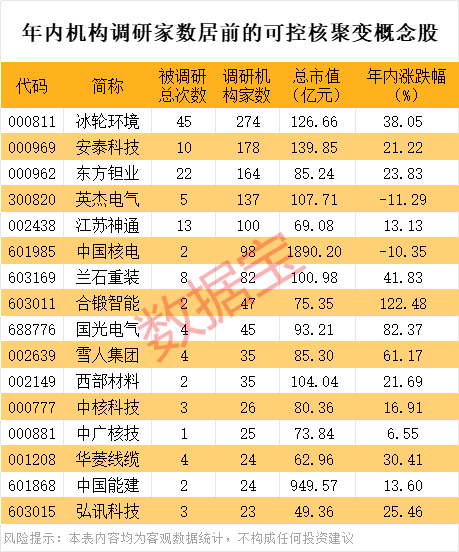
可控核聚变概念股获密集调研
Zheng Quan Shi Bao Wang· 2025-08-01 00:28
Core Insights - The report highlights that nearly all of the over 50 controllable nuclear fusion concept stocks have undergone investor research this year, indicating strong interest in the sector [1] - Several companies have released their performance data for the first half of 2025, with some reporting profit increases while others are facing losses [1] Group 1: Company Research and Performance - Ice Wheel Environment (000811) and Antai Technology (000969) have received over 10 investor research sessions, with Ice Wheel Environment leading with 42 sessions [2] - The total market capitalization of Ice Wheel Environment is 126.66 billion, with a year-to-date increase of 38.05% [2] - Other notable companies include Jiangsu Shentong (002438) with 13 research sessions and a market cap of 69.08 billion, showing a year-to-date increase of 13.13% [2] Group 2: Performance Variability - Companies such as Baoshan Co. (600973) and Yongding Co. (600105) have reported performance increases, while China First Heavy Industries (601106) and others have reported performance losses [1] - The report indicates that the performance of controllable nuclear fusion stocks is varied, with some companies like China Nuclear Power (601985) experiencing a year-to-date decline of 10.35% [2]