
电力需求增长

Search documents
国际能源署最新报告预计:全球电力需求将保持强劲增长
Jing Ji Ri Bao· 2026-02-10 00:54
Core Insights - The International Energy Agency (IEA) forecasts strong global electricity demand growth, with an average annual growth rate exceeding 3.5% from 2026 to 2030, driven by industrial, electric vehicle, air conditioning, and data center electricity consumption [1] - By 2030, renewable energy and nuclear power are expected to account for 50% of the global electricity mix, with emerging economies contributing nearly 80% of the new electricity demand [1][2] Group 1: Global Electricity Demand - Global electricity demand is projected to grow by 3% year-on-year in 2025, with the growth rate expected to be 50% higher than the average of the past decade over the next five years [1] - China will remain the main driver of global electricity demand growth, contributing nearly 50% of the increase, with an average annual growth rate of 4.9% over the next five years [1] - India and Southeast Asian countries are expected to significantly increase their share of electricity demand growth in emerging economies by 2030 due to rapid economic growth and rising air conditioning demand [1] Group 2: Renewable Energy and Nuclear Power - By 2030, about half of the global electricity will come from renewable energy and nuclear power, with renewable energy generation expected to grow at an annual rate of 8%, driven by record solar photovoltaic generation [2] - Global nuclear power generation is anticipated to reach a historical high in 2025, supported by increased nuclear capacity in countries like France, China, and India [2] Group 3: Coal and Natural Gas - Despite the decline of coal power, it will remain the largest source of electricity globally until 2030, with coal generation levels stabilizing in 2025 [3] - Natural gas generation is expected to grow at an annual rate of 2.6% by 2030, significantly higher than the 1.4% growth rate of the past five years, primarily driven by rising electricity demand in the U.S. and the Middle East's transition from oil to gas [3] Group 4: Electricity Infrastructure and Investment - The report emphasizes the need for rapid and efficient expansion of the electricity grid to integrate the changing generation structure and high-load demands from electric vehicles and data centers [4] - To meet the electricity demand by 2030, global grid investment must increase by at least 50% from the current $400 billion, alongside significant expansion of the supply chain [4] Group 5: Carbon Emissions and Pricing - Global electricity sector carbon emissions are expected to stabilize in 2025, with a further decline anticipated as low-carbon generation increases [5] - Electricity price disparities among regions continue to exist, with rising prices in the EU and U.S. due to high natural gas prices, while countries like Australia and India see price decreases [5] Group 6: Electricity Security - Recent large-scale power outages highlight the importance of electricity security, making it a priority for countries to enhance the resilience of their power systems [6] - The report calls for modern operational frameworks and updated regulations to address the evolving demands on electricity systems [6]
全球电力需求将保持强劲增长
Sou Hu Cai Jing· 2026-02-10 00:01
Core Insights - The International Energy Agency predicts strong global electricity demand growth, with an average annual increase of over 3.5% from 2026 to 2030, driven by industrial, electric vehicle, air conditioning, and data center electricity consumption [2] - By 2030, renewable energy and nuclear power are expected to account for 50% of the global electricity mix, with significant contributions from emerging economies, particularly China and India [3][4] Group 1: Global Electricity Demand - Global electricity demand is projected to grow by 3% year-on-year by 2025, with the growth rate expected to exceed the economic growth rate in the coming years [2] - Emerging economies will contribute nearly 80% of the new electricity demand by 2030, with China accounting for about 50% of the incremental demand [2] - China's average annual growth rate for new electricity is expected to reach 4.9% over the next five years [2] Group 2: Renewable Energy and Nuclear Power - By 2030, approximately half of the global electricity will come from renewable energy and nuclear power, with renewable energy generation expected to grow at an annual rate of 8% [3] - Solar photovoltaic generation is anticipated to increase by over 600 terawatt-hours annually, contributing significantly to the overall growth of renewable energy [3] - Global nuclear power generation is expected to reach a historical high by 2025, driven by increased capacity in countries like France, China, and India [3] Group 3: Coal and Natural Gas - Despite the decline of coal power, it will remain the largest source of electricity globally until 2030, with regional disparities in coal usage [4] - Natural gas generation is projected to grow at an annual rate of 2.6% by 2030, primarily due to rising electricity demand in the U.S. and a shift from oil to gas in the Middle East [4] Group 4: Electricity Infrastructure and Investment - To meet the electricity demand by 2030, global grid investments need to increase by at least 50% from the current $400 billion, alongside significant supply chain expansions [5] - The report emphasizes the need for enhanced grid flexibility and modernization of operational frameworks to adapt to changing electricity demands [5] Group 5: Carbon Emissions and Environmental Impact - Global electricity sector carbon emissions are expected to stabilize by 2025, with a projected decline in carbon intensity by 14% compared to a decade ago [5] - The electricity production sector remains the largest source of energy-related carbon emissions, generating approximately 13.9 billion tons of CO2 annually [5] Group 6: Electricity Pricing and Competition - Electricity price disparities continue to exist globally, with rising prices in regions like the EU and the U.S. due to higher natural gas prices, while countries like Australia and India see price declines [6] - Recent large-scale power outages highlight the importance of electricity security, making it a priority for nations to enhance the resilience of their power systems [6]

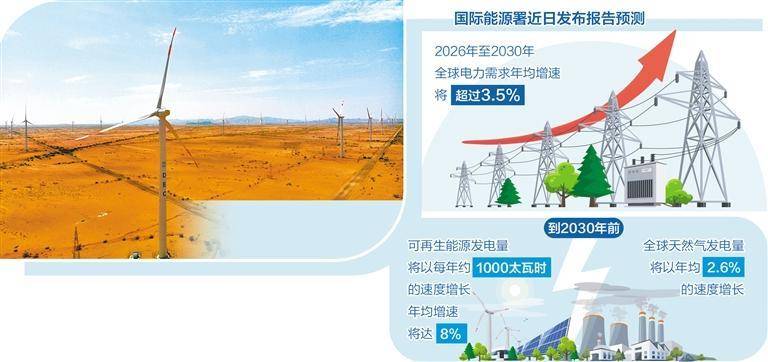
国际能源署最新报告预计——全球电力需求将保持强劲增长
Jing Ji Ri Bao· 2026-02-09 22:33
Group 1: Global Electricity Demand Growth - The International Energy Agency predicts strong global electricity demand growth, with an average annual growth rate exceeding 3.5% from 2026 to 2030, driven by industrial, electric vehicle, air conditioning, and data center electricity consumption [1] - By 2025, global electricity demand is expected to grow by 3% year-on-year, with the growth rate surpassing economic growth becoming a common trend in the coming years [1] - Emerging economies will contribute nearly 80% of the new electricity demand by 2030, with China being the main driver, accounting for nearly 50% of the incremental demand [1] Group 2: Renewable Energy and Nuclear Power - By 2030, approximately half of the global electricity will come from renewable energy and nuclear power, with renewable energy generation expected to grow at an annual rate of 8% [2] - Solar photovoltaic generation is projected to increase significantly, with an annual increment exceeding 600 terawatt-hours [2] - Global nuclear power generation is expected to reach a historical high by 2025, driven by increased capacity in countries like France, China, and India [2] Group 3: Coal and Natural Gas Generation - Despite the decline of coal power, it will remain the largest source of electricity globally until 2030, with regional disparities in coal usage [3] - Natural gas generation is expected to grow at an annual rate of 2.6% by 2030, driven by rising electricity demand in the U.S. and a shift from oil to gas in the Middle East [3] Group 4: Electricity Infrastructure and Flexibility - The report emphasizes the need for rapid and efficient expansion of the electricity grid to integrate changing generation structures and demand [4] - Global investment in electricity grids needs to increase by at least 50% from the current $400 billion to meet the 2030 electricity demand [4] - The importance of large battery storage systems is growing in ensuring supply security as battery costs decline and technology matures [4] Group 5: Carbon Emissions and Electricity Prices - Global electricity sector carbon emissions are expected to stabilize in 2025, with a further acceleration in the reduction of carbon intensity anticipated by 2030 [5] - Electricity price disparities among regions continue to exist, with rising prices in the EU and U.S. due to high natural gas prices, while countries like Australia and India see price declines [5] Group 6: Electricity System Security - Recent large-scale power outages highlight the importance of electricity system security, making it a priority for countries [6] - The electricity system faces risks from aging infrastructure, extreme weather events, and cyber threats, necessitating enhanced protection and monitoring systems [6] - A modern operational framework is needed to adapt to changing electricity demands, including updated grid standards and regulatory frameworks [6]
国海证券:电力需求总量增长仍具韧性 维持煤炭开采行业“推荐”评级
智通财经网· 2026-02-04 02:05
Core Viewpoint - Emerging industries have a strong driving effect on electricity consumption, with resilient overall electricity demand growth. Short-term, the intermittent nature of wind and solar power highlights the importance of coal power for peak regulation, indicating a rigid demand for coal. High-quality coal assets still hold investment value, and leading coal companies exhibit characteristics of high profitability, high cash flow, high barriers, high dividends, and high safety margins. The coal mining industry maintains a "recommended" rating, focusing on stable and elastic coal targets [1]. Group 1: First Industry - The first industry shows high growth but low proportion, with electricity consumption expected to grow at a CAGR of 11.46% to 149.4 billion kWh from 2019 to 2025, contributing 2% to overall electricity growth. The livestock sector is a key driver, with significant growth in machinery power consumption [1]. Group 2: Second Industry - The second industry remains the main electricity consumer, with consumption projected to grow at a CAGR of 5.19% to 6.64 trillion kWh from 2016 to 2025, maintaining a 64.01% share. The internal structure is optimizing, with high-tech and equipment manufacturing gradually replacing high-energy-consuming sectors as the core growth drivers, particularly in computer communication electronics, electrical machinery, and automotive manufacturing, all expected to exceed 10% CAGR from 2018 to 2025 [2]. Group 3: Third Industry - The third industry is experiencing significant growth, with electricity consumption projected to reach 1.99 trillion kWh by 2025, growing at a CAGR of 10.73% from 2016 to 2025, and contributing 30.89% to overall electricity growth. Key growth sectors include wholesale and retail, driven by the rapid penetration of new energy vehicles, and information transmission, software, and IT services, driven by the rapid development of artificial intelligence [3]. Group 4: Urban and Rural Residential Electricity - Urban and rural residential electricity consumption is expected to grow at a CAGR of 7.81% to 1.59 trillion kWh from 2016 to 2025, with a 15.32% share. The growth is driven by the penetration of electrical appliances and increased demand due to extreme weather conditions, with a contribution rate peaking at 50.03% in 2022. Projections for 2026 indicate continued growth across all sectors, with overall electricity demand expected to grow by 5.1% [4].

A股电网设备股走强,中国西电、三变科技等涨停
Ge Long Hui· 2026-01-13 06:02
Group 1 - The core viewpoint of the article highlights a significant increase in the stock prices of electric grid equipment companies in the A-share market, driven by rising electricity demand from data centers [1] Group 2 - YN Power surged over 19%, while Anke Intelligent Electric and Can Energy both rose over 15%, indicating strong market performance among these companies [1] - Other notable performers included Shuangjie Electric with a rise of over 14%, and Kerun Intelligent Control with an increase of over 12% [1] - The U.S. Department of Energy and Lawrence Berkeley National Laboratory (LBNL) estimated that electricity consumption by data centers will increase from approximately 176 TWh in 2023 to potentially an additional 325-580 TWh by 2028, significantly boosting overall electricity demand and creating localized capacity shortages [1]



华泰证券:明年主网设备的紧缺和传统电源设备出海将带来差异化投资机会
Di Yi Cai Jing· 2025-12-15 23:52
Group 1 - The core viewpoint is that the company is optimistic about the growth magnitude and duration of electricity demand, driven by overseas AI development and the increase in domestic electrification rates [1] - The company anticipates a super cycle in electricity development, with both sustainability and magnitude exceeding expectations [1] - Although short-term energy structure may exhibit cyclical attributes due to bottlenecks in the new energy system, the manufacturing nature of new energy and low resource dependency will ultimately lead to parity in the future system, resulting in non-linear growth in the industry [1] Group 2 - The global backdrop of tight electricity infrastructure indicates that the market has not fully recognized the revaluation of traditional electrical equipment (grid power sources), which presents significant valuation gaps [1] - The anticipated shortage of main network equipment next year and the export of traditional power equipment will create differentiated investment opportunities [1]

11月用电需求或延续高增速
HTSC· 2025-12-11 11:56
Investment Rating - The report maintains a "Buy" rating for key companies in the power and coal sectors, including Harbin Electric, China Shenhua, and Zhongmei Energy [7][9][30]. Core Insights - The electricity demand in November 2025 is expected to continue its high growth rate, with a projected increase of 6.6% year-on-year, reaching 8,364 billion kWh [1]. - The report highlights a significant rebound in exports, particularly in integrated circuits and automobiles, which is expected to support electricity demand growth [3]. - The heating season is anticipated to be longer this year due to the late timing of the Spring Festival, potentially leading to higher-than-expected heating demand [4]. - The report emphasizes the resilience of domestic demand driven by government policies aimed at stabilizing growth and reducing competition [5]. Summary by Sections Electricity Generation Forecast - The estimated national electricity generation for November 2025 is 7,898 billion kWh, reflecting a year-on-year increase of 3.9% [1][10]. - The breakdown of generation includes thermal power at 5,069 billion kWh (down 2.1%), hydropower at 1,138 billion kWh (up 38.3%), wind power at 955 billion kWh (up 16.0%), solar power at 336 billion kWh (up 12.8%), and nuclear power at 400 billion kWh (up 6.4%) [10][14]. Coal Consumption Trends - Thermal coal consumption has shown a decline, with coastal provinces averaging 1.84 million tons per day (down 2.5% year-on-year) and inland provinces averaging 3.35 million tons per day (down 5.6% year-on-year) [2][10]. - The report suggests that improved water conditions and seasonal wind energy output may lead to a reduction in thermal power generation [2]. Company Recommendations - Harbin Electric is recommended due to its leading position in traditional power equipment and expected benefits from ongoing nuclear power approvals and global electricity shortages [30]. - Zhongmei Energy is highlighted for its effective cost control and expected recovery in coal prices, maintaining a "Buy" rating [31]. - China Shenhua is noted for its strong cost management and improved profitability, with a target price increase to 51.3 yuan [35]. Market Outlook - The report anticipates that electricity demand will outpace GDP growth for the year, supported by both domestic and export recovery [5]. - The potential for higher-than-expected coal demand during the heating season is emphasized, suggesting a bullish outlook for coal prices [4][5].




10月月度全社会用电量数据发布-20251124
Guosen International· 2025-11-24 06:32
Investment Rating - The report suggests a positive investment outlook for the electricity operators, highlighting low valuations and high dividend yields, particularly for China Power (2380.HK) and Huaneng International Power (902.HK) [5][6]. Core Insights - In October 2025, the total electricity consumption in China increased by 10.4% year-on-year, with a significant acceleration in growth compared to September [2][3]. - The cumulative electricity consumption from January to October 2025 reached 86,246 billion kWh, reflecting a year-on-year growth of 5.1% [2][3]. - The growth in electricity consumption was primarily driven by the tertiary industry and residential usage, contributing significantly to the overall increase [3][5]. Summary by Sections Electricity Consumption Data - In October 2025, total electricity consumption was 8,572 billion kWh, marking a 10.4% increase year-on-year and a 5.9 percentage point rise from September [2][4]. - The breakdown of electricity consumption by sector in October shows: - Primary industry: 120 billion kWh, up 13.2% - Secondary industry: 5,688 billion kWh, up 6.2% - Tertiary industry: 1,609 billion kWh, up 17.1% - Residential consumption: 1,155 billion kWh, up 23.9% [2][3]. Industrial Power Generation - The industrial power generation in October was 8,002 billion kWh, with a year-on-year increase of 7.9%, showing a 6.4 percentage point improvement from September [4]. - Notable changes in generation types include: - Thermal power: increased by 7.3% - Hydropower: increased by 28.2% - Nuclear power: increased by 4.2% - Wind power: decreased by 11.9% - Solar power: increased by 5.9% [4]. Investment Recommendations - The report emphasizes the attractiveness of undervalued electricity operators with high dividend yields, particularly China Power (2380.HK) and Huaneng International Power (902.HK), as they are expected to outperform the industry growth [5][6].
电网ETF(561380)连续10日净流入超4.2亿元,人工智能技术发展驱动电力需求激
Mei Ri Jing Ji Xin Wen· 2025-11-17 03:45
Group 1 - The core issue facing the AI industry is not a surplus of computing power, but a lack of sufficient electricity to support all GPU operations [1] - Global data center electricity consumption reached 415 TWh in 2024, accounting for 1.5% of global electricity consumption, equivalent to the total annual electricity usage of the UK [1] - This electricity consumption is increasing at an annual rate of 12%, and it is expected to double to 945 TWh by 2030, pushing the global energy system towards a critical turning point [1] Group 2 - The Electric Grid ETF (561380) tracks the Hang Seng A-share electric grid equipment index, which selects listed companies in the electric grid equipment sector to reflect the overall performance of the electric grid equipment industry chain [1]
异常高温带动电量加速增长,水电延续强势火电显著修复
Changjiang Securities· 2025-11-16 23:30
Investment Rating - The report maintains a "Positive" investment rating for the utility sector [8] Core Insights - In October, the national power generation increased by 7.9% year-on-year, driven by abnormal high temperatures in southern regions, marking the highest monthly growth rate of the year [2][18] - Hydropower continues to perform strongly with a 28.2% year-on-year increase in October, while thermal power shows significant recovery with a 7.3% increase [2][24] - The report highlights the improvement in the operational environment for thermal power, with a narrowing decline of 0.4% for the year-to-date [11][45] Summary by Sections Power Generation Data - In October, total power generation reached 800.2 billion kWh, with thermal power contributing 513.8 billion kWh, hydropower 135.1 billion kWh, nuclear power 38.7 billion kWh, wind power 73.3 billion kWh, and solar power 39.4 billion kWh [17][24] - For the first ten months of 2025, total power generation was 8062.5 billion kWh, reflecting a 2.3% year-on-year growth [17][18] Thermal Power Insights - Thermal power generation in October saw a significant turnaround with a 7.3% increase, alleviating previous pressures, and the year-to-date decline has narrowed to 0.4% [2][45] - The average coal price at Qinhuangdao port was 746.89 RMB/ton in October, down 105.22 RMB/ton year-on-year, contributing to the improved operational environment for thermal power [11][45] Hydropower Performance - Hydropower generation in October was 135.1 billion kWh, up 28.2% year-on-year, supported by improved rainfall and a low base from the previous year [11][26] - The average rainfall in October was 51.5 mm, significantly above the historical average, enhancing hydropower generation capacity [26] Renewable Energy Trends - Wind power generation decreased by 11.9% year-on-year in October, while solar power generation increased by 5.9%, although the growth rate has slowed [11][32] - The report notes that the cumulative installed capacity for wind and solar power has seen a decline in new installations compared to previous years [32][40] Investment Recommendations - The report recommends focusing on quality thermal power operators such as Huaneng International, Datang Power, and Guodian Power, as well as hydropower companies like Yangtze Power and State Power Investment Corporation [11][50] - For renewable energy, it suggests companies like Longyuan Power and China Nuclear Power, highlighting their potential for growth in the current market environment [50][52]