商用车

Search documents
中国汽车流通协会:8月重型卡车零售销量为6.76万辆 牵引车占比约59%
智通财经网· 2025-09-23 10:02
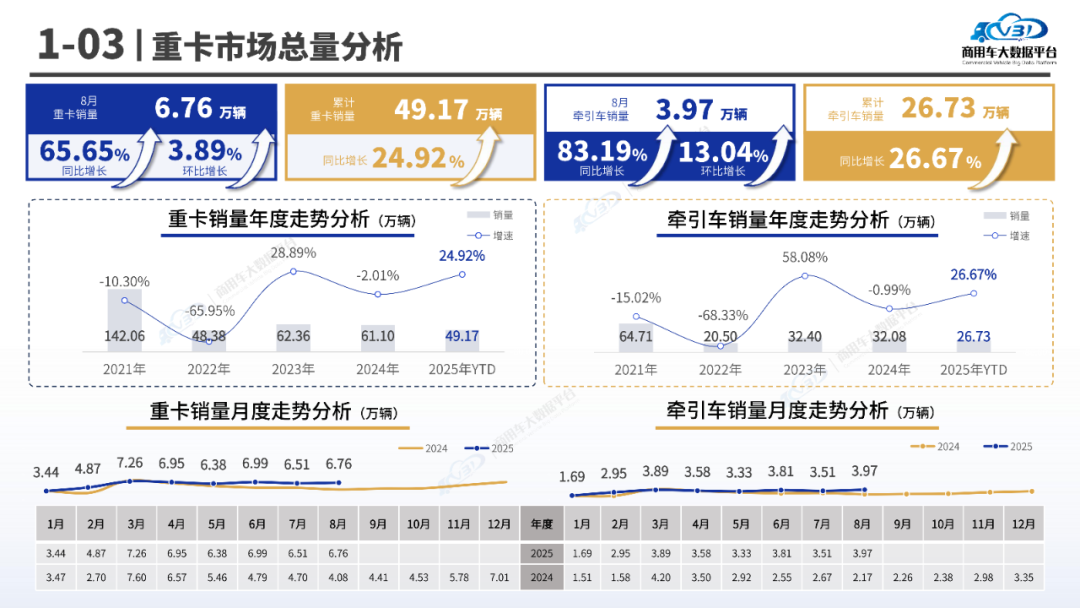
Core Insights - In August 2025, the retail sales of heavy trucks reached 67,600 units, marking a year-on-year increase of 65.65% and a month-on-month increase of 3.89% [1] - Cumulative sales from January to August 2025 totaled 491,700 units, reflecting a year-on-year growth of 24.92% [1] Market Structure - In the first eight months of 2025, the market structure for heavy truck sales showed that tractors accounted for 54% of total sales [3] - The top three horsepower segments in the tractor market were ≤300hp, 500-600hp, and 400-500hp, with the 500-600hp segment holding a 41% share [3] - The leading drive forms were 6×4, 4×2, and 8×4, with 6×4 accounting for 91% of the tractor market [4] - In terms of fuel types, diesel, natural gas, and new energy were the top three, with natural gas comprising 44% of the tractor market [4] Brand Performance - In August 2025, the top five brands in heavy truck sales accounted for 62.2% of the market, led by FAW Jiefang, Dongfeng Commercial Vehicle, and others [7] - Cumulative sales for the top five brands from January to August 2025 represented 60.6% of the market share [7] - The top five brands in tractor sales for August 2025 accounted for 69.5% of the market, with FAW Jiefang and Ouman leading [8] Regional Competition - The top three provinces for heavy truck sales in August 2025 were Shandong, Guangdong, and Hebei, while the leading cities were Shanghai, Shenzhen, and Guangzhou [9] - Sales in Shandong reached 7,340 units, showing significant year-on-year growth [10]


高伟达目标价涨幅近100% 江铃汽车评级被调低丨券商评级观察
2 1 Shi Ji Jing Ji Bao Dao· 2025-09-23 02:15
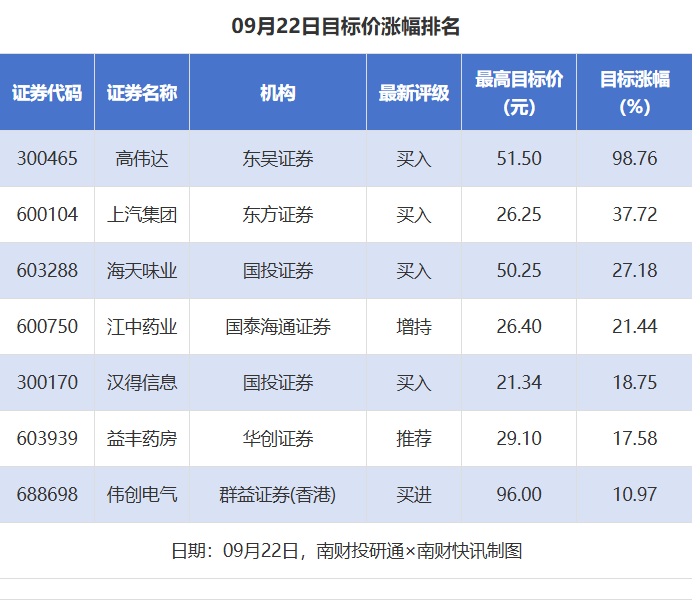
Core Insights - On September 22, brokerages set target prices for listed companies, with notable increases for Gao Weida, SAIC Motor, and Haitian Flavoring, showing target price increases of 98.76%, 37.72%, and 27.18% respectively, across the software development, passenger vehicle, and seasoning industries [1][3] Group 1: Target Price Increases - Gao Weida received a target price of 51.50 yuan, reflecting a target price increase of 98.76% [3] - SAIC Motor's target price was set at 26.25 yuan, indicating a 37.72% increase [3] - Haitian Flavoring's target price reached 50.25 yuan, with a 27.18% increase [3] Group 2: Rating Adjustments - One company, Tebian Electric Apparatus, had its rating upgraded from "Hold" to "Strong Buy" by China Merchants Securities [4] - One company, Jiangling Motors, had its rating downgraded from "Buy" to "Hold" by Industrial Securities [5] Group 3: First Coverage - On September 22, brokerages initiated coverage on nine companies, including Jiangling Motors with a rating of "Hold" from Industrial Securities, and Ximai Food with a "Hold" rating from Shanxi Securities [6] - Gao Weida received a "Buy" rating from Dongwu Securities [6] - Other companies receiving coverage include Hengxin Life with a "Hold" rating and Xianglou New Materials with a "Hold" rating [6]



入华60年,“公路之王”斯堪尼亚二次创业了
Zhong Guo Qi Che Bao Wang· 2025-09-22 09:35
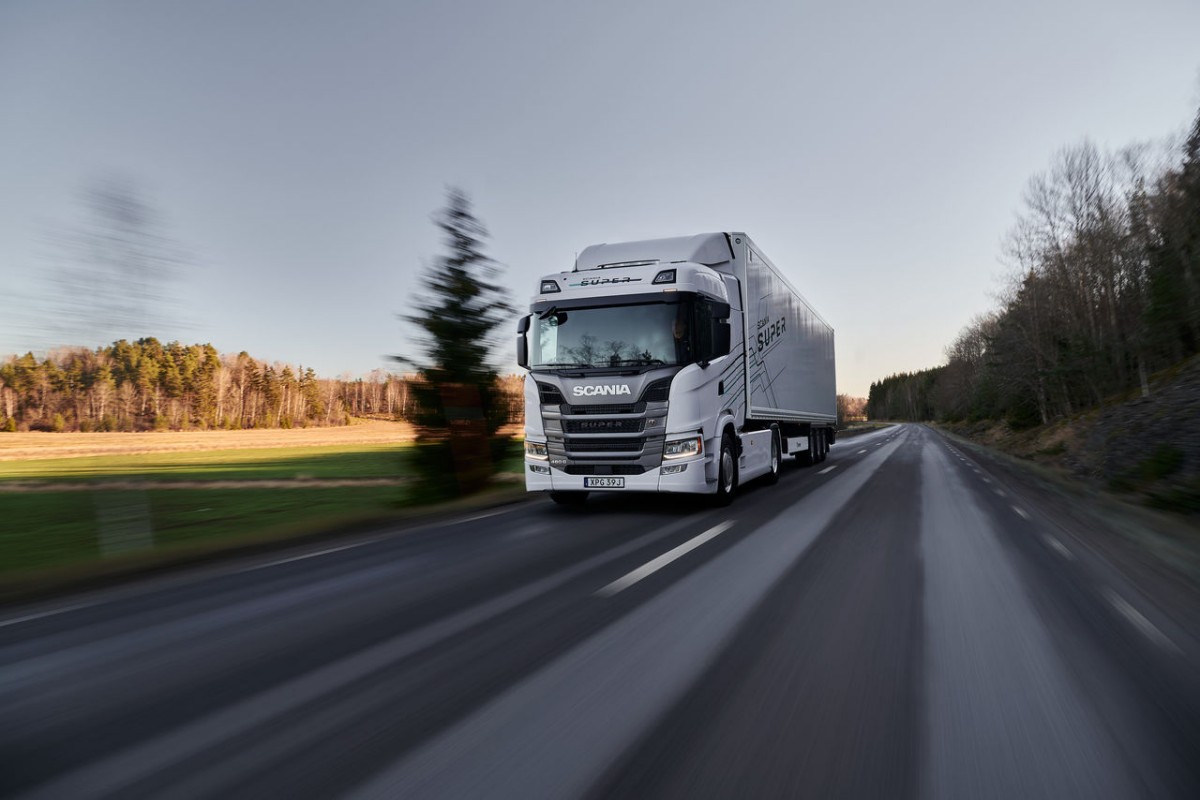
Core Insights - Scania is marking 2025 as a significant year in its development in the Chinese market, celebrating 60 years of partnership while launching a new production base in Rugao, which symbolizes its commitment to localizing operations and enhancing its supply chain in China [1][3]. Strategic Upgrades - Scania is implementing a comprehensive upgrade of its strategy in China, focusing on R&D, manufacturing, and overall solutions, transitioning from a transactional partner to an operational partner, which is akin to a "second startup" for the company [3][7]. - The new "Strategy 2.0" is driven by evolving industry regulations, increasing logistics demands, and the rapid development of digital solutions, which present both opportunities and challenges for the company [7][16]. Operational Focus - The core of Scania's strategic upgrade is the introduction of "worry-free solutions" based on Total Cost of Ownership (TCO), allowing for customized solutions for various applications, supported by a digital hub through the Scania app [8][10]. - Scania's new operating lease business aims to reduce initial capital expenditure for logistics companies and individual owners, enhancing operational efficiency and resource allocation [10][17]. Dealer Network Expansion - Scania is focused on expanding its dealer network in China, with plans to increase the number of dealers from over 40 by the end of 2025 to more than 70 by the end of 2026, thereby improving market coverage [18][23]. - The company is also addressing the financing needs of its dealers by providing comprehensive financing solutions, enabling them to operate with reduced financial pressure [23]. Service Strategy - Scania plans to enhance its service offerings by providing value-added services such as fleet consulting and management, allowing customers to focus on their core operations while Scania manages the backend services [23].

十九载坚守 推动商用车行业技术跃迁
Zhong Guo Qi Che Bao Wang· 2025-09-22 09:10
Core Viewpoint - The commercial vehicle industry in China is undergoing a significant transformation towards high-quality development, driven by technological innovation and market demands, as evidenced by the ongoing commercial vehicle testing activities in Chongqing [1][4][7]. Group 1: Industry Overview - The commercial vehicle sector is a crucial component of China's economy and logistics, with a strong emphasis on self-innovation and rapid growth in production and sales [3][4]. - In August, commercial vehicle production and sales reached 315,000 and 316,000 units respectively, marking a month-on-month increase of 5.9% and 3.4%, and a year-on-year increase of 16.4% and 16.3% [3]. - From January to August, the total production and sales of commercial vehicles were 2.713 million and 2.744 million units, reflecting a year-on-year growth of 7.1% and 5.2% [3]. Group 2: Testing Activities - The 2026 China Commercial Vehicle Product Testing event, organized by China Automotive News and the China Automotive Engineering Research Institute, has become a significant platform for evaluating and promoting commercial vehicles in the country [1][4]. - The testing procedures have been upgraded to align with the trends of intelligence, connectivity, and electrification in the commercial vehicle industry [4][5]. - The testing aims to scientifically evaluate products, promote advanced technologies, and guide the industry towards safer, more efficient, greener, and smarter vehicles [4][5]. Group 3: Technological Advancements - The commercial vehicle industry is experiencing a triple transformation involving intelligent, energy, and technological revolutions, with companies increasingly focusing on enhancing product performance and technological capabilities [5][6]. - The testing has shown significant improvements in vehicle technology, manufacturing processes, and user experience, with many vehicles narrowing the performance gap with imported models [5][6]. - The emphasis on electric, intelligent, and connected vehicles is growing, with advancements in information communication technology and artificial intelligence becoming more evident [5][6]. Group 4: Future Outlook - The commercial vehicle testing activities serve as a platform for companies to assess their product developments and strategize for future technological advancements [7][8]. - The industry is poised for a historical opportunity to leapfrog in the global market, with the testing activities playing a dual role as a catalyst and benchmark for progress [7][8]. - The commitment to continuous improvement and innovation is essential for the commercial vehicle sector to achieve global competitiveness and recognition [8].

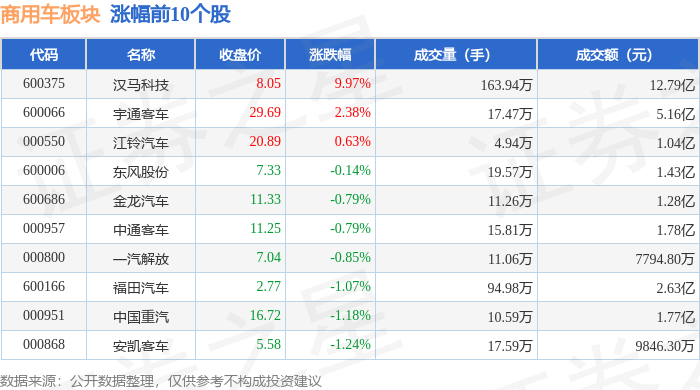
商用车板块9月22日跌0.63%,江淮汽车领跌,主力资金净流出12.49亿元
Zheng Xing Xing Ye Ri Bao· 2025-09-22 08:46
Market Overview - The commercial vehicle sector experienced a decline of 0.63% on September 22, with Jianghuai Automobile leading the drop [1] - The Shanghai Composite Index closed at 3828.58, up 0.22%, while the Shenzhen Component Index closed at 13157.97, up 0.67% [1] Stock Performance - Hanma Technology saw a significant increase of 9.97%, closing at 8.05, with a trading volume of 1.6394 million shares and a turnover of 1.279 billion yuan [1] - Yutong Bus increased by 2.38%, closing at 69.69, with a trading volume of 174,700 shares and a turnover of 516 million yuan [1] - Jiangling Motors closed at 20.89, up 0.63%, with a trading volume of 49,400 shares and a turnover of 10.4 million yuan [1] - Other companies like Dongfeng Motor, King Long Automobile, and FAW Jiefang experienced slight declines [1] Capital Flow - The commercial vehicle sector saw a net outflow of 1.249 billion yuan from institutional investors, while retail investors contributed a net inflow of 710 million yuan [2][3] - The overall capital flow indicates a mixed sentiment, with institutional investors withdrawing funds while retail investors showed interest [2][3] Individual Stock Capital Flow - Yutong Bus had a net inflow of 38.84 million yuan from institutional investors, while retail investors had a net outflow of 76.79 million yuan [3] - Jianghuai Automobile experienced a net outflow of 9.2068 million yuan from institutional investors, but a net inflow of 17.0034 million yuan from retail investors [3] - Other companies like Foton Motor and China National Heavy Duty Truck also showed varying capital flows, with some experiencing significant outflows from institutional investors [3]


预见2025:《2025年中国重卡行业全景图谱》(附市场现状、竞争格局和发展趋势等)
Qian Zhan Wang· 2025-09-22 08:39
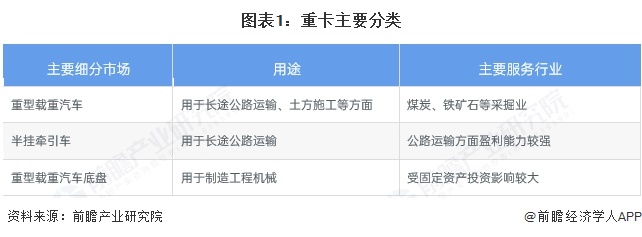
Industry Overview - The heavy-duty truck (HDT) market is defined by vehicles with a length of at least 6 meters and a total weight of at least 12,000 kg, categorized into complete vehicles, incomplete vehicles (chassis), and semi-trailers [1] - The HDT industry chain consists of upstream components like automotive glass and metals, midstream manufacturing of complete trucks, and downstream applications in engineering transport, truck leasing, and logistics [2] Industry Development History - The first heavy-duty truck in China was produced in the 1960s, with significant advancements in the 1980s when technology was imported from Austria [4] - The industry saw explosive growth starting in 2004 due to increased infrastructure investment and the implementation of stricter emission standards [4] - Since 2017, the industry has been undergoing adjustments and upgrades with the introduction of technologies like autonomous driving and vehicle networking [4] Policy Background - The Chinese government emphasizes the environmental and high-quality development of the HDT industry, promoting green low-carbon products and the development of autonomous trucks [8] - Various policies have been introduced to support the replacement of old trucks with new energy vehicles, including subsidies for scrapping older models [9] Supply and Demand Status - The production of heavy-duty trucks in China has shown significant fluctuations, peaking at 2.9765 million units in 2020, with a projected production of 1.6559 million units in 2024 [10] - The sales of heavy-duty trucks reached a peak of over 1.6 million units in 2020, driven by the transition to stricter emission standards, but have since declined due to market saturation [10] - The average price of heavy-duty trucks ranges from 300,000 to 400,000 yuan, estimating the market size at approximately 314.7 billion yuan in 2024 [13] Competitive Landscape - Major players in the market include China National Heavy Duty Truck Group, Dongfeng Motor Corporation, and FAW Jiefang, with market shares of approximately 30%, 22%, and 18% respectively [14] - The distribution of heavy-duty truck manufacturers is concentrated in regions like Anhui, Hubei, and Zhejiang [17] Future Development Prospects - The replacement demand for old heavy-duty trucks is expected to drive market growth, with projections indicating a market size exceeding 410 billion yuan by 2030 [19] - Key trends in the industry include the advancement of high-end intelligent, environmentally friendly, personalized, and customized heavy-duty trucks [21]
牵引车8月实销近4万辆“5连增”!解放/重汽争冠 三一/联合重卡领涨 | 头条
第一商用车网· 2025-09-22 06:58
Core Viewpoint - In August 2025, domestic tractor truck terminal sales experienced a significant year-on-year increase of 83%, marking a "five consecutive months of growth" trend. Cumulatively, tractor truck sales from January to August 2025 increased by nearly 30% compared to the same period last year, with a net increase of over 56,000 units [1][30]. Group 1: Sales Performance - In August 2025, the actual sales of domestic tractor trucks reached 39,600 units, representing a month-on-month increase of 13% and a year-on-year increase of 83%. This growth rate is significantly higher than the overall heavy truck market's growth of 66% [3][6]. - The market share of tractor trucks in the overall heavy truck market reached approximately 59.30% in August, up from 54.41% in July and 53.10% for the entire year of 2024 [5][12]. - The cumulative sales of tractor trucks from January to August 2025 reached 266,700 units, with a year-on-year growth of 27%, an increase of 7 percentage points compared to the growth rate after July [18][22]. Group 2: Brand Performance - In August 2025, the top-selling brand, Jiefang, sold 9,174 units, achieving a year-on-year growth of 72%. Other brands such as China National Heavy Duty Truck and Foton also saw significant increases, with sales of 7,222 units (88% growth) and 5,866 units (90% growth) respectively [9][12][14]. - The top 12 companies in the tractor truck market all achieved sales growth in August, with companies like Xugong, Sany, and United Heavy Truck experiencing more than double growth rates of 156%, 212%, and 216% respectively [14][19]. - The top ten companies accounted for 95.99% of the market share in August, with the top five companies each holding over 10% market share. Jiefang led with a market share of 23.17% [17][22]. Group 3: Market Trends - The market for tractor trucks is experiencing a shift in fuel types, with the share of gas-powered trucks declining by over 20 percentage points compared to the previous year, while the share of pure electric trucks increased by 20.74 percentage points [24][26]. - From January to August 2025, the share of new energy vehicles in tractor truck sales reached 31.93%, significantly higher than the 17.43% share in 2024 [26][28]. - The competition in the tractor truck market remains intense, with the performance of new energy vehicles continuing to be a key factor influencing market dynamics [30].



卡车市场爆出近400辆大单!
第一商用车网· 2025-09-22 06:58
Core Viewpoint - The launch event of the new wide-body heavy-duty small truck, Xiangling V5, in the Beijing-Tianjin-Hebei region was highly successful, with significant sales achieved in a short time frame, indicating strong market demand and enthusiasm among customers [1][15]. Group 1: Product Launch and Market Response - The Xiangling V5 was officially launched in the Beijing-Tianjin-Hebei region, attracting considerable attention and participation from local customers [6][22]. - The event saw a remarkable sales performance, with 388 units sold within just 2 hours, reflecting a robust market response [1][15]. - Seven major clients signed contracts for a total of 358 units during the event, showcasing the product's appeal to large customers [12][15]. Group 2: Regional Logistics Enhancement - Xiangling V5 is positioned to enhance the logistics ecosystem in the Beijing-Tianjin-Hebei region, addressing diverse last-mile logistics needs effectively [4][22]. - The vehicle's comprehensive advantages are expected to contribute to the improvement and upgrading of regional logistics efficiency [4][22]. Group 3: Promotional Offers and Customer Engagement - The launch event featured attractive promotional offers, including six major gifts for customers, aimed at boosting sales and customer satisfaction [9][11]. - Customers participating in the event could enjoy various incentives, such as a 2,500 yuan purchase subsidy and a 6-year or 200,000 km warranty [11][12]. - The company is organizing nationwide group purchase events to further engage customers and drive sales [11][12].

全能源覆盖+全场景适配 解放鹰驰或进一步冲击市场格局
第一商用车网· 2025-09-22 06:58
Core Viewpoint - The launch of the FAW Jiefang Yingchi series highlights its "four highs and two lows" six core competitive advantages, attracting significant industry attention [1][8]. Group 1: Market Context and Launch Event - On September 21, the FAW Jiefang Yingchi all-energy series was launched in Qingdao, receiving 1858 new vehicle orders, further enriching the Jiefang series product matrix [3][20]. - The commercial vehicle industry in China is undergoing profound changes, with a focus on efficient transportation and safety, leading to the development of the Yingchi series to meet diverse transportation needs [7][15]. Group 2: Competitive Advantages - The Yingchi trucks are designed to cater to a younger user demographic, featuring upgraded aesthetics and comfort, including a spacious interior and enhanced driving experience [8][9]. - High reliability and safety are emphasized, with rigorous manufacturing processes and advanced safety features such as ABS and collision warning systems, ensuring lower failure rates and higher operational efficiency [11][13]. - The Yingchi series achieves low energy consumption and low weight, with fuel economy improved by 10%, and weight reductions to as low as 7.4 tons for fuel models, enhancing operational efficiency for users [13][14]. Group 3: Strategic Implications - The introduction of the Yingchi series is part of FAW Jiefang's "12345 Yingzhen series" strategy, aimed at providing superior solutions for cost reduction and efficiency in the transportation market [15]. - The strong market response, with over 1858 orders, demonstrates FAW Jiefang's robust position in the transportation sector and its commitment to enhancing competitiveness through lightweight and intelligent manufacturing [15].

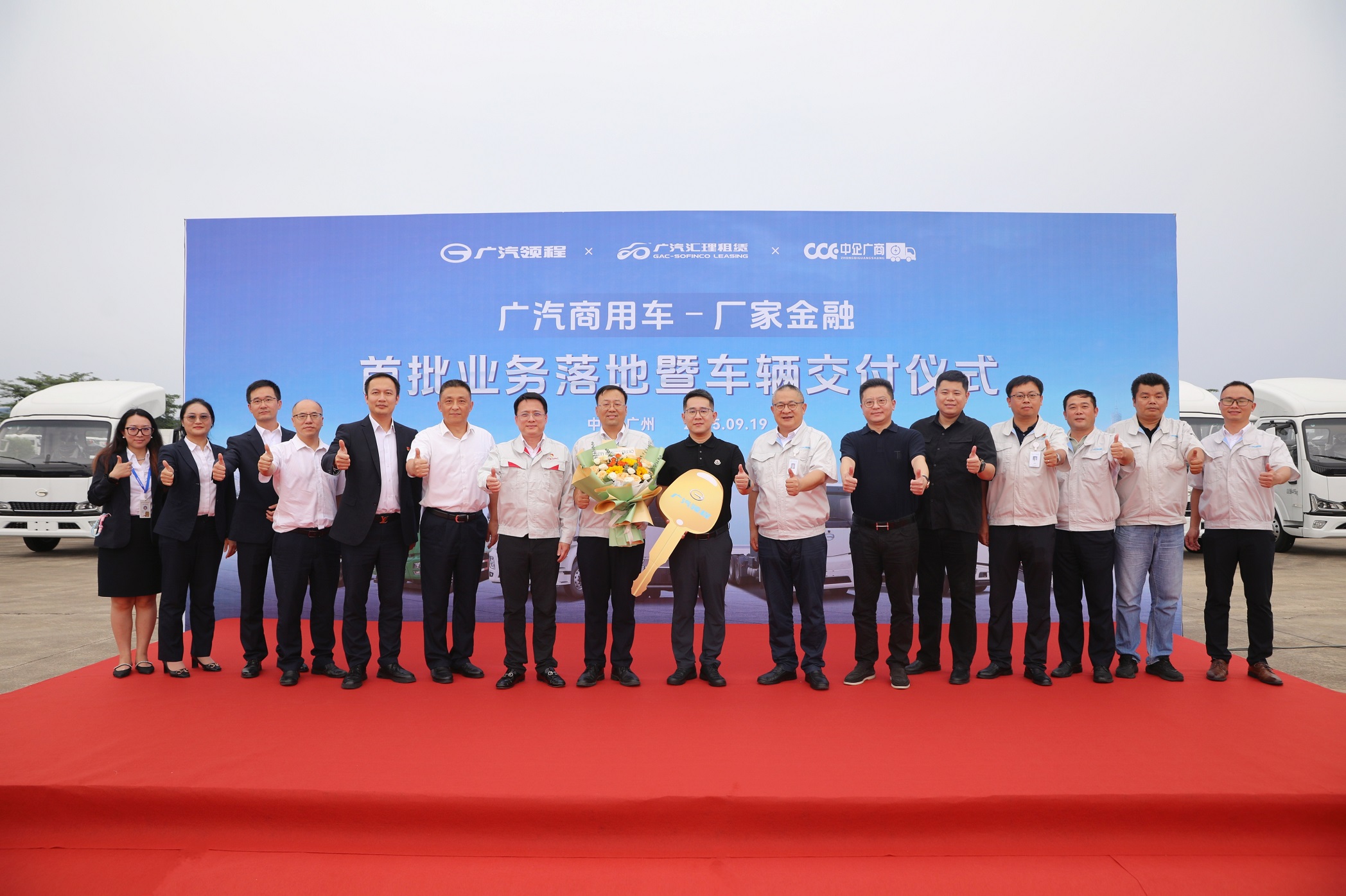
广汽商用车厂家金融首批业务成功落地,46台广汽领程轻卡圆满交付
Zhong Guo Qi Che Bao Wang· 2025-09-22 01:18
Core Insights - The launch of GAC Commercial Vehicle's financial services marks a significant advancement in the company's operations, with the delivery of 46 GAC light trucks [1][10] Group 1: Financial Services Launch - GAC Commercial Vehicle's financial service, "Green Cheng Zhi Rong," has been officially launched, facilitating the delivery of 46 light trucks [1] - This initiative represents a breakthrough in the implementation of a manufacturer financial model within GAC's commercial vehicle sector, aimed at providing flexible and efficient financing solutions for customers [3][6] Group 2: Strategic Collaboration - The collaboration between GAC Lingcheng and GAC Huiri Leasing exemplifies the integration of finance and industry, offering customized financing solutions to support vehicle upgrades and operational efficiency [6] - GAC Lingcheng's General Manager emphasized the importance of this financial service in responding to market demands and enhancing the ecosystem for new energy commercial vehicles [4] Group 3: Market Impact and Future Plans - The introduction of the financial model lowers the barriers for customers to purchase vehicles, thereby enhancing the market competitiveness of GAC Lingcheng's products [10] - Future plans include strengthening internal and external collaborations to build a comprehensive support network for commercial vehicle energy replenishment and accelerate international expansion [4][10]