电商平台

Search documents
电商“包邮区”持续西进 撬动国内消费大循环
Zheng Quan Shi Bao· 2025-06-13 18:13
Core Viewpoint - The launch of Taobao's first self-operated local warehouse in Xinjiang marks a significant improvement in logistics efficiency for e-commerce in the region, enabling next-day delivery for consumers [1][2]. Group 1: Logistics Improvements - The establishment of the local warehouse aims to reduce logistics costs and enhance delivery speed for frequently purchased low-cost items, addressing long-standing issues faced by consumers in Xinjiang [2][3]. - The new model allows for direct shipping from local warehouses, eliminating long-distance transportation and optimizing cost structures, which is a notable shift from the previous collective shipping model [2][3]. Group 2: Market Expansion and Consumer Impact - The introduction of the local warehouse is expected to increase order volume in Xinjiang by over 150% during the "618" shopping festival, as it removes restrictions on previously unavailable products [2][3]. - The overall e-commerce market in Xinjiang is experiencing rapid growth, with a reported 9.77% increase in online transaction volume in 2024 [11]. Group 3: Competitive Landscape - Other e-commerce platforms, such as Pinduoduo and JD.com, are also enhancing their logistics capabilities in western regions through similar collective shipping models and local warehouse strategies [4][5][7]. - The logistics sector is seeing increased investment from courier companies, which are establishing transfer centers to streamline shipping processes and reduce costs significantly [7][8]. Group 4: Future Prospects - The "e-commerce westward expansion" initiative is expected to continue driving growth in western regions, with significant potential for market development and consumer demand activation [12][13]. - Despite challenges such as high delivery costs and infrastructure limitations, the potential for e-commerce growth in western China remains substantial, supported by government policies and innovative business models [12][13].


每惠莱APP下载前必读:入口渠道、官网信息与平台合规性
Sou Hu Cai Jing· 2025-06-13 15:15
Core Viewpoint - The article highlights the emergence of a differentiated digital platform, Meihuilai, which operates on a "community + supply chain" model, aiming to thrive in a competitive e-commerce landscape where traditional platforms dominate [1][7]. Group 1: Business Model - Meihuilai's business model integrates "community scenario operation," "AI-assisted product selection," and "offline service reach," creating a three-in-one ecosystem that diverges from conventional e-commerce practices [1][2]. - The platform relies on user relationships built through social groups rather than advertising, utilizing familiar recommendations and community leaders to establish low-cost, sustainable user connections [2][5]. - Meihuilai's revenue model is based on product sales, service sharing, and brand partnerships, focusing on direct supply from manufacturers to reduce costs and enhance profitability [5][6]. Group 2: Technology and Operations - The platform employs a self-developed AI product selection system that matches products to community user profiles, improving efficiency and accuracy in product recommendations [6]. - Meihuilai emphasizes the establishment of a local service network through community stations, enhancing the connection between online touchpoints and offline experiences [6][7]. - The operational framework allows service providers to monitor orders and earnings in real-time via the Meihuilai app, promoting a standardized digital management system [5][6]. Group 3: Market Positioning - Meihuilai distinguishes itself from traditional e-commerce platforms by focusing on community engagement and service-oriented growth rather than merely competing on price and traffic [6][7]. - The platform aims to provide not just a shopping experience but also a connection to local life, product experiences, and community relationships, fostering a holistic approach to commerce [7][8]. - Meihuilai's transparent operational structure and clear business logic contribute to its credibility and sustainability in the market [7].


这个618,好内容让“地域宝藏好货”成了“全网爆款”
Zhong Guo Shi Pin Wang· 2025-06-13 13:17
Core Insights - The article highlights the success of merchants from lesser-known production areas leveraging high-quality content to turn unique products into nationwide bestsellers during the 618 shopping festival [1][2][6] Group 1: Event Highlights - The "Go to Foshan for Furniture" event saw a 169% year-on-year increase in GMV over 7 days, with 34 merchants breaking their own sales records [1] - The "Go to Lingnan to Pick Lychee" event achieved a staggering 7331% increase in live broadcast GMV in the first 5 days, with a year-on-year growth of 7112% [2] - The fruit merchant "Jiawo" showcased the largest lychee, creating a visually impactful experience that led to a top 3 ranking in fresh produce sales [2][4] Group 2: Merchant Performance - The furniture merchant "Yi Er Li Xiang Jia" achieved a sales record of 7.96 million, breaking both self-broadcast and audience engagement records for the category [1] - "Jiawo" experienced a 2000% increase in GMV and over 5 million cumulative exposures in their live broadcast [4] - The live broadcast featuring the character "Yang Guifei" attracted 6 million viewers, ranking first in the fresh produce category [4][6] Group 3: Content Strategy - Merchants utilized immersive content that showcased the growth environment, production processes, and real-life scenarios to build consumer trust and stimulate purchasing desire [6] - The integration of cultural narratives and historical context in live broadcasts helped consumers connect with the products on a deeper level [2][6] - The ongoing 618 promotion aims to further leverage content-driven strategies to enhance the visibility of unique local products across the nation [6]

“今年‘618’ 我不投流了”
经济观察报· 2025-06-13 12:54
"7折其实是给线下经销商的价格,'618'期间,平台零售价完全低于经销商采购价,经销商也挺难 的。"杨子君称。 "平台和算法机制让你不得不持续花钱。"对平台,食品商家杨 子君爱恨交织。 作者:冯雨晨 封图:图虫创意 面对"618",食品商家杨子君开心不起来。 几年摸爬滚打下来,杨子君的经验是, 在这种大节点,产品不打折很难获得足够的流量,并且大 促节点 的 投流费用更多、更贵,还需要做站外引流。 他举例,在某平台的"618"活动中,产品在S级价格(大促价格)上打了9折后,叠加平台会员,再 加上满减券,实际打折力度为零售价格的7折,还要另外付费做直通车等营销,利润空间进一步压 缩。 幸运的是,他做起来了。 6年后,始终在一线的杨子君自认为,今天再走来时路,要做起来是很难的。 杨子君的公司今年在各电商平台的营销成本都在上涨,但在部分平台营销效益却已见顶。他回顾, 公司自2023年起在某平台的利润已接近于零,他预计2025年即使中台成本不摊销,在该平台还要 再亏十几个点。 "平台和算法机制让你不得不持续花钱。"对平台,杨子君爱恨交织。 权衡后,杨子君决定今年不参加该平台的"618"活动。 他也知道不参加活动,店铺在 ...

李国庆官宣离婚案终结 曾豪掷4000万与京东打价格战
Jing Ji Guan Cha Wang· 2025-06-13 11:12
Core Insights - Li Guoqing, the founder of Dangdang, announced a final settlement regarding property division with his ex-wife Yu Yu, marking the end of their long-standing divorce battle and indicating a shift towards focusing on AI applications [2][6] Company History - Li Guoqing and Yu Yu founded Dangdang in November 1999 after meeting in the U.S. in 1996, and the company became a significant player in China's e-commerce sector [2] - Dangdang went public on the New York Stock Exchange on December 8, 2010, with an IPO price of $16, opening at $24.5, and closing at $29.91, achieving a market capitalization of over $2.3 billion [2] Market Challenges - The company faced intense competition from giants like JD.com and Tmall, leading to a price war initiated by Li Guoqing on the day of the IPO, which escalated into a broader industry price war involving multiple platforms [3][4] - Despite initial success, Dangdang's market value stagnated due to missed investment opportunities and internal management conflicts between Li Guoqing and Yu Yu [4] Privatization and Management Conflict - Dangdang was privatized in September 2016, with a buyout price of $6.70 per American Depositary Share, allowing the company to focus on domestic market opportunities [5] - A public feud between Li Guoqing and Yu Yu began in late 2018, culminating in a series of legal disputes and public accusations, including Li Guoqing's dramatic takeover attempt in 2020 [5][6] Recent Developments - As of June 2023, Li Guoqing confirmed the completion of their divorce and the resolution of property division, with Yu Yu retaining 64.2% of Dangdang's shares and Li Guoqing holding 27.51% [6]

“今年‘618’ 我不投流了”
Jing Ji Guan Cha Bao· 2025-06-13 09:43
Core Insights - The article highlights the challenges faced by food merchants during major promotional events like "618," where discounting is essential for traffic but leads to reduced profit margins [1][3] - The increasing marketing costs on e-commerce platforms are squeezing profit margins for small and medium-sized businesses, prompting some to reconsider their participation in these promotional events [1][3][4] - The recent draft of the "Guidelines for Compliance with Charging Behavior of Online Trading Platforms" is seen as a potential relief for merchants, aiming to regulate platform fees and reduce the financial burden on businesses [4][10][11] Group 1: Marketing Costs and Strategies - Merchants are experiencing rising marketing costs on e-commerce platforms, with some reporting near-zero profits from their investments [3][5] - A specific case shows that the cost per thousand impressions (CPM) has surged by 57%, while the conversion rate has dropped by 17%, leading to a 38% decrease in return on investment [5][6] - Merchants are shifting their marketing strategies, with one company reducing its online-to-offline marketing ratio from 9:1 to 5:5, favoring offline channels due to lower costs and less dependency on platform algorithms [1][3] Group 2: Platform Fee Concerns - Merchants express frustration over opaque fee structures and repeated charges for the same promotional efforts, leading to questions about the fairness of platform practices [6][8] - The article discusses a specific case where a merchant faced unexpected costs due to a lack of transparency in the platform's advertising fee structure [6][8] - The draft guidelines aim to address these concerns by prohibiting unreasonable charges and ensuring that platforms provide adequate services for the fees collected [10][11] Group 3: Regulatory Developments - The article notes that regulatory bodies are increasingly focused on reducing the financial burdens on e-commerce merchants, with recent guidelines aimed at clarifying acceptable charging practices [10][12] - The guidelines outline specific unreasonable charging behaviors that platforms must avoid, such as double charging and lack of service provision [11][12] - Experts believe that these guidelines will enhance merchants' awareness of their rights and encourage platforms to adopt fairer practices [12]
“618”网络促销季 市场监管总局要求电商平台加强管理
Xiao Fei Ri Bao Wang· 2025-06-13 02:34
本报讯 时下正值网络集中促销季,为规范促销经营行为,维护"618"期间网络交易秩序,保护消费者合 法权益,日前,市场监管总局向综合电商、直播电商、跨境电商等平台企业发布《"618"网络集中促销 合规提示》,重点包括严格落实平台主体责任、规范促销行为、化解网络消费纠纷等内容。 在落实平台主体责任方面,市场监管总局提示平台要切实落实审查核验义务,督促平台内经营者亮照、 亮证、亮标经营,确保经营者主体信息真实有效,提升线上经营行为透明度。 在规范促销行为方面,要求围绕促销工具、折扣展示、优惠发放、结算支付等关键环节,优化促销规 则。严禁不按规定明码标价、价格欺诈等侵害消费者权益行为。未取得拍卖许可不得以拍卖名义开展竞 价促销活动。严格区分跨境电商零售进口商品和非跨境商品,保障消费者知情权、选择权。 此外,电商平台要加强合规管理,发现违法违规问题及时向所在地县级以上市场监管部门报告,形成平 台自治与政府监管的良性互动,共同引导平台内经营者提高守法经营意识。 市场监管部门提示,"618"期间,广大消费者应保持理性消费心态,提高维权意识,遇到违法行为及时 向市场监管部门或有关主管部门投诉举报,依法依规维护自身合法权益。 ...
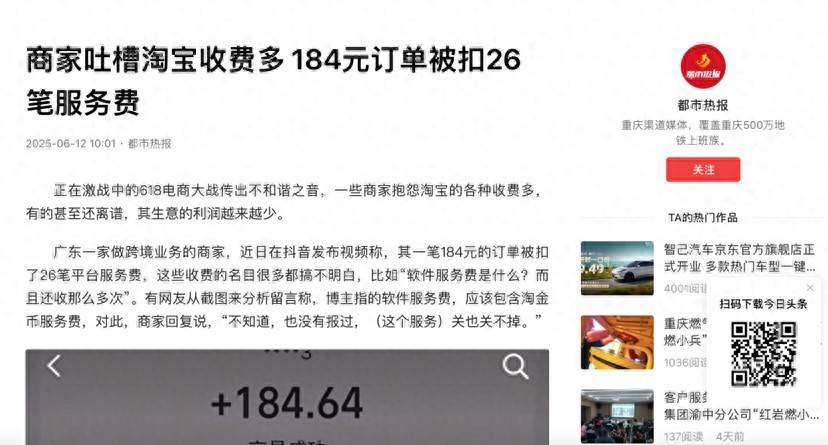
“184元订单被扣26笔服务费”暴露了什么
Bei Jing Qing Nian Bao· 2025-06-13 01:11
Core Insights - The "618" e-commerce promotion is facing backlash from small and medium-sized businesses (SMBs) due to excessive fees imposed by platforms, which are eroding their profits [1][2] - The promotional event, intended to benefit all parties, is instead leading to dissatisfaction among SMBs, who feel that platforms prioritize their own growth over the interests of smaller merchants [1][3] - The current e-commerce landscape favors top brands, with a small percentage of them generating a significant portion of the Gross Merchandise Volume (GMV), leaving SMBs at a disadvantage [2][3] Group 1: Issues Faced by SMBs - SMBs are reporting high and unclear service fees during the "618" event, with one merchant citing 26 different fees on a single order, leading to confusion and frustration [1] - The promotional strategies of some platforms are perceived as detrimental to SMBs, as they face a dilemma of either participating and incurring losses or opting out and losing visibility [1][2] - The trend of platforms favoring top brands is evident, with only 1% of brands contributing 30%-40% of GMV on one platform, highlighting the challenges SMBs face in competing [2] Group 2: Platform Business Model Concerns - Platforms are increasingly using a "pay for traffic" model, where higher spending on advertising leads to more visibility, effectively sidelining many SMBs [2] - The reliance on high commissions and forced promotions to maintain financial performance is raising concerns about the sustainability of the e-commerce ecosystem [2][3] - The current practices of platforms may lead to a decline in product diversity and quality, as SMBs struggle to remain profitable, ultimately harming consumer experience and platform reputation [3]
上海企业求贤若渴 哪些专业人才被热捧
Di Yi Cai Jing· 2025-06-12 12:37
从蓬勃发展的电商巨头到前沿探索的硬科技先锋,从逐步升温的文旅产业到更加传统的物流板块,在上 海开展业务的本土、跨国企业正以创新的招聘策略、深度的产教融合和具有竞争力的发展平台,积极破 解人才供需的结构性矛盾。 上海展现出强大的"人才磁场"效应。 从蓬勃发展的电商巨头到前沿探索的硬科技先锋,从逐步升温的文旅产业到更加传统的物流板块,在上 海开展业务的本土、跨国企业正以创新的招聘策略、深度的产教融合和具有竞争力的发展平台,积极破 解人才供需的结构性矛盾。 企业将"揽才"与"稳就业"紧密结合,为培育新质生产力提供坚实支撑。这一点在硬核科技领域尤其突 出,一家企业负责人对记者表示:"企业现在确实是求贤若渴。" 电商对AI人才求贤若渴 这股人才争夺战的热潮,在电商领域表现得尤为突出。 海外市场的激烈角逐与人工智能技术的深度应用,正驱动着企业对特定领域人才的渴求急剧升温。记者 了解到,拼多多、饿了么等总部扎根上海的电商平台,纷纷将校招和实习计划作为人才储备的关键战 场,释放出对"出海"干将与AI人才的强烈信号。 进入夏天,拼多多的"招新"也如火如荼进行中。记者关注到,在拼多多官方招聘渠道,大量校招、实习 岗位正在释出,涉 ...
淘宝收费迷局:184元订单被扣26笔费用,中小商家遭遇“围剿”
Sou Hu Cai Jing· 2025-06-12 11:34
Core Viewpoint - The current situation of excessive fees charged by Taobao has become a significant burden for merchants, particularly those engaged in cross-border e-commerce, leading to widespread dissatisfaction and financial strain [1][2][4][8]. Group 1: Fee Structure and Merchant Experiences - A Guangdong cross-border e-commerce merchant reported that a 184 yuan order was subjected to 26 different service fees, including various unclear charges [2][4]. - Merchants have expressed confusion over the numerous fees, with many unaware of their meanings or purposes, leading to frustration and financial losses [4][7]. - Some merchants have shared experiences of unexpected deductions, such as a Zhejiang merchant who was charged 3000 yuan without using any related services [4][8]. Group 2: Impact of Fee Adjustments - In response to market changes, Taobao has adjusted its fee policies, including a 0.6% basic software service fee introduced in September of the previous year, which is waived for small sellers with annual sales below 120,000 yuan [7]. - Despite the exemption for some small sellers, many merchants report that hidden fees continue to accumulate, resulting in no significant reduction in overall costs [7][10]. - The lack of effective communication regarding these policy changes has left many merchants confused and struggling to adapt [7][10]. Group 3: Consequences for Merchants - The unclear and excessive fees have led some merchants to experience minimal profits or even losses, with one merchant stating that after deductions, their profit from a 405 yuan transaction was reduced to only 344.83 yuan [8][10]. - The financial pressure has forced some merchants to close their services or exit the platform entirely, as seen in the case of a merchant who stopped selling after incurring high fees on a single order [10]. - The current fee practices threaten the mutual benefit relationship between the platform and merchants, potentially harming the overall health of the e-commerce ecosystem [10].