支付

Search documents
便捷支付服务升级优化体验
Jing Ji Ri Bao· 2025-07-06 21:47
Core Viewpoint - The recent guidelines issued by the People's Bank of China and six other departments aim to enhance financial support for consumption, focusing on improving payment services and experiences for consumers, particularly in key consumption areas such as food, housing, transportation, tourism, shopping, entertainment, and healthcare [1] Payment Experience Enhancement - The rapid development of mobile payments in China has led to an increased need for inclusive payment services for foreign visitors who may prefer cash or card payments. From 2019 to May 2025, the total transaction volume for "foreign card binding" and "foreign wallet usage" reached 3.79 billion transactions, amounting to 604.39 billion yuan [2] - Daily average transactions for these services reached 1.2193 million, with a daily average transaction amount of 16.997 million yuan by May 2025, reflecting year-on-year growth of 185% and 135% respectively [2] Increased Acceptance of Mobile Payments - The acceptance of mobile payments among foreign visitors has significantly improved, with WeChat Pay transactions for foreign cards tripling compared to the previous year. New users can enjoy fee waivers for the first 60 days after binding their foreign cards [3] - Alipay reported a more than 200% increase in usage among inbound tourists from January to May this year, with a 400% increase in transaction volume on the first day of the Dragon Boat Festival [3] Policy Incentives and Consumer Engagement - The "old-for-new" consumption promotion policies have been actively supported by payment platforms like China UnionPay, WeChat Pay, and Alipay, facilitating the distribution of subsidies and enhancing consumer engagement [5] - By May 2025, UnionPay had supported the redemption of over 80 billion yuan in national subsidies, directly stimulating consumption by over 500 billion yuan and benefiting 64 million consumers [5] Digital Currency Innovations - The digital yuan has seen service upgrades, including the expansion of "tap and go" access for public transport in Shanghai, allowing seamless travel for both locals and foreign visitors [7] - The digital yuan hard wallet is gaining popularity among foreign tourists and various demographic groups due to its low entry barriers and wide application scenarios [8] Future Outlook - The digital yuan's promotional activities have not only increased its adoption but also boosted sales in local businesses, with significant transaction volumes reported by banks involved in the initiative [9] - Analysts suggest that enhancing the stability and reliability of the digital yuan system while expanding its application scenarios will be crucial for its future growth [9]
13家支付机构获“长期有效”牌照,合规要求不松懈!
Bei Jing Shang Bao· 2025-07-06 11:04
Core Viewpoint - The renewal results of payment licenses indicate a shift in regulatory focus from quantity control to quality optimization, promoting industry consolidation and resource integration while ensuring compliance remains a priority for licensed institutions [1][4][8]. Group 1: License Renewal Results - On July 4, the People's Bank of China announced the renewal of payment licenses for 13 institutions, including Douyin Payment and LeShua Payment, granting them "long-term" status [1][3]. - Six institutions had their license renewals suspended or rejected, highlighting a dynamic exit mechanism in the industry [1][4]. Group 2: Regulatory Changes - The renewal process is the first under the newly implemented Non-Bank Payment Institution Supervision Management Regulations, which set a 12-month transition period for institutions to meet new compliance standards [3][4]. - Institutions must adhere to capital and reserve requirements to successfully renew their licenses, with many already increasing their registered capital to comply [3][4]. Group 3: Industry Trends - The industry is experiencing a phase of "survival of the fittest," with non-renewed institutions often citing strategic shifts or compliance pressures as reasons for their exit [4][8]. - The total number of canceled payment licenses has reached 103, with seven cancellations occurring within the year [4]. Group 4: Compliance and Future Expectations - Obtaining a long-term license is seen as a recognition of past compliance, but it also imposes higher expectations for ongoing adherence to regulatory standards [5][7]. - Institutions must maintain rigorous internal controls and compliance measures to avoid penalties and ensure continued operation [7][8].

专家访谈汇总:稳定币也成“新基建”了
阿尔法工场研究院· 2025-07-06 03:38
Group 1: Web3 Companies and Market Trends - Antalpha and Circle successfully listed on Nasdaq and NYSE, with first-day stock price increases of 70% and 168%, indicating high investor confidence in Web3 infrastructure and stablecoin businesses [1] - Coinbase's upcoming inclusion in the S&P 500 index marks a significant step in integrating Web3 into mainstream financial asset allocation, likely driving capital inflow and enhancing valuation stability [1] - The trend suggests that leading Web3 companies are increasingly meeting the transparency, profitability, and regulatory compliance required for public companies, potentially attracting traditional financial institutions and institutional investors [1] - Guotai Junan International became the first to receive approval from the Hong Kong Securities and Futures Commission, significantly expanding its business scope and achieving a nearly 200% stock price surge [1] - Investors should focus on the future product deployment and customer expansion capabilities of brokerage firms involved in virtual asset businesses [1] - Companies like Coinbase and Ripple are exploring banking licenses to standardize their stablecoin, custody, and payment capabilities into traditional financial services [1] - Web3 companies are evolving from mere technology providers to new financial infrastructure operators in the digital economy, opening up greater commercial model and valuation opportunities [1] - The U.S. has incorporated digital assets into its national financial development plan, with regulatory bodies restructuring rules to balance innovation encouragement and risk control [1] - This trend indicates a reduction in policy risks for Web3 companies, with mid-to-long-term valuations likely receiving institutional support, especially for compliant leading firms [1] Group 2: Stablecoin Market Dynamics - Stablecoins have evolved from tools for hedging and on-chain payments in the crypto ecosystem to a new infrastructure for global cross-border payments, settlements, and digital finance [2] - The total market capitalization of stablecoins surged from $650 million to over $250 billion in six years, a growth of over 380 times, with projected transaction volumes reaching $27 trillion in 2024, surpassing Visa and Mastercard [2] - The stablecoin industry is undergoing a structural shift from being "Web3 native" to being dominated by "Web2 giants," reshaping the entire payment market landscape [2] - Mastercard is actively participating in building infrastructure rather than just collaborating with crypto companies, co-developing compliant on-chain card purchase processes with Chainlink, Zerohash, and Swapper [2] - By integrating stablecoins like FIUSD into its global payment network, Mastercard is addressing the conversion pain points between fiat and on-chain assets, enhancing user experience and capital efficiency [2] - Mastercard's support for merchants to choose stablecoins as settlement currencies breaks the long-standing fiat payment monopoly, significantly optimizing cross-border settlement experiences [2] - Companies like JD.com, Ant Group, and Fiserv are not just using existing stablecoins but are applying for regulatory licenses to create their own stablecoins for core business services [2] - Fiserv's FIUSD is designed for financial institutions and merchants, aligning with the current demand for "programmable dollars," while JD.com aims to reduce cross-border logistics payment costs by 90% [2] - Monitoring whether these companies can shift their revenue structure from "platform fees" to "settlement fees" and "clearing service fees" is crucial, as this may represent new profit growth points [2] Group 3: Regulatory Developments and Market Implications - The U.S. GENIUS Act, the EU's MiCA, and regulatory sandboxes in Singapore and Hong Kong have opened compliance pathways for stablecoin issuance, making "licenses" a scarce financial resource for the next phase [3] - Meta plans to integrate stablecoins into WhatsApp and Instagram, enabling "chat-to-transfer" functionalities, while eight major banks in South Korea have formed a stablecoin alliance to provide lower-threshold international financial services for SMEs [3] - These cases indicate a trend where stablecoins are becoming the preferred pathway for Web2 products to enter the Web3 space, serving as the most compliant and lowest user-threshold "on-chain entry" [3] Group 4: Investment Opportunities in Traditional Financial Institutions - Guotai Junan Securities (Hong Kong) partnered with HashKey to issue tokenized securities "GF Token," creating a fusion path between digital assets and traditional securities [4] - The Hong Kong stock market has formed a closed-loop cooperation between "compliant brokerages" and "on-chain issuance platforms," indicating that the traditional financial system is opening interfaces to the virtual asset system [4] - Chinese brokerages with first-mover advantages are expected to receive structural valuation reassessment opportunities, with virtual asset-related revenues (custody, trading, issuance) likely becoming new profit sources [4] - The combination of fundamental turning points and increased policy support is expected to drive Chinese brokerages from "cyclical valuation recovery" to "structural profit improvement," leading to a more sustained performance-driven market [4]


支付新规后首次续展:13家机构获长期许可,5家出局
Guo Ji Jin Rong Bao· 2025-07-05 01:59
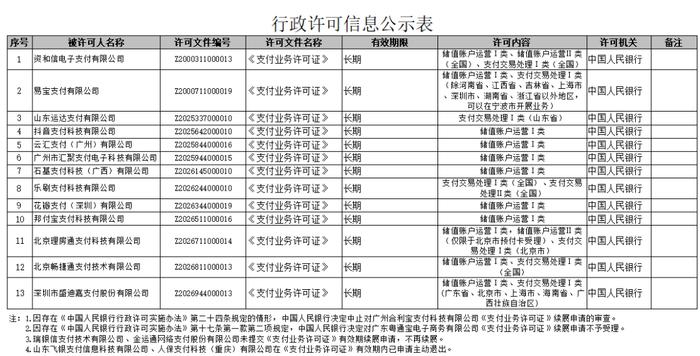
Core Insights - The People's Bank of China announced the renewal results for non-bank payment institutions' licenses, with 13 institutions receiving long-term licenses, while one institution's renewal was suspended and three were not renewed [1][3][5] Group 1: License Renewal Outcomes - 13 payment institutions successfully renewed their licenses, which are now valid for the long term instead of the previous five-year term [1][5] - The institutions that received long-term licenses include: Zhihexin Electronic Payment Co., Yibao Payment Co., Shandong Yunda Payment Co., Douyin Payment Technology Co., Yunhui Payment (Guangzhou) Co., and others [2][5] - Guangzhou Heli Payment Technology Co. had its license renewal application suspended due to the restructuring of its parent listed company [3] Group 2: Regulatory Implications - The renewal of licenses reflects the implementation of the "Non-Bank Payment Institutions Supervision Management Regulations," indicating a shift in regulatory approach towards a more stable operational environment for payment institutions [5] - The long-term validity of licenses is expected to alleviate the cyclical pressure of license renewals, providing a stable outlook for strategic planning and operations within the industry [5]
支付牌照变局:抖音等13家获长期许可,5家退出
第一财经· 2025-07-04 15:31
Core Viewpoint - The renewal of payment business licenses for 13 non-bank payment institutions marks a significant shift in regulatory approach, transitioning from quantity control to quality optimization, which is expected to enhance the stability and strategic planning of the industry [2][3]. Group 1: License Renewal - The People's Bank of China announced the renewal of payment business licenses for 13 non-bank payment institutions, granting them long-term validity [1]. - This is the first license renewal announcement following the implementation of the Non-Bank Payment Institution Supervision and Management Regulations [2]. Group 2: Regulatory Changes - The renewal reflects the regulatory body's shift towards a registration system, alleviating the cyclical pressure of license renewals and providing a stable outlook for institutions [2]. - The announcement also included the suspension of license renewal applications for certain institutions due to compliance issues, indicating a rigorous enforcement of regulatory standards [2]. Group 3: Industry Dynamics - The non-renewal of licenses for some institutions highlights a trend of industry consolidation, where firms either exit due to strategic realignment or face compliance challenges [3]. - The regulatory focus is now on quality, promoting a dynamic exit mechanism that accelerates industry clearing and resource integration, leading to a more orderly issuance of licenses and stricter dynamic supervision [3].

支付牌照续展结果揭晓:抖音支付等13家机构换发长期牌照
Mei Ri Jing Ji Xin Wen· 2025-07-04 15:18
Core Points - The People's Bank of China has announced the renewal status of payment business licenses for non-bank payment institutions, with 13 companies, including Douyin Payment and LeShua Payment, receiving "long-term" validity for their licenses [1][2] - The renewal process has seen some companies, such as Guangzhou Heli Bao Payment and Guangdong Yutongbao E-commerce, face suspension or rejection due to regulatory issues, while others like UBS Payment and Jin Yuntong have not applied for renewal [1][2][3] Group 1 - The renewal of licenses marks the first major update since the implementation of the Non-Bank Payment Institutions Supervision and Management Regulations, indicating a shift towards a registration-based system that alleviates cyclical renewal pressures for institutions [2][3] - The transition period for these licenses will end on July 9, 2025, and the current renewal signifies a critical evaluation phase for the payment institutions involved [2][3] Group 2 - The inability of some institutions to renew their licenses highlights a trend of industry consolidation, where companies are exiting due to strategic realignment or compliance pressures, reflecting a regulatory focus on "survival of the fittest" [3] - The renewal process is seen as a move towards quality optimization in license management, promoting compliance and innovation within the payment industry while facilitating resource integration [3]
支付牌照变局:抖音等13家获长期许可,5家退出
第一财经网· 2025-07-04 13:36
Core Viewpoint - The first renewal of payment business licenses under the "Non-Bank Payment Institutions Supervision and Management Regulations" has been announced, indicating a shift in regulatory approach towards long-term validity for certain institutions [1][2]. Group 1: License Renewal - The People's Bank of China has published the renewal information for payment business licenses, with 13 non-bank payment institutions receiving licenses that are now valid indefinitely [1][2]. - The renewal reflects the implementation of the new regulations and signifies a transition from a focus on quantity control to quality optimization in the industry [2][3]. Group 2: Regulatory Changes - The renewal process is seen as a response to the regulatory framework that aims to alleviate the cyclical pressure of license renewals, providing stability for institutions' long-term operations and strategic planning [2][3]. - Institutions that did not successfully renew their licenses include those that have either strategically divested from payment services or faced compliance issues, highlighting a trend of industry consolidation and regulatory scrutiny [3]. Group 3: Industry Dynamics - The ongoing process of license renewals indicates a competitive environment where non-compliant and less competitive institutions are being weeded out, reinforcing the regulatory body's role in promoting a healthier industry landscape [3]. - The shift towards a dynamic exit mechanism is expected to accelerate industry clearing and resource integration, fostering a balance between compliance and innovation for high-quality development in the payment sector [3].
苏超的“世仇”不只在球场,京东、阿里、美团三巨头激战苏超营销
3 6 Ke· 2025-07-04 11:31
Core Viewpoint - The "Su Super" league has gained significant popularity, attracting numerous sponsors and creating a competitive marketing landscape among major players like JD, Alibaba, and Meituan, each employing distinct strategies to engage consumers and enhance brand visibility [1][2][29]. Group 1: JD's Strategy - JD has become the official strategic partner of the "Su Super," engaging in multi-dimensional cooperation that includes event marketing, cultural entertainment, and public fitness initiatives [7][10]. - The partnership allows JD to frequently showcase its brand through event advertisements and live broadcasts, establishing a solid foundation for future marketing activities [7][10]. - JD has launched various promotional activities, such as offering significant discounts on local specialties and food deliveries after matches, which has led to a notable increase in platform consumption [12][15]. - The interactive guessing game for match outcomes has attracted substantial user engagement, with a live event drawing over 1.15 million viewers and generating 135,000 orders [15]. - JD's sales data indicates a remarkable increase in orders, with a tenfold rise in Jiangsu's delivery orders and an 82% year-on-year growth in local specialty sales [27][28]. Group 2: Alibaba's Approach - Alibaba has adopted a "scattered sponsorship" strategy, with its brands like Taobao, Alipay, and Huabei sponsoring various teams, creating a sponsorship matrix that enhances brand visibility [31][50]. - The brands have tailored their marketing messages to resonate with local culture, such as using regional dialects and themes to connect with fans [38][54]. - Alipay reported a 12% increase in offline payment transactions in Jiangsu during the "Su Super," indicating effective integration of payment and consumer engagement strategies [55]. Group 3: Meituan's Tactics - Meituan has not sponsored the league outright but has implemented extensive consumer subsidies across various cities, significantly increasing user engagement and platform usage [62][76]. - The company has introduced themed dining packages and promotional activities that have led to a fourfold increase in orders for "Su Super" themed meals since June [68][71]. - Meituan's data-driven marketing approach has allowed for personalized promotions based on local preferences, resulting in substantial sales growth for specific food items [79]. Group 4: Industry Insights - The "Su Super" has demonstrated the effectiveness of combining regional culture with mass participation in marketing strategies, suggesting that brands should leverage local characteristics to enhance consumer connection [80]. - The evolution of event marketing has shifted from mere brand exposure to a comprehensive ecosystem integration, with companies like JD, Alibaba, and Meituan constructing closed-loop consumption ecosystems [82]. - The rising popularity of the "Su Super" has created a demand for quantifiable marketing ROI, prompting brands to develop multi-dimensional evaluation systems to optimize their marketing strategies [83]. - The competition among major platforms represents a broader struggle for consumer attention and resource integration, highlighting the need for brands to convert short-term engagement into long-term brand equity [85].



微众银行与银联商务达成战略合作,打造数字普惠金融新生态
Zhong Guo Chan Ye Jing Ji Xin Xi Wang· 2025-07-04 10:03
Group 1 - The core viewpoint of the news is the strategic cooperation between WeBank and UnionPay Business to enhance digital inclusive finance through a deep integration of WeBank's digital financial capabilities and UnionPay's extensive merchant network [1][2][3] Group 2 - The collaboration aims to expand the "Micro Loan National Subsidy Merchant Exclusive Loan" product, which previously targeted specific merchants in Shenzhen, to a broader range of small and micro enterprises across the country [2][3] - The partnership will provide comprehensive financial services beyond just loans, including account management, bill discounting, insurance, and wealth management, integrating these services into various business transaction processes [3][4] - The cooperation emphasizes the importance of ecological collaboration in the development of high-quality inclusive finance, leveraging technology and data to enhance risk identification and customer insights [4]

拉卡拉赴港上市:跨境支付高增长难掩业绩颓势 稳定币能否成破局关键?
Xin Lang Zheng Quan· 2025-07-04 09:49
Core Viewpoint - Lakala plans to issue H-shares and list on the Hong Kong Stock Exchange to advance its international development strategy, despite facing significant performance challenges, including a 51.71% year-on-year decline in net profit for Q1 2025 [1][2]. Group 1: Strategic Background and Performance Challenges - The announcement of the Hong Kong listing aims to accelerate the application of digital currency in cross-border scenarios, targeting the growing fintech sector of cross-border payments and digital currencies [2]. - In 2024, Lakala's cross-border payment transaction volume reached 49.2 billion yuan, a 14% increase year-on-year, with over 120,000 clients, an 80% growth [2]. - However, cross-border business only accounted for 1.16% of the company's total payment transaction volume, limiting its contribution to overall performance [2]. - Financial data shows a decline in revenue to 5.759 billion yuan in 2024, down 3% year-on-year, and a net profit of 351 million yuan, a 23% decrease [2]. Group 2: Recent Financial Performance - In Q1 2025, revenue fell to 1.299 billion yuan, a 13.01% decrease year-on-year, with net profit halving to 101 million yuan, a 51.71% drop [3]. - The company's payment transaction volume in Q1 2025 was 982 billion yuan, down 10.51% year-on-year, contributing to the decline in revenue and profit [3]. - Lakala's user base is significantly smaller compared to competitors, with only 18 million active personal users, less than 1/50 of Alipay's user base [3]. Group 3: Transformation Efforts and Market Position - Lakala is pursuing three transformation paths: cross-border payments, a "payment + SaaS" strategy, and AI technology applications, each facing substantial challenges [4]. - In the "payment + SaaS" strategy, the company added over 10,000 SaaS service stores in 2024, with a 65% increase in transaction volume, but its SaaS penetration rate is only 8%, lower than competitors [4]. - The company has adopted an "AI First" approach, achieving over 70% replacement of human customer service with AI, but 60% of R&D spending is focused on POS upgrades, limiting innovation [4]. Group 4: Opportunities and Governance Issues - The recent enactment of the "Stablecoin Ordinance" in Hong Kong presents potential opportunities for Lakala, although significant challenges remain in integrating stablecoin operations [5]. - The cross-border application of digital renminbi has surged, with a 217% year-on-year increase in trade settled using digital renminbi in Q1 2025, providing Lakala with a first-mover advantage [5]. - Governance concerns have arisen, with major shareholders reducing their stakes significantly, and executive compensation rising despite declining profits, indicating potential structural imbalances [5]. Group 5: Investment Outlook - Lakala has faced setbacks in investments, including a significant loss from exiting a stake in a bank, reflecting a passive strategic adjustment [6]. - The market's short-term optimism is evident from a 16.16% stock price increase following the listing announcement, but long-term viability remains uncertain [6]. - Analysts suggest that while the Hong Kong listing may provide short-term funding and brand benefits, overcoming business bottlenecks is essential for sustainable growth [6].