家电

Search documents
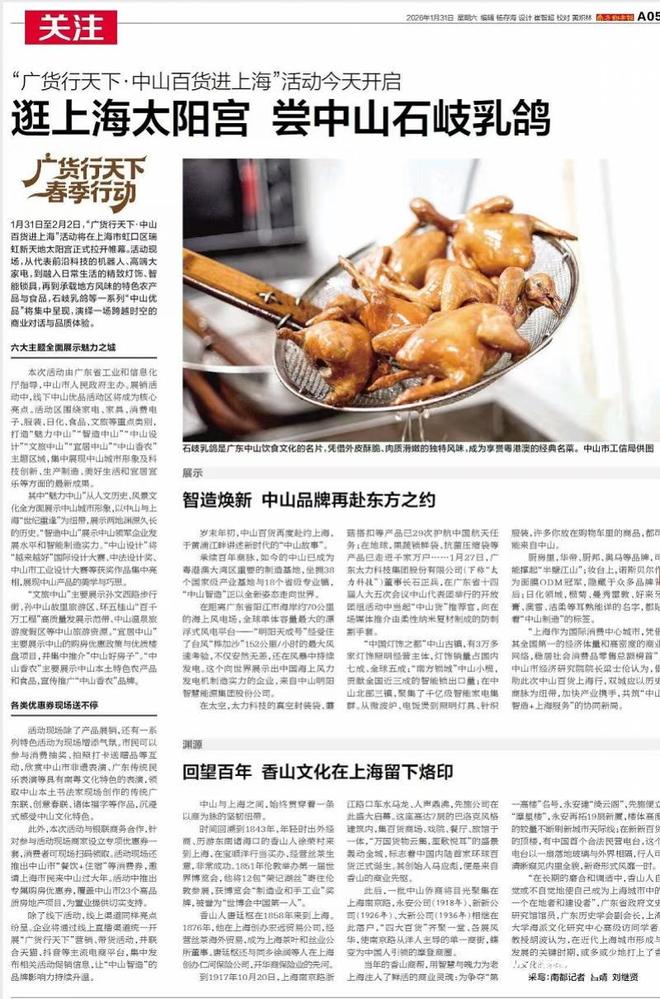
“广货行天下·中山百货进上海”活动今日开启
Nan Fang Du Shi Bao· 2026-01-31 02:19
Group 1 - The event "Guanghuo Hang Tianxia: Zhongshan Department Store Enters Shanghai" will take place from January 31 to February 2 in Shanghai, showcasing a variety of products from Zhongshan, including advanced technology robots, high-end appliances, and local specialty foods [1][7] - The event is guided by the Guangdong Provincial Department of Industry and Information Technology and hosted by the Zhongshan Municipal Government, focusing on key categories such as home appliances, furniture, consumer electronics, clothing, daily chemicals, food, and cultural tourism [7][9] - The "Charming Zhongshan" theme will highlight the city's cultural and historical aspects, while "Intelligent Manufacturing Zhongshan" will showcase the development level of leading enterprises and their smart manufacturing capabilities [9][11] Group 2 - The event will feature various interactive activities, including consumer lotteries, traditional performances, and the distribution of local coupons to encourage participation from Shanghai residents [12][13] - Zhongshan is recognized as a significant manufacturing base in the Guangdong-Hong Kong-Macao Greater Bay Area, with over 38 national industrial bases and 18 provincial professional towns, promoting the "Zhongshan Intelligent Manufacturing" brand [13][18] - The historical ties between Zhongshan and Shanghai date back to the 19th century, with notable figures from Zhongshan contributing to Shanghai's commercial development, establishing a strong cultural and economic connection [19][21][22]

财政部:2025年消费品以旧换新相关产品销售额超2.6万亿元 惠及超3.6亿人次
Xin Hua Cai Jing· 2026-01-31 01:36
Core Insights - The Ministry of Finance announced a total of 300 billion yuan in special government bond funds to support the "old for new" consumption policy in 2025, significantly boosting consumer spending and aiding industry transformation [1][2] - The sales revenue from products related to the "old for new" policy is expected to exceed 2.6 trillion yuan, benefiting over 360 million people [1] - The trial programs for new consumption models and international consumption environments have been initiated, with 65 pilot cities selected and an initial funding of 9.6 billion yuan allocated [2] Group 1: Consumption Policy Impact - The "old for new" policy led to the replacement of over 11.5 million vehicles, with nearly 60% being new energy vehicles [1] - Approximately 130 million home appliances were replaced, with over 90% being first-level energy-efficient products [1] - Sales of digital products, including mobile phones, reached over 91 million units, with mid-to-high-end models accounting for 72.5% of sales [1] Group 2: Pilot Programs and Initiatives - The pilot programs focus on three areas: supporting the "first launch economy," service consumption, and "IP + consumption" [2] - A reward invoice initiative will be launched in 50 cities to stimulate daily consumer spending in areas such as shopping, dining, and tourism [2] - The selected pilot cities account for 44% of the national GDP and social retail sales, with funding to be disbursed promptly after the public announcement [2]
利好来了!上海重大发布!事关消费 最高补贴不超2万元
Xin Lang Cai Jing· 2026-01-30 23:52
Core Viewpoint - Shanghai has announced a comprehensive policy to promote large-scale equipment updates and a trade-in program for consumer goods, aiming to stimulate consumption and enhance the recycling economy [1][3]. Group 1: Large-Scale Equipment Updates - The policy supports applications for national equipment update projects across various sectors, including industrial, electronic information, energy, transportation, logistics, education, cultural tourism, healthcare, and more [7]. - Specific support is provided for the scrapping and updating of old operational trucks and the renewal of new energy city buses, with subsidies following existing guidelines [8]. Group 2: Consumer Goods Trade-In Program - The policy outlines subsidies for scrapping and updating vehicles, with a maximum subsidy of 20,000 yuan for purchasing new energy passenger vehicles and 15,000 yuan for 2.0-liter or below fuel vehicles [10]. - For vehicle trade-ins, consumers can receive up to 15,000 yuan for new energy vehicles and 13,000 yuan for fuel vehicles, depending on the vehicle's price [10]. Group 3: Household Appliances and Digital Products - Consumers purchasing energy-efficient household appliances such as refrigerators, washing machines, and air conditioners can receive a subsidy of 15% of the product price, capped at 1,500 yuan per item [10]. - For digital and smart products, a subsidy of 15% is available for items priced under 6,000 yuan, with a maximum of 500 yuan per item [11]. Group 4: Recycling and Resource Utilization - The policy emphasizes the establishment of a comprehensive recycling network for old equipment and consumer goods, promoting a "two-network integration" recycling system [8]. - It aims to enhance the recycling and remanufacturing industry, focusing on high-end remanufacturing projects and improving the quality and safety of remanufactured products [9].
利好来了!上海,重大发布!事关消费
券商中国· 2026-01-30 23:42
Core Viewpoint - Shanghai has issued a significant policy document aimed at promoting large-scale equipment updates and a trade-in program for consumer goods, focusing on various sectors including industrial, electronic information, and transportation [2][3]. Group 1: Large-Scale Equipment Updates - The policy supports applications for national equipment update projects, specifically targeting sectors such as industrial, electronic information, energy, transportation, and healthcare [5]. - It encourages the scrapping and updating of old operational trucks and the renewal of new energy city buses, with subsidies based on existing guidelines [5]. Group 2: Consumer Goods Trade-In Program - The policy outlines subsidies for scrapping and updating vehicles, with a maximum subsidy of 20,000 yuan for purchasing new energy vehicles and 15,000 yuan for 2.0L or below fuel vehicles [10]. - For household appliances, consumers can receive a subsidy of 15% of the purchase price (up to 1,500 yuan) for energy-efficient products like refrigerators and washing machines [10]. Group 3: Recycling and Resource Utilization - The initiative aims to enhance the recycling network for old equipment and consumer goods, promoting a "two-network integration" recycling system [7]. - It emphasizes the development of the resource recycling and remanufacturing industry, with a focus on high-end remanufacturing projects and improving the technology level of recycled resources [8].

海尔智家公布国际专利申请:“磁场保鲜冰箱”
Sou Hu Cai Jing· 2026-01-30 23:00
证券之星消息,根据企查查数据显示海尔智家(600690)公布了一项国际专利申请,专利名为"磁场保 鲜冰箱",专利申请号为PCT/CN2025/099910,国际公布日为2026年1月29日。 专利详情如下: 今年以来海尔智家已公布的国际专利申请22个,与去年同期持平。结合公司2025年中报财务数据,2025 上半年公司在研发方面投入了57.9亿元,同比增11.73%。 数据来源:企查查 以上内容为证券之星据公开信息整理,由AI算法生成(网信算备310104345710301240019号),不构成 投资建议。 图片来源:世界知识产权组织(WIPO) ...


关于巩固拓展经济回升向好势头实现一季度“开门红”的若干政策措施
Xin Lang Cai Jing· 2026-01-30 22:49
(来源:黑龙江日报) 转自:黑龙江日报 中共黑龙江省委办公厅 黑龙江省人民政府办公厅印发 中共黑龙江省委办公厅 黑龙江省人民政府办公厅 2026年1月29日 为深入贯彻中央经济工作会议精神,全面落实省委十三届九次全会暨省委经济工作会议部署,发挥存量 政策和增量政策集成效应,全力巩固拓展经济回升向好势头,确保实现一季度"开门红",确保"十五 五"开好局、起好步,制定本政策措施。 一、大力提振消费 (一)优化消费品以旧换新政策实施。抓紧审核兑付2025年度消费品补贴,1月底前全部兑付到位,实 现跨年度顺畅衔接和平稳有序过渡。一季度安排各类资金12亿元左右,实施好汽车报废更新、汽车置换 更新、6类家电以旧换新、4类数码和智能产品购新等领域国家补贴政策。汽车更新补贴由定额补贴调整 为按车价比例补贴。家电以旧换新调整为补贴1级能效或水效产品,按照产品售价的15%给予补贴。 (二)开展促消费系列活动。打造"购在龙江"、"龙江味道"、"龙江好物"等品牌,抓住春节、元宵节等 重要消费节点,统筹开展"新春年货节"等冬季促消费活动500场以上。鼓励各市(地)精准发放消费 券,因地制宜设计简便灵活的领用规则,合理确定消费券有效期, ...
寻找未来制造新方向 ——珠海格力电器股份有限公司打造“协同屋”新范式
Jing Ji Ri Bao· 2026-01-30 21:55
Core Viewpoint - Gree Electric Appliances has successfully established a highly automated and intelligent manufacturing facility, recognized as a "leading-level smart factory" for 2025, showcasing significant advancements in production efficiency and quality control through the integration of AI and automation technologies [2][10]. Group 1: Intelligent Manufacturing Achievements - The Gree Jinwan Intelligent Manufacturing Factory features a production line where automation has reduced the workforce from over 70 to approximately 20, achieving a 200% increase in production efficiency and 100% digital coverage [3][5]. - The factory employs an "Industrial Brain" that captures real-time data on production progress, order status, and equipment performance, allowing for autonomous optimization of production schedules and resource allocation [3][7]. - Gree has developed over 30 patented technologies, including automatic assembly, welding, fastening, and adhesive application techniques, contributing to a self-research equipment rate exceeding 80% [5][10]. Group 2: Quality Control Innovations - Gree's automated inspection system includes 26 testing stations that assess noise, vibration, and operational performance, achieving a detection accuracy of 99.99% through AI and high-precision sensors [4][9]. - Each air conditioning unit produced is assigned a unique "ID," allowing for real-time data collection and process optimization throughout the manufacturing cycle [4][10]. Group 3: Collaborative Manufacturing Model - The "Collaborative House" model integrates various stages of the supply chain, enabling real-time visibility for over 20,000 suppliers and facilitating efficient production based on market demand [8][11]. - This model aims to break down information silos within the industry, creating an ecosystem that enhances collaboration between demand and supply sides, thereby improving responsiveness to market changes [8][11]. Group 4: Future Development and Expansion - Gree plans to replicate the successful intelligent manufacturing system from the Jinwan factory across 13 new or upgraded air conditioning manufacturing bases [10][11]. - The company is positioned to provide smart factory solutions to various industries, including automotive and renewable energy, leveraging its modular and lightweight solutions to assist small and medium enterprises in their transformation [10][11].

寻找未来制造新方向
Jing Ji Ri Bao· 2026-01-30 21:51
Core Viewpoint - Gree Electric Appliances has successfully established a leading smart manufacturing factory, recognized as a "Navi-level Smart Factory" for 2025, showcasing advanced automation and digitalization in its production processes [1][9]. Group 1: Smart Manufacturing Achievements - The Gree Jinwan Smart Manufacturing Factory features a fully automated production line with a 200% increase in production efficiency and a 100% digital coverage rate [2]. - The factory has implemented an "Industrial Brain" that integrates data across the entire value chain, optimizing production schedules and resource allocation through AI algorithms [2][5]. - Automation has significantly reduced labor requirements, with a production line that previously needed over 70 workers now operating with only about 20 [2]. Group 2: Quality Control Innovations - Gree has developed an automated inspection system with 26 testing stations to ensure product quality, achieving a detection accuracy of 99.99% [3]. - Each air conditioning unit produced is assigned a unique "ID," allowing for real-time data collection and process optimization throughout production [3]. Group 3: Technological Advancements - The factory boasts over 30 patented technologies, including automated assembly, welding, fastening, and adhesive application techniques [4]. - Gree's self-developed equipment accounts for over 80% of the factory's machinery, enhancing its competitive edge in the smart manufacturing sector [4][8]. Group 4: Collaborative Manufacturing Model - The "Collaborative House" model integrates various stages of production, from sales to logistics, creating a seamless business loop that enhances efficiency [5][6]. - This model allows real-time visibility for suppliers and customers, breaking down information silos and enabling a demand-driven production approach [6]. Group 5: Future Expansion and Industry Impact - Gree plans to replicate the successful smart manufacturing model across 13 new or upgraded air conditioning manufacturing bases [8]. - The company aims to provide smart factory solutions to various industries, including automotive and renewable energy, promoting broader industrial transformation [8].
美的集团(000333) - 2026年1月30日投资者关系活动记录表
2026-01-30 14:18
Group 1: Business Strategy - In 2026, Midea's business strategy focuses on "core growth," aiming to achieve a leading global position in white goods and HVAC sectors, targeting to be "number one or two" globally [2] - The company emphasizes the need to strengthen market advantages in technology innovation and user experience to achieve its global market goals [2] - Midea plans to maintain strategic focus on robotics, energy, and healthcare sectors, which have significant market potential and are crucial for navigating economic cycles [2] Group 2: Raw Material Management - Midea has implemented bulk procurement strategies to mitigate the impact of raw material price fluctuations, which have seen significant volatility [3] - In 2021, copper prices increased by approximately 40%, leading to a slight decline in net profit margin by less than 1%, but by 2022, the net profit margin had returned to an upward trajectory [3] - The company will address future raw material price volatility through cost reduction via technology development, product structure upgrades, efficiency improvements across the value chain, and optimized supply chain management [3] Group 3: AI Empowerment - Midea's Wuhu kitchen appliance factory has been recognized as a "lighthouse factory" by the World Economic Forum, marking it as the first fully AI-enabled water heater factory globally [4] - The factory utilizes AI for comprehensive data transparency across 23 process nodes, with a 39% improvement in end-to-end delivery cycles, significantly exceeding the industry average improvement of 10%-15% [4] - Midea is integrating AI tools into its home appliance products, creating a unified ecosystem of "people, vehicles, and homes," and collaborating with major partners like Huawei and BYD to enhance connectivity [5]

深市消费企业践行“质量回报双提升” 以创新赋能价值 以实干回馈股东
Zheng Quan Ri Bao Wang· 2026-01-30 14:01
Core Viewpoint - The Shenzhen Stock Exchange has launched the "Quality and Return Dual Improvement" initiative to enhance the quality and investment value of listed companies, thereby strengthening the stability of the capital market [1] Group 1: Company Performance - By the end of 2025, 472 companies have released action plans focusing on core business, innovation, and investor returns [1] - Sanhua Intelligent Control Co., Ltd. (002050) expects a net profit of 3.874 billion to 4.649 billion yuan in 2025, representing a year-on-year growth of 25% to 50% [2] - Hisense Home Appliances (000921) achieved operating revenue of 71.533 billion yuan and a net profit of 2.812 billion yuan in the first three quarters of 2025 [2] - TCL Smart Home (002668) reported operating revenue of 14.346 billion yuan, a year-on-year increase of 2.87%, and a net profit of 977 million yuan, up 18.45% [3] Group 2: Technological Innovation - Sanhua Intelligent Control increased R&D investment to 705 million yuan in the first half of 2025, accounting for 4.34% of operating revenue [4] - TCL Smart Home invested 517 million yuan in R&D in the first three quarters of 2025, representing 3.61% of operating revenue [4] - Hisense Home Appliances focuses on technological innovation in smart, healthy, and energy-saving directions, establishing over 20 technology innovation platforms [5] Group 3: Investor Returns - Sanhua Intelligent Control plans to distribute a cash dividend of 932 million yuan for the 2024 fiscal year and has repurchased 7.1501 million shares for approximately 303 million yuan [7] - Hisense Home Appliances increased its cash dividend payout ratio from 30% to 50% of net profit in 2022, with cumulative dividends reaching 6.751 billion yuan over the past decade [8] - The practices of Sanhua Intelligent Control, Hisense Home Appliances, and TCL Smart Home serve as benchmarks for other companies in the Shenzhen market to enhance quality and returns [8]