航空航天

Search documents
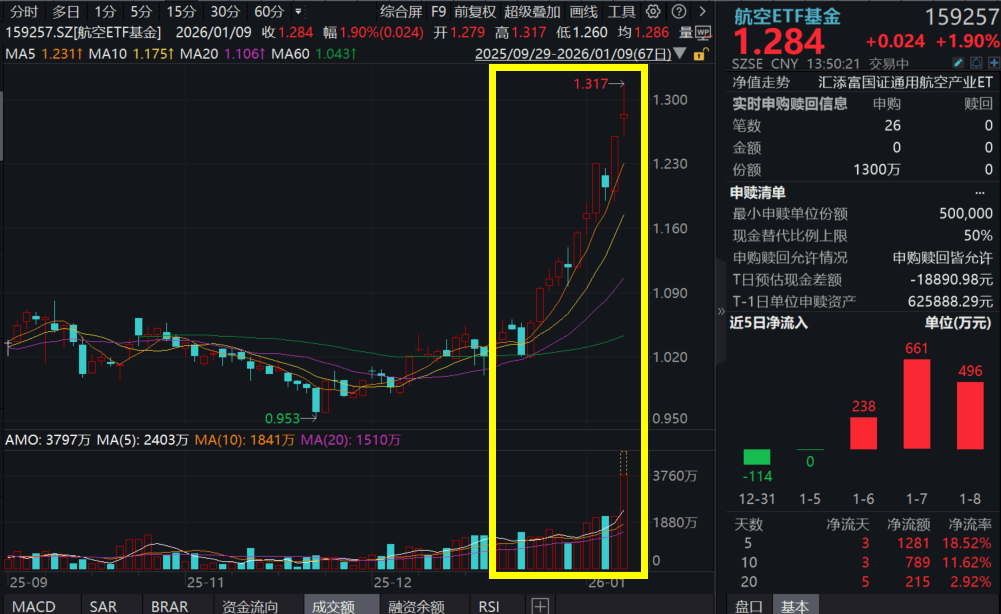
商业航天持续火爆!航天宏图、航天电子等涨超8%,航空ETF基金(159257)爆量涨2%创新高,连续4日净流入,商业航天开启黄金发展窗口?
Sou Hu Cai Jing· 2026-01-09 06:27
Core Viewpoint - The A-share market has seen a significant surge, with the Shanghai Composite Index returning to 4100 points for the first time in a decade, driven by the booming commercial aerospace theme [1] Group 1: Market Performance - The Aviation ETF Fund (159257) experienced a substantial increase, rising by 1.9% and reaching a peak of over 4.5% during the trading session, with trading volume hitting 40 million yuan [1] - The fund has seen a net inflow of over 30 million yuan over the past four days, indicating strong investor interest [1] Group 2: Component Stocks Performance - Most component stocks of the Aviation ETF Fund saw significant gains, with Aerospace Hongtu and Aerospace Electronics rising over 8%, and Aerospace Rainbow increasing over 6% [3] - Notable performers also included Hongdu Aviation and Huali Chuantong, both rising over 2% [3] Group 3: Policy and Industry Developments - The commercial aerospace sector received a boost from new policies, including Guangzhou's plan to accelerate the development of strategic industries such as artificial intelligence, semiconductors, and aerospace [4] - China submitted an application to the International Telecommunication Union (ITU) for an additional 203,000 satellites, indicating a strong push in satellite industry development [5] Group 4: Demand for Commercial Rockets - The construction of satellite internet is driving strong demand for commercial rockets, with projections indicating a need for approximately 150 rocket launches per year due to various satellite constellation plans [6][7] - The commercial rocket industry is entering a new phase of engineering and industrialization, supported by favorable policies and market conditions [7] Group 5: Investment Opportunities - The Aviation ETF Fund focuses on low-altitude economy, military industry, and commercial aerospace, with a significant portion of its components in the defense and military sector [8] - The fund's components are well-positioned to benefit from the anticipated growth in the low-altitude economy and commercial aerospace sectors, which are expected to see high-quality development in the coming years [12]


美国曾经辉煌的两大军工巨头,如今已经边缘化了!
Sou Hu Cai Jing· 2026-01-09 06:05
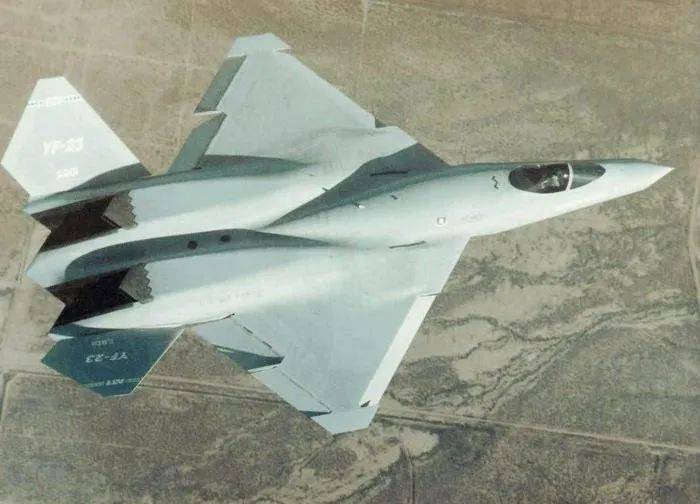
Core Viewpoint - The article discusses the historical rise and challenges faced by major players in the U.S. aerospace industry, particularly Lockheed Martin and Northrop Grumman, highlighting their successes, failures, and the competitive landscape of the industry. Group 1: Lockheed Martin's Dominance - Lockheed Martin emerged as the leading company in the U.S. aerospace industry due to significant government contracts won in key competitions at the turn of the century [1][4] - The company's growth from a marginal player during World War II to a dominant force in the aerospace sector is noted, indicating a challenging journey that led to the decline of other companies [4] Group 2: Northrop Grumman's Struggles - Northrop Grumman, formed from the merger of Northrop and Grumman, faced significant challenges, including the failure of the YF-23 project, which led to a loss of competitive edge [3][12] - Grumman's historical significance is highlighted, particularly its contributions during World War II with aircraft like the F4F Wildcat and F6F Hellcat, which played crucial roles in naval aviation [5][6][10] - The company struggled in the jet age, with its first jet fighter, the F9F Panther, underperforming against competitors, leading to a decline in confidence and market position [13] Group 3: Current Industry Challenges - Both Lockheed Martin and Northrop Grumman are facing challenges in adapting to new technological demands, with Lockheed's F-22 and F-35 programs encountering issues that require substantial resources for resolution [12] - The upcoming competition for sixth-generation fighter jets involves Lockheed Martin, Northrop Grumman, and Boeing, but the future winner remains uncertain due to unclear technical specifications [12] - A significant challenge for the U.S. aerospace industry is the shortage of skilled talent, exacerbated by deindustrialization, raising concerns about the ability to develop a new generation of engineers and technicians [12]


金元证券每日晨报-20260109
Jinyuan Securities· 2026-01-09 05:51
Core Insights - The report highlights the performance of major stock indices across different markets, indicating mixed results with some indices showing gains while others experienced declines [6][11]. - The report discusses significant developments in international and domestic news that may impact various industries, including economic forecasts and corporate actions [10][12][13]. International Market Overview - European markets showed slight gains with Germany's DAX30 up 0.02% at 25127.46 points and France's CAC40 up 0.12% at 8243.47 points, while the UK’s FTSE 100 fell 0.04% to 10044.69 points [11]. - In the US market, the Dow Jones increased by 0.55% to 49266.11 points, and the S&P 500 rose by 0.01% to 6921.46 points, whereas the Nasdaq dropped by 0.44% to 23480.02 points [11]. - The Asia-Pacific market saw the Hang Seng Index decline by 1.17% to 26149.31 points, and the Nikkei 225 fell by 1.63% to 51117.26 points, while the Korean Composite Index slightly increased by 0.03% to 4522.37 points [11]. Domestic News - The Ministry of Commerce is reviewing Meta's acquisition of Manus for $2 billion, emphasizing compliance with Chinese laws and regulations for foreign investments [12]. - The Ministry of Industry and Information Technology warned against irrational competition in the lithium battery industry, highlighting the need for regulatory measures to ensure sustainable development [13]. - Guangzhou's government plans to advance reusable rocket technology, aiming to establish a significant presence in the commercial aerospace sector by 2035 [14]. - The first domestic offshore recovery and reuse rocket production base has commenced construction in Hangzhou, marking a significant advancement in high-end manufacturing within the commercial aerospace field [15]. Important Company Developments - Chinese concept stocks saw a general increase, with the Nasdaq China Golden Dragon Index rising by 1.09% and notable gains in companies like Century Internet and WanGuo Data [16]. - Nvidia has requested overseas customers to pay in full for its H200 AI chips, with orders exceeding 2 million units, indicating strong demand [16]. - Apple announced that JPMorgan Chase will replace Goldman Sachs as the issuer of its credit card, which is expected to bring over $20 billion in credit card balances to the bank [16]. - OpenAI established an employee equity incentive pool equivalent to 10% of its total equity, valued at approximately $50 billion based on a $500 billion company valuation [16]. - China Petroleum and Chemical Corporation (Sinopec) is undergoing a restructuring with China National Aviation Fuel Group, aimed at enhancing the resilience of the aviation fuel supply chain [16].
军工+商业航天双轮驱动,航空航天ETF(159227)盘中爆发,成交额居同类第一
Mei Ri Jing Ji Xin Wen· 2026-01-09 05:33
Core Viewpoint - The A-share market experienced a collective rise, particularly in the commercial aerospace and military-related sectors, driven by favorable policies and technological advancements in the commercial aerospace industry [1][2]. Group 1: Market Performance - On January 9, the three major A-share indices rose collectively, with the aerospace ETF (159227) increasing by 2.8% and achieving a transaction volume of 771 million yuan, marking a new single-day high [1]. - Key stocks such as Guangqi Technology hit the daily limit, while Guokai Military Industry, Huaqin Technology, and Shanghai Hanhua all rose over 10% [1]. Group 2: Policy and Planning - On January 8, Guangzhou issued a plan to accelerate the construction of an advanced manufacturing city from 2024 to 2035, emphasizing the development of the low-altitude economy and commercial aerospace [1]. - The plan aims to establish a series of advanced launch vehicle industrial bases, focusing on low-cost, high-reliability launch vehicles and commercial applications in aerospace [1]. Group 3: Industry Insights - CITIC Securities believes that the commercial aerospace industry is entering a new era, supported by national policies and technological breakthroughs [2]. - The commercial aerospace sector includes key areas such as remote sensing applications, satellite control systems, and space computing, with a focus on the synergy between state-owned and private enterprises [2]. - The aerospace ETF (159227) closely tracks the National Aerospace Index, with a high concentration of military industry stocks, covering critical sectors like aerospace equipment and commercial aerospace, with a weight of 70.19% in commercial aerospace concepts [2].
ETF午评 | A股一度站上4100点,稀土板块+行业航天领涨,稀土ETF易方达、航空航天ETF天弘涨3%
Xin Lang Cai Jing· 2026-01-09 04:14
Core Viewpoint - The A-share market showed a collective rise in the morning session, with significant trading volume and various sectors experiencing notable performance, particularly in AI applications, military equipment, and commercial aerospace [1] Market Performance - The three major A-share indices rose, with the Shanghai Composite Index increasing by 0.3%, briefly surpassing 4100 points, while the Shenzhen Component Index rose by 0.57% and the ChiNext Index by 0.1% [1] - The total trading volume in the Shanghai and Shenzhen markets reached 20,819 billion yuan, an increase of 3,004 billion yuan compared to the previous day [1] - Over 2,300 stocks in the market experienced gains [1] Sector Performance - Leading sectors included AI applications, military equipment, commercial aerospace, smart healthcare, oil and gas extraction and services, computing power leasing, retail, minor metals, cross-border payments, and controllable nuclear fusion [1] - Underperforming sectors included banking, glyphosate, airport and shipping, brain-computer interfaces, cement, and agriculture [1] ETF Performance - The rare earth sector saw strong gains, with the E Fund Rare Earth ETF and the Jiashi Rare Earth ETF rising by 3.57% and 3.54%, respectively [1] - The commercial aerospace sector continued to thrive, with the Tianhong Aerospace ETF and the Penghua Satellite ETF increasing by 3.54% and 3.43%, respectively [1] - The AI application sector also performed well, with the GF Fund Media ETF rising by 3.39% [1] - The semiconductor sector experienced a pullback, with the Sci-Tech Semiconductor ETF, Semiconductor Materials ETF, and Sci-Tech Semiconductor ETF from Penghua declining by 1.83%, 1.79%, and 1.77%, respectively [1] - Overnight, U.S. tech stocks fell, with the Nasdaq Biotechnology ETF and S&P Biotechnology ETF both dropping by 1% [1]
航空航天概念股走强,相关ETF涨约6%
Mei Ri Jing Ji Xin Wen· 2026-01-09 03:20
Group 1 - Aerospace concept stocks have strengthened, with companies like Guangqi Technology and Aerospace Electronics hitting the daily limit, and AVIC Chengfei rising over 6%, while China Satellite and AVIC High-Tech increased by over 5% [1] - The aerospace-related ETFs have risen approximately 6% due to market influences [1] Group 2 - The Star River Power Aerospace announced plans to implement the "Ceres-1 Sea Launch Type (Remote 7)" commercial launch vehicle mission in the near future. This mission, if successful, could make Star River Power Aerospace the first private aerospace company to complete a launch by 2026, injecting strong momentum into the development of China's private aerospace industry [2] - Analysts believe that with the increasing demand for space computing and the maturation of reusable launch vehicle technology, China's commercial aerospace sector is expected to experience a significant growth inflection point, characterized by reduced costs and enhanced launch capabilities [2]



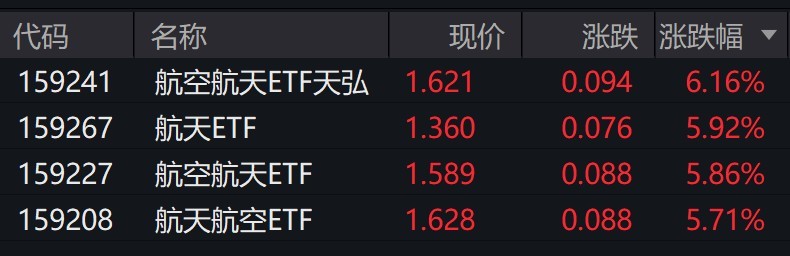
商业航天连续爆发,航天电子两连板,通用航空ETF基金(159230)大涨3.39%
Sou Hu Cai Jing· 2026-01-09 03:18
Group 1 - The three major indices collectively strengthened, with the commercial aerospace and large aircraft sectors experiencing a resurgence, as evidenced by the Aerospace ETF rising by 5.93% and the General Aviation ETF increasing by 4.48% [1] - The low-altitude economy has seen significant deployment in provincial "14th Five-Year" plans, showcasing distinct regional characteristics and development paths, with Guangdong focusing on low-altitude flight and infrastructure, while Chongqing aims to become a strong city for low-altitude economic innovation [1] - The logistics drone market in China reached a scale of 6.13 billion yuan in 2023, with expectations for continued rapid growth, particularly in the last-mile drone market, which is projected to see a year-on-year increase of 286% in delivery volume by mid-2025, with the market size expected to exceed 96 billion yuan by the end of the year [1] Group 2 - The General Aviation ETF tracks the National General Aviation Industry Index, focusing on the low-altitude economy, covering sectors such as aviation materials, infrastructure, aircraft manufacturing, operational services, and application scenarios, with low-altitude economy content at 88.26% and commercial aerospace content at 65.32% [2]


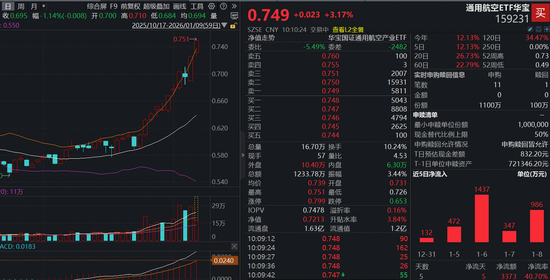
ETF盘中资讯|商业航天再迎重磅催化,航天电子霸气连扳!聚焦航空航天产业链的通用航空ETF(159231)开盘大涨3%再刷新高,资金火线申购1000万份!
Sou Hu Cai Jing· 2026-01-09 02:32
Group 1 - The core viewpoint of the news highlights the launch of the first offshore reusable rocket production base in China, along with the introduction of the "Qiantang" rocket, marking a significant event in the commercial aerospace sector [1] - Guangzhou has issued a plan to accelerate the construction of a strong advanced manufacturing city, focusing on reusable rocket technology and establishing a solid foundation for the development of medium and large liquid rockets [1] - The plan aims to support the construction of satellite constellations such as the "Five Rams" series and "Greater Bay Intelligence," promoting the development of satellite manufacturing, rocket launches, and satellite operations, thereby fostering a complete commercial aerospace industry ecosystem in Guangzhou [1] Group 2 - CITIC Securities points out that the commercial aerospace industry is expected to enter a new era, driven by national policy support and technological breakthroughs [2] - The commercial aerospace sector encompasses key areas such as remote sensing applications, satellite control systems, and space computing, with a focus on the synergy between state-owned and private enterprises [2] - The General Aviation ETF Huabao (159231) and its associated funds cover a wide range of sectors, including military and civilian aviation, commercial aerospace, and satellite navigation, with over 37% of the index allocated to the aerospace industry [2] Group 3 - On January 9, the aerospace sector showed strong performance, with significant gains in stocks such as Aerospace Electronics and Aerospace Hongtu, and the General Aviation ETF Huabao reaching a new high with a 3.17% increase [4] - The ETF has seen accelerated capital inflow, with a net subscription of 10 million shares in real-time, following a total net purchase of 33.73 million yuan over the previous five days [4]
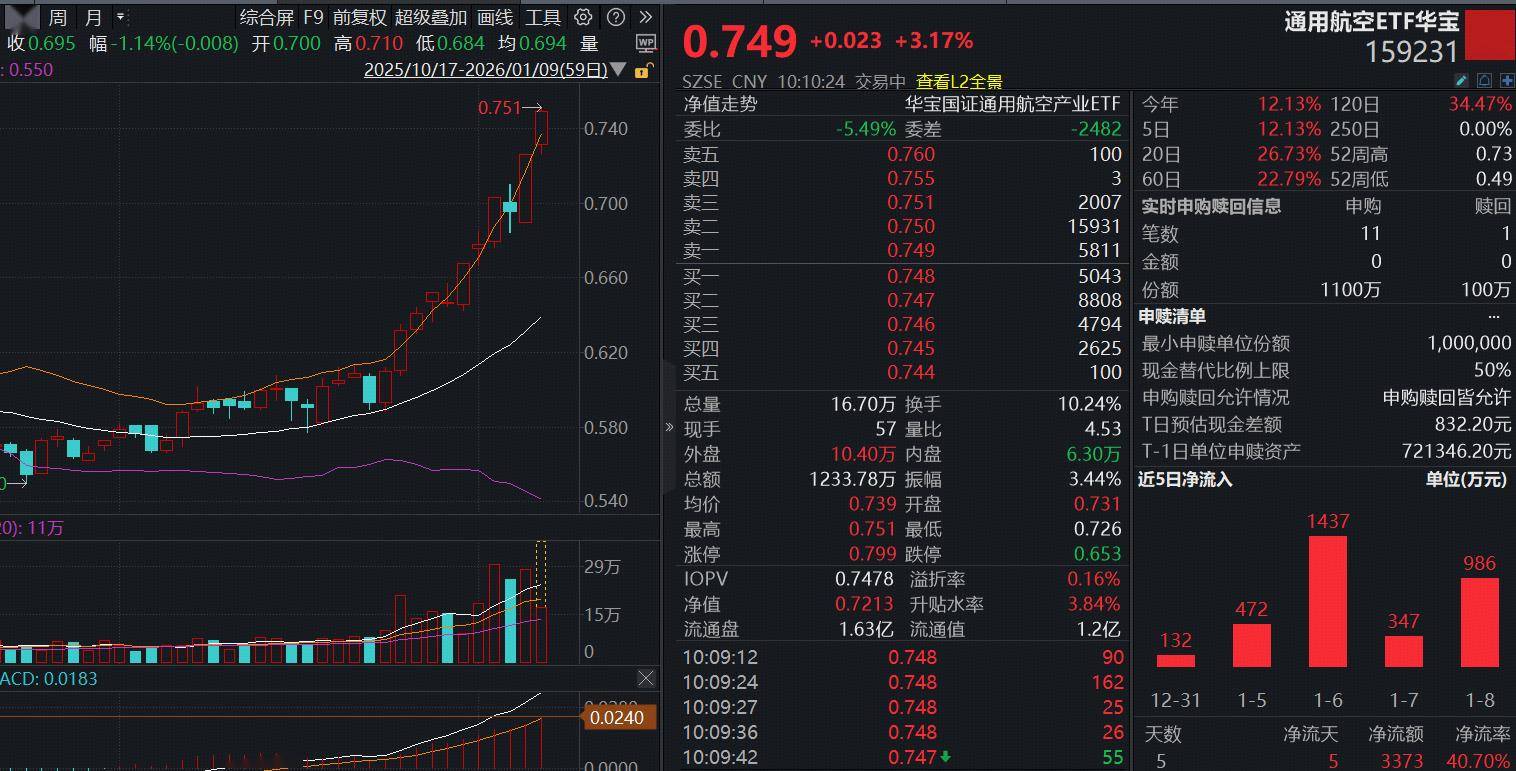
商业航天再迎重磅催化,航天电子霸气连扳!通用航空ETF(159231)开盘大涨3%再刷新高,资金火线申购1000万份
Xin Lang Cai Jing· 2026-01-09 02:17
Group 1 - The aerospace sector remains strong, with significant gains in stocks such as Aerospace Electronics and Aerospace Hongtu, and a notable increase in the General Aviation ETF Huabao (159231) which rose by 3.17% to reach a new high [1][6] - The General Aviation ETF has seen a net subscription of 10 million shares in real-time, following a total net inflow of 33.73 million yuan over the past five days [1][6] - The launch of the first domestic offshore reusable rocket recovery base, along with the introduction of the "Qiantang" rocket, serves as a catalyst for the commercial aerospace sector [8] Group 2 - Guangzhou has issued a plan to accelerate the construction of a strong advanced manufacturing city, focusing on reusable rocket technology and establishing a solid foundation for the development of medium and large liquid rockets [3][8] - The plan aims to attract talent, capital, and enterprises to Guangzhou, fostering a complete commercial aerospace industry ecosystem while enhancing the city's advantages in communication and navigation equipment manufacturing [3][8] - By 2035, the goal is to create a globally influential "Sky City" and a new hub for China's commercial aerospace industry, with a significant increase in the scale of the industry [3][8] Group 3 - CITIC Construction Investment highlights that the commercial aerospace industry is entering a new era supported by national policies and technological breakthroughs, with key areas including remote sensing applications and satellite control systems [4][9] - The General Aviation ETF Huabao and its associated funds cover a wide range of sectors, including military and civilian aerospace, with over 37% of its components in the aerospace industry, focusing on technological barriers and core commercial aspects [4][9]
10座3万亿超级城市来了?你的工作、房子正在被重新定价!
Sou Hu Cai Jing· 2026-01-09 01:44
Core Viewpoint - In the next five years, it is projected that ten cities in China will achieve an economic scale of 3 trillion yuan, each comparable to a medium-developed European country [1] Group 1: Current Achievements - Five cities have already reached the 3 trillion yuan target: Shanghai, Beijing, Shenzhen, Chongqing, and Guangzhou, with Shanghai's GDP surpassing 5 trillion yuan for the first time [3] - Hong Kong's GDP is expected to reach 2.93 trillion yuan in 2024, likely achieving the target by 2025 [3] - Suzhou is projected to exceed 3 trillion yuan by 2026, with a current GDP of 2.67 trillion yuan in 2024 [3] - Chengdu and Wuhan, with GDPs of 2.35 trillion yuan and 2.11 trillion yuan respectively, aim to reach the 3 trillion yuan target by 2030, although this will require significant annual growth [3][4] Group 2: Economic Transformation - The cities are expected to undergo a fundamental transformation, evolving from production centers to global resource allocation centers, focusing on capital, technology, data, and high-level talent [5] - The industrial structure will shift from manufacturing to intelligent manufacturing, reducing reliance on real estate [5] - Cities like Chengdu and Chongqing will focus on electronic information and aerospace, while Suzhou and Hangzhou will leverage technological innovation and advanced manufacturing [5] Group 3: Implications for Ordinary People - The emergence of these cities will intensify talent attraction, making it difficult for lower-tier cities to retain talent, leading to a loss of population and vitality [8] - Resources, opportunities, and wealth will be redistributed across cities, potentially re-evaluating property values and creating significant disparities in asset appreciation [8] - Individuals in cities with growth potential may find new opportunities for wealth creation [8] Group 4: Recommendations for Individuals - Continuous learning will become essential for survival, as future job security will depend on the ability to adapt and learn [10] - Individuals should align their skills with the industrial needs of cities rather than simply relocating to major cities [10] - Assessing one's current city and its potential for growth will be crucial for future opportunities [10]