
热带农业

Search documents
企业出海投资合作国别(地区)指南
Sou Hu Cai Jing· 2026-02-10 03:43
Core Insights - The report titled "Guide for Enterprises' Overseas Investment and Cooperation by Country (Region) - Southeast Asia Volume" provides comprehensive guidance for Chinese enterprises looking to invest in Southeast Asia, focusing on ASEAN and its 11 member countries, including East Timor, which will join in 2025 [1][19] - ASEAN has become China's largest trading partner for several consecutive years and is a crucial strategic node in the Belt and Road Initiative, with the signing of the "China-ASEAN Free Trade Area 3.0 Upgrade Protocol" in October 2025, covering nine areas including digital and green economies [1][19] - The region has a population exceeding 685 million and a GDP of $37,816 billion in 2023, with most member countries experiencing economic growth rates above the global average, particularly in sectors like mining, tropical agriculture, and electronics manufacturing [1][19] Investment Environment - The guide outlines the investment environment in ASEAN, highlighting its significant attractiveness due to population size, economic growth, and regional integration, with a gradually opening financial and securities market [2][20] - The digital economy in Southeast Asia reached a Gross Merchandise Value (GMV) of $218 billion in 2023, with rapid growth in investments in green industries such as electric vehicles [1][2] Legal and Policy Framework - The guide details trade regulations, foreign investment access, tax systems, labor employment, and intellectual property protection across the member countries, emphasizing the diverse policy frameworks and the expansion of foreign investment access [2][20] - The Regional Comprehensive Economic Partnership (RCEP) came into full effect in 2023, achieving zero tariffs on over 90% of goods traded within the region, enhancing trade facilitation [2][20] Practical Attachments - Practical attachments in the guide provide specific processes for Chinese enterprises regarding investment procedures, patent registration, and tax declarations, along with contact information for government agencies and consulting services [2][20] - The guide emphasizes the significant differences in political systems, legal frameworks, and cultural customs across the region, aiming to integrate macroeconomic, business environment, and policy information for authoritative reference [2][20] Structure of the Guide - The guide is structured into an overall ASEAN section and individual country sections, covering investment environments, legal systems, cooperation considerations, and practical attachments for each of the 11 member countries [1][20] - Each country section includes investment attractiveness, financial environment, securities market, and specific legal regulations, along with potential investment risks and mitigation strategies [20][22]


中外热带农业科技合作结硕果
Ren Min Ri Bao· 2026-01-27 22:17
Group 1: Key Points on Agricultural Cooperation - The China Tropical Agricultural Academy (CTAA) has been actively collaborating with Belt and Road Initiative countries to promote sustainable agricultural technology, helping to alleviate poverty and enhance global tropical agriculture development [1] - In Cambodia, the CTAA has been involved in developing pepper cultivation since 2015, addressing issues like pest control and low production standards, resulting in a 22% average increase in pepper yield [2][3] - The CTAA's expert team has provided hands-on training to local technicians and farmers, leading to significant improvements in agricultural practices and crop management [3] Group 2: Key Points on Specific Agricultural Projects - In Sri Lanka, the CTAA has initiated a project to enhance the value of tropical fruits, with techniques such as pruning and integrated pest management, leading to a 50% increase in mango yield [4][5] - Over two years, the CTAA has trained over 2,200 farmers and technicians in Sri Lanka, resulting in a threefold increase in pineapple yield and a 70% increase in banana production [5] - The collaboration has also led to the certification of over 300 local farms under Sri Lanka's Good Agricultural Practices [5] Group 3: Key Points on Date Palm Cooperation with UAE - The CTAA has been working with the UAE on date palm cultivation, with a donation of 25,000 date palm seedlings from the UAE to China between 2021 and 2024 [6] - The collaboration has included the establishment of a regional pest control system, significantly reducing pest incidence from 1% to 0.1% [6] - The partnership aims to enhance agricultural innovation and strengthen ties between China and the UAE through mutual cooperation in the date palm industry [6][7]
聚焦中印尼“两国双园”建设 福州两会代表委员建言赋能
Zhong Guo Xin Wen Wang· 2026-01-22 08:04
Group 1 - The establishment of the China-Indonesia Economic and Trade Innovation Development Demonstration Park marks a significant milestone, with the park officially approved in January 2023, indicating the acceleration of the "two parks" initiative between China and Indonesia [1][2] - As of now, there are 251 industrial enterprises in the Yuanhong Investment Zone, focusing on five cross-border industrial chains: marine fisheries, tropical agriculture, light industry and textiles, mechanical electronics, and green mining [1] - The first imports of Indonesian fresh coconuts and frozen durians to Fuzhou are expected in April and November 2025, respectively, showcasing the ongoing industrial agglomeration effects and expanding cross-border industrial cooperation [1] Group 2 - The "two parks" initiative is a crucial strategic support for Fuzhou's development as a core area of the Maritime Silk Road, with significant investment growth and positive development momentum in marine fisheries, tropical agriculture, and materials processing [2] - The Fuzhou government plans to implement 18 cooperation projects, including the Indonesian Fisheries Center, by 2026, aiming to strengthen the "two parks" initiative [2] - Suggestions for improving trade facilitation include optimizing customs processes and creating online cross-border declaration channels to reduce institutional costs and enhance efficiency [2]
(经济观察)中印尼“两国双园”建设提速
Zhong Guo Xin Wen Wang· 2026-01-22 06:48
Core Insights - The construction of the China-Indonesia "Two-Country Twin Parks" is accelerating, becoming a key support for Fuzhou's connection to the global market [1][2] Group 1: Project Development - The China-Indonesia Economic and Trade Innovation Development Demonstration Park was officially established in Fuzhou's Yuanhong Investment Zone, marking the formal launch of the "Two-Country Twin Parks" [1] - As of now, there are 251 industrial enterprises in the Chinese park, collaborating across five cross-border industrial chains: marine fisheries, tropical agriculture, light industry and textiles, machinery and electronics, and green mining [1] - The first imports of Indonesian fresh coconuts and frozen durians to Fuzhou are expected in April and November 2025, respectively, showcasing the ongoing industrial agglomeration effects [1] Group 2: Strategic Importance - The "Two-Country Twin Parks" are a crucial strategic support for Fuzhou in establishing itself as a core area of the Maritime Silk Road [2] - The Yuanhong Investment Zone has developed a cross-border industrial cooperation pattern in marine fisheries, tropical agriculture, and materials processing, with expanding investment scales and positive growth momentum [2] Group 3: Recommendations for Improvement - Suggestions include optimizing customs and inspection processes, creating online cross-border declaration channels, and reducing institutional costs to enhance trade facilitation [2] - There is a call for breakthroughs in regulatory alignment and institutional innovation to overcome cross-border regulatory barriers and promote mutual recognition of standards and regulatory collaboration [2] - Emphasis on macro-level policy coordination to address barriers in cross-border taxation and logistics, and to expand the regional supply chain center in collaboration with multiple ASEAN countries [2]
推动海南打造“科技小院全球中心”
Hai Nan Ri Bao· 2026-01-16 01:41
Core Viewpoint - The initiative to promote the "Global Center for Technology Courtyards" in Hainan represents an upgraded model of the technology courtyard, aiming to enhance China's soft power and participate in global governance while serving national strategies [2]. Group 1: Technology Courtyard Model - The technology courtyard model, created by Zhang Fushuo's team in 2009, integrates innovation, social services, and talent cultivation to provide farmers with accessible services [2]. - Currently, Hainan has established 136 technology courtyards, including 97 at the national level, demonstrating the model's successful implementation [2]. - The model has also been effectively promoted in countries like Malawi, with 16 international technology courtyards established in 13 countries since 2019 [2]. Group 2: Advantages of Hainan - Hainan's tropical agricultural resources align well with the agricultural production conditions of many developing countries, providing a unique advantage for cross-national agricultural technology adaptation research [3]. - The diverse agricultural industry structure and complete industrial chain in Hainan support the transfer and output of technological achievements [3]. - The Sanya Yazhou Bay Science and Technology City High-tech Zone can serve as a model for international agricultural technology services and incubation systems, promoting Hainan's agricultural products [3]. Group 3: Opportunities and Future Plans - The launch of the Hainan Free Trade Port offers unprecedented opportunities for the internationalization of technology courtyards [3]. - A five-year plan has been proposed to develop the technology courtyard model into a demonstrative international agricultural cooperation network, connecting Hainan with the global South [3].
签订单、增投资,火热!海南各行业抢抓封关后政策新机遇开辟发展新热土
Yang Shi Wang· 2026-01-10 02:42
Group 1 - Hainan Free Trade Port is set to enter a new phase of development in 2026, with various industries seizing new policy opportunities post-closure [1] - Hainan has selected over a hundred quality projects from its "14th Five-Year Plan" for development, covering all 18 cities and counties, including low-altitude economy and tropical agriculture [3] - A business leader indicated that with sufficient funding, they expect to generate 200 to 300 million yuan in equipment output by 2026, expressing confidence in establishing and growing their operations in Hainan [6] Group 2 - Hainan has seen a significant increase in tourist numbers, with inbound visitors to Sanya and Haikou rising by 28% and 15% respectively during the first week of the new year [10] - The duty-free shopping in Hainan has surged, with sales amounting to 1.21 billion yuan in the first week of the new year, marking an 88% year-on-year increase, and nearly 150,000 shoppers, a 38.3% increase [15] - The marketing director of a global duty-free city reported a 10% increase in inventory for new product categories, anticipating a busy shopping season as the Spring Festival approaches [21] Group 3 - Since the closure, Hainan has added 4,396 new foreign trade registered enterprises, with many companies signing contracts and increasing investments, showing optimism for the new year [22] - A business leader mentioned that they have imported over 5 million yuan worth of "zero tariff" biomedical technology equipment, saving nearly 1 million yuan, and expect to establish a project worth over 20 million yuan by 2026 [24] - Another business leader projected a 20% increase in orders for 2026 compared to 2025, indicating growth expectations [25]

外资鼓励目录“上新”——中国修订扩大《鼓励外商投资产业目录》
Ren Min Ri Bao Hai Wai Ban· 2026-01-06 03:23
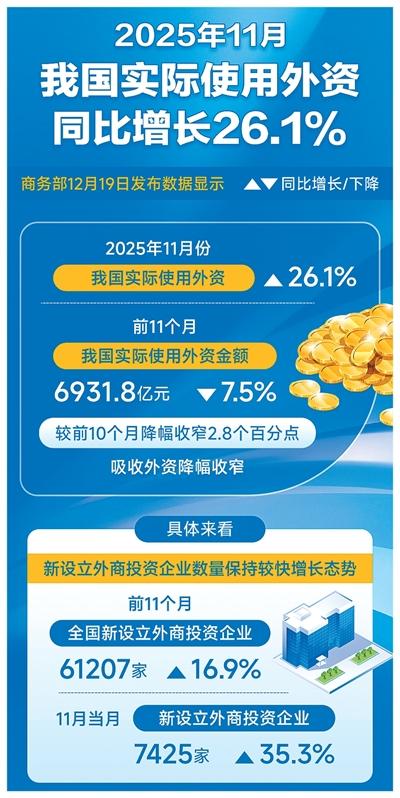
Core Viewpoint - The Chinese government has released the "Encouraged Foreign Investment Industry Catalog (2025 Edition)" to promote foreign investment in specific sectors and regions, effective from February 1, 2025, which aims to optimize the structure of foreign investment and enhance high-quality development [1][4]. Summary by Relevant Sections Encouraged Sectors and Regions - The 2025 edition continues the structure of the 2022 version, comprising a national catalog applicable nationwide and a regional catalog for the central and western regions, Northeast China, and Hainan Province [4]. - The total entries in the encouraged catalog have increased to 1,679, with a net addition of 205 entries and 303 modifications compared to the 2022 version [4]. Policy Incentives - Foreign investment in encouraged sectors will continue to enjoy benefits such as tax exemptions on imported self-use equipment, priority land supply for intensive land-use projects, and a reduced corporate income tax rate of 15% for investments in the western regions and Hainan [5]. - New policies allow foreign enterprises more flexibility in land use, including long-term leasing and flexible terms for land transfer, reducing initial land costs [5][6]. Focus on Advanced Manufacturing and Modern Services - The national catalog emphasizes advanced manufacturing and modern services, with new entries for research and production in areas like zero-magnetic medical equipment and smart detection devices [10]. - The catalog aims to attract foreign investment in technology innovation, supporting sectors such as equipment manufacturing and key components [10]. Regional Investment Focus - The catalog encourages foreign investment in the central and western regions, with Hainan Province seeing significant growth in foreign investment, reaching 102.5 billion yuan with an annual growth rate of 14.6% [12][14]. - New entries in the regional catalog include sectors like marine environmental governance and clean energy, aligning with Hainan's development goals [14][15]. Expansion of Investment Opportunities - The regional catalog has added new sectors for investment in various provinces, such as cruise tourism in Liaoning and snow equipment manufacturing in Heilongjiang, reflecting regional strengths [15]. - The government aims to enhance foreign investment inflow by implementing policies effectively and organizing international investment cooperation activities [15][16].
中国(海南)改革发展研究院院长迟福林:海南对标高标准经贸规则,以制度型开放应对逆全球化
2 1 Shi Ji Jing Ji Bao Dao· 2026-01-01 02:39
Core Viewpoint - The launch of the Hainan Free Trade Port's closure operation marks a significant transformation in China's economic landscape, emphasizing institutional openness and attracting global high-end resources [1][3]. Group 1: Economic Impact - During the first week of closure operation, Hainan Customs supervised over 400 million yuan worth of "zero tariff" imports and over 20 million yuan of tax-exempt goods for domestic processing [1]. - Hainan saw a 230% year-on-year increase in newly registered foreign trade enterprises, totaling 1,972 [1]. Group 2: Institutional Openness - Institutional openness focuses on internationalization and legalization of rules, regulations, management, and standards, moving beyond traditional policy incentives [1][6]. - The core of institutional openness is to establish a stable, transparent, and predictable system to attract global high-end factors [7]. Group 3: Regional Cooperation - Hainan aims to implement "unilateral openness" towards ASEAN, offering lower tariffs or zero tariffs on goods and higher levels of service trade openness [4][5]. - This proactive approach is designed to reshape regional cooperation and enhance the resilience of the China-ASEAN Free Trade Area [5]. Group 4: Global Trade Rules - Hainan's practices will serve as a pressure test for China to engage in global trade rule reconstruction, particularly in aligning with high-standard agreements like CPTPP [8]. - The region will explore various pilot projects in state-owned enterprise reform, intellectual property protection, environmental standards, and digital economy regulations [7][8]. Group 5: Future Development Potential - The combination of "zero tariffs and low tax rates" with Hainan's geographical and ecological advantages is expected to drive growth in green low-carbon industries, digital economy, and high-end tourism [9]. - Specific sectors poised for development include international medical tourism, tropical agriculture, and digital content industries [9][10]. Group 6: Financial and Data Flow Innovations - Post-closure, Hainan is expected to further reduce the negative list for foreign investment and allow foreign control in sectors like healthcare and education [10]. - The region will pilot cross-border data flow systems and explore innovations in financial openness, including digital currency applications [10]. Group 7: Collaborative Mechanisms - Hainan and the Guangdong-Hong Kong-Macao Greater Bay Area should focus on differentiated positioning, with Hainan emphasizing institutional openness and regional cooperation [10][11]. - The collaboration aims to create a resource allocation center in the Asia-Pacific region, leveraging Hainan's open platform and the Greater Bay Area's industrial advantages [11].

2025年海南省最美科技工作者发布仪式举行
Hai Nan Ri Bao· 2025-12-30 23:49
Core Viewpoint - The event held in Haikou recognized ten outstanding technology workers in Hainan Province, highlighting their contributions across various fields and promoting a culture of respect for knowledge and innovation [2][3]. Group 1: Recognition of Technology Workers - The ceremony awarded the title of "Most Beautiful Technology Workers in Hainan Province 2025" to ten individuals, including experts in tropical agriculture, aerospace technology, nuclear power engineering, and food science [2]. - The recognized workers also include industry pioneers focused on digital transformation and representatives dedicated to basic education, healthcare, and agricultural technology promotion [2]. Group 2: Event Purpose and Activities - The event featured video clips, artistic performances, and guest interactions to showcase the achievements and inspiring stories of the honored technology workers [3]. - The aim of the event was to foster a strong social atmosphere that values knowledge, innovation, and dedication to science, encouraging other technology workers to follow the examples set by the awardees [3].
专访迟福林:海南对标高标准经贸规则 以制度型开放应对逆全球化
2 1 Shi Ji Jing Ji Bao Dao· 2025-12-29 16:24
Core Insights - The Hainan Free Trade Port officially commenced its closure operation on December 18, 2023, marking a significant transformation in China's economic landscape and showcasing the country's commitment to high-level openness [1][2] Group 1: Economic Impact - In the first week of operation, Hainan Customs supervised over 400 million yuan worth of "zero tariff" imports and over 20 million yuan of domestic processing goods exempt from tariffs [1] - Hainan saw the addition of 1,972 foreign trade registered enterprises, a year-on-year increase of 230% [1] Group 2: Institutional Reform - The concept of institutional openness focuses on internationalization and legalization of rules, regulations, management, and standards, moving beyond traditional policy incentives [4][5] - The core of institutional openness is to establish a stable, transparent, and predictable system to attract global high-end resources [5] Group 3: Global Trade Dynamics - Hainan's closure operation serves as a "pressure test" for China's high-level openness and aims to counteract rising global protectionism and unilateralism [2] - The initiative is designed to align with international high-standard trade rules, enhancing China's participation in global competition and cooperation [2] Group 4: Regional Cooperation - Hainan is positioned to implement "unilateral openness" towards ASEAN, offering lower tariffs or zero tariffs on goods and higher levels of service trade openness [3] - The region aims to enhance economic resilience and upgrade the China-ASEAN Free Trade Area through proactive regional cooperation [3] Group 5: Future Development Potential - The "zero tariff, low tax rate" policies combined with Hainan's geographical and ecological advantages are expected to drive growth in green low-carbon industries, digital economy, and high-end tourism [8][9] - Hainan is anticipated to attract foreign investment by reducing the negative list and allowing foreign control in sectors like healthcare and education [9] Group 6: Legal and Regulatory Framework - The Hainan Free Trade Port Law grants significant legislative power to ensure policy stability and predictability post-closure, focusing on the development of local regulations in trade, investment, finance, and ecology [6][7] - Key tasks include establishing an international commercial court and a diversified dispute resolution mechanism to enhance legal frameworks [6]