
债券

Search documents
2025年债券市场发展报告
Lian He Zi Xin· 2026-02-13 11:47
1. Report's Industry Investment Rating No information provided in the content. 2. Core Viewpoints of the Report - In 2025, the central bank implemented a moderately loose monetary policy, keeping liquidity abundant. The yields of interest - rate bonds showed an overall fluctuating upward trend, while the issuance rates of credit bonds decreased. The total issuance of interest - rate and credit bonds increased steadily year - on - year. Credit risks were converging. Looking forward to 2026, bond market yields are expected to remain volatile at low levels, credit spreads may show structural differentiation, the bond market issuance scale is expected to grow steadily, and bond market credit risks will continue to converge with the default rate possibly at a historical low [2]. 3. Summary by Relevant Catalogs 3.1 Bond Market Overall Situation - In 2025, China's bond market issued a total of 88.52 trillion yuan of various bonds, a year - on - year increase of 12.35%. Excluding inter - bank certificates of deposit, the total issuance of various bonds was 54.70 trillion yuan, a year - on - year increase of 15.40%. By the end of 2025, the stock of various bonds in China reached 196.17 trillion yuan, a growth of 11.45% compared with the end of 2024 [4]. 3.1.1 Interest - rate Bonds - **Yield Trend**: The yield of China's treasury bonds showed an overall fluctuating upward trend in 2025. The 10 - year treasury bond yield fluctuated in five different stages throughout the year, affected by factors such as economic data, policy expectations, and market sentiment [5]. - **Issuance Scale**: The bond market issued 32.39 trillion yuan of interest - rate bonds in 2025, a year - on - year increase of 20.63%. The issuance scale of each type of bond increased. By the end of 2025, the stock of interest - rate bond varieties in China's bond market was 123.51 trillion yuan, a growth of 14.75% compared with the previous year - end [8][9]. 3.1.2 Credit Bonds - **Issuance Interest Rate**: In 2025, the issuance rates of major credit bonds showed a downward trend. Taking the credit bonds issued by AAA - rated entities as an example, the average issuance rates of major bond types with various maturities decreased [10]. - **Issuance Volume**: The issuance scale of credit bonds reached 22.06 trillion yuan in 2025, a year - on - year increase of 8.14%. By the end of 2025, the stock of credit bonds was 51.35 trillion yuan, a year - on - year increase of 8.61%. Different sub - categories of credit bonds had different issuance trends [13]. - **Non - financial Enterprise Bonds**: In 2025, non - financial enterprises issued 15,790 issues of bonds with a total issuance scale of 13.94 trillion yuan. The issuance period and scale increased by 2.87% and 1.70% year - on - year respectively. By the end of 2025, the stock of non - financial enterprise bonds was 31.29 trillion yuan, a growth of 10.00% compared with the previous year - end [14]. - **Non - policy Financial Bonds**: Financial institutions issued 1,488 issues of non - policy financial bonds in 2025, with a total issuance scale of 5.66 trillion yuan. The issuance period and scale increased by 34.54% and 24.74% year - on - year respectively. By the end of 2025, the stock of non - policy financial bonds was 15.66 trillion yuan, a growth of 11.35% compared with the previous year - end [18]. - **Asset - backed Securities**: In 2025, the issuance period, number, and scale of asset - backed securities all increased by about 15%. By the end of 2025, the stock of asset - backed securities was 3.61 trillion yuan, an increase of 9.16% compared with the previous year - end [22]. - **Other Credit Bonds**: In 2025, the issuance period and scale of other credit bonds increased year - on - year. By the end of 2025, the stock of other credit bonds was 1.07 trillion yuan, a decrease of 14.81% compared with the previous year - end [24]. 3.2 Bond Market Operation Characteristics - **Issuance of Urban Investment Bonds and Industrial Bonds**: In 2025, the issuance of urban investment bonds decreased, while the issuance of industrial bonds increased. The net financing of urban investment bonds decreased, and that of industrial bonds increased [27]. - **Rating and Credit - grade Distribution**: The proportion of bonds without debt ratings continued to increase, and the proportion of bonds issued by AAA - rated entities continued to rise. The credit grades of non - financial enterprise credit bond issuers were mainly distributed between AAA and AA [29][34]. - **Enterprise Nature of Issuers**: In 2025, state - owned enterprises were still the main issuers of non - financial enterprise bonds. The proportion of bonds issued by central state - owned enterprises and private enterprises increased, while that of local state - owned enterprises decreased [36]. - **Regional and Industry Differentiation**: The regions and industries involved in non - financial enterprise bond issuers remained differentiated. In terms of regions, the issuance scale of non - financial enterprise bonds in some regions increased, while in some others it decreased. In terms of industries, the issuance scale of some industries increased, while in some others it decreased [41]. - **Innovative Bond Issuance**: In 2025, the issuance of innovative bonds maintained a good momentum. The issuance period and scale of science and technology innovation bonds increased by about 80%, and the issuance of other innovative bonds also increased significantly [43]. - **Credit Risk Convergence**: In 2025, the number of new default issuers, the number of defaulted bonds, and the default amount in China's bond market all decreased year - on - year. The number of new extended - maturity issuers decreased, but the number of extended - maturity bonds and the extended - maturity scale increased. Overall, the bond market credit risk showed a converging trend [47]. 3.3 Bond Market Outlook - **Yield and Credit Spread**: Interest - rate bond yields are expected to remain volatile at low levels, with limited upside and downside space. Credit bond yields are expected to follow interest - rate bonds and maintain a low - level volatile trend. Credit spreads are expected to remain low, but market disturbances may increase [48][49]. - **Issuance Scale**: In 2026, the issuance scale of interest - rate bonds is expected to increase due to a more active fiscal policy. The issuance scale of financial institution bonds in the credit bond market is expected to grow steadily, while the issuance of urban investment bonds may shrink slightly, and the issuance of industrial bonds is expected to grow continuously [50]. - **Credit Risk**: In 2026, the bond market credit risk is expected to continue to converge, and the default rate may be at a historical low. Different types of bonds, such as urban investment bonds, real estate enterprise bonds, financial bonds, and convertible bonds, have different credit risk characteristics and need to be monitored [51][52].
固收|2025年波动率回顾-多资产大变局下的锚重构
2026-02-13 02:17
Summary of Key Points from the Conference Call Industry Overview - The report discusses the structural changes in the financial markets, particularly focusing on the bond market and asset pricing logic in 2025, highlighting a significant shift in risk-adjusted returns across various asset classes [2][3][4]. Core Insights and Arguments - **Risk-Adjusted Returns Reversal**: In 2025, the performance of various asset classes led to a reversal in risk-adjusted returns, with cash-like assets such as short-term deposits showing a high downside risk ratio of 16.9%, becoming a safe haven. Conversely, low-volatility dividend strategies turned negative due to crowding effects and a globally high-volatility environment [2][4]. - **Decoupling of Funds and Securities**: The bond market experienced a fundamental change where the correlation between funds and securities dropped from a historical high of 0.772 to 0.047, indicating almost no relationship. This decoupling resulted in short-term bonds being constrained within their own region while long-term bonds were influenced by fiscal supply shocks and risk preferences [2][6]. - **Credit Bond Market Dynamics**: The credit bond market broke the traditional notion that high ratings equate to low risk. For instance, AAA-rated bonds and high-quality regions like Zhejiang and Jiangsu exhibited higher volatility compared to lower-rated varieties. This led to a significant divergence in Sharpe ratios within the credit bond market [2][7]. - **Investment Strategies for 2026**: The proposed strategies for 2026 include using 1-3 year credit bonds and short-term deposits as a foundation, while also investing in hard technology assets like tech ETFs. Long-term local government special bonds are suggested for hedging, creating a new core for fixed income and equity markets [4][8][9]. Other Important Insights - **Volatility in Hard Technology Assets**: Hard technology equity assets experienced over 25% annualized volatility but provided high-risk compensation, indicating a shift towards extreme defensive and offensive strategies in the market [3]. - **Sector-Specific High Sharpe Characteristics**: In the industrial bond sector, high Sharpe characteristics were primarily found in real estate and overcapacity sectors, which managed downside risks effectively despite previous negative perceptions [2][7]. - **Emerging Trends in Asset Classes**: The year 2025 marked the beginning of a layered volatility environment, moving away from simple directional bets to a more complex interplay between cash management assets and hard technology investments [3][4]. This summary encapsulates the critical insights and trends discussed in the conference call, providing a comprehensive overview of the evolving landscape in the financial markets.
大类资产早报-20260213
Yong An Qi Huo· 2026-02-13 01:59
Group 1: Global Asset Market Performance - The latest yields of 10 - year government bonds in major economies are as follows: US 4.100, UK 4.452, France 3.363, Germany 2.777, Italy 3.383, Spain 3.150, Switzerland 0.268, Greece 3.375, Japan 2.232, Brazil 6.127, China 1.776, Australia 4.807, New Zealand 4.518 [3] - The latest yields of 2 - year government bonds in major economies are: US 3.457, UK 3.595, Germany 2.055, Japan 1.303, Italy 2.191, China (1Y yield) 1.304, Australia 4.281 [3] - The latest exchange rates of the US dollar against major emerging - economy currencies are: Brazil 5.213, South Africa zar 15.961, Korean won 1439.100, Thai baht 30.932, Malaysian ringgit 3.903. The latest values of on - shore RMB, off - shore RMB, RMB central parity rate, and RMB 12 - month NDF are 6.902, 6.898, 6.946, and 6.778 respectively [3] - The latest values of major economies' stock indices are: S&P 500 6832.760, Dow Jones Industrial Index 49451.980, NASDAQ 22597.150, Mexican stock index 70888.040, UK stock index 10402.440, France CAC 8340.560, Germany DAX 24852.690, Spanish stock index 17896.900, Russian stock index (not provided), Nikkei 57639.840, Hang Seng Index 27032.540, Shanghai Composite Index 4134.018, Taiwan stock index (not provided), South Korean stock index 5522.270, Indian stock index 8265.352, Thai stock index 1441.530, Malaysian stock index 1750.850, Australian stock index 9281.789, emerging - economy stock index 1570.440 [3] - The latest values of credit - bond indices are: Eurozone investment - grade credit - bond index 268.564, Eurozone high - yield credit - bond index 413.620 [3] Group 2: Stock Index Futures Trading Data - For A - shares, the closing price is 4134.02 with a 0.05% increase; for CSI 300, the closing price is 4719.58 with a 0.12% increase; for SSE 50, the closing price is 3079.73 with a 0.28% decrease; for ChiNext, the closing price is 3328.06 with a 1.32% increase; for CSI 500, the closing price is 8423.57 with a 1.17% increase [4] - The PE (TTM) values of CSI 300, SSE 50, CSI 500, S&P 500, and Germany DAX are 14.20, 11.70, 38.08, 27.29, and 19.28 respectively, with环比 changes of - 0.03, - 0.06, 0.38, - 0.43, and 0.00 [4] - The risk premiums (1/PE - 10 - year interest rate) of S&P 500 and Germany DAX are - 0.44 and 2.41 respectively, with环比 changes of 0.13 and 0.01 [4] - The latest capital flows of A - shares, main board, small - and medium - sized enterprise board, ChiNext, and CSI 300 are 106.78, - 237.55, (not provided), 239.92, and - 109.58 respectively, and the 5 - day average values are 7.38, - 101.94, (not provided), 80.09, and - 1.88 respectively [4] Group 3: Transaction Amount and Other Data - The latest transaction amounts of the Shanghai and Shenzhen stock markets, CSI 300, SSE 50, small - and medium - sized enterprise board, and ChiNext are 21417.38, 4904.74, 1304.13, 4190.81, and 6134.82 respectively, with环比 changes of 1574.86, 570.45, 163.27, 148.57, and 531.84 [5] - The basis values of IF, IH, and IC are - 2.78, 3.27, and 25.23 respectively, with spreads of - 0.06%, 0.11%, and 0.30% [5] - The closing prices of T2303, TF2303, T2306, and TF2306 in Treasury bond futures are 108.59, 106.07, 108.60, and 106.15 respectively, with increases of 0.04%, 0.01%, 0.06%, and 0.03% [5] - The funding rates of R001, R007, and SHIBOR - 3M are 1.4329%, 1.6029%, and 1.5800% respectively, with daily changes of - 17.00 BP, 0.00 BP, and 0.00 BP [5]
德债收益率跌约1个基点
Jin Rong Jie· 2026-02-12 17:26
周四欧市尾盘,德国10年期国债收益率跌1.4个基点,报2.779%,日内交投于2.805%-2.775%区间。两年 期德债收益率跌0.6个基点,报2.060%,日内交投于2.077%-2.054%区间,北京时间00:00前后显著下 挫;30年期德债收益率跌0.7个基点,报3.449%。2/10年期德债收益率利差跌0.735个基点,报+71.658个 基点。 ...
瞒不住了!美债美股遭双杀,美重大数据造假,人民币突破6.8
Sou Hu Cai Jing· 2026-02-12 16:50
这一幕闹剧的背后,是刚刚出炉的一月份就业数据和物价指数。数据乍看之下光鲜亮丽,非农就业远超 预期,仿佛美国经济一片繁荣。然而,只要稍加深究,便会发现其中的猫腻。原来,这繁荣的景象,很 大程度上是建立在对前期数据的"优化"之上。就好比期末考试前,偷偷把期中成绩从八十分改成四十 分,然后期末考了六十分,便大肆宣扬自己进步了五成。这种"先抑后扬"的障眼法,早已不是新鲜事。 美国统计部门隔三差五便会进行一次"数据大修正",悄悄戳破之前的牛皮,再吹一个新的。 然而,这一次,市场似乎不再买账了。诡异的是,通常情况下,就业数据强劲意味着经济向好,股市理 应上涨。但现实却是,数据公布后,美股应声下跌,纳斯达克更是画出了一道惊险的"跳水运动员"曲 线。同时,美债也未能幸免,遭遇抛售。这背后,是华尔街交易员的冷静判断:好的经济数据意味着通 胀压力犹存,美联储短期内降息的可能性微乎其微,而当前美股的估值,很大程度上是建立在降息的预 期之上。全球资本更是用实际行动表达了对"美国经济很好"这一叙事的质疑,纷纷抛售美债。 在全球资本的暗流涌动中,一场信任的迁移正在悄然发生。过去几十年,美元凭借其坚实的经济基础和 强大的国家信用,在全球金 ...


品类掘金系列之一:浮息债:债熊之盾,穿越周期
GF SECURITIES· 2026-02-12 13:10
[Table_Page] 固定收益|专题报告 2026 年 2 月 12 日 证券研究报告 [Table_Title] 浮息债:债熊之盾,穿越周期 ——品类掘金系列之一 [Table_Summary] 报告摘要: [分析师: Table_Author]杜渐 SAC 执证号:S0260526020003 010-59136690 dujian@gf.com.cn 分析师: 吴棋滢 SAC 执证号:S0260519080003 SFC CE No. BQN213 021-38003588 wuqiying@gf.com.cn 请注意,杜渐并非香港证券及期货事务监察委员会的注册 持牌人,不可在香港从事受监管活动。 识别风险,发现价值 请务必阅读末页的免责声明 1 / 23 [Table_Contacts] 972918116公共联系人2026-02-12 20:25:03 ⚫ 为何近期浮息债受到市场关注? ⚫ 在风浪中寻求稳定器:"低利率+高波动"环境下,降低发行成本与防 御性配置需求显著提升。一是利率高波动催生防御性配置需求,当前 债市分歧加大,投资者担忧中长期的利率上行风险,浮息债票息重置机 制使其能够有效对冲 ...
2025年债券市场政策回顾:服务实体提质效,深化改革促开放
Lian He Zi Xin· 2026-02-12 11:16
1. Report Industry Investment Rating No information provided in the content. 2. Core View of the Report In 2025, affected by the changing external environment, China's economy advanced steadily, social confidence continued to improve, and new achievements were made in high - quality development. However, the contradiction between strong supply and weak demand was prominent, and there were many risks and hidden dangers in key areas. Against this background, regulatory authorities took multiple measures to continuously improve the bond market system and mechanism, innovatively launched the "Technology Board" in the bond market, promoted the expansion of bonds in green and private sectors, solidly carried out the "Five Major Articles" in finance, continuously promoted the opening - up of the bond market, strengthened credit risk management and control in the bond market, and improved the default disposal mechanism, further enhancing the marketization, legalization, and internationalization levels of China's bond market [2]. 3. Summary by Directory 3.1完善债券市场体制机制 - **规范债券发行业务**: In 2025, the Dealer Association issued a series of notices to regulate bond underwriting behavior, including prohibiting underwriters from distorting market prices and competing with below - cost quotes, and establishing self - disciplinary mechanisms. The exchange launched the pilot of corporate bond continuation issuance, which helps meet the investment and financing needs of market entities and enhance market liquidity. The Dealer Association optimized the bond financing mechanism for mature - layer enterprises, adjusting relevant indicators and requirements to improve enterprise financing convenience and efficiency [4]. - **完善信息披露制度**: In 2025, the Shanghai, Shenzhen, and Beijing Stock Exchanges revised relevant rules and issued guidelines to expand the scope of specific situations to be concerned, strengthen information disclosure and verification requirements for issuers' solvency, and clarify the requirements for information disclosure and verification of honest practice, as well as the management requirements, responsibilities, and self - regulatory arrangements for information disclosure responsible persons, which helps standardize corporate bond information disclosure behavior [5]. - **发展债券指数化产品**: In 2025, the China Securities Regulatory Commission issued an action plan to promote the high - quality development of capital market index investment, including expanding bond ETFs, optimizing registration and issuance arrangements, and improving operation mechanisms. The Shanghai and Shenzhen Stock Exchanges allowed bond ETFs to conduct general pledge - style repurchase transactions, which helps enrich the bond index product system and meet investors' diverse investment needs [7]. - **规范债券估值业务发展**: In 2025, the Dealer Association issued a self - regulatory guidance on bond valuation business, including requirements for the entire valuation production process, measures to improve transparency, a multi - level verification mechanism, and clear prohibitive behaviors, which helps standardize bond valuation management and improve valuation quality and transparency [8]. 3.2创新推出债市"科技板" In 2025, multiple departments issued a series of policies to support the high - quality development of science and technology innovation corporate bonds, including optimizing the issuance and registration process, providing credit enhancement support, exploring new bond products, and establishing a "Technology Board" in the bond market, which helps guide bond funds to be more efficiently, conveniently, and cost - effectively invested in the field of scientific and technological innovation and improve the service level of the bond market for scientific and technological innovation [9][10]. 3.3支持绿色等领域债券扩容 - **做好"绿色金融大文章"**: Multiple departments issued policies to support green bond investment and financing, including optimizing green bond standards, encouraging rating agencies to incorporate environmental information indicators, and supporting green enterprises' bond issuance. The Dealer Association optimized the issuance mechanism of green panda bonds, which helps promote the issuance and investment of green bonds and expand the green bond market [11][12]. - **支持民营企业债券融资**: The Dealer Association and relevant laws provided a series of measures to support private enterprise bond financing, including product innovation, improving the financing environment, and enhancing the service of bond financing support tools, which helps protect the legitimate rights and interests of private enterprises and expand their bond financing scale [13]. - **支持乡村振兴领域债券发行**: The People's Bank of China issued policies to encourage financial institutions to issue special financial bonds for "agriculture, rural areas, and farmers" and support enterprises to issue rural revitalization bonds, which helps guide financial resources to the "agriculture, rural areas, and farmers" field and expand the rural revitalization bond market [14]. - **支持体育领域债券发行**: The People's Bank of China and the State Council issued policies to support the issuance of financial bonds and corporate credit - type bonds in the sports field, which helps promote the development of the sports industry and expand the relevant bond market [15]. - **支持消费领域债券融资**: Multiple departments issued policies to support the issuance of bonds by enterprises in the service consumption field, encourage science and technology innovation enterprises to raise funds through the bond market, and support the issuance of financial bonds by relevant financial institutions, which helps promote the issuance of consumer - related bonds and expand the bond market [15]. - **支持林业领域债券发行**: The People's Bank of China issued a notice to encourage forest - related enterprises to issue bonds and support financial institutions to issue relevant financial bonds, which helps broaden the financing channels for forestry development and expand the relevant bond market [16]. - **支持制造业企业融资**: The People's Bank of China issued a policy to promote the growth of the number of manufacturing enterprises issuing bonds and their scale by 2027, support bond variety innovation, and apply green financial tools in the manufacturing industry's green and low - carbon transformation, which helps broaden the financing channels for manufacturing enterprises and expand the manufacturing - related bond market [16]. - **优化并购票据工作机制**: The Dealer Association issued a notice to optimize the working mechanism of merger and acquisition notes, including clarifying the definition and scope of application, strengthening fund use supervision, and innovating the information disclosure mechanism, which helps improve the issuance efficiency of merger and acquisition notes and expand their scale [17]. 3.4推进债券市场对外开放 - **优化债券通机制安排**: In 2025, the People's Bank of China and the Hong Kong Monetary Authority announced three optimization measures for opening up, including expanding the scope of participants in the South - bound Connect, optimizing the offshore RMB bond repurchase business, and optimizing the Swap Connect operation mechanism, which helps promote the opening - up of China's bond market [18]. - **支持境外投资者参与债券回购业务**: The People's Bank of China and relevant exchanges issued policies to expand the scope of overseas institutional investors participating in bond repurchase business, which helps improve the liquidity value and collateral function of RMB bonds and enhance their attractiveness to global institutions [19]. - **推进上海自贸区离岸债券发展**: The Shanghai Head Office of the People's Bank of China issued measures to optimize the issuance process, expand the issuer types, and encourage product innovation of Shanghai Free Trade Zone offshore bonds, which helps expand the offshore bond market and provide financing channels for Chinese enterprises and countries and regions along the "Belt and Road" [20]. 3.5推动评级行业高质量发展 - **支持评级行业创新发展**: The General Offices of the Communist Party of China Central Committee and the State Council issued an opinion to support the innovation and development of the credit rating industry, including innovating business models, regulating the behavior of credit service institutions, and promoting the internationalization of domestic credit rating agencies [21]. - **支持评级机构服务债市"科技板"**: The People's Bank of China and the China Securities Regulatory Commission, as well as the Dealer Association, issued policies to encourage rating agencies to design special rating methods and models for science and technology innovation enterprises, which helps provide more accurate rating results for the "Technology Board" in the bond market and reduce information asymmetry [22]. 3.6加强债券市场风险管控 - **优化信用风险缓释工具管理机制**: The Dealer Association revised relevant rules and issued notices to optimize the management mechanism of credit risk mitigation tools, including simplifying the filing process, expanding the scope of underlying assets, and strengthening the rights and responsibilities of participants, which helps improve the operation mechanism of credit risk mitigation tools and the credit risk sharing system [23]. - **加强存续期管理**: The Dealer Association and the Shanghai Stock Exchange issued policies to strengthen the supervision of raised funds, standardize the handling of ongoing business, and strengthen the rules for entrusted management, which helps prevent the risk of misappropriation of raised funds, improve the efficiency of information disclosure and risk management, and promote the due performance of entrusted managers [25]. - **完善违约处置机制**: Exchanges and relevant departments issued policies to standardize debt - restructuring bond swaps, optimize bond buy - back business mechanisms, and improve the diversified dispute resolution mechanism, which helps standardize bond default disposal, enrich debt management tools, and improve the efficiency of default bond disposal [26][27].
债市节前暖意回归:收益率下破1.8%后企稳,大行成买入主力
2 1 Shi Ji Jing Ji Bao Dao· 2026-02-12 10:05
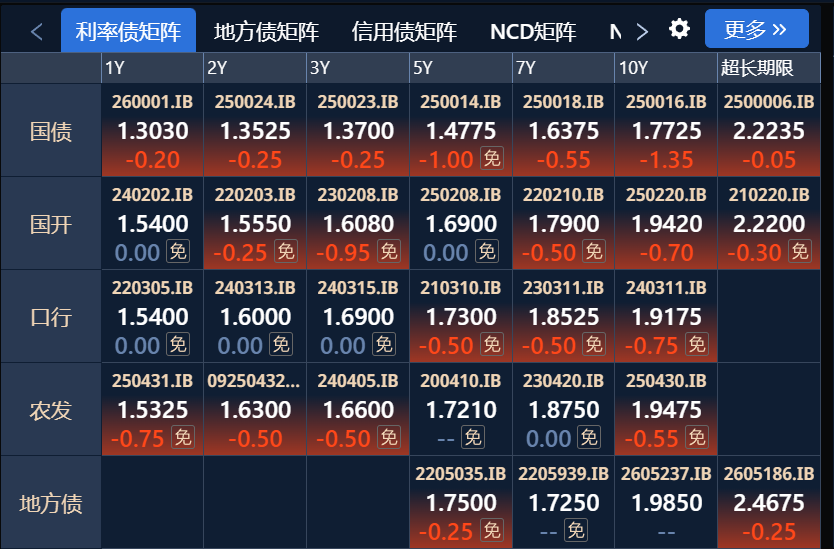
Group 1 - The bond market is experiencing a bullish trend supported by ample liquidity and institutional demand, with yields dropping below the critical 1.8% level as investors prefer bonds over other assets ahead of the holiday [1][3] - Major banks have become the primary buyers in the bond market, driven by a "deposit-loan mismatch" phenomenon, which has led to increased bond allocations since December [2][6] - The central bank's recent actions, including a net injection of 448 billion yuan into the market, have contributed to a favorable environment for bonds, with interbank liquidity remaining abundant [3][6] Group 2 - As of February 12, 2026, the yield on the 10-year government bond has decreased to around 1.77%, reflecting a broader trend of declining yields across various maturities [3][4] - A significant majority of bond funds have delivered positive returns since the beginning of 2026, with 3523 out of 3574 medium to long-term pure bond funds achieving positive returns [4][5] - The current market sentiment is optimistic, with expectations for a relatively mild bond market environment in 2026, as banks are likely to continue favoring long-term bonds due to improved cost structures and ample liquidity [7][8]
韩国央行官员:近期韩国国债收益率涨幅“有些过度”
Sou Hu Cai Jing· 2026-02-12 03:45
韩国央行金融市场局局长Choi Yong-hoon表示,近期债券收益率大幅攀升,在政策利率维持在2.5%的情 况下,3年期韩国国债收益率已升破3.2%。根据政策利率持稳期间市场利率的历史平均水平来看,目前 的收益率理应处于2%以上的较高区间。他认为,尽管近期收益率上涨反映了包括市场预期和股市表现 强劲在内的多种因素,但由于当前的经济和通胀情况并未显著偏离通胀目标或潜在增长率,目前的收益 率水平显得"有些过度"。 ...
产业永续债分析框架和机会挖掘
GUOTAI HAITONG SECURITIES· 2026-02-12 02:23
债券研究 /[Table_Date] 2026.02.12 本报告导读: 博弈偏股条款,挖掘偏高利差。 投资要点: 请务必阅读正文之后的免责条款部分 产业永续债分析框架和机会挖掘 [Table_Authors] 王宇辰(分析师) 010-83939801 wangyuchen4@gtht.com 登记编号 S0880523020004 [Table_Report] 相关报告 如何择时股债对冲效率 2026.02.05 "做陡曲线"还是"宏观对冲",基金参与国债期 货的两面 2026.02.01 如何理解 ONRRP 类工具与双向隔夜回购 2026.01.30 承接"存款搬家",理财投了什么,收益如何 2026.01.30 债券 ETF 规模跃升之后:业绩归因、策略优化与 未来挑战 2026.01.29 债 券 研 究 专 题 研 究 证 券 研 究 报 告 [Table_Summary] 产业永续债的发行主要以降低企业杠杆率为目标,过去有两轮发行 与净融资的高峰。(1)2018 年-2020 年,《关于加强国有企业资产负 债约束的指导意见》的落地,推动国有企业平均资产负债率到 2020 年年末比 2017 年 ...