外卖服务

Search documents
饿了么往事丨晚点口述史
晚点LatePost· 2025-12-11 03:55
Core Viewpoint - The renaming of Ele.me to "Taobao Flash Purchase" signifies the end of an era for a pure food delivery platform, marking a shift towards integration with Alibaba's broader e-commerce ecosystem [3][5][17]. Company History - Ele.me was founded in 2008 in a dormitory at Shanghai Jiao Tong University, initially targeting campus food delivery before evolving into a major player in the food delivery industry [6][7]. - The company faced significant competition from Meituan, which launched its food delivery service in 2013, leading to a fierce battle for market share [6][10]. - Ele.me's early growth was driven by innovative marketing strategies, including partnerships with local restaurants and a focus on user-friendly technology [7][8]. Competitive Landscape - The competitive environment intensified in 2015 when Meituan and Dianping merged, further challenging Ele.me's market position [10][11]. - Ele.me's strategy involved aggressive spending on subsidies to attract users and restaurants, leading to a cash flow crisis where the company often operated with less than six months of cash reserves [13][17]. - The company underwent a significant transformation after being acquired by Alibaba in 2018 for $9.5 billion, integrating into Alibaba's ecosystem and shifting focus towards logistics and market share recovery [17][19]. Operational Changes Post-Acquisition - After the acquisition, Ele.me aimed to leverage Alibaba's resources to enhance its delivery capabilities and compete more effectively against Meituan [19][20]. - The integration process involved restructuring and aligning Ele.me's operations with Alibaba's corporate culture and operational standards [20][21]. - Ele.me's leadership emphasized the importance of innovation and efficiency in operations, aiming to regain market share and improve profitability [22][23]. Future Outlook - Ele.me's future strategy includes focusing on local services and enhancing delivery efficiency, with aspirations to capture a significant market share in the competitive landscape [19][22]. - The company is also exploring partnerships and collaborations to expand its service offerings and improve customer experience [24][25].




全国骑手社保补贴已到账
Hang Zhou Ri Bao· 2025-12-11 02:40
Core Viewpoint - Meituan has launched a nationwide pension insurance subsidy program for its delivery riders, marking a significant advancement in social security for gig economy workers in China [8][10]. Group 1: Pension Insurance Subsidy Program - The pension insurance subsidy program allows riders to choose to enroll in their hometown or work location, with Meituan covering 50% of the pension insurance costs for eligible riders [8][9]. - The program aims to benefit both full-time and part-time riders, with a focus on those whose monthly income meets the local contribution base minimum [8][9]. - As of November 1, the pension insurance coverage has been extended to all provinces and cities in China, following a pilot program that began in April [7][10]. Group 2: Impact on Riders - Riders like Cui Longlong have reported significant financial benefits, with annual savings of approximately 6,000 yuan, allowing for more flexible work schedules [6][7]. - The subsidy has been positively received, with riders expressing relief and satisfaction regarding their social security coverage, which was previously a concern [7][9]. - The program has been described as a game-changer for riders, enabling them to view their work as a long-term career rather than a temporary job [8][9]. Group 3: Broader Implications for Gig Economy - The initiative reflects a broader trend in improving labor rights and social security for gig workers, moving from pilot programs to widespread implementation [11]. - Experts suggest that this development could serve as a model for other cities and industries, addressing the historical issue of "flexible employment equals no insurance" [11]. - Meituan's comprehensive approach includes various forms of support beyond pension insurance, such as occupational injury insurance and educational support for riders' children [10].

三大外卖巨头,郑重声明→
Sou Hu Cai Jing· 2025-12-06 09:54
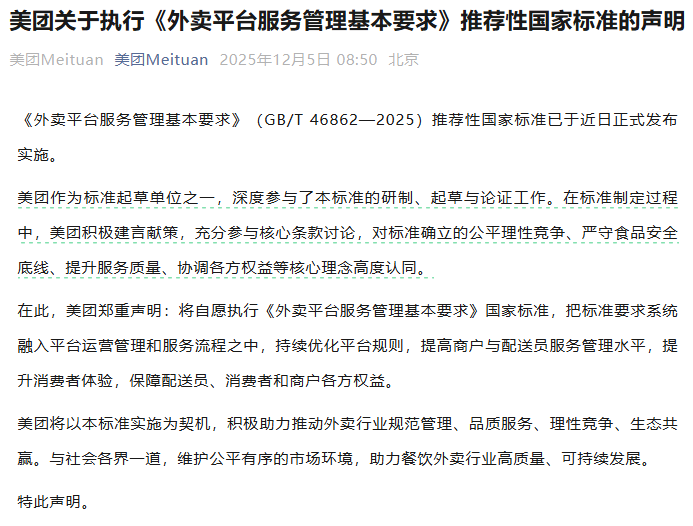
将自愿执行《外卖平台服务管理基本要求》国家标准,把标准要求系统融入平台运营管理和服务流程之中,持 续优化平台规则,提高商户与配送员服务管理水平,提升消费者体验,保障配送员、消费者和商户各方权益。 近日,美团、京东外卖、淘宝闪购分别发布关于执行《外卖平台服务管理基本要求》推荐性国家标准的声明: 本文综合自:智通财经 来源:上观新闻 ...

外卖平台“新国标”发布,专家:具备较强的实操性,但也面临劳动者权益保障与平台成本冲突等挑战
Xin Lang Cai Jing· 2025-12-05 20:24
Core Viewpoint - The newly approved national standard for food delivery platforms aims to address key issues in service management, including merchant management, pricing behavior, delivery personnel rights protection, and consumer rights protection [1][3]. Group 1: Standard Implementation - The standard has been accepted by major platforms such as Taobao Shanguo, Meituan, and JD Delivery, indicating its practical applicability [1]. - The standard emphasizes that platforms cannot force merchants to participate in promotions or transfer promotional costs to merchants or delivery personnel [1][4]. - It includes provisions to optimize platform scheduling algorithms to alleviate delivery pressure, ensuring that delivery personnel are not forced to work overtime [1]. Group 2: Impact on Market Dynamics - The introduction of the standard is expected to improve the governance of the food delivery market, addressing issues related to merchant qualification, fair trading rights, and delivery personnel rights [3]. - Experts believe that the current market structure, characterized by a "three-way split," is healthy and unlikely to change significantly due to the new standard [4]. - The standard's implementation may require additional resources from both platforms and regulatory bodies to ensure compliance and address challenges such as labor rights and pricing regulation [4].

美团、京东外卖、淘宝闪购集体声明:自愿执行国标
2 1 Shi Ji Jing Ji Bao Dao· 2025-12-05 04:43
Core Points - Major food delivery platforms including Taobao Flash Sale, Meituan, and JD Delivery have announced their commitment to voluntarily implement the "Basic Requirements for Food Delivery Platform Service Management" national standard [2] - These platforms aim to integrate the standard requirements into their operational management and service processes, focusing on continuous optimization of platform rules [2] - The initiative is designed to enhance service management levels for merchants and delivery personnel, improve consumer experience, and safeguard the rights and interests of delivery personnel, consumers, and merchants [2]
美团、京东外卖、淘宝闪购发声!自愿执行外卖平台“新国标”
Sou Hu Cai Jing· 2025-12-05 03:32
Core Viewpoint - The newly implemented national standard "Basic Requirements for Delivery Platform Services" aims to enhance service quality, ensure fair competition, and protect the rights of consumers, delivery personnel, and merchants in the food delivery industry [1][3][5]. Group 1: Implementation of National Standard - Major players in the food delivery sector, including Meituan, JD Delivery, and Taobao Flash Purchase, have announced their voluntary commitment to implement the national standard [1][3][5]. - The standard (GB/T 46862—2025) was developed with significant input from JD Delivery and Taobao Flash Purchase, who participated in its drafting and discussion [3][5]. Group 2: Objectives of the Standard - The standard emphasizes fair and rational competition, strict adherence to food safety, improvement of service quality, and coordination of interests among all parties involved [3][5]. - The implementation of this standard is seen as a catalyst for promoting regulated management, quality service, rational competition, and ecological win-win scenarios within the food delivery industry [3][5].
美团、京东外卖、淘宝闪购发布声明
Xin Lang Cai Jing· 2025-12-05 02:30
Core Viewpoint - Major food delivery platforms, including Meituan, JD.com, and Taobao, have announced their voluntary commitment to implement the newly released national standard for food delivery platform service management, aiming to enhance service quality and protect the rights of consumers, merchants, and delivery personnel [1][4]. Group 1: Implementation of National Standards - JD.com, as one of the drafters of the national standard GB/T 46862—2025, has actively participated in its development and supports its core principles, which include fair competition, food safety, service quality improvement, and coordination of stakeholder rights [4]. - The company will integrate the standard requirements into its operational management and service processes, continuously optimizing platform rules to enhance the management of merchants and delivery personnel [4]. Group 2: Industry Impact - The implementation of this standard is seen as a catalyst for promoting regulatory management, quality service, rational competition, and ecological win-win scenarios within the food delivery industry [4]. - The commitment from these platforms is expected to contribute to a fair and orderly market environment, supporting the high-quality and sustainable development of the food delivery sector [4].
饿了么更名
21世纪经济报道· 2025-12-05 01:16
Group 1 - The core viewpoint of the article is the rebranding of the "Ele.me" app to "Taobao Flash Purchase," indicating a strategic shift towards instant retail and deeper integration with Taobao's traffic [1][2]. - The rebranding is part of a broader strategy to transform Ele.me from an independent food delivery platform to a foundational facility for instant retail, aiming to achieve the goal of "30-minute delivery for everything" [2]. - Taobao Flash Purchase was upgraded from Taobao's "Hourly Delivery" in April 2023, with Ele.me providing supply, logistics, and technical support for this initiative [2]. Group 2 - The full rebranding of the Ele.me app is seen as a significant signal of Alibaba Group's continued investment in the consumer and service e-commerce sectors [2].

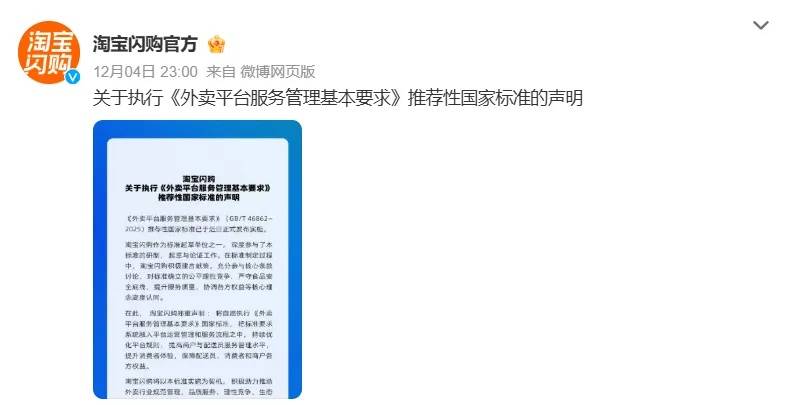
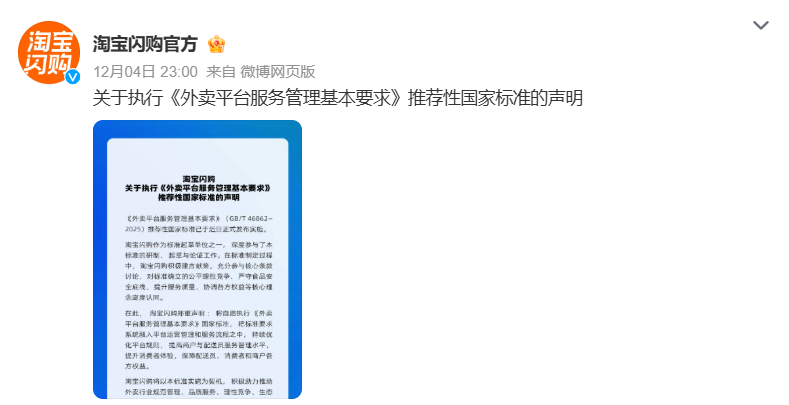
淘宝闪购:将自愿执行《外卖平台服务管理基本要求》国家标准
Zheng Quan Shi Bao Wang· 2025-12-04 15:35
Core Viewpoint - Taobao Flash Sale has announced its voluntary implementation of the national standard "Basic Requirements for Food Delivery Platform Services," aiming to integrate these standards into its operational management and service processes to enhance service quality and consumer experience [1] Group 1 - The company will continuously optimize platform rules to improve the management level of merchants and delivery personnel [1] - The initiative aims to safeguard the rights and interests of delivery personnel, consumers, and merchants [1]
平台促销成本自行承担 不得以流量倾斜等方式强制商家参与
Sou Hu Cai Jing· 2025-12-04 15:27
(央视财经《经济信息联播》)对于许多中小餐饮商户反映的平台促销活动"不参加就没流量,参加了 就亏本"等问题,这次发布的国家标准,明确平台收费规则及促销活动管理要求,督促引导外卖平台简 化收费项目、规范促销行为,营造公平有序的市场竞争环境。 标准明确,商户是否开展价格促销活动应由其自主决定,外卖平台不得以承诺流量倾斜、优先配送等明 示或暗示方式,强制或变相强制商户开展价格促销。外卖平台开展的价格促销活动,相应成本应由外卖 平台自身承担,不应要求商户进行分摊,或通过推广工具捆绑、临时上调服务收费等方式,变相转嫁给 商户。 中国信息通信研究院政策与经济研究所副所长 李强治:同时,为防止用户混淆,标准要求以显著方式 区分展示平台促销金额和商户促销金额。 为避免"唯价格论"加剧行业"低价内卷",标准倡导,平台自身发起的价格促销活动,要坚持合理限度原 则,不应扰乱正常市场价格秩序。 此外,标准明确,平台面向商户的收费项目,主要限定在技术服务费、配送服务费和推广服务费三大 类,并提出不应随意新设收费项目。 转载请注明央视财经 编辑:令文芳 中国信息通信研究院政策与经济研究所副所长 李强治:活动宣传上,明确不应使用"零元购" ...