
工业软件

Search documents
三大指数全线反弹!创业板50ETF(159949)成交11.22亿居同类首位,政策助力科技成长主线
Xin Lang Cai Jing· 2026-01-14 04:09
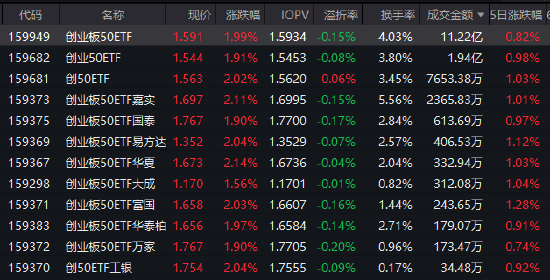
Market Performance - On January 14, the A-share market experienced a collective rebound, with the Shanghai Composite Index rising over 1%, the ChiNext Index increasing by over 2%, and the Sci-Tech 50 Index gaining over 4% [1][8] - The ChiNext 50 ETF (159949) rose by 1.99%, reaching a price of 1.591 yuan, with a turnover rate of 4.03% and a transaction volume of 1.122 billion yuan, leading among similar ETF products [1][8] Top Holdings Performance - As of the midday session, most of the top ten holdings of the ChiNext 50 ETF showed an upward trend, with notable performances including: - Dongfang Wealth up by 4.82% - Sunshine Power up by 4.16% - Tonghuashun up by 9.33% - Other stocks like Ningde Times and Zhongji Xuchuang saw slight declines of 0.22% and 1.04% respectively [2][10] Policy Developments - A meeting on January 13 highlighted the focus on enhancing the self-controllable capabilities of the supply chain in the energy-saving and new energy vehicle industry, aiming for high-quality development actions [4][12] - The Ministry of Industry and Information Technology released a plan for the high-quality development of industrial internet platforms from 2026 to 2028, targeting the establishment of over 450 influential platforms and connecting over 120 million industrial devices [4][12] Investment Insights - Multiple institutions are paying attention to the "AI + manufacturing" policies, which are expected to accelerate the development of the industrial AI sector, with recommendations to focus on AI applications, data labeling, and AI computing power [5][12] - The ChiNext 50 ETF has shown a return of 41.83% over the past three years, outperforming its benchmark and ranking 475th among 1630 products, making it an efficient investment tool for those optimistic about China's tech growth sector [7][13]


工业软件概念拉升,用友网络涨停,中控技术等大涨
Zheng Quan Shi Bao Wang· 2026-01-14 04:02
Core Viewpoint - The industrial software sector is experiencing a strong surge, driven by government initiatives aimed at enhancing the development of industrial internet platforms and the integration of artificial intelligence in manufacturing [1][2] Group 1: Government Initiatives - The Ministry of Industry and Information Technology released an action plan for the high-quality development of industrial internet platforms from 2026 to 2028, aiming for over 450 influential platforms and a connectivity of over 120 million industrial devices by 2028 [1] - The plan emphasizes a multi-layered platform system characterized by "professional, industry-specific, and collaborative" types, with a target platform penetration rate exceeding 55% [1] - A separate initiative on January 7 focuses on enhancing artificial intelligence capabilities in manufacturing, promoting the development of smart chips and high-level industry models [1] Group 2: Market Response - Following the announcement of these policies, stocks in the industrial software sector saw significant gains, with companies like Zhongkong Technology and Dingjie Smart rising over 10%, and Yonyou Network hitting the daily limit [1] - Guohai Securities predicts that the ongoing policy support will accelerate the deployment of industrial models and intelligent systems by leading domestic companies, potentially leading to rapid advancements in AI-driven industrial software innovation [2]



中望软件股价涨5.48%,国寿安保基金旗下1只基金重仓,持有47.23万股浮盈赚取204.49万元
Xin Lang Cai Jing· 2026-01-14 02:57
Group 1 - The core point of the news is that Zhongwang Software's stock price increased by 5.48% to 83.33 CNY per share, with a trading volume of 181 million CNY and a turnover rate of 1.31%, resulting in a total market capitalization of 14.137 billion CNY [1] - Zhongwang Software, established on August 24, 1998, is located in Tianhe District, Guangzhou, Guangdong Province, and specializes in the research, promotion, and sales of CAD/CAM/CAE industrial software [1] - The company's main business revenue composition includes: standard general software 95.45%, technical services 2.45%, customized software 1.32%, purchased software and hardware 0.66%, and others 0.12% [1] Group 2 - From the perspective of major fund holdings, Guoshou Anbao Fund has a fund that heavily invests in Zhongwang Software, specifically the Guoshou Anbao Strategy Selected Mixed (LOF) A (168002), which held 472,300 shares in the third quarter, accounting for 5.9% of the fund's net value, making it the sixth largest holding [2] - The Guoshou Anbao Strategy Selected Mixed (LOF) A (168002) was established on September 27, 2017, with a latest scale of 490 million CNY, and has experienced a loss of 3.16% this year, ranking 8014 out of 8145 in its category [2] - Over the past year, the fund has incurred a loss of 4.21%, ranking 7950 out of 8064, while since its inception, it has achieved a return of 61.99% [2]

科创创业人工智能ETF鹏华(588410)涨超2.5%,工业部推动工业互联网与人工智能融合赋能
Xin Lang Cai Jing· 2026-01-14 02:09
Group 1 - The Ministry of Industry and Information Technology (MIIT) issued the "Action Plan for Promoting High-Quality Development of Industrial Internet Platforms (2026-2028)", which aims to guide platform and manufacturing companies to co-build an open-source ecosystem and enhance compatibility with open-source operating systems like HarmonyOS [1] - Pacific Securities highlighted that industrial software is the foundation for industrial AI applications, predicting a compound annual growth rate (CAGR) of 41.4% for the AI + industrial software segment in China from 2024 to 2029, significantly outpacing the 19.3% CAGR of core industrial software during the same period [1] - By 2029, the penetration rate of AI + industrial software is expected to increase from 9% in 2024 to 22%, indicating a strong growth trajectory for the sector [1] Group 2 - As of January 14, 2026, the CSI Innovation and Entrepreneurship Artificial Intelligence Index (932456) rose by 2.5%, with notable increases in constituent stocks such as Dongfang Guoxin (up 9.50%), Hehe Information (up 9.28%), and Runze Technology (up 6.08%) [1] - The CSI Innovation and Entrepreneurship Artificial Intelligence ETF (588410) increased by 1.61%, with the latest price reported at 1.14 yuan [1] - The CSI Innovation and Entrepreneurship Artificial Intelligence Index comprises 50 listed companies involved in providing foundational resources, technology, and application support for artificial intelligence, reflecting the overall performance of AI-themed stocks [2]
生成式搜索兴起,AI应用催化密集
Mei Ri Jing Ji Xin Wen· 2026-01-14 00:26
Group 1 - The core viewpoint is that during the "14th Five-Year Plan" period, the Chinese economy will enter a transformation phase dominated by new quality productivity, with a downward shift in the growth center and intensified external geopolitical competition [1] - Industry investment will focus on four main lines: technology self-reliance driven by new quality productivity, green transformation during the carbon peak period, the silver economy driven by population aging, and strategic resource allocation under the coordination of development and security [1] - Non-ferrous metals are expected to maintain strong performance, with gold being a core safe-haven asset under the "de-dollarization" pricing logic, while copper and aluminum will benefit from energy transition and supply constraints [1] Group 2 - The asset allocation strategy suggested is a dual-peak strategy: defensive allocation in high-dividend assets (such as hydropower, telecom operators, and state-owned banks) to secure stable cash flow returns, and offensive allocation in hard technology growth assets (such as semiconductor equipment, industrial software, and humanoid robots) to capture excess returns from domestic substitution and industrial upgrading [1] Group 3 - The AI industry is experiencing continuous catalysis, with significant commercial development potential for AI applications, particularly in generative search (GEO) [2] - In addition to content generation, content interaction is becoming an important breakthrough point, enhancing user engagement significantly, especially in gaming and other content sectors [2] Group 4 - The chemical industry, characterized as a typical cyclical industry, usually follows a five-year cycle consisting of four stages: profit upturn, capacity expansion, profit bottoming, and capacity clearance/improvement in demand expectations [3] - With capital expenditure growth turning negative, anti-involution, overseas interest rate cuts, and domestic demand expansion, the chemical industry is viewed positively at the beginning of the "14th Five-Year Plan" as it enters a "dawn" phase [3] - The ongoing global technological revolution is accelerating, presenting new opportunities for material transformation [3]

最高补助1000万元,一地支持仪器仪表等企业
仪器信息网· 2026-01-13 09:07
Core Viewpoint - Shanghai has released a three-year action plan to support the transformation and upgrading of advanced manufacturing, aiming to add 100 enterprises with an annual output value exceeding 1 billion yuan by 2028, totaling over 600, and to drive the addition of 500 new large-scale industrial enterprises in the supply chain, while significantly increasing the proportion of R&D expenses in revenue [2][3][7]. Group 1: Main Goals - By 2028, the plan aims to add 100 manufacturing enterprises with an annual output value exceeding 1 billion yuan, totaling over 600, and to drive the addition of 500 new large-scale industrial enterprises in the supply chain [7]. Group 2: Implementation Actions - **Optimizing Traditional Advantage Industries**: The plan encourages petrochemical companies to reduce oil dependency and develop new functional materials, while supporting steel and non-ferrous metal companies to strengthen specialty steel and expand lightweight alloys [8]. - **Accelerating Leading Industry Strategies**: Support for integrated circuit companies to focus on equipment, advanced processes, and materials, aiming to cultivate internationally competitive leading enterprises [8]. - **Promoting Key and Emerging Industries**: The plan emphasizes the development of new-generation electronic information, smart connected vehicles, high-end equipment, and green low-carbon industries [9]. Group 3: Innovation and Technology - **Releasing Innovation Vitality**: The plan supports enterprises to increase basic research investment, providing financial subsidies based on the amount of R&D expenditure [9]. - **Accelerating Core Technology Breakthroughs**: Focus on supporting enterprises in laser manufacturing, quantum technology, and new functional materials to conduct foundational research [10]. Group 4: Quality and Efficiency Enhancement - **Promoting Technological Transformation**: Support for enterprises to upgrade production, R&D, and design processes, with financial support for fixed asset investment loans [10]. - **Deepening Digital Transformation**: The plan includes initiatives for AI integration in manufacturing, aiming for large enterprises to achieve full digital application coverage by 2027 [10]. Group 5: Resource and Support Actions - **Strengthening Talent Development**: The plan supports enterprises in attracting high-level talent, providing priority recommendations for national and local talent cultivation programs [11]. - **Enhancing Financial Support**: Focus on promoting low-interest, high-amount, and long-term loan products for manufacturing enterprises, with interest subsidies for key component and raw material loans [12]. - **Expanding Logistics Support**: The plan aims to build industrial logistics and warehousing facilities to integrate logistics with manufacturing [12].

关键核心技术必须牢牢掌握在自己手中
Xin Jing Bao· 2026-01-13 08:10
Core Viewpoint - The article emphasizes the importance of developing key core technologies for China's economic high-quality development and national security, advocating for a shift from simple imitation to independent innovation in critical areas such as integrated circuits, advanced materials, and biomanufacturing [1][2]. Group 1: Importance of Independent Innovation - The "15th Five-Year Plan" period is crucial for China to advance towards an innovative nation, highlighting the fatal flaws of simple imitation, which fails to grasp core technologies and leads to a passive cycle of dependence [2][3]. - Over-reliance on imitation can result in a loss of vitality in the innovation system, trapping industries in the low-end of the value chain and exposing them to risks from external technology blockades [2][3]. Group 2: Strengthening Basic Research - A primary task is to enhance the supply of basic research, as the root of the "bottleneck" issue lies in weak foundational theories, with China's basic research funding at 6.91% of total R&D expenditure, significantly lower than the 12%-23% ratio in developed countries [3]. - The "15th Five-Year Plan" should establish a stable growth mechanism for basic research investment, optimize evaluation systems, and encourage exploration in foundational disciplines and cutting-edge fields [3][4]. Group 3: Original Innovation and New Standards - To solve the "bottleneck" problem, it is essential to pursue original innovation and explore new methods, with China making strides in carbon-based and quantum chips, as well as in the electric vehicle sector, where it leads globally in production and market share [4][5]. - Original innovation is seen as a fundamental path to creating new technological paradigms and industrial ecosystems, supporting self-reliance in technology [4][5]. Group 4: System Integration and Collaborative Innovation - Enhancing system integration innovation capabilities is necessary due to the interdisciplinary nature of modern technology, requiring a new type of national system to facilitate cross-departmental and cross-disciplinary collaboration [5][6]. - Establishing innovation consortia centered around leading enterprises can promote efficient allocation of innovation resources and improve the resilience of industrial ecosystems [5][6]. Group 5: Reforming the Innovation Ecosystem - Deepening reforms in the technology system is crucial to foster an environment that stimulates original innovation, with a focus on creating a technology innovation system led by enterprises and integrating market demands [6][7]. - The "15th Five-Year Plan" aims to enhance the overall effectiveness of the innovation system by breaking down institutional barriers that hinder technological innovation [6][7]. Group 6: Cultivating an Innovative Culture - Cultivating a culture that encourages exploration and tolerates failure is vital, with an emphasis on enhancing public scientific literacy and integrating science and technology education into schools [7]. - The article advocates for an open and confident approach to global innovation networks, promoting international cooperation while fostering domestic talent [7].
持续看好战略金属投资机遇
Mei Ri Jing Ji Xin Wen· 2026-01-13 00:44
Group 1 - The core viewpoint of the reports indicates that the market may exhibit characteristics of a bottom lift and active main lines in the first quarter and beyond, with China's economy expected to enter a recovery phase by 2026 [1] - The macro environment is supported by policies focusing on "stabilizing growth" and "strengthening technology," which will favor technology-related sectors through sustained institutional support and fiscal resources [1] - The transition from old to new driving forces is showing initial effectiveness, with several high-tech listed companies moving from "policy-driven" to "performance verification," providing necessary conditions for medium to long-term capital participation [1] Group 2 - The asset allocation strategy suggested by the company is a dual-peak strategy, focusing on defensive high-dividend assets for stable cash flow and offensive hard technology growth assets to capture excess returns from domestic substitution and industrial upgrades [2] - The report emphasizes that during the "14th Five-Year Plan" period, China's economy will enter a transformation phase led by new productive forces, with investment focusing on technology self-reliance, green transition, silver economy due to aging population, and strategic resource layout [2] Group 3 - The company maintains a positive outlook on strategic metal investment opportunities characterized by resource scarcity and supply rigidity, which can create a "bullish option" due to their inherent supply vulnerabilities [3] - Strategic metals are essential for developing new productive forces and are expected to see increased demand due to significant changes in demand structure driven by global technological revolutions [3] - The report highlights that global resource supply security is under threat, prompting countries to increase strategic reserves, particularly for metals used in the military industry [3]

中信建投:资产配置建议采用双峰型策略
Zheng Quan Shi Bao Wang· 2026-01-12 23:57
Core Viewpoint - During the "14th Five-Year Plan" period, China's economy is expected to enter a transformation phase dominated by new quality productivity, with a downward shift in growth center and intensified external geopolitical competition [1] Group 1: Investment Focus Areas - Industry investment will concentrate on four main lines: technology self-reliance driven by new quality productivity, green transformation during the carbon peak battle, the silver economy driven by an aging population, and strategic resource allocation under the coordination of development and security [1] - Non-ferrous metals are expected to maintain strong performance, with gold being a core safe-haven asset under the "de-dollarization" pricing logic, while copper and aluminum will benefit from energy transition and supply constraints [1] Group 2: Asset Allocation Strategy - The asset allocation strategy suggests a dual-peak approach: defensive allocation in high-dividend assets (such as hydropower, telecommunications operators, and state-owned banks) to secure stable cash flow returns [1] - Offensive allocation should focus on hard technology growth assets (including semiconductor equipment, industrial software, and humanoid robots) to capture excess returns from domestic substitution and industrial upgrading [1]
东欣公司发布新一代船舶产品数据全生命周期管理平台
Zhong Guo Jing Ji Wang· 2026-01-12 13:50
Core Viewpoint - The SPDM3.0 platform, developed by Shanghai Dongxin Software Engineering Co., Ltd., a subsidiary of China Shipbuilding Group, represents a significant advancement in the lifecycle management of shipbuilding data, aiming to enhance efficiency and precision in design processes [1] Group 1: Platform Features - SPDM3.0 covers the core business chain of ship design, establishing an integrated data management system [1] - The platform enables full lifecycle management of design documents and data, from drafting to archiving, through intelligent control [1] - It facilitates design task breakdown, cost accounting, and process standardization, promoting lean management in design [1] Group 2: Future Development - Dongxin Company aims to strengthen its technological foundation to enhance research and development efficiency through iterative technology [1] - The company plans to ensure the value of system implementation through professional services [1] - The goal is to transition China's shipbuilding software industry from a "follower" to a "leader" in the field [1]