
彩电

Search documents
兆驰股份跌2.10%,成交额5.96亿元,主力资金净流出2041.97万元
Xin Lang Cai Jing· 2025-09-16 02:41
Company Overview - Zhaochi Co., Ltd. is located in Longgang District, Shenzhen, Guangdong Province, and was established on April 4, 2005. The company was listed on June 10, 2010. Its main business involves the research, development, manufacturing, sales, and service of home audio-visual and electronic products [1] - The revenue composition of Zhaochi Co., Ltd. includes multimedia audio-visual products and operation services at 66.90% and the LED industry chain at 33.10% [1] Financial Performance - As of June 30, 2025, Zhaochi Co., Ltd. reported a revenue of 8.483 billion yuan, a year-on-year decrease of 10.89%. The net profit attributable to shareholders was 661 million yuan, down 27.37% year-on-year [2] - The company has cumulatively distributed 1.944 billion yuan in dividends since its A-share listing, with 1.308 billion yuan distributed in the last three years [3] Stock Performance - On September 16, Zhaochi Co., Ltd. experienced a 2.10% decline in stock price, trading at 6.54 yuan per share, with a total market capitalization of 29.606 billion yuan [1] - Year-to-date, the stock price has increased by 15.28%, with a 5-day increase of 18.69%, a 20-day increase of 34.02%, and a 60-day increase of 52.09% [1] Shareholder Information - As of June 30, 2025, the number of shareholders reached 100,600, an increase of 0.45% from the previous period. The average number of circulating shares per person decreased by 0.45% to 44,993 shares [2] - Among the top ten circulating shareholders, Hong Kong Central Clearing Limited holds 33.918 million shares, a decrease of 41.0538 million shares compared to the previous period [3]

海信视像跌2.03%,成交额1.74亿元,主力资金净流出791.41万元
Xin Lang Zheng Quan· 2025-09-15 05:43
Core Viewpoint - Hisense Visual's stock has experienced fluctuations, with a recent decline of 2.03% and a year-to-date increase of 11.18%, indicating volatility in market performance [1] Financial Performance - For the first half of 2025, Hisense Visual reported revenue of 27.23 billion yuan, a year-on-year increase of 6.95%, and a net profit attributable to shareholders of 1.06 billion yuan, up 26.59% [2] - Cumulative cash dividends since the company's A-share listing amount to 6.97 billion yuan, with 3.04 billion yuan distributed over the past three years [3] Shareholder Information - As of June 30, 2025, the number of shareholders increased by 6.22% to 32,800, while the average circulating shares per person decreased by 5.86% to 39,482 shares [2] - The top ten circulating shareholders include Hong Kong Central Clearing Limited, which holds 56.70 million shares, a decrease of 2.42 million shares from the previous period [3]

昔日“彩电大王”主业仍失血 亏超10亿元
Nan Fang Du Shi Bao· 2025-09-03 23:11
Core Insights - Konka Group's consumer electronics business continues to face challenges, with a slight revenue decline in the first half of 2025 despite a significant reduction in net losses [2][3] - The company reported a revenue of 5.248 billion yuan, a year-on-year decrease of 3.05%, while net loss attributable to shareholders was 383 million yuan, a 64.75% improvement from the previous year's loss of 1.088 billion yuan [2] - The improvement in net loss was primarily due to non-recurring gains totaling 644 million yuan, indicating that the core business remains under pressure [2][3] Consumer Electronics Business - The consumer electronics segment generated revenue of 4.713 billion yuan, a slight decrease of 0.87% year-on-year, with TV revenue growing by 6.09% but with a low gross margin of only 0.39% [3] - The white goods segment saw a revenue decline of 6.76%, and the overall gross margin for the consumer electronics business was just 3.23%, highlighting ongoing challenges in profitability [3] Financial Challenges - The company faces high financial costs and tight cash flow, with financial expenses reaching 311 million yuan in the first half of the year [4] - The net cash flow from operating activities was -676 million yuan, worsening by 53.78% compared to the previous year, indicating significant financial pressure [4] Semiconductor Business - Konka's semiconductor business reported revenue of 97 million yuan, a year-on-year increase of 17.38%, but remains in the early stages of industrialization without achieving scale or profitability [5][6] - There are expectations that the resources from China Resources Group could synergize with Konka's existing semiconductor operations to accelerate growth [7] PCB Business - The PCB (Printed Circuit Board) segment emerged as a bright spot, achieving revenue of 263 million yuan, a year-on-year growth of 13.63%, marking it as one of the few segments with stable growth [7] Strategic Outlook - The entry of China Resources Group as a new controlling shareholder brings potential for strategic restructuring and resource integration, but the new management faces the challenge of revitalizing the core business and nurturing new growth areas [5][7]


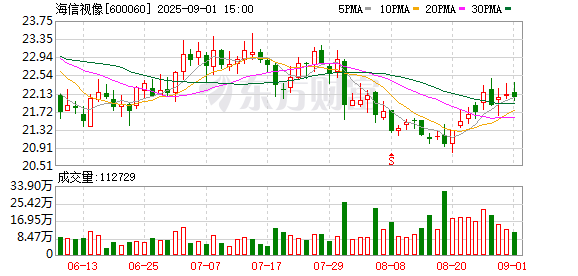
海信视像跌2.04%,成交额8641.02万元,主力资金净流出675.62万元
Xin Lang Cai Jing· 2025-09-03 03:43
Core Viewpoint - Hisense Visual's stock price has shown fluctuations, with a recent decline despite a year-to-date increase, indicating potential volatility in the market [1][2]. Financial Performance - For the first half of 2025, Hisense Visual achieved a revenue of 27.23 billion yuan, representing a year-on-year growth of 6.95%, while the net profit attributable to shareholders was 1.06 billion yuan, up 26.59% year-on-year [2]. - The company has distributed a total of 6.97 billion yuan in dividends since its A-share listing, with 3.04 billion yuan distributed over the past three years [3]. Stock Market Activity - As of September 3, Hisense Visual's stock price was 21.62 yuan per share, with a market capitalization of 28.21 billion yuan. The stock experienced a 2.04% decline during the trading session [1]. - The stock has increased by 13.43% year-to-date, but has seen a slight decline of 1.14% over the last five trading days [2]. Shareholder Information - As of June 30, 2025, the number of shareholders increased to 32,800, with an average of 39,482 circulating shares per shareholder, a decrease of 5.86% from the previous period [2]. - Major shareholders include Hong Kong Central Clearing Limited, which holds 56.70 million shares, and new entrants like Southern CSI 500 ETF, holding 11.60 million shares [3].
海信视像:第十届董事会第十六次会议决议公告
Zheng Quan Ri Bao· 2025-09-01 13:36
Core Viewpoint - Hisense Visual announced the approval of the second lock-up period and the unlocking conditions of the 2021 restricted stock incentive plan during the 16th meeting of the 10th board of directors [2] Group 1 - The board meeting discussed the matters related to the restricted stock incentive plan [2] - The announcement was made on the evening of September 1 [2]
社保基金增持传递信心 20多家主流券商机构看好海信视像增长前景
Zheng Quan Ri Bao· 2025-09-01 12:42
Core Viewpoint - Hisense Visual Technology Co., Ltd. reported a revenue of 27.231 billion yuan for the first half of 2025, marking a year-on-year increase of 6.95%, and a net profit attributable to shareholders of 1.056 billion yuan, up 26.63% year-on-year [2] Financial Performance - The company achieved a revenue of 27.231 billion yuan, reflecting a 6.95% increase compared to the previous year [2] - The net profit attributable to shareholders reached 1.056 billion yuan, representing a 26.63% year-on-year growth [2] - The gross profit margin improved by 1.4 percentage points to 16.8% in the second quarter [4] Shareholder Activity - The top ten circulating shareholders of the company changed, with the Southern CSI 500 ETF entering the top ten, and the National Social Security Fund 103 combination increasing its holdings by 11.89% compared to the previous quarter [2] - The National Social Security Fund 103 combination has been continuously increasing its holdings since the first quarter of 2024, now holding 29.09 million shares [2] Market Position and Growth - Hisense's global TV shipment market share increased from 5.9% in 2017 to 14.0% in the first half of 2025, making it the fastest-growing brand among the top 10 in the global TV market [3] - In the domestic market, Hisense holds a retail market share of 30.0% in revenue and 25.7% in volume, maintaining the leading position [4] Business Development - The company is focusing on high-end product development, with significant advancements in smart display terminals, laser display, commercial display, and AI+AR new businesses [3] - New display businesses generated a revenue of 3.43 billion yuan, showing a year-on-year growth of 7.4% [4] - The company is expanding its global presence through sponsorship of major events like the FIFA Club World Cup and increasing brand marketing efforts [3][4] Analyst Ratings - Over 20 mainstream brokerage firms have issued reports with a "bullish" rating for Hisense, highlighting the company's long-term investment value due to its product structure upgrades and global capacity layout [4][5] - Analysts from Guotai Haitong Securities and Huatai Securities noted the company's strong performance in high-end product segments and the potential for growth in new display technologies [3][5]
海信视像获社保基金增持 20多家主流券商机构给予“看好”评级
Sou Hu Cai Jing· 2025-09-01 09:10
Core Viewpoint - Hisense Visual's 2025 semi-annual report shows a revenue of 27.231 billion yuan, a year-on-year increase of 6.95%, and a net profit of 1.056 billion yuan, up 26.63% year-on-year, indicating strong financial performance and growth potential [1] Financial Performance - The company achieved a revenue of 27.231 billion yuan in the first half of 2025, reflecting a 6.95% increase compared to the previous year [1] - The net profit attributable to shareholders reached 1.056 billion yuan, marking a 26.63% year-on-year growth [1] - The top ten circulating shareholders saw changes, with the Southern CSI 500 ETF entering the list and the social security fund increasing its holdings by 11.89% from the previous quarter [1] Market Position and Growth - Hisense's global TV shipment market share increased from 5.9% in 2017 to 14.0% in the first half of 2025, making it the fastest-growing brand among the top 10 global TV brands [6] - In the domestic market, Hisense holds a retail market share of 30.0% in revenue and 25.7% in volume, maintaining the leading position [6] - The company is expanding its global presence, with significant increases in Mini LED shipments in North America and Europe [6] Product Development and Innovation - Hisense has made significant advancements in RGB-Mini LED technology, overcoming key challenges in chip and algorithm development, enhancing its competitive edge over Japanese and Korean brands [4] - The company is diversifying its new display business, with strong growth in laser display applications and commercial displays, which saw a 43% year-on-year increase in overseas revenue [6][7] - The integration of AI technologies into products like smart headphones and lightweight AI glasses is part of the company's strategy to break through traditional TV market limitations [6][7] Analyst Ratings and Market Sentiment - Over 20 mainstream brokerage firms have issued positive ratings for Hisense, highlighting its long-term investment value driven by product upgrades and global expansion [7] - Analysts from Guotai Junan Securities and Huatai Securities maintain a "buy" rating, citing the company's product structure improvements and growth potential in emerging markets [7]

海信视像(600060)2025年中报点评:内销结构升级 经营符合预期
Xin Lang Cai Jing· 2025-08-31 02:32
Core Viewpoint - Hisense Visual reported a steady revenue growth in H1 2025, with a significant increase in net profit, indicating a positive trend in both domestic and international markets [1][2][3]. Group 1: Financial Performance - In H1 2025, the company achieved a revenue of 27.23 billion, a year-on-year increase of 7.0%, and a net profit attributable to shareholders of 1.06 billion, up 26.6% year-on-year [1]. - For Q2 2025, revenue reached 13.86 billion, reflecting an 8.6% year-on-year growth, while net profit attributable to shareholders was 500 million, marking a 36.7% increase [1]. - The gross profit margin improved by 1.41 percentage points in Q2 2025, attributed to the upgrade in domestic sales structure and cost reduction in exports [2]. Group 2: Sales and Market Dynamics - Domestic sales showed a steady upgrade, with Q2 2025 TV sales volume increasing by 3% year-on-year, while the average selling price is expected to see double-digit growth [2]. - The company’s new display business revenue grew by 7.43% to 3.434 billion in H1 2025, with Qian Zhao Optoelectronics reporting a 37.08% increase in revenue to 1.743 billion [2]. - International sales faced short-term fluctuations due to inventory issues in the North American market, impacting export growth rates [2]. Group 3: Future Outlook - The company is expected to continue its revenue growth driven by high-end product promotions such as MiniLED and large screens, with a positive outlook for the U.S. business and emerging markets [3]. - The projected net profits for 2025 and 2026 are 2.56 billion and 3.07 billion respectively, with corresponding price-to-earnings ratios of 11.3 and 9.4 times [3].
政策红利下行业分化凸显 关注科技家电赛道投资机遇
Zhong Guo Zheng Quan Bao· 2025-08-28 22:29
Core Viewpoint - The home appliance industry is experiencing significant differentiation, driven by the expansion of the trade-in policy, which not only stimulates existing consumption but also promotes a shift towards smart and green technologies [1][2]. Group 1: Industry Performance - The overall revenue of the home appliance industry has improved significantly compared to last year, with notable differences across various segments [2]. - The white goods sector shows strong resilience, benefiting from national subsidies and improved cost structures, leading to revenue and profit growth that outpaces 2024 projections [2]. - The kitchen appliance sector faces challenges, with revenue declines expected in the first half of 2025 due to a sluggish real estate market, although leading companies are gaining market share [2]. - The technology appliance sector continues to grow rapidly, with companies like Roborock and Ninebot leading the charge, particularly in the robot vacuum segment, which is expected to exceed 15 billion yuan in online sales in 2024, marking a nearly 50% year-on-year increase [2]. Group 2: Policy Impact - As of July 2025, over 66 million consumers have participated in the trade-in policy, directly driving consumption by over 270 billion yuan, with retail sales of home appliances increasing by 30.7% year-on-year [3]. - The policy has not only activated the existing market but also pushed the industry towards smart and green upgrades, with significant sales growth in high-end products like energy-efficient air conditioners and built-in refrigerators [3]. Group 3: Transformation Strategies - The home appliance industry is in a transformation phase, requiring breakthroughs through technology, supply chain optimization, and strategic balance to achieve sustainable development [4]. - AI technology is rapidly being integrated into the home appliance sector, enhancing product design and functionality, particularly in cleaning appliances like robot vacuums [4][5]. - Companies are encouraged to build digital supply chain systems to improve efficiency and reduce delivery times, while also creating differentiated solutions to enhance brand loyalty [5]. Group 4: Investment Opportunities - The growth momentum of the home appliance industry is shifting from traditional categories to technology-driven segments, with emerging categories like robot vacuums and lawn mowers expected to see explosive growth [6]. - The smart cleaning appliance sector is highlighted as a core growth area, with significant market potential and a shift from policy-driven to technology-driven growth [6][7]. - Investors are advised to focus on leading companies in the smart cleaning appliance sector that can leverage both domestic penetration and international expansion for dual investment returns [7].
海信视像涨2.03%,成交额3.25亿元,主力资金净流入2732.85万元
Xin Lang Zheng Quan· 2025-08-26 06:38
Core Viewpoint - Hisense Visual's stock has shown a positive trend with a year-to-date increase of 16.21%, despite some fluctuations in the short term [1][2]. Financial Performance - For the first half of 2025, Hisense Visual achieved a revenue of 27.231 billion yuan, representing a year-on-year growth of 6.95%. The net profit attributable to shareholders was 1.056 billion yuan, marking a significant increase of 26.59% [2]. - Cumulatively, since its A-share listing, Hisense Visual has distributed a total of 6.970 billion yuan in dividends, with 3.039 billion yuan distributed over the past three years [3]. Stock Market Activity - As of August 26, Hisense Visual's stock price was 22.15 yuan per share, with a trading volume of 3.25 billion yuan and a turnover rate of 1.14%. The total market capitalization stood at 28.905 billion yuan [1]. - The stock has seen a net inflow of 27.328 million yuan from main funds, with significant buying activity from large orders [1]. Shareholder Information - As of June 30, 2025, the number of shareholders for Hisense Visual was 32,800, an increase of 6.22% from the previous period. The average number of circulating shares per person decreased by 5.86% to 39,482 shares [2]. - Among the top ten circulating shareholders, Hong Kong Central Clearing Limited held 56.7045 million shares, while new entrants included Southern CSI 500 ETF with 11.5978 million shares [3].