
特色农业

Search documents
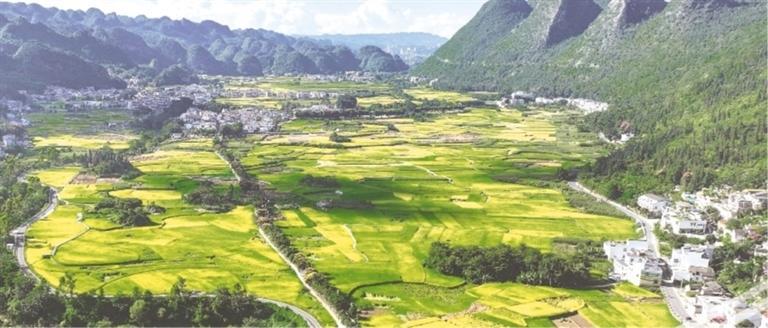
峰林潮涌展风采 金州大地焕新颜
Xin Lang Cai Jing· 2025-12-21 22:46
Core Viewpoint - The article highlights the significant economic and infrastructural development in Qianxinan, showcasing the region's progress in various sectors and its commitment to high-quality development during the 14th Five-Year Plan period [11][12]. Economic Growth - The regional GDP increased from 132.2 billion yuan at the end of the 13th Five-Year Plan to an estimated 147.67 billion yuan in 2024, with projections to exceed 150 billion yuan by the end of the 14th Five-Year Plan [12]. - Infrastructure investment has grown at an average annual rate of 12.3%, with industrial contributions to economic growth reaching 41.5% [12]. Industrial Development - Qianxinan has focused on four main industries: energy, basic materials and processing, new energy batteries and materials, and specialty light industry, aiming to build a competitive modern industrial system [13]. - The region has seen traditional industries expand, with electrolytic aluminum production capacity reaching 575,300 tons and aluminum processing output exceeding 21 billion yuan [14]. Agricultural and Tourism Advancements - The agricultural sector has introduced 19 nationally recognized specialty products, with significant contributions from brands like "Puan Red Tea" and "Xingren Job's Tears" [14]. - The creation of a national 5A scenic area at Wanfenglin and the integration of various tourism sectors have enhanced the region's tourism brand recognition [15]. Social and Environmental Initiatives - Qianxinan has invested over 1.22 billion yuan in infrastructure and industry development in poverty alleviation areas, ensuring stability in grain planting areas and maintaining a forest coverage rate of 63.19% [16]. - The region has achieved a 97.9% coverage rate for community elderly care services and ranks at the top tier in education levels within the province [16]. Future Outlook - As the 14th Five-Year Plan concludes, Qianxinan aims to continue its high-quality development trajectory, focusing on leveraging its advantages and pursuing modernization in line with national strategies [17].

市政协成立乡村治理委员工作室
Xin Lang Cai Jing· 2025-12-21 19:39
Core Insights - The establishment of the rural governance committee office in Guxiang Village, Changping District, aims to provide intellectual support for rural governance, focusing on the theme of "Urban-Rural Co-construction and Building a Circle of Good Governance" [1][3] - This office is the 52nd committee office set up by the Beijing Municipal Political Consultative Conference, which will leverage the committee's extensive connections and professional advantages to modernize the rural governance system and capabilities in the capital [1][3] Group 1 - The office will collect public opinions and specific demands from rural communities, addressing both individual needs and common issues in rural governance through proposals and research reports [1][3] - It aims to explore effective ways for the committee to participate in rural governance, establishing a high-quality expert think tank and facilitating regular connections between committee members and rural areas [1][2] - Activities such as "Enterprise-Linked Villages" and "Village-Society Co-construction" will be organized to promote mutual development, enhance livelihoods, and foster talent [1][2] Group 2 - Wang Bigang, a member of the committee, suggested that rural governance should consider the unique characteristics of the capital, emphasizing the need for coordinated urban-rural development and optimizing village layouts [2][3] - Guxiang Village has developed unique industries, such as traditional tofu-making and honey production, which have led to significant economic benefits, but also face challenges like increased environmental pressure due to rising tourist numbers [2] - The committee office will play a crucial role in coordinating resources and providing professional guidance to help Guxiang Village address its development challenges [2][3]
北京平谷冰雪季开幕 多举措激活“冷资源”
Xin Lang Cai Jing· 2025-12-21 13:35
Group 1 - The 17th Ice and Snow Season in Pinggu District, Beijing, officially commenced on December 20, featuring the opening of the country's first professional-level pet ice and snow theme park, allowing pets and their owners to enjoy winter sports together [1][3] - The ice and snow season aims to activate the "cold resources" of the ice and snow economy through six major initiatives, breaking away from traditional operational models to create a comprehensive entertainment system across the district [3][5] - The event promotes a diverse range of activities under the "ice and snow+" integration model, including "ice and snow + agriculture," "sports + research," and "ice and snow + commerce," enhancing winter commercial consumption and providing an immersive experience for young audiences [5]

走进这里,仿佛拥有整个世界
Ren Min Ri Bao Hai Wai Ban· 2025-12-18 13:06
Core Viewpoint - The completion of the Galongla Tunnel marks a significant milestone in connecting the remote region of Motuo in Tibet, enhancing accessibility and promoting economic development in the area [4][8]. Group 1: Infrastructure Development - The Galongla Tunnel serves as a crucial passage from Bomi to Motuo, overcoming geographical challenges and harsh weather conditions [3][4]. - The construction of the Motuo highway is noted for its complexity, being characterized by the highest seismic intensity and the most diverse geological hazards in China [4][5]. - The successful completion of the highway is seen as a remarkable achievement in human transportation history and a representation of China's modernization [4]. Group 2: Economic Impact - Since the opening of the highway in 2013, Motuo's GDP has increased from less than 300 million yuan in 2012 to over 1 billion yuan in 2024, while per capita income for farmers and herders has risen from under 5,000 yuan to 25,000 yuan [8]. - The development of the tea industry in Motuo has reached a value exceeding 100 million yuan, significantly contributing to local income [10]. Group 3: Tourism Growth - Motuo is experiencing a surge in tourism, with visitor numbers projected to reach 600,000 in 2024, and a 145% increase in tourist volume during the 2025 Spring Festival compared to the previous year [12]. - The region is becoming a popular tourist destination, necessitating improvements in infrastructure and service levels to accommodate the growing influx of visitors [12][13].

扬州援疆多点开花 绘就边疆发展答卷
Xin Hua Ri Bao· 2025-12-17 21:56
Group 1 - The core viewpoint of the news highlights the successful implementation of the "down to Yangzhou" consumption assistance initiative, which has facilitated the sale of over 650 tons of specialty agricultural products valued at 7.5 million yuan, marking a significant phase in the aid efforts from Yangzhou to Xinjiang [1] - The consumption assistance has been a core focus of the aid work, with an annual scale of 30 million yuan aimed at resolving sales challenges for local agricultural products, thereby increasing farmers' income [1] - The project has established a complete industrial chain for the breeding of Sanhua geese, with the breeding scale increasing from 6,500 to 150,000 by 2025, contributing to a "goose economy" worth over 100 million yuan [1] Group 2 - The investment of 90 million yuan in water supply expansion has improved daily water supply capacity from 55,000 cubic meters to 105,000 cubic meters, benefiting over 200,000 residents [2] - A total of 1.38 million yuan has been invested in 55 small-scale projects, enhancing infrastructure and benefiting over 100,000 people [2] - The cultural integration project at the Xijun Princess Square has become a landmark, attracting 21.648 million tourists and generating 16.09 billion yuan in tourism revenue in 2025, significantly increasing local income [2] Group 3 - Since 2023, the 11th batch of Yangzhou aid work group has invested 365 million yuan in 21 completed projects, maintaining the highest investment completion and fund disbursement rates in the province for three consecutive years [3] - Future efforts will focus on deepening specialty agriculture and expanding sales channels to enhance the economic benefits of local ecological products [3]
金融+产业+物流 德庆贡柑的 “三位一体”振兴模式
2 1 Shi Ji Jing Ji Bao Dao· 2025-12-16 11:22
Core Insights - The success of the Deqing Gonggan industry is attributed to its high-quality product endowment and the "finance + industry + logistics" integrated revitalization model, which provides a replicable path for high-quality development in specialty agriculture [1] Group 1: Financial Services - Financial services play a core role as the "funding engine" in the integrated model, with Postal Savings Bank of China (601658) Deqing County branch offering targeted loan products that address the pain points of farmers regarding "difficult and slow financing" [1] - The bank has integrated online approval and credit loans into agricultural production scenarios, significantly improving the efficiency of capital turnover in the industry [1] Group 2: Industry Development - Deqing Gonggan, recognized as a "Yue brand" specialty agricultural product, has achieved scale planting and brand operation with the support of financial services, leading to a steady increase in yield [1] - Individual farms are expected to reach an annual output of 400,000 pounds and sales of 900,000 yuan this year, creating a virtuous cycle of "high quality - high yield - good benefits" [1] Group 3: Logistics Collaboration - Logistics collaboration has effectively addressed the "last mile" issue, with the bank leveraging its unique advantage of "bank + postal logistics" to deeply integrate financial and logistics services [1] - This integration allows farmers to receive financial support while enjoying convenient agricultural product delivery services, establishing a comprehensive ecosystem of "growing well, selling well, and receiving quickly" [1] Group 4: Impact and Reach - By the end of October 2025, the Postal Savings Bank Deqing County branch's model has served over 1,600 agricultural operating entities, with cumulative agricultural loans exceeding 300 million yuan [2] - The model has created a brand reputation of "sending agricultural products through postal services" and "seeking loans from Postal Savings," aligning precisely with the development needs of specialty agriculture [2]

顺义10个镇级国土空间规划获批
Bei Jing Wan Bao· 2025-12-16 08:44
Core Viewpoint - The approval of the land spatial planning and detailed control planning for the concentrated construction area in Mulin Town marks a significant step in defining the future development direction for the ten towns outside Shunyi New City [1] Group 1: Town Planning and Development Goals - The ten towns include Gaoliying, Zhaoqianying, Beishicao, Mulin, Longwantun, Yangzhen, Liqiao, Beiwutun, Dasunggezhuang, and Zhangzhen, all of which have established spatial blueprints for future development [1] - Yangzhen's plan aims to enhance overall functions through the integration of the Beijing City University, positioning it as a "smart and innovative university town" and a "culturally rich and green development ecological town" [1] - Zhaoqianying's plan focuses on leveraging its industrial base and suburban location, aiming to create a "smart manufacturing livable small town" with a focus on innovative industries and healthcare services [1] - Liqiao's plan envisions a "demonstration town for port-city integrated development" characterized by international standards and capital features [1] - Beiwutun's plan emphasizes specialty agriculture, smart manufacturing, and modern logistics, aiming to establish a new trade hub for agricultural products and a new engine for green agriculture collaboration [1] - Mulin's plan targets the development of new industries such as new energy vehicles and high-end equipment manufacturing, alongside outdoor tourism and agricultural health tourism brands [1]
2024年山东农林牧渔业总产值1.28万亿元,较“十三五”末增长24.3%
Qi Lu Wan Bao· 2025-12-12 08:27
Core Insights - Shandong Province is making significant progress in agricultural modernization and rural revitalization during the "14th Five-Year Plan" period, with notable achievements in various sectors [1][6] Agricultural Production - The total output value of agriculture, forestry, animal husbandry, and fishery in Shandong is projected to reach 1.28 trillion yuan in 2024, a 24.3% increase from the end of the "13th Five-Year Plan" [1] - The added value of the primary industry is expected to be 661.69 billion yuan, up 21.3% from the previous period [1] - Total grain production is anticipated to be 114.2 billion jin, reflecting a 4.8% increase [1] - Agricultural product exports are forecasted to total 164.82 billion yuan, marking a 31.1% growth [1] - Per capita disposable income for rural residents is projected at 25,257 yuan, a 34.7% increase [1] Rural Development Initiatives - Shandong is implementing the "Ten Thousand Projects" experience, focusing on tailored development based on local needs, with 2,070 construction areas initiated, covering over 18,000 administrative villages [2] - The province is promoting a "1+4" agricultural production system, enhancing major grain and oil crop yields while developing four key sectors: facility agriculture, animal husbandry, marine fisheries, and saline-alkali land utilization [2] Industry Growth - The number of national leading enterprises in agriculture has reached 151, with over 11,600 regulated agricultural product processing enterprises, leading the nation in scale and capacity [3] - Shandong has developed a "13+N" industry cultivation system, with 10 national advantageous characteristic industry clusters and 19 national modern agricultural parks [3] Technological Advancements - The coverage rate of major crop varieties has increased to over 98%, and the comprehensive mechanization rate for farming has reached 91.7%, both exceeding national averages [4] - Digital agriculture initiatives, including the "Qilu Agricultural Cloud" and various digital platforms, are being implemented to enhance agricultural efficiency [4] Social Welfare and Poverty Alleviation - Rural infrastructure has improved significantly, with a rural road network of 266,000 kilometers and sanitation facilities widely adopted [5] - Shandong has successfully maintained a stable poverty alleviation status, with 917,000 individuals benefiting from poverty alleviation policies [5] Future Outlook - The province aims to continue advancing agricultural modernization and rural revitalization, contributing to the broader goals of China's modernization efforts [6]
村村“手牵手” 致富“抱团走” 党建引领聚合力,丹阳“共富片区”促振兴
Zhen Jiang Ri Bao· 2025-12-11 23:32
Core Viewpoint - Dan Yang is exploring a new development model of "common prosperity areas" through party building, resource integration, industrial linkage, and talent cultivation, transitioning villages from "individual efforts" to "collective development" [1] Group 1: Organizational Development - The establishment of a joint party building mechanism has allowed three villages to break administrative barriers and create a coordination mechanism, leading to increased tourist flow and shared benefits [2] - Dan Yang has formed eight "common prosperity area" party coordination committees covering 38 villages, resulting in a collective economic income increase of over 9.2 million yuan, a year-on-year growth of 11.6% [2] Group 2: Resource Integration - The creation of a "common prosperity area development company" among three villages has led to the design of tourism routes and a unified regional brand, attracting over 20,000 tourists and generating 4 million yuan in tea sales [3] - Dan Yang has developed five regional public brands for agricultural products, enhancing product value and market recognition through unified standards and marketing [3] Group 3: Talent Development - The collaboration with the Chinese Academy of Fishery Sciences has enabled the successful breeding of a new shrimp variety, benefiting local farmers through shared resources and technical guidance [4] - A "shared talent pool" of over 180 individuals has been established to facilitate knowledge transfer and technical support across villages, resulting in over 230 instances of assistance [4] Group 4: Service Enhancement - The establishment of a working group to address community needs has led to the successful implementation of improvements in local infrastructure, enhancing residents' quality of life [5] - Over 600 party members have been mobilized to implement more than 730 community service initiatives, bringing essential services directly to residents [5]
重庆出台方案 明确到2030年基本构建产品碳足迹管理体系
Zhong Guo Xin Wen Wang· 2025-12-11 07:52
Core Viewpoint - Chongqing aims to establish a product carbon footprint management system by 2030, focusing on green and low-carbon transformation for foreign trade enterprises [1][2]. Group 1: Implementation Plan - The plan includes the development of over 10 national product carbon footprint accounting rules involving enterprises and social entities by 2030 [1]. - It targets over 50 key products for carbon footprint accounting in sectors such as new energy vehicles, laptops, automotive parts, natural gas chemicals, new materials, equipment manufacturing, and specialty agricultural products [1][2]. - The establishment and operational exploration of a product carbon footprint factor database will be a significant focus [1]. Group 2: Support and Services - The plan emphasizes the need for a dynamic classification management directory to support the development of the export foreign trade industry [2]. - It encourages research institutions and enterprises to participate in the formulation of national and industry-specific carbon footprint accounting standards [2]. - A one-stop comprehensive service platform will be created to provide data monitoring, information collection, carbon footprint accounting, and carbon labeling certification services for enterprises [2]. Group 3: Market Integration and Incentives - The plan promotes the integration of carbon footprint accounting with local carbon markets and green electricity policies, making it a key indicator for cultivating green trade demonstration enterprises [3]. - It encourages government and state-owned enterprises to prioritize the procurement of products with lower carbon footprints [3]. - Financial institutions are urged to use carbon footprint certification as a basis for green finance initiatives, including innovative applications linked to carbon footprint [3].