
黑色系

Search documents
商品日报(9月29日):金银再创新高 黑色系继续走低
Xin Hua Cai Jing· 2025-09-29 09:20
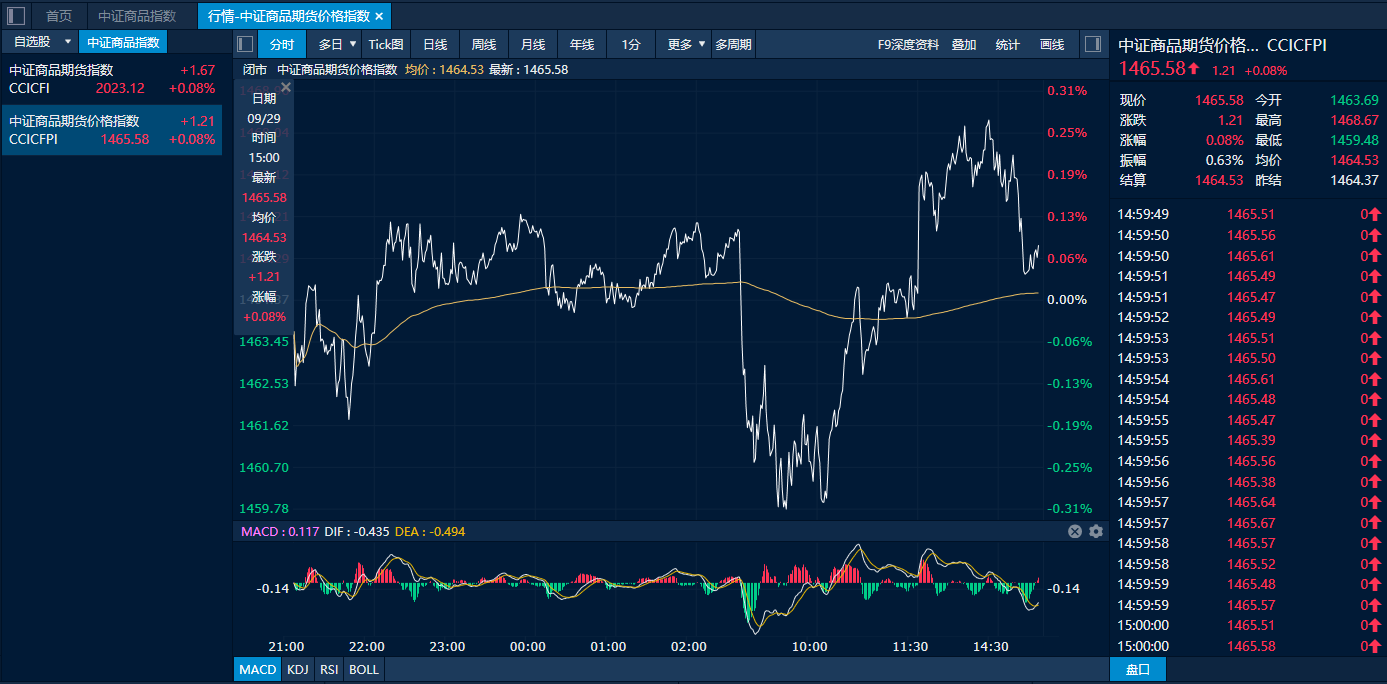
Group 1: Commodity Market Overview - The domestic commodity futures market on September 29 saw more declines than increases, with the main contract for silver rising over 3% and gold and apple contracts increasing over 1% [1] - The China Securities Commodity Futures Price Index closed at 1465.58 points, up 1.21 points or 0.08% from the previous trading day [1] Group 2: Precious Metals Performance - International gold prices surpassed $3800 per ounce and silver prices exceeded $47 per ounce, driven by expectations of interest rate cuts and safe-haven demand [2] - Both gold and silver have seen year-to-date increases of over 40%, making them standout assets amid monetary policy easing and geopolitical uncertainties [2] Group 3: Apple Market Dynamics - The apple contract reached a six-month high, supported by strong consumer demand and stable prices for quality goods, despite a slight decline in inventory turnover [3] - The expectation for higher opening prices for the new apple season also contributed to the positive market sentiment [3] Group 4: Black Metals Sector - The black metals sector continued to decline, with coking coal contracts dropping by 4.98%, reflecting a cooling market sentiment and nearing the end of downstream replenishment demand [4] - The overall fundamentals for black metals are expected to remain weak in the short term, with market participants awaiting further demand recovery post-holiday [4] Group 5: Industrial Silicon Market - The industrial silicon market remains oversupplied, with stable supply but no significant demand improvement, leading to a drop of 4.33% in the main contract [5] - The market sentiment has cooled, but prices are expected to stabilize in the short term, with a focus on inventory pressures in the fourth quarter [5]

金属期权策略早报:金属期权-20250929
Wu Kuang Qi Huo· 2025-09-29 02:43
Group 1: General Information - The report is a metal options strategy morning report dated September 29, 2025 [1] - The research team includes Lu Pinxian, Huang Kehan, and Li Renjun [2] - The metal - related sectors are divided into non - ferrous metals, precious metals, and black metals. Options strategies and suggestions are provided for selected varieties in each sector [8] Group 2: Market Overview - The report provides the latest prices, price changes, trading volumes, and open interest of various metal futures contracts, such as copper (CU2511 closed at 81,890 with a - 0.79% change), aluminum (AL2511 at 20,660 with a - 0.55% change), etc. [3] Group 3: Option Factors 3.1 Volume and Open Interest PCR - The volume PCR and open interest PCR of different metal options are presented, which are used to describe the strength of the underlying asset's market and potential turning points. For example, the volume PCR of copper is 0.26 with a - 0.02 change, and the open interest PCR is 0.70 with a 0.01 change [4] 3.2 Pressure and Support Levels - The pressure points, support points, and the corresponding offsets of various metal options are given. For instance, the pressure point of copper is 92,000 with an 8,000 offset, and the support point is 80,000 with a 2,000 offset [5] 3.3 Implied Volatility - The report shows the at - the - money implied volatility, weighted implied volatility, changes in weighted implied volatility, annual average implied volatility, call and put implied volatilities, and the difference between implied and historical volatilities for each metal option. For example, the at - the - money implied volatility of copper is 20.97%, and the weighted implied volatility is 27.63% with a 1.87 change [6] Group 4: Strategy Recommendations 4.1 Non - Ferrous Metals - **Copper**: Build a bull spread strategy for directional gain, a short - volatility option seller strategy for time - value gain, and a spot hedging strategy [7] - **Aluminum/Alumina**: For aluminum, build a short - neutral call + put option combination strategy and a spot collar strategy; for alumina, similar strategies are recommended [9] - **Zinc/Lead**: Build a short - neutral call + put option combination strategy and a spot collar strategy for zinc; similar strategies for lead [9] - **Nickel**: Build a short - bearish call + put option combination strategy and a spot covered - call strategy [10] - **Tin**: Build a short - volatility strategy and a spot collar strategy [10] - **Lithium Carbonate**: Build a short - bearish call + put option combination strategy and a spot hedging strategy [11] 4.2 Precious Metals - **Gold/Silver**: For gold, build a bull spread strategy for directional gain, a short - volatility option seller strategy with a positive delta, and a spot hedging strategy; for silver, similar strategies are recommended [12] 4.3 Black Metals - **Rebar**: Build a short - bearish call + put option combination strategy and a spot covered - call strategy [13] - **Iron Ore**: Build a short - neutral call + put option combination strategy and a spot collar strategy [13] - **Ferroalloys**: For manganese silicon, build a short - volatility strategy; for industrial silicon/polysilicon, build a short - volatility option seller strategy and a spot hedging strategy; for glass, build a short - volatility strategy and a spot collar strategy [13][14][15]
金属期权策略早报:金属期权-20250923
Wu Kuang Qi Huo· 2025-09-23 01:48
1. Report Industry Investment Rating - No information provided in the document 2. Core Viewpoints of the Report - For non - ferrous metals, construct a seller neutral volatility strategy as they are in a range - bound oscillation [2] - For black metals, build a short - volatility portfolio strategy due to their large - amplitude fluctuations [2] - For precious metals, create a spot hedging strategy as they are rising and breaking through [2] 3. Summary by Related Catalogs 3.1 Market Overview of Underlying Futures - Copper (CU2511): Latest price 80,100, down 20 (-0.02%), volume 6.34 million lots, open interest 17.70 million lots [3] - Aluminum (AL2511): Latest price 20,715, down 55 (-0.26%), volume 11.87 million lots, open interest 23.61 million lots [3] - Zinc (ZN2511): Latest price 22,035, up 40 (0.18%), volume 14.05 million lots, open interest 13.04 million lots [3] - And other metal futures with their respective prices, changes, volumes, and open interests [3] 3.2 Option Factors - Volume and Open Interest PCR - Different metal options have their own volume PCR, volume change, open interest PCR, and open interest change, which are used to describe the strength of the option underlying market and the turning point of the market [4] 3.3 Option Factors - Pressure and Support Levels - Each metal option has its pressure point, pressure point offset, support point, support point offset, maximum call open interest, and maximum put open interest, indicating the pressure and support levels of the underlying [5] 3.4 Option Factors - Implied Volatility - The implied volatility of different metal options includes at - the - money implied volatility, weighted implied volatility, its change, annual average, call implied volatility, put implied volatility, 20 - day historical volatility, and the difference between implied and historical volatility [6] 3.5 Strategies and Recommendations for Different Metals 3.5.1 Non - ferrous Metals - Copper: Build a short - volatility seller option portfolio strategy and a spot long - hedging strategy [7] - Aluminum/Alumina: Construct a short - neutral call + put option combination strategy and a spot collar strategy [9] - Zinc/Lead: Build a short - neutral call + put option combination strategy and a spot collar strategy [9] - Nickel: Create a short - bearish call + put option combination strategy and a spot covered call strategy [10] - Tin: Implement a short - volatility strategy and a spot collar strategy [10] - Lithium Carbonate: Build a short - bearish call + put option combination strategy and a spot long - hedging strategy [11] 3.5.2 Precious Metals - Gold/Silver: Construct a bullish call spread strategy, a short - volatility option seller portfolio strategy, and a spot hedging strategy [12] 3.5.3 Black Metals - Rebar: Build a short - bearish call + put option combination strategy and a spot covered call strategy [13] - Iron Ore: Construct a short - neutral call + put option combination strategy and a long - collar strategy [13] - Ferroalloys: Implement a short - volatility strategy [14] - Industrial Silicon/Polysilicon: Build a short - volatility call + put option combination strategy and a spot hedging strategy [14] - Glass: Implement a short - volatility call + put option combination strategy [15]
美联储降息25BP:商品走势分化,后市交易逻辑待切换
Sou Hu Cai Jing· 2025-09-22 13:46
Core Viewpoint - The recent "Super Central Bank Week" concluded with the Federal Reserve lowering interest rates by 25 basis points, prompting other central banks to follow suit, leading to a recalibration of asset pricing and new trading logic in the market [1] Market Performance - Global stock markets exhibited mixed results, with U.S. stocks initially declining but later reaching new highs, while A-shares experienced a pullback after a rise [1] - The Baltic Dry Index (BDI) saw a slight increase, while the volatility index (VIX) rose, indicating market uncertainty [1] - U.S. Treasury yields and the dollar index initially fell but later rebounded, showcasing volatility in non-U.S. currencies [1] Commodity Market Trends - Commodity prices displayed divergence, with gold experiencing high volatility, copper prices dropping significantly, and oil prices remaining weak, leading to a weekly decline in the CRB index [1] - In the domestic market, a trend against "involution" boosted black commodities, particularly coking coal and coke, while glass and soda ash also saw gains [1] - The domestic bond market showed mixed results, with stock indices reflecting varied performances [1] Commodity Sector Analysis - The Wind Commodity Index reported a weekly change of -0.19%, with 4 out of 10 sectors gaining and 6 sectors declining, indicating a pattern of strength domestically but weakness externally [1] - Precious metals faced a correction, and the significant drop in non-ferrous metals negatively impacted overall commodity performance, while coal, steel, and non-metallic building materials sectors surged [1] - Agricultural products led the decline among commodity sectors [1] Future Outlook - The resumption of the interest rate cut process is expected to shift global macro trading logic, with the Fed's rate cut likely to influence commodity prices through various channels [1] - Generally, rate cuts enhance the attractiveness of gold and other commodities, as a weaker dollar supports commodity prices and liquidity injections boost expectations [1] - The phenomenon of "buying the expectation, selling the fact" is noted, with gold experiencing a rise followed by a pullback post-rate cut, suggesting that future commodity trends may diverge [1]
金属期权策略早报:金属期权-20250922
Wu Kuang Qi Huo· 2025-09-22 03:04
1. Report Industry Investment Rating No relevant information provided. 2. Core View of the Report - For non - ferrous metals, construct a seller's neutral volatility strategy as they are in a range - bound oscillation; for black metals, build a short - volatility portfolio strategy due to their large - amplitude fluctuations; for precious metals, create a spot hedging strategy as they are rising and breaking through [2]. 3. Summary by Related Catalogs 3.1 Futures Market Overview - The latest prices, price changes, trading volumes, and open interest changes of various metal futures contracts are presented, including copper, aluminum, zinc, etc. For example, the latest price of copper (CU2511) is 80,080, up 260 with a 0.33% increase, and its trading volume is 5.41 million lots with a decrease of 3.52 million lots [3]. 3.2 Option Factors - Volume and Open Interest PCR - The volume and open interest PCR of different metal options are given. For instance, the volume PCR of copper options is 0.65 with a change of 0.01, and the open interest PCR is 0.75 with a change of 0.04 [4]. 3.3 Option Factors - Pressure and Support Levels - The pressure and support levels of various metal options are analyzed. For example, the pressure level of copper options is 82,000 and the support level is 78,000 [5]. 3.4 Option Factors - Implied Volatility - The implied volatility of different metal options is provided, including at - the - money implied volatility, weighted implied volatility, etc. For example, the at - the - money implied volatility of copper options is 12.26%, and the weighted implied volatility is 15.27% with a change of - 1.54% [6]. 3.5 Strategy and Recommendations 3.5.1 Non - ferrous Metals - **Copper**: Build a short - volatility seller option portfolio strategy and a spot long - hedging strategy. The three - exchange copper inventory increased by 11,000 tons. The implied volatility of copper options fluctuates around the historical average, and the open interest PCR indicates some pressure above [7]. - **Aluminum**: Construct a short - neutral call + put option portfolio strategy and a spot collar strategy. The domestic aluminum ingot social inventory increased, and the LME inventory is at a low level. The market shows a long - biased upward and high - level oscillating trend [9]. - **Zinc/Lead**: Build a short - neutral call + put option portfolio strategy and a spot collar strategy. The zinc market shows an oscillating and falling trend after rising, and the implied volatility of zinc options continues to decline [9]. - **Nickel**: Construct a short - bearish call + put option portfolio strategy and a spot covered strategy. The domestic nickel ore port inventory increased, and the market shows a wide - range oscillating trend with bearish pressure above [10]. - **Tin**: Build a short - volatility strategy and a spot collar strategy. The tin production in Yunnan and Jiangxi is affected, and the market shows a short - term high - level oscillating trend with pressure above [10]. - **Lithium Carbonate**: Construct a short - bearish call + put option portfolio strategy and a spot long - hedging strategy. The lithium carbonate production increased, and the market shows a large - amplitude fluctuating and continuously falling trend [11]. 3.5.2 Precious Metals - **Gold/Silver**: Build a bullish option bull - spread combination strategy, a long - biased short - volatility option seller portfolio strategy, and a spot hedging strategy. The relationship between gold and silver prices is related to the overseas manufacturing PMI. The gold market shows a short - term oscillating and strongly breaking - through trend [12]. 3.5.3 Black Metals - **Rebar**: Construct a short - bearish call + put option portfolio strategy and a spot long - covered strategy. The rebar inventory decreased slightly, and the market shows a weak oscillating trend with pressure above [13]. - **Iron Ore**: Build a short - neutral call + put option portfolio strategy and a spot long - collar strategy. The iron ore inventory decreased, and the market shows a range - bound oscillating and rebounding trend [13]. - **Ferroalloys**: Build a short - volatility strategy for manganese silicon. The manganese silicon production decreased, and the market shows a weak and bearish trend [14]. - **Industrial Silicon/Polysilicon**: Construct a short - volatility call + put option portfolio strategy and a spot hedging strategy. The industrial silicon inventory remains high, and the market shows a large - amplitude range - bound oscillating trend [14]. - **Glass**: Build a short - volatility call + put option portfolio strategy and a spot long - collar strategy. The glass inventory decreased in some areas, and the market shows a weak trend with pressure above [15].
冠通期货资讯早间报-20250922
Guan Tong Qi Huo· 2025-09-22 03:02
Report Summary 1. Overnight Night Market Trends - International precious metal futures generally rose, with COMEX gold futures up 1.12% at $3,719.4 per ounce and a weekly gain of 0.9%, and COMEX silver futures up 2.96% at $43.365 per ounce and a weekly gain of 1.25% [3] - International oil prices weakened, with the U.S. oil main contract down 1.42% at $62.36 per barrel and a weekly decline of 0.53%, and the Brent crude main contract down 1.3% at $66.05 per barrel and a weekly decline of 1.4% [4] - Most London base metals fell, with LME tin up 1.51% at $34,220 per ton and a weekly decline of 2.16%, LME copper up 0.57% at $9,996.50 per ton and a weekly decline of 0.71%, etc [4] - As of the close on September 19 at 23:00, domestic futures main contracts showed mixed results, with coking coal, iron ore, glass, and rapeseed meal up over 1%, and fuel oil, LPG, and low - sulfur fuel oil down over 1% [4] 2. Important News Macro News - The State Council executive meeting emphasized ecological protection and green development, and the Ministry of Commerce will promote the release of the automotive aftermarket consumption potential [7] - Fed's Kashkari said two more interest rate cuts this year are appropriate, and the State Council Information Office will hold a press conference on the "14th Five - Year Plan" achievements in the financial industry [7] - President Xi Jinping had a phone call with U.S. President Trump, and the U.S. Chief Justice asked Fed Governor Cook to respond to Trump's request [8] - Fed Governor Milan said gradually reaching the neutral interest rate at 50 - basis - point increments is reasonable [10] Energy and Chemical Futures - China's styrene factory output decreased by 2.03% week - on - week, and PVC production enterprise capacity utilization rates declined [12] - Russian oil product exports showed a significant decline in early September, and the EU plans to increase pressure on Russia's access to oil dollars [12][13] - U.S. President Trump called on European countries to stop buying Russian oil [14] Metal Futures - China has formed three lithium carbonate production process routes, and the Simandou iron ore project in Guinea has started the first - batch mining operations [17] - Citi expects the gold bull market to continue in the short term and forecasts Brent crude prices to decline [18] - Congo is considering extending the cobalt export ban, and the inventory of some metals in the domestic market changed last week [18][21] - India is considering establishing a strategic reserve mechanism for critical minerals [22] Black - Series Futures - Independent electric arc furnace construction steel mills are in a serious loss state and may continue to cut production [24] - Last week, the scale of construction steel mill overhauls increased, and Shanghai issued a pilot method for property tax on some personal housing [24] - The total inventory of construction steel in cities decreased by 0.58% week - on - week [25] Agricultural Product Futures - Malaysia has raised its October crude palm oil reference price, and there was news of domestic soybean oil exports to India [28] - India's sugar exports this year may be less than 800,000 tons, and the soybean crushing volume and开机率 of domestic oil mills are expected to change [28][29] - The profit of pig farming has declined, and Malaysia's palm oil exports from September 1 - 20 increased by 8.7% compared to the same period last month [29][30] 3. Financial Markets Finance - Since the implementation of the "9·24" package of policies, the A - share market has shown positive trends, with increased trading volume and new accounts [33] - Institutions have conducted intensive research on A - share companies, especially in "hard - tech" fields [33] - Goldman Sachs believes the current rally in the Chinese stock market is sustainable, and Fed's interest rate cut may drive foreign capital back to A - shares and Hong Kong stocks [34] - The average position of domestic stock private equity institutions has reached the highest level this year [36] - The number of brokerage analysts has exceeded 6,000 [37] Industry - The head of the National Data Bureau emphasized data investment in the manufacturing industry, and the government is promoting the formulation of pre - prepared food national standards [38] - China has completed the "14th Five - Year Plan" goal for pumped - storage power stations, and the power spot market has shown a guiding role in new energy consumption [40] - The operating data of some private banks showed mixed results, and China's civil aviation transport scale reached a new high in August [40][41] - The medical logistics cost in China in the first half of 2025 exceeded 50 billion yuan, and the Sanya government issued a policy on affordable rental housing [41] - The International Low - Altitude Economy Expo will be held in 2026, and Shanxi's coalbed methane production reached a record high in the first 8 months [42][43] Overseas - South Korea and the U.S. have differences in the $350 billion investment issue, and Wall Street is betting on faster and larger interest rate cuts by the Fed [45] - India and the U.S. are seeking a "mutual - benefit" trade agreement, and Argentina is negotiating to avoid a debt crisis [45] - Australia, Canada, and the UK recognized the State of Palestine [46] International Stock Markets - Musk's social platform X's revenue in Q2 2025 dropped by 40% compared to 2022, and it is accelerating its transformation into the AI field [47] Commodities - The Shanghai Futures Exchange launched new trading businesses for international copper and alumina standard warehouse receipts [49] - If Congo extends the cobalt export ban, the cobalt price may rise sharply in the short term [49] - The Oseberg oil field in Norway had an unplanned shutdown, and Iraq increased oil exports [50] Bonds - Many banks have redeemed "Tier 2 and Perpetual Bonds", and the issuance scale of special new special bonds for "repaying local government arrears to enterprises" has exceeded 1.2 trillion yuan [51] 4. Upcoming Economic Data and Events - Economic data to be released include China's September LPR, China Hong Kong's August CPI, etc [54] - Events include the Australian Reserve Bank Governor's testimony, a press conference on the financial industry's "14th Five - Year Plan" achievements, etc [56]
金属期权策略早报:金属期权-20250919
Wu Kuang Qi Huo· 2025-09-19 02:09
1. Report Industry Investment Rating - Not provided in the document 2. Core Views of the Report - For non - ferrous metals, construct a neutral volatility strategy for sellers when the market is range - bound, and a short - volatility strategy for black metals with large fluctuations. For precious metals, build a spot hedging strategy as they break upward [2]. 3. Summary by Related Catalogs 3.1 Futures Market Overview - Various metal futures have different price movements, trading volumes, and open interest changes. For example, copper (CU2511) closed at 79,660, down 0.15% with a trading volume of 8.93 million lots and an open interest of 17.26 million lots [3]. 3.2 Option Factors - Volume and Open Interest PCR - Volume PCR and open interest PCR are used to describe the strength of the option underlying market and the turning point of the market respectively. For instance, the volume PCR of copper is 0.64 with a change of 0.08, and the open interest PCR is 0.71 with a change of - 0.01 [4]. 3.3 Option Factors - Pressure and Support Levels - From the perspective of the maximum open interest of call and put options, the pressure and support levels of each metal option are determined. For example, the pressure point of copper is 82,000 and the support point is 79,000 [5]. 3.4 Option Factors - Implied Volatility - Implied volatility data such as at - the - money implied volatility, weighted implied volatility, and their changes, historical average, call and put implied volatility, and historical volatility are provided for each metal option. For example, the at - the - money implied volatility of copper is 13.02% [6]. 3.5 Option Strategies and Recommendations 3.5.1 Non - ferrous Metals - **Copper**: Build a short - volatility seller option portfolio strategy and a spot long - hedging strategy [7]. - **Aluminum/Alumina**: Construct a short - neutral call + put option combination strategy and a spot collar strategy [9]. - **Zinc/Lead**: Build a short - neutral call + put option combination strategy and a spot collar strategy [9]. - **Nickel**: Construct a short - bearish call + put option combination strategy and a spot covered call strategy [10]. - **Tin**: Build a short - volatility strategy and a spot collar strategy [10]. - **Lithium Carbonate**: Construct a short - bearish call + put option combination strategy and a spot long - hedging strategy [11]. 3.5.2 Precious Metals - **Gold/Silver**: Build a long - biased short - volatility option seller portfolio strategy and a spot hedging strategy [12]. 3.5.3 Black Metals - **Rebar**: Construct a short - bearish call + put option combination strategy and a spot long - covered call strategy [14]. - **Iron Ore**: Build a short - neutral call + put option combination strategy and a spot long - collar strategy [14]. - **Ferroalloys**: Build a short - volatility strategy [15]. - **Industrial Silicon/Polysilicon**: Construct a short - volatility call + put option combination strategy and a spot hedging strategy [15]. - **Glass**: Build a short - volatility call + put option combination strategy and a spot long - collar strategy [16].
金属期权策略早报-20250917
Wu Kuang Qi Huo· 2025-09-17 03:09
1. Report Industry Investment Rating No relevant content provided. 2. Core Viewpoints of the Report - The report offers a morning strategy for metal options, suggesting different strategies for non - ferrous metals, black metals, and precious metals. For non - ferrous metals, a seller's neutral volatility strategy is recommended; for black metals, a short - volatility combination strategy is suitable; for precious metals, a spot hedging strategy is proposed [2]. 3. Summary by Relevant Catalogs 3.1 Futures Market Overview - The report presents the latest prices, changes, trading volumes, and open interests of various metal futures contracts, including copper, aluminum, zinc, etc. For example, the latest price of copper (CU2510) is 80,900, down 190 (-0.23%) with a trading volume of 8.85 million lots and an open interest of 16.52 million lots [3]. 3.2 Option Factors - Volume and Open Interest PCR - PCR indicators, including volume PCR and open interest PCR, are used to describe the strength of the option underlying market and the turning points of the underlying market. For instance, the volume PCR of copper is 0.41 with a change of 0.03, and the open interest PCR is 0.75 with a change of 0.02 [4]. 3.3 Option Factors - Pressure and Support Levels - The pressure and support levels of option underlying assets are determined by the strike prices with the largest open interests of call and put options. For example, the pressure level of copper is 82,000 and the support level is 79,000 [5]. 3.4 Option Factors - Implied Volatility - The implied volatility data of various metal options are provided, including at - the - money implied volatility, weighted implied volatility, and their changes. For example, the at - the - money implied volatility of copper is 12.63%, and the weighted implied volatility is 17.94% with a change of - 0.12% [6]. 3.5 Strategy and Recommendations 3.5.1 Non - Ferrous Metals - **Copper**: Based on the analysis of fundamentals and option factors, a short - volatility seller's option combination strategy and a spot hedging strategy are recommended [7]. - **Aluminum/Alumina**: A bullish option bull spread strategy, a short - neutral call + put option combination strategy, and a spot collar strategy are suggested [9]. - **Zinc/Lead**: A short - neutral call + put option combination strategy and a spot collar strategy are recommended [9]. - **Nickel**: A short - bearish call + put option combination strategy and a spot covered call strategy are proposed [10]. - **Tin**: A short - volatility strategy and a spot collar strategy are recommended [10]. - **Lithium Carbonate**: A short - bearish call + put option combination strategy and a spot hedging strategy are suggested [11]. 3.5.2 Precious Metals - **Gold/Silver**: A bullish option bull spread strategy, a short - bullish volatility option seller's combination strategy, and a spot hedging strategy are recommended [12]. 3.5.3 Black Metals - **Rebar**: A short - bearish call + put option combination strategy and a spot covered call strategy are proposed [13]. - **Iron Ore**: A short - neutral call + put option combination strategy and a spot collar strategy are recommended [13]. - **Ferroalloys**: A short - volatility strategy is suggested for manganese silicon, and no spot hedging strategy is provided [14]. - **Industrial Silicon/Polysilicon**: A short - volatility short - call + put option combination strategy and a spot hedging strategy are recommended [14]. - **Glass**: A short - volatility short - call + put option combination strategy and a spot collar strategy are proposed [15].
金属期权策略早报-20250915
Wu Kuang Qi Huo· 2025-09-15 02:52
1. Report Industry Investment Rating No relevant content provided. 2. Core Views of the Report - The metal sector is divided into non - ferrous metals, precious metals, and black metals. Different strategies are recommended for each sector and its selected varieties based on their market conditions and option factors [8]. - For non - ferrous metals, which are in a weak and volatile state, a seller's neutral volatility strategy is recommended. Black metals maintain a large - amplitude volatile market, suitable for building a short - volatility portfolio strategy. Precious metals show a bullish upward trend, and a spot hedging strategy is suggested [2]. 3. Summary by Related Catalogs 3.1 Futures Market Overview - The latest prices, price changes, trading volumes, and open interest changes of various metal futures are provided, including copper, aluminum, zinc, etc. For example, the latest price of copper (CU2510) is 80,810, with a price increase of 150 and a trading volume of 9.16 million lots [3]. 3.2 Option Factors - PCR - The PCR indicators (volume PCR and open interest PCR) of various metal options are presented. These indicators are used to describe the strength of option underlying market trends and potential turning points. For instance, the volume PCR of copper options is 0.30, with a change of - 0.08, and the open interest PCR is 0.72, with a change of 0.01 [4]. 3.3 Option Factors - Pressure and Support Levels - The pressure and support levels of various metal options are analyzed. For example, the pressure point of copper options is 82,000, and the support point is 78,000. These levels are determined by the strike prices with the maximum open interest of call and put options [5]. 3.4 Option Factors - Implied Volatility - The implied volatility data of various metal options are provided, including at - the - money implied volatility, weighted implied volatility, and the difference between implied and historical volatility. For example, the at - the - money implied volatility of copper options is 17.51%, and the weighted implied volatility is 19.24% [6]. 3.5 Strategy and Recommendations 3.5.1 Non - Ferrous Metals - **Copper Options**: Fundamentally, the inventory of the three major exchanges has increased by 12,000 tons. The market shows a high - level consolidation with support below. Option strategies include building a short - volatility seller's option portfolio and a spot hedging strategy [7]. - **Aluminum/Alumina Options**: Aluminum inventory has decreased, and the market shows a bullish upward trend. Strategies include a bullish call spread strategy, a short - neutral call + put option combination strategy, and a spot collar strategy [9]. - **Zinc/Pb Options**: Zinc inventory has increased, and the market shows a volatile decline. Strategies include a short - neutral call + put option combination strategy and a spot collar strategy [9]. - **Nickel Options**: Nickel inventory has increased, and the market shows a wide - range volatile pattern with upward pressure. Strategies include a short - bearish call + put option combination strategy and a spot covered call strategy [10]. - **Tin Options**: Tin supply is tight, and the market shows a short - term high - level volatile pattern with upward pressure. Strategies include a short - volatility strategy and a spot collar strategy [10]. - **Lithium Carbonate Options**: Lithium carbonate inventory has decreased, and the market shows a large - amplitude volatile and continuous decline. Strategies include a short - bearish call + put option combination strategy and a spot hedging strategy [11]. 3.5.2 Precious Metals - **Gold/Silver Options**: For gold, inflation data in the US is lower than expected, and the market shows a short - term consolidation and a strong upward breakthrough. Strategies include a bullish call spread strategy, a short - bullish volatility option seller's combination strategy, and a spot hedging strategy [12]. 3.5.3 Black Metals - **Rebar Options**: Rebar inventory has increased, and the market shows a weak consolidation with upward pressure. Strategies include a short - bearish call + put option combination strategy and a spot covered call strategy [13]. - **Iron Ore Options**: Iron ore inventory has increased, and the market shows a volatile rebound. Strategies include a short - neutral call + put option combination strategy and a spot collar strategy [13]. - **Ferroalloy Options**: Manganese silicon shows a weak and bearish market. Strategies include a short - volatility strategy [14]. - **Industrial Silicon/Polysilicon Options**: Industrial silicon production has increased, and the market shows a large - amplitude volatile pattern with upward pressure. Strategies include a short - volatility call + put option combination strategy and a spot hedging strategy [14]. - **Glass Options**: Glass inventory has decreased, and the market shows a weak market with upward pressure. Strategies include a short - volatility call + put option combination strategy and a spot collar strategy [15].
金属期权策略早报-20250912
Wu Kuang Qi Huo· 2025-09-12 02:36
1. Report Industry Investment Rating - Not provided in the content 2. Core Viewpoints of the Report - For non - ferrous metals, a neutral volatility seller strategy is recommended for the current weak and volatile market; for the black series, a short - volatility combination strategy is suitable due to large - amplitude fluctuations; for precious metals, a spot hedging strategy is advisable as the bulls break through and rise [2]. 3. Summary by Relevant Catalogs 3.1 Futures Market Overview - The latest prices, price changes, trading volumes, and open interest changes of various metal futures such as copper, aluminum, zinc, etc. are presented. For example, the latest price of copper (CU2510) is 80,490, with a price increase of 410 and a trading volume of 6.48 million hands [3]. 3.2 Option Factor - Volume and Open Interest PCR - The volume PCR and open interest PCR of different metal options are provided, which are used to describe the strength of the option underlying market and the turning point of the underlying market respectively. For instance, the volume PCR of copper options is 0.38, with a change of - 0.20 [4]. 3.3 Option Factor - Pressure and Support Levels - The pressure and support levels of various metal options are given, which are determined by the strike prices with the largest open interest of call and put options. For example, the pressure level of copper options is 82,000, and the support level is 79,000 [5]. 3.4 Option Factor - Implied Volatility - The implied volatility data of different metal options are presented, including at - the - money implied volatility, weighted implied volatility, etc. For example, the at - the - money implied volatility of copper options is 11.62% [6]. 3.5 Strategy and Recommendations 3.5.1 Non - ferrous Metals - **Copper Options**: Build a short - volatility seller option portfolio strategy and a spot long - hedging strategy [7]. - **Aluminum/Alumina Options**: Construct a bull spread combination strategy for call options, a short - neutral call + put option combination strategy, and a spot collar strategy [9]. - **Zinc/Lead Options**: Build a short - neutral call + put option combination strategy and a spot collar strategy [9]. - **Nickel Options**: Construct a short - bearish call + put option combination strategy and a spot covered - call strategy [10]. - **Tin Options**: Build a short - volatility strategy and a spot collar strategy [10]. - **Lithium Carbonate Options**: Construct a short - bearish call + put option combination strategy and a spot long - hedging strategy [11]. 3.5.2 Precious Metals - **Gold/Silver Options**: Build a bull spread combination strategy for call options, a short - bullish volatility seller option portfolio strategy, and a spot hedging strategy [12]. 3.5.3 Black Series - **Rebar Options**: Build a short - bearish call + put option combination strategy and a spot covered - call strategy [13]. - **Iron Ore Options**: Construct a short - neutral call + put option combination strategy and a spot long - collar strategy [13]. - **Ferroalloy Options**: Build a short - volatility strategy [14]. - **Industrial Silicon/Polysilicon Options**: Construct a short - volatility call + put option combination strategy and a spot hedging strategy [14]. - **Glass Options**: Build a short - volatility call + put option combination strategy and a spot long - collar strategy [15].