
加密货币

Search documents
以前币涨股更涨,如今币跌股更崩:加密金库公司的循环断链了
智通财经网· 2025-11-28 13:01
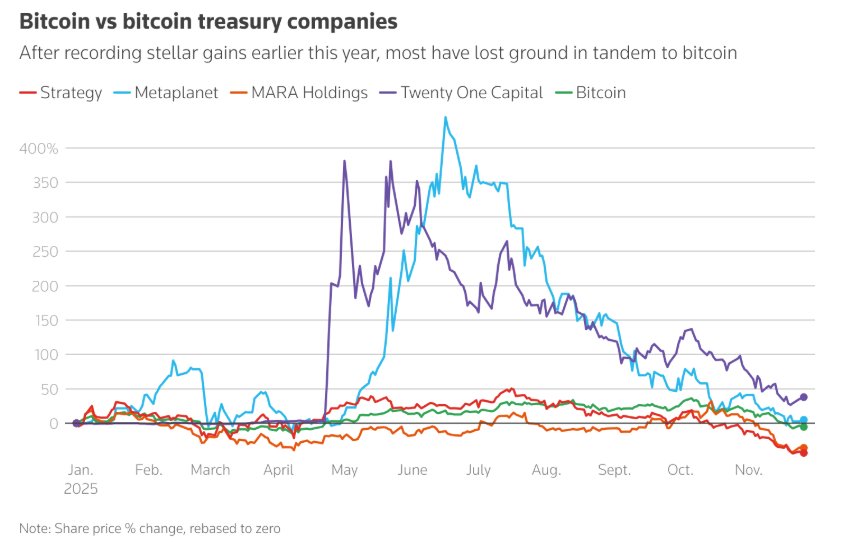
Core Insights - The cryptocurrency market is experiencing significant turmoil, negatively impacting the stock prices of companies that hold substantial amounts of Bitcoin and other tokens, leading to increased investor concerns about this rapidly growing sector in 2023 [1][4] Group 1: Market Performance - At least 15 Bitcoin treasury companies are trading significantly below their net asset value (NAV) of held cryptocurrencies, with Strategy Inc. (MSTR.US) seeing a nearly 36% drop in stock price in November [1][6] - Strategy Inc.'s stock has plummeted over 60% since its peak in July, and over 70% since reaching record highs in November last year, despite a cumulative increase of over 1300% since Michael Saylor announced the first Bitcoin purchase in August 2020 [2][3] Group 2: Investment Strategies - Strategy Inc. has relied heavily on a model of issuing stock and convertible debt to finance further Bitcoin purchases, creating a recursive leverage effect that has now become unsustainable as the cryptocurrency market's total value has evaporated by over $1 trillion in November [4][6] - The mNAV of Strategy Inc. has dropped to just above 1.1, indicating that the previous support for its stock price is no longer functioning effectively [4] Group 3: Industry Trends - The digital asset treasury (DAT) sector holds approximately 4% of all Bitcoin and 3.1% of all Ethereum, suggesting that the performance of these companies could significantly impact overall cryptocurrency prices [5] - As the DAT sector becomes saturated, new entrants are diversifying into other cryptocurrencies like Ethereum and Solana, with some companies announcing plans to accumulate Ethereum, which can also be staked for rewards [8][12] Group 4: Alternative Strategies - Smaller DAT companies are expanding their holdings to include alternative cryptocurrencies like Solana and Ripple, while some micro-companies are venturing into more volatile assets like Dogecoin to enhance profitability [12][15]


电商行业主导权易主?琉球部署导弹引连锁反应,军工股领涨A股
Sou Hu Cai Jing· 2025-11-28 11:16
Group 1: Global Market Dynamics - The U.S. stock market has recently experienced a decline of 7% in November, indicating sensitivity to market fluctuations [4] - The Federal Reserve's third-ranking official, Williams, mentioned increasing risks to employment and decreasing inflation risks, suggesting potential for further interest rate cuts [5] - The performance of global stock markets has been poor due to concerns over high valuations in tech stocks and the exhaustion of previous rate cut expectations [7] Group 2: Cryptocurrency Market - The cryptocurrency market has seen significant volatility, with reports of substantial losses in assets owned by the Trump family, including a 25% drop in the price of Trump meme coins [9] - Eric Trump remains optimistic about the future of cryptocurrencies, while notable investor Cathie Wood has increased her holdings in Bitcoin-related stocks [11] - U.S. Treasury Secretary Yellen's visit to a Bitcoin-themed bar is perceived as a supportive signal for the cryptocurrency industry [11] Group 3: A-Share Market and Geopolitical Factors - The A-share market has shown signs of recovery, particularly in the technology sector, with military stocks leading the charge due to geopolitical tensions [13] - Japan's defense minister's visit to the Ryukyu Islands and comments on missile deployment have heightened market concerns, leading to speculation about China's military response [15] - Both Chinese and Japanese stock markets have faced declines, with the Shanghai Composite Index down 4.78% and the Nikkei 225 Index down 7% from recent highs [17] Group 4: E-commerce Industry Trends - A significant number of internet celebrities are leaving Hangzhou, leading to a sharp decline in rental prices for office spaces [19] - The shift in the e-commerce landscape is characterized by the rise of "Taobao Flash Sale" and the integration of AI technology to enhance efficiency and reduce costs [21][23] - The competitive landscape is evolving, with brands increasingly taking control of sales through "store broadcasting" rather than relying solely on influencers [26] - Advances in AI digital human technology are improving operational efficiency in e-commerce, allowing for better consumer engagement [28]

美股加密货币概念股盘前普涨,BMNR涨近5%
Mei Ri Jing Ji Xin Wen· 2025-11-28 09:43
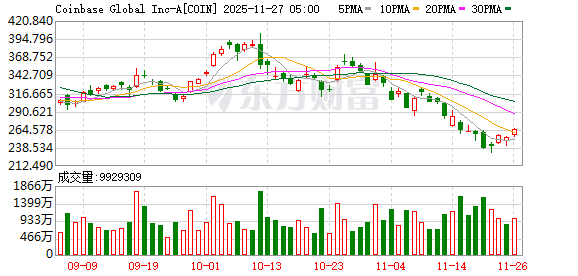
Core Insights - The cryptocurrency concept stocks in the US market experienced a pre-market rally on November 28, with notable gains across various companies [2] Group 1: Company Performance - BMNR saw an increase of nearly 5% [2] - CleanSpark and Bitfarms both rose over 4% [2] - Circle experienced a rise of over 3% [2] - Coinbase increased by nearly 3% [2] - Strategy gained over 2% [2]





全线大涨!美联储降息大消息!
天天基金网· 2025-11-28 01:06
Core Viewpoint - The cryptocurrency market experienced a significant rebound, with Bitcoin rising over 4% and Ethereum over 3%, driven by oversold conditions and expectations of interest rate cuts by the Federal Reserve [2][4][5]. Group 1: Market Performance - As of November 27, Bitcoin's price reached $91,420, marking a cumulative increase of over 13% from its low of $80,843 on November 21 [4]. - The total liquidation amount in the cryptocurrency market reached $301 million (approximately 2.1 billion RMB), with over 100,000 traders liquidated within 24 hours [2]. Group 2: Factors Driving the Rebound - The rebound is attributed to two main factors: the significant prior decline in prices leading to a technical rebound, and the rising expectations of a 25 basis point rate cut by the Federal Reserve, with an 84.9% probability of this occurring in December [5]. - The probability of cumulative rate cuts by the Federal Reserve in January is estimated at 67.2%, with a 21.6% chance of a total cut of 50 basis points [5]. Group 3: Federal Reserve Leadership Speculation - Kevin Hassett, the current Director of the National Economic Council, is considered the leading candidate for the next Federal Reserve Chair, which could lead to a more dovish monetary policy [6]. - Hassett's potential appointment is seen as a move to align the Federal Reserve with President Trump's economic policies, particularly regarding interest rate cuts [6]. Group 4: Market Sentiment and Risks - Despite the recent rebound, Bitcoin's price is still down over 27% from its all-time high of $126,080 reached in October [8]. - Analysts warn that the asset may still be at risk of entering a bear market, indicating ongoing volatility in the cryptocurrency sector [8].

深夜,全线大涨!美联储,降息大消息!
Zheng Quan Shi Bao Wang· 2025-11-27 23:43
Core Viewpoint - The cryptocurrency market experienced a significant rebound, with Bitcoin rising over 4% and Ethereum over 3%, driven by oversold conditions and expectations of interest rate cuts by the Federal Reserve [1][2][3] Market Performance - As of November 27, Bitcoin's price reached $91,420, marking a cumulative increase of over 13% from its low of $80,843 on November 21 [2] - The total liquidation amount in the cryptocurrency market reached $301 million (approximately 2.1 billion RMB), with over 100,000 traders liquidated within 24 hours [1] Factors Driving the Rebound - The rebound is attributed to two main factors: 1. Oversold conditions in the cryptocurrency market, particularly for Bitcoin, which had previously peaked at over $126,000 before dropping to around $80,000 [3] 2. Rising expectations for a Federal Reserve interest rate cut, with an 84.9% probability of a 25 basis point cut in December, boosting investor sentiment [3][4] Federal Reserve Leadership Speculation - Kevin Hassett, the Director of the National Economic Council, is considered the leading candidate for the next Federal Reserve Chair, which could lead to a more dovish monetary policy [4] - Hassett has indicated a willingness to implement immediate rate cuts if appointed, aligning with President Trump's economic strategies [4] Impact of Political Climate on Cryptocurrency - The decline in Bitcoin's price is linked to President Trump's decreasing approval ratings, which have fallen to 38%, the lowest since his second term began [8] - Nobel laureate Paul Krugman suggests that Trump's waning influence negatively affects Bitcoin prices, as the cryptocurrency has become associated with "Trumpism" [7][9][10] Historical Context of "Trump Trade" - The "Trump trade" refers to the surge in cryptocurrency prices following Trump's election, driven by expectations of favorable policies for digital assets [10] - Despite initial support for cryptocurrencies, the market has faced volatility due to trade wars and other economic factors during Trump's presidency [10]
深夜,全线大涨!美联储,降息大消息!
券商中国· 2025-11-27 23:29
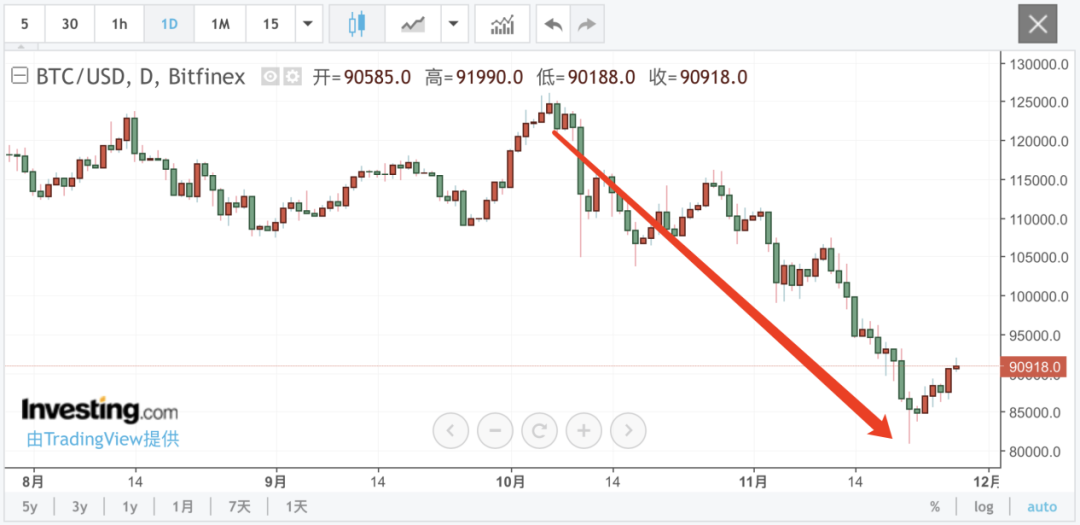
Core Viewpoint - The cryptocurrency market experienced a significant rebound, with Bitcoin rising over 4% and Ethereum over 3%, driven by oversold conditions and expectations of interest rate cuts by the Federal Reserve [1][3][4]. Group 1: Market Performance - As of November 27, Bitcoin's price reached $91,420, marking a cumulative increase of over 13% from its low of $80,843 on November 21 [3]. - The total liquidation amount in the cryptocurrency market reached $301 million (approximately 2.1 billion RMB), with over 100,000 traders liquidated within 24 hours [1]. Group 2: Factors Driving the Rebound - The rebound is attributed to two main factors: the significant prior decline in prices leading to a technical rebound, and the rising expectations of a Federal Reserve interest rate cut [4]. - The probability of a 25 basis point rate cut by the Federal Reserve in December has risen to 84.9%, with a 67.2% chance of cumulative cuts by January [4]. Group 3: Federal Reserve Leadership Speculation - Kevin Hassett, the current Director of the National Economic Council, is considered the leading candidate for the next Federal Reserve Chair, which could lead to a more dovish monetary policy [5]. - Hassett has indicated that he would advocate for immediate rate cuts if appointed, reflecting a potential shift in monetary policy direction [5]. Group 4: Market Sentiment and Risks - Despite the recent price rebound, Bitcoin remains over 27% lower than its peak of $126,080 in October, raising concerns about a potential bear market [6]. - Nobel laureate Paul Krugman attributes the recent volatility in Bitcoin prices to the declining popularity of former President Trump, suggesting that political dynamics significantly impact cryptocurrency valuations [8][9].

前瞻全球产业早报:中国科学院工业人工智能研究所成立
Qian Zhan Wang· 2025-11-27 23:26
Group 1: Economic Policies and Infrastructure Development - The National Development and Reform Commission (NDRC) has allocated 700 billion yuan and 800 billion yuan in special bonds for "hard investment" projects in the last two years, supporting 1465 and 1459 projects respectively, reflecting strategic and forward-looking planning [2] - The NDRC plans to enhance parking facilities and upgrade existing infrastructure, with over 3.4 million new parking spaces added during the 14th Five-Year Plan period, and a total of 18.645 million electric vehicle charging points as of October, marking a 54% year-on-year increase [3] - The Ministry of Industry and Information Technology (MIIT) aims to cultivate three trillion-level consumption sectors and ten hundred-billion-level consumption hotspots by 2027, based on comprehensive assessments of consumption trends and technological changes [4] Group 2: Technological Advancements and Innovations - The first clinical brain-computer interface (BCI) surgery in China was successfully completed, marking a significant step in the clinical application of BCI technology, with the procedure priced at 6,552 yuan per operation [6] - The establishment of the Industrial Artificial Intelligence Research Institute by the Chinese Academy of Sciences aims to drive innovation in industrial AI, focusing on the entire chain from top-level design to implementation [7] - Li Xiang, CEO of Li Auto, emphasized that the most valuable robots in the next decade will be cars equipped with autonomous capabilities, highlighting the need for vehicles to possess complete sensory and decision-making abilities [8] Group 3: Corporate Developments and Market Reactions - Anta Sports has been rumored to be considering a bid for Puma, with potential collaboration with a private equity firm, although the company has refrained from commenting on market speculation [10] - The resignation of Zong Fuli from her positions at Wahaha Group has been noted, with her retaining a 29.40% stake in the company [11] - SuperX announced a stock repurchase plan authorized by its board, allowing for the repurchase of up to 20 million USD in common stock over the next year [16]

Almost 20% of Gen Z Investors Are Only in Crypto — Is That Brilliant or Dumb?
Yahoo Finance· 2025-11-27 16:42
Core Insights - Approximately 19% of Gen Z investors are invested solely in cryptocurrency, indicating a significant trend among younger investors towards high-risk assets [1][2] - This trend contradicts traditional investment wisdom, which advocates for diversification and cautious investment in volatile assets [2] - A Bank of America study shows that 94% of Gen Z and millennial investors prefer collectibles over traditional stock/bond portfolios, reflecting a shift in investment attitudes [3] Investment Attitudes - Younger investors believe that stocks and bonds cannot deliver above-average returns, leading them to favor cryptocurrencies [3] - The decentralized nature and high volatility of crypto align with the fast-paced lifestyle and expectations of younger generations [3] Performance Data - Bitcoin's annual returns over the past 11 years show significant volatility, with notable highs and lows, including a peak return of 1,368.905% in 2017 and a decline of -73.56% in 2018 [4] - Since 2011, Bitcoin has returned over 20,000,000%, vastly outperforming traditional indices like the Nasdaq and S&P 500, which returned approximately 541% and 245% respectively during the same period [5]
稳定币发行商买了上百吨黄金
Bei Jing Shang Bao· 2025-11-27 14:25
Core Insights - Tether, a major player in the cryptocurrency market, has emerged as a significant buyer of gold, holding 116 tons valued at approximately $14 billion, surpassing some national central banks [3][4] - The price of gold has surged by 56% in 2025, with Tether's purchases coinciding with this increase, particularly during the second wave of price growth from mid-August to mid-October [3][4] - The rise of gold-backed stablecoins is gaining traction, with Tether's USDT and XAUt contributing to this trend, reflecting a shift in the stablecoin market [4][7] Tether's Gold Purchases - Tether's gold purchases accounted for about 2% of global gold demand in Q3 and 12% of known central bank purchases during the same period [3] - In Q2, Tether's gold buying represented 14% of global central bank purchases, indicating its growing influence in the gold market [3] - Tether holds 104 tons of gold as reserves for USDT and an additional 12 tons for XAUt, suggesting a strategic move to bolster its asset backing [4] Market Dynamics - The gold price increase has occurred in two phases, with the first phase seeing a nearly $1,000 rise before April and the second phase mirroring this increase from August to October [3] - Tether's demand for gold may have tightened supply and influenced market sentiment, driving speculative investments into gold [4][6] - The stablecoin market is evolving, with gold-backed stablecoins becoming a new category, currently valued at $1.6 billion, representing 0.67% of the total stablecoin market [7] Regulatory Considerations - Tether's use of gold as a reserve asset contrasts with new U.S. regulations that prohibit compliant issuers from using gold as backing, leading Tether to plan a new stablecoin, USAT, that will not be gold-backed [5] - The intertwining of gold and cryptocurrency ecosystems raises questions about the stability and regulatory compliance of such assets [5][6] Future of Digital Gold - The development of digital gold is seen as timely, with potential for innovation in financial products, provided regulatory frameworks are established [7][8] - Challenges remain in ensuring transparency and security in the issuance and tracking of digital gold, as well as maintaining sufficient physical gold reserves [8] - The future landscape may see digital gold complementing physical gold rather than replacing it, enhancing the overall gold market [8]

1 Spectacular Cryptocurrency to Buy Before It Soars 147%, According to a Top Wall Street Analyst
The Motley Fool· 2025-11-27 09:12
Core Viewpoint - Tom Lee predicts that Ether could reach $7,000 per coin by Q1 2026, representing a potential upside of 147% from its current level, driven by the ongoing demand for Ether as the Ethereum network grows in popularity [3][10]. Group 1: Ethereum Network and Demand - The Ethereum network is a leading platform for decentralized applications, creating ongoing demand for Ether as users incur fees when utilizing these applications [2][3]. - The network has maintained zero downtime over the past decade, supported by its decentralized structure, which enhances reliability for developers [3][4]. Group 2: Smart Contracts and Decentralized Applications - Smart contracts, which are integral to decentralized applications on Ethereum, ensure that applications remain decentralized and protected from manipulation [4]. - Notable decentralized applications like Uniswap facilitate trading without intermediaries, further driving demand for Ether as users activate smart contracts that incur fees payable in Ether [6][7]. Group 3: Market Performance and Predictions - Ether reached a record high of $4,946 in August but has since dropped 42% amid broader market volatility [8]. - Lee's short-term target of $7,000 would result in a market capitalization of approximately $845 billion, still below Bitcoin's valuation of $1.7 trillion [11]. Group 4: Long-term Outlook and Competition - Lee envisions Ether potentially reaching $62,000 by 2035, which would imply a market cap of $7.5 trillion, significantly higher than current leading companies [10][12]. - The Solana network presents competition by offering faster transaction processing and lower fees, which could challenge Ethereum's dominance in the decentralized application space [13][14].