芯片制造

Search documents
有英特尔的“虚假竞争”,对台积电“只有好处”
硬AI· 2025-08-21 08:45
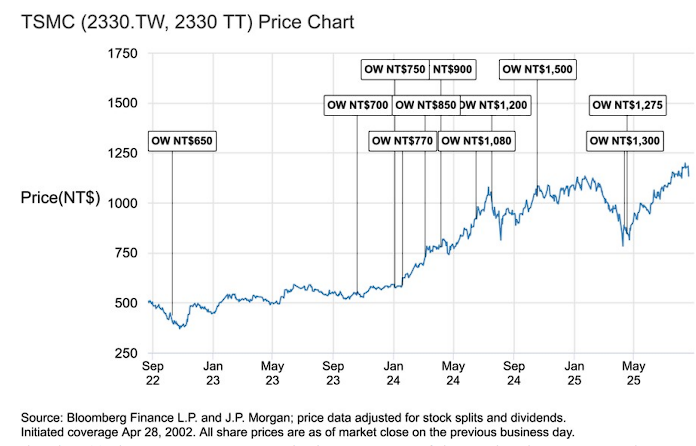
Core Viewpoint - Morgan Stanley believes that the existence of a slightly weaker competitor in the advanced process field may create a false sense of "choice" for customers, which could actually benefit TSMC by reducing ongoing government scrutiny and pressures from policies like "manufacturing return to the U.S." [2][3][7] Group 1: Market Dynamics - TSMC is expected to maintain over 90% market share in the advanced process field, with a "buy" rating and a target price of 1,275 New Taiwan Dollars [3][7]. - The notion of TSMC becoming a monopolist has not significantly increased its price-to-earnings ratio, which remains under pressure from government scrutiny and geopolitical risks [7][8]. Group 2: Intel's Foundry Business - The market may view the participation of major TSMC clients like Apple and Nvidia in Intel's foundry revival as a direct loss of market share for TSMC, but this is not entirely negative [9]. - Intel's foundry business faces fundamental challenges beyond financial issues, including the need for a different corporate culture and customer-centric innovation [11][12]. Group 3: Competitive Landscape - Intel's foundry strategy has historically struggled to gain traction, even when it had a dominant position in the CPU market [11]. - The best chance for Intel's foundry success may lie in adopting an N-1 approach, which could mitigate risks for potential customers and enhance capacity without directly competing with TSMC in advanced processes [12][13].


Palantir“六连跌”!成为“做空焦点”!纳指两连跌,科技股遭遇“获利了结”
美股IPO· 2025-08-21 03:28
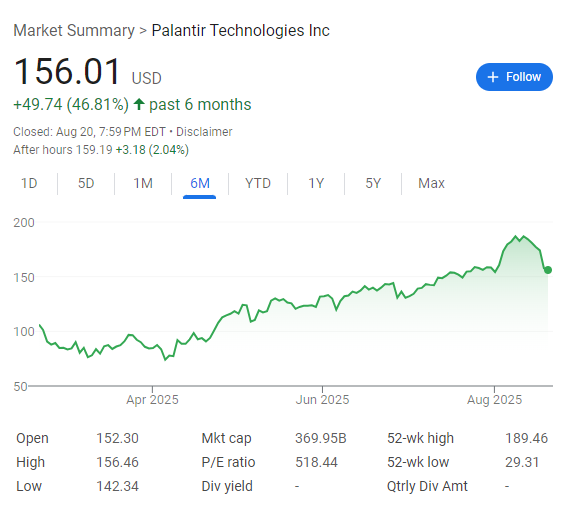
Core Viewpoint - Palantir's stock has experienced a significant decline of over 18% from its recent peak, marking the longest consecutive drop since April 2024, resulting in a market capitalization loss of $73 billion [1][5][12]. Group 1: Stock Performance and Market Reaction - The recent sell-off in technology stocks has led to profit-taking among investors, particularly affecting high-flying stocks that had previously driven index gains [3][10]. - Palantir's stock has fallen for six consecutive trading days, with a total drop of over 18%, pushing it out of the top 20 U.S. companies by market capitalization [12][11]. - The stock's decline has been attributed to a report from short-seller Citron Research, which criticized Palantir's valuation as disconnected from its fundamentals [8][11]. Group 2: Short Selling and Market Dynamics - Since early June, short positions in Palantir have increased by approximately 10 million shares, leading to over $1.6 billion in paper profits for short-sellers during this downturn [1][16][14]. - Despite the recent drop, Palantir's stock has still risen 106% year-to-date, making it the best-performing stock in the S&P 500 [15]. - The short interest in Palantir has decreased from nearly 5% a year ago to about 2.5%, indicating a shift in market sentiment among short-sellers [15]. Group 3: Valuation Concerns - Analysts have raised concerns about Palantir's high valuation, with a forward P/E ratio of 193 times, making it appear particularly expensive compared to peers [13][12]. - Citron's founder, Andrew Left, suggested that Palantir's stock price should be significantly lower based on its fundamentals, especially when compared to AI leaders like OpenAI [12][13]. - The overall market sentiment reflects a re-evaluation of high-valuation stocks, with many investors locking in profits and reallocating funds to cheaper sectors [10][9].
有英特尔的“虚假竞争”,对台积电“只有好处”
Hua Er Jie Jian Wen· 2025-08-21 02:28
Core Viewpoint - The threat posed by Intel's foundry business revival to TSMC is overstated, and it may actually benefit TSMC by alleviating regulatory pressures due to its monopoly status [1][3]. Group 1: Intel's Foundry Business - Intel's foundry revival is not purely negative for TSMC, as it may create a competitive environment that reduces regulatory scrutiny [1][5]. - The fundamental challenges facing Intel's foundry business extend beyond financial issues, including the need for a cultural shift towards customer-centric innovation and cost efficiency [1][6]. - Analysts believe that Intel must successfully execute on multiple advanced process nodes to gain credibility in the foundry market, which remains a significant challenge [5][6]. Group 2: TSMC's Market Position - TSMC is expected to maintain over 90% market share in advanced process technology, regardless of Intel's foundry efforts [1][5]. - The perception of TSMC as a potential monopolist has not significantly boosted its price-to-earnings ratio, and may instead attract more scrutiny from government agencies [3][5]. - A slightly weaker competitor in the advanced process space could create a perception of choice for customers, which may ultimately benefit TSMC by reducing regulatory pressures [3][5].
纳指两连跌,科技股遭遇“获利了结”,Palantir“六连跌”成“做空焦点”
Hua Er Jie Jian Wen· 2025-08-21 00:37
Core Viewpoint - The recent sell-off in technology stocks continues, with investors cashing in on gains from high-flying stocks that had driven indices higher this year [1][4] Group 1: Market Performance - The Dow Jones Industrial Average rose by less than 0.1%, while the S&P 500 index fell for the fourth consecutive day, and the Nasdaq Composite dropped by 0.7%, totaling a 2.1% decline over two days [1] - Palantir Technologies has seen its stock price decline for six consecutive trading days, marking its longest losing streak since April 2024, resulting in a market capitalization loss of $73 billion [1][5] Group 2: Factors Behind the Sell-off - The sell-off was triggered by a report from short-selling firm Citron Research, which claimed that Palantir's stock price was "disconnected from fundamentals" and suggested a much lower fair value [3] - Analysts view Palantir's decline as indicative of a broader market revaluation of overvalued stocks, particularly as major tech companies like Google, Meta, and Microsoft also experience declines [3][4] Group 3: Palantir's Valuation Concerns - Palantir's stock has dropped over 18% from recent highs, entering a technical correction and falling out of the top 20 U.S. companies by market capitalization [5] - Citron's founder Andrew Left stated that Palantir's current price reflects success beyond its fundamentals compared to true AI leaders, with a suggested price of $40 based on OpenAI's recent valuation metrics [6][5] Group 4: Short Selling Dynamics - The recent price drop has generated over $1.6 billion in paper profits for short sellers, although this only partially offsets their cumulative losses of $4.5 billion for the year [7] - Despite the recent downturn, Palantir's stock has still risen by 106% year-to-date, making it the best-performing stock in the S&P 500 [8] - There are signs that short sellers may be regrouping, with short positions in Palantir increasing by approximately 10 million shares since early June [9]

美股异动|芯片制造商亚德诺涨近5% 第三财季业绩超预期
Ge Long Hui· 2025-08-20 13:53
Core Viewpoint - Analog Devices, Inc. (ADI) reported strong financial results for Q3 FY2025, exceeding analyst expectations in both revenue and earnings per share, which led to a nearly 5% increase in stock price, reaching a high of $241.78 [1] Financial Performance - Revenue for Q3 FY2025 increased by 25% year-over-year, reaching $2.88 billion, surpassing analyst expectations of $2.76 billion [1] - Adjusted earnings per share (EPS) were reported at $2.05, exceeding the analyst forecast of $1.95 [1] - Adjusted gross margin improved by 130 basis points, reaching 69.2% [1] Future Outlook - The company anticipates Q4 FY2025 revenue to be approximately $3 billion, with adjusted EPS expected to be around $2.22, both figures exceeding market expectations [1] - The board of directors announced a quarterly dividend of $0.99 per share [1]

工业领域需求强劲 亚德诺(ADI.US)Q4营收与盈利指引齐超预期
Zhi Tong Cai Jing· 2025-08-20 13:17
Core Insights - Analog Devices (ADI) reported Q3 revenue of $2.88 billion, a 24.7% year-over-year increase, surpassing analyst expectations of $2.77 billion [1] - Adjusted earnings per share for Q3 were $2.05, exceeding market expectations of $1.95 [1] - The company experienced strong demand in the industrial sector, which accounted for 45% of total sales, growing 23% to $1.29 billion in Q3 [1] Financial Performance - Q3 revenue: $2.88 billion, up 24.7% YoY [1] - Adjusted EPS: $2.05, above market expectations [1] - Industrial sector revenue: $1.29 billion, up 23% [1] Future Outlook - For Q4, the company forecasts revenue of $3 billion, exceeding analyst predictions of $2.82 billion [1] - Expected adjusted EPS for Q4 is $2.22, higher than the analyst forecast of $2.03 [1] Dividend Announcement - The company declared a quarterly dividend of $0.99 per share, payable on September 16 to registered shareholders [2]
亚德诺第三财季业绩超预期 拟派季度股息每股99美分
Ge Long Hui A P P· 2025-08-20 12:57
Core Insights - Analog Devices reported a 25% year-over-year revenue growth for Q3 FY2025, reaching $2.88 billion, exceeding analyst expectations of $2.76 billion [1] - Adjusted earnings per share (EPS) were $2.05, surpassing the forecast of $1.95 [1] - Adjusted gross margin improved by 130 basis points to 69.2% [1] Revenue Breakdown - Industrial revenue increased by 23% year-over-year, amounting to $1.29 billion [1] - Automotive business revenue grew by 22% year-over-year, reaching $850.6 million [1] Dividend Announcement - The board declared a quarterly dividend of $0.99 per share [1] Future Outlook - For Q4, the company anticipates revenue of approximately $3 billion, higher than the analyst estimate of $2.82 billion [1] - Adjusted EPS is expected to be around $2.22, also above the analyst forecast of $2.03 [1] - The CEO noted a continued increase in backlog and healthy order trends, particularly in the industrial end market [1]
美股异动|台积电、美光盘前跌超1% 美国或考虑将“补贴换股权”计划扩围至其他芯片公司
Ge Long Hui· 2025-08-20 08:41
消息面上,据业内人士透露,美商务部部长霍华德·卢特尼克正在考虑是否将"补贴换股权"计划扩围至 英特尔之外的其他芯片制造公司,可能包括美光科技、台积电和三星等公司。据悉,去年年底时,美国 商务部最终确定向美光提供62亿美元补贴,向台积电提供66亿美元补贴,向三星提供47.5亿美元补贴, 以支持它们在美国生产半导体。目前,对这些公司的大部分补贴资金尚未发放。(格隆汇) 美光科技(MU.US)盘前跌超1.3%,报120.4美元;台积电(TSM.US)跌超1%,报230.2美元。 ...

特朗普迷上了“以股换补”! 继英特尔后台积电、三星等芯片巨头或面临美国政府入股
智通财经网· 2025-08-20 02:33
Core Viewpoint - The U.S. government is exploring a plan to exchange equity stakes in semiconductor companies for funding under the CHIPS Act, potentially expanding beyond Intel to include companies like Micron, TSMC, and Samsung [1][2][4]. Group 1: Government Initiatives - U.S. Commerce Secretary Howard Lutnick is investigating the possibility of the federal government acquiring equity in semiconductor giants that receive funding from the CHIPS Act [1][2]. - The plan aims to provide substantial financial support to companies building chip factories in the U.S., with the government potentially holding stakes in these firms [1][4]. - The initiative has received backing from former President Trump, who views it as a novel approach to bolster national security and economic interests [2][5]. Group 2: Financial Implications - The U.S. government has already committed significant cash subsidies to major chip manufacturers, including $4.75 billion to Samsung, $6.2 billion to Micron, and $6.6 billion to TSMC [4]. - The government is also re-evaluating previous cash subsidies, suggesting that some may be deemed overly generous [4]. - The equity stake approach could provide long-term financial benefits to the government amid a rising demand for AI-related chips and infrastructure [5][6]. Group 3: Market Outlook - The global semiconductor market is expected to grow significantly, with a projected increase of 11.2% in 2025, reaching a total value of $700.9 billion, driven by strong demand in AI and cloud computing sectors [7]. - The demand for AI chips and related infrastructure is anticipated to continue expanding, with companies like SK Hynix predicting a 30% annual growth in the HBM market over the next decade [7].
靠传闻撑起240亿市值 英特尔的“泡沫”能持续多久?
Jin Rong Jie· 2025-08-20 02:16
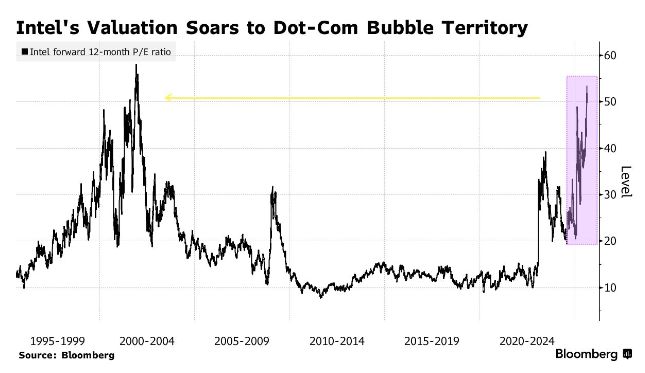
Core Viewpoint - Intel's stock has rebounded sharply, rising 28% this month, but its valuation has reached the highest level since the dot-com bubble, with a forward P/E ratio of 53 times, indicating significant market speculation and uncertainty about its future performance [1][3]. Group 1: Stock Performance and Valuation - Intel's market capitalization has increased by approximately $24 billion due to rumors of potential government equity acquisition and a $2 billion investment from SoftBank [1]. - The stock's current valuation reflects a dramatic increase in expectations, with a forward P/E ratio not seen since early 2002 [1][3]. - Analysts express concerns about the sustainability of Intel's high valuation, given its recent financial struggles and the uncertainty surrounding its earnings growth [4][5]. Group 2: Government Involvement and Market Sentiment - The U.S. government is reportedly exploring a plan to acquire about 10% of Intel's shares, which could convert existing subsidies into non-voting equity [3]. - Market analysts are divided, with less than 8% recommending a "buy" rating, while nearly 80% maintain a "neutral" stance, indicating widespread caution among investors [5]. - Despite the challenges, there is still some optimism regarding CEO Pat Gelsinger's leadership and ongoing cost-cutting measures, although concerns remain about the potential abandonment of technological competition [5].