代工业务

Search documents
统一企业中国(00220):营收稳定增长,分红优势仍足:统一企业中国(00220):
Shenwan Hongyuan Securities· 2026-03-20 11:19
Investment Rating - The investment rating for the company is "Buy" (Maintain) [2] Core Insights - The company reported a stable revenue growth with a proposed cash dividend of RMB 0.4747 per share, totaling approximately RMB 2.05 billion, resulting in a dividend payout ratio of 100% [7] - The company’s revenue for 2025 was RMB 31.71 billion, a year-on-year increase of 4.6%, while the net profit attributable to shareholders was RMB 2.05 billion, up 10.9% year-on-year [7] - The company is expected to achieve net profits of RMB 2.21 billion, RMB 2.31 billion, and RMB 2.47 billion for the years 2026, 2027, and 2028, respectively, with growth rates of 7.6%, 4.7%, and 7.0% [7] Financial Data and Profit Forecast - Revenue projections for the company are as follows: - 2024: RMB 30.33 billion - 2025: RMB 31.71 billion - 2026E: RMB 33.22 billion - 2027E: RMB 34.61 billion - 2028E: RMB 36.03 billion - The net profit attributable to ordinary shareholders is projected as follows: - 2024: RMB 1.85 billion - 2025: RMB 2.05 billion - 2026E: RMB 2.21 billion - 2027E: RMB 2.31 billion - 2028E: RMB 2.47 billion - The company’s return on equity (ROE) is expected to improve from 13.80% in 2024 to 17.62% in 2028 [6][8]
英特尔代工--最后的“机会窗口”
Hua Er Jie Jian Wen· 2026-02-20 07:13
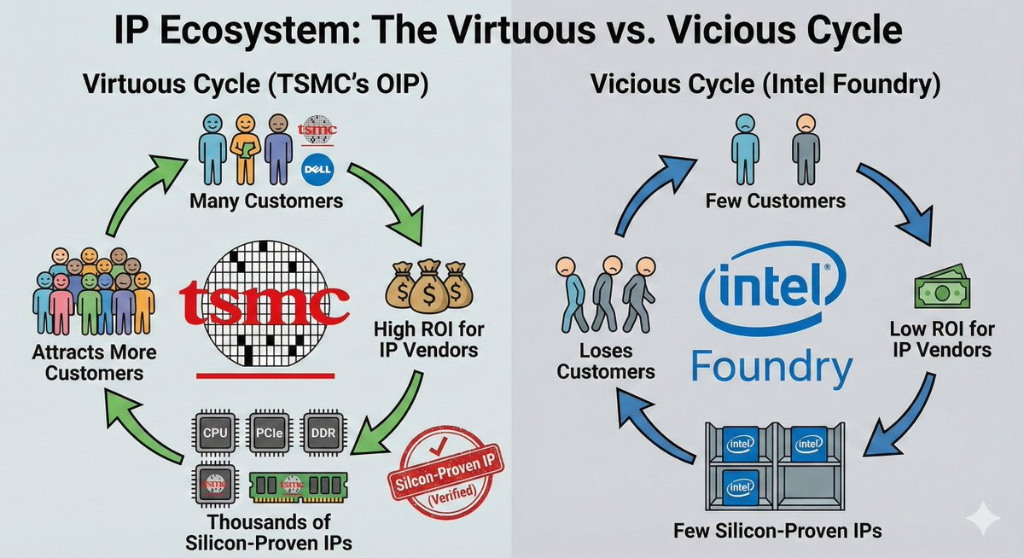
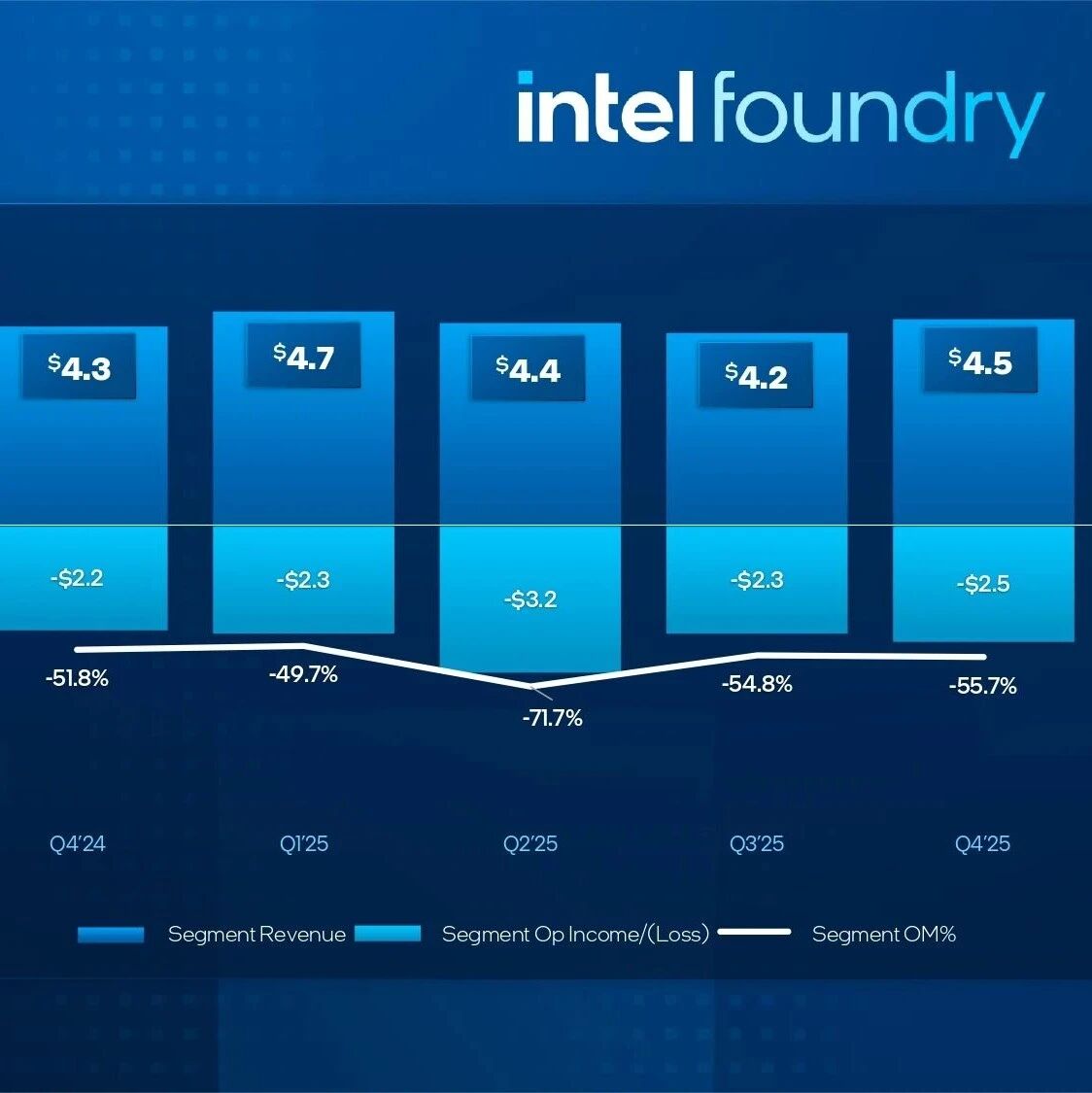
Core Insights - Intel's foundry business is at a critical juncture, facing significant financial losses and a lack of external customers, which poses a structural challenge to its operations [1][2] - The company has made aggressive technological bets, particularly with the 18A process node, but has yet to secure meaningful external client orders [1][2] Financial Performance - In Q4 2025, Intel's foundry business reported revenues of $4.5 billion but incurred an operating loss of $2.5 billion [1] - CEO Lip-Bu Tan acknowledged that the company has "invested too much, too fast" amid insufficient demand [1] Market Dynamics - The focus for investors has shifted from technological blueprints to the execution of Intel's strategies, particularly within a narrow "opportunity window" from 2026 to 2027 [2] - If Intel fails to establish a positive business cycle during this period, its foundry strategy may face irreversible contraction [2] Technological Barriers - The core barrier in the foundry business is not just technology but systemic barriers built over time, including the correlation between process design kits (PDK) and model hardware [3] - Intel's 18A PDK is not expected to be released until July 2024, which lags behind competitors like TSMC [3] Manufacturing Challenges - Best Known Methods (BKM) accumulation relies on scale, and Intel's current reliance on its x86 processors limits its experience with diverse designs [5] - The economic implications of low yield and capacity utilization are significant, with wafer costs exceeding $20,000 and yield improvements directly impacting chip costs [7] Competitive Landscape - Intel's 18A process is set to enter production in late 2025, but its success hinges on external customer validation, which is not expected until 2026 [10] - In direct competition with TSMC's N2 process, Intel claims advantages in performance and efficiency but faces challenges in transistor density [13] Client Acquisition Strategies - Intel's last chance may lie in securing contracts with fabless clients like Apple and Nvidia, who are exploring partnerships to diversify their supply chains [18][21] - Apple is reportedly testing Intel's 18A-P PDK, with potential plans to use Intel for entry-level chips in 2026 [18] - Nvidia has invested in Intel but remains cautious about collaboration, exploring a mixed approach to chip manufacturing [21] Time Sensitivity - Intel's time window is closing as TSMC and Samsung ramp up production capacity, which could dilute Intel's current advantages in U.S. manufacturing [22] - The success of the 18A-P process in attracting external customers is critical for Intel to initiate a positive feedback loop in yield learning and secure its future in the foundry market [22]


钓鱼第一股上市首日翻倍,95后女将掌舵,家族四年分红超4亿
21世纪经济报道· 2026-02-10 12:45
Core Viewpoint - Le Xin Outdoor International Limited, a fishing equipment manufacturer, has successfully listed on the Hong Kong Stock Exchange, becoming the first fishing equipment stock in the market, with a significant initial price surge of 102.29% on its debut day [1][3]. Company Overview - Le Xin Outdoor, headquartered in Deqing County, Huzhou City, Zhejiang Province, focuses on the design, research, and manufacturing of fishing equipment, having evolved from a fishing equipment division established in 1993 [5]. - The company operates three modern factories in Deqing, covering a total area of 63,637.7 square meters, with an annual production capacity of 6.2 million pieces and a product line of over 9,000 SKUs [5]. - Le Xin Outdoor holds a 23.1% share of the global fishing equipment market and a 28.4% share in the Chinese market, ranking first in both categories [3]. Financial Performance - The company's revenue from 2022 to 2024 was reported as follows: 818 million yuan in 2022, 463 million yuan in 2023, and 573 million yuan in 2024, with corresponding gross profits of 190 million yuan, 120 million yuan, and 153 million yuan [5]. - For the first eight months of 2025, the company achieved revenue of 460 million yuan and a net profit of 56.24 million yuan, nearing the total profit level of 2024 [6]. Business Model - Le Xin Outdoor employs a dual operational strategy of OEM/ODM and OBM, with OEM/ODM revenues consistently accounting for 90%-94% of total revenue from 2022 to 2025 [6]. - The top five customers contribute approximately 55% of the company's revenue, with the largest customer, Ardisam from the U.S., accounting for 17.7% [6]. Market Expansion - The company sells products to over 40 countries, including mature markets like the UK and the US, as well as rapidly growing markets in China and Southeast Asia [7]. - Le Xin Outdoor is also expanding its own brand business, having acquired the UK brand Solar in 2017, which has seen sales triple since 2018 [7]. Ownership Structure - The company is primarily controlled by the Yang family, with founder Yang Baoqing's family holding 94.77% of the shares post-IPO [10][11]. - Prior to the IPO, Le Xin Outdoor had no external investors, making it a typical family-controlled enterprise [10]. IPO Details - The IPO raised approximately 285 million HKD, with a significant oversubscription rate of 3654.23 times for the public offering [11]. - The funds raised will be allocated to brand development, product design, establishing a global innovation center for fishing gear, upgrading production facilities, and enhancing digital capabilities [11].

英特尔谈先进封装的机遇
半导体行业观察· 2026-01-25 03:52
Core Viewpoint - Intel's foundry business is progressing steadily, with expectations of generating "billions of dollars" in revenue from chip and advanced packaging orders, despite slow progress in balancing consumer and data center/AI segments [2][5]. Group 1: Foundry Business Progress - CEO Lip-Bu Tan highlighted advancements in process nodes and customer sampling, particularly with the 18A process, which is now shipping initial products based on Intel's most advanced semiconductor technology developed and manufactured in the U.S. [2] - Intel is competing with TSMC's N3 process, with potential customers like Apple showing interest in Intel's foundry services, although Intel's ability to scale production depends on securing sufficient capital expenditure [2][5]. - CFO David Zinsner indicated that capital spending for the 14A process will be unlocked once customer commitments are confirmed, with expected order commitments likely in the second half of this year and the first half of next year [2][5]. Group 2: Advanced Packaging Developments - Intel's advanced packaging business is seen as a significant growth area, with EMIB and Foveros technologies being recognized as promising solutions by high-performance computing customers [5][6]. - Orders for advanced packaging are projected to exceed "1 billion dollars," which is crucial for reducing operational losses in the foundry business and achieving breakeven [8]. - The willingness of customers to prepay production costs indicates strong demand for Intel's EMIB and EMIB-T technologies, showcasing a commitment to collaboration [6][8].
英特尔,有望拿下苹果芯片订单
半导体行业观察· 2026-01-24 02:39
Core Viewpoint - Intel is expected to secure Apple as a major client for its upcoming foundry business, driven by the steady advancement of its next-generation manufacturing processes [1][3]. Group 1: Intel's Manufacturing Process - Intel has released its advanced 14A process node's 0.5 Process Design Kit (PDK), with expectations that clients will officially adopt this technology between the second half of 2026 and the first half of 2027 [3]. - The analyst Jeff Pu anticipates a sufficient external customer reserve for the 14A process, listing potential partners such as Apple, Nvidia, and AMD [3]. - Intel's execution capabilities have improved, laying the groundwork for potential orders, including non-Pro series iPhone chips by 2028 [3]. Group 2: Current Focus and Future Prospects - Before the launch of the 14A process, Intel is focusing on its 18A process, which is showing steady yield improvements, expected to approach 70% by Q1 2026 [3]. - Other analysts, including Ming-Chi Kuo, have reported that Intel may begin delivering low-end M-series chips for Apple using the 18A process as early as 2027 [3]. - Apple is reportedly seeking to diversify its supply chain to mitigate geopolitical risks and control rising costs, making Intel a potential second supplier alongside TSMC [3].

4Q25全球科技业绩快报:英特尔
Haitong Securities International· 2026-01-23 08:13
Investment Rating - The report does not explicitly state an investment rating for the semiconductor industry or Intel, but it highlights strong performance metrics that suggest a positive outlook for the company. Core Insights - Intel delivered a solid fourth quarter for 2025, with revenue reaching $13.7 billion, surpassing both its guidance and consensus estimates, driven by growth in AI infrastructure and server segments [1][8] - The company achieved a non-GAAP gross margin of 37.9%, exceeding guidance by approximately 140 basis points, and a non-GAAP EPS of $0.15, significantly outperforming expectations [1][8] - Intel anticipates a CPU supply shortage in 1Q26 due to depleted buffer inventories, with improvements expected starting in 2Q26 as production efficiency increases [3][11] - The foundry business is progressing, with Intel beginning shipments of its 18A process and reporting steady yield improvements [4][12] Summary by Sections Financial Performance - In 4Q25, Intel's revenue was $13.7 billion, exceeding guidance and consensus estimates, with a non-GAAP gross margin of 37.9% and a non-GAAP EPS of $0.15 [1][8] - For 1Q26, Intel forecasts revenue between $11.7 billion and $12.7 billion, with a midpoint of $12.2 billion, lower than consensus due to supply constraints [5][13] Capital Expenditure (CapEx) - CapEx for 2026 is expected to be flat or slightly down due to balancing capital efficiency with demand signals, but a significant yield improvement of 7% to 8% has been reported [2][10] - Intel is securing equipment from suppliers like ASML to mitigate lead time issues, with an expected increase in CapEx in 2027 to support manufacturing expansion [2][10] Supply Chain and Production - Intel identifies 1Q26 as a critical period for CPU supply shortages, primarily due to production shifts towards server wafers [3][11] - The company is experiencing significant demand for CPUs driven by AI workloads, which is expected to sustain shortages for several years [3][11] Foundry Business Development - Intel's foundry revenue reached $4.5 billion, with successful shipments of the 18A process and steady yield improvements [4][12] - Development of the 14A process is on track, with customer engagement expected to lead to firm supply decisions in late 2026 to early 2027 [4][12]
长久以来最乐观的时候!财报前夜英特尔股价暴涨
Hua Er Jie Jian Wen· 2026-01-22 00:13
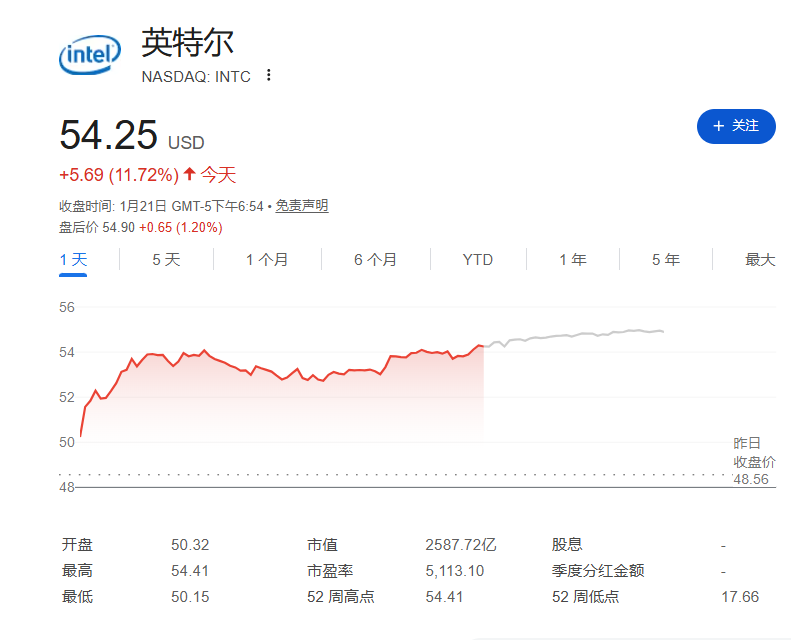
Core Viewpoint - Intel is regaining favor on Wall Street due to strong demand expectations in the data center segment and significant external investments, leading to a notable increase in stock price and market capitalization [1][2]. Group 1: Stock Performance and Market Sentiment - Intel's stock surged over 11% on Wednesday, reaching its highest point since January 2022, with a market capitalization surpassing $250 billion for the first time since 2022 [1]. - The stock has increased approximately 35% year-to-date in 2026 and has seen a cumulative rise of 149% over the past 12 months [1]. - Analysts express optimism about Intel's recovery, highlighting favorable recent developments and the upcoming earnings report as a critical test for the company's resurgence [1]. Group 2: Revenue Expectations and Business Performance - Intel's data center and AI business revenue is projected to surge nearly 29% to approximately $4.4 billion [5]. - Analysts from KeyBanc have upgraded Intel's stock rating to "buy" with a target price of $60, noting that server CPUs may be sold out this year, indicating potential price increases [5]. - There is an expectation of significant demand from large cloud computing firms, which is seen as a major tailwind for Intel's data center business [5]. Group 3: Strategic Investments and Business Vision - Intel's turnaround is supported by a restructuring of its capital and ambitions in the foundry business, with significant investments from external stakeholders [6]. - The U.S. government has become Intel's largest shareholder after investing $8.9 billion, partly due to Intel's unique capability to manufacture advanced chips domestically [6]. - Nvidia has invested $5 billion and is collaborating with Intel to integrate Intel's CPUs into Nvidia systems, while SoftBank has also invested $2 billion [6]. Group 4: Challenges in the PC Market and Profit Margins - Despite positive market sentiment, Intel faces challenges, with fourth-quarter revenue expected to decline by 6% to $13.4 billion [7]. - The PC segment is experiencing mixed results, with revenue projected to grow only 2.5% to $8.21 billion, amid rising memory prices and competition from AMD and Arm-based designs [7]. - Profit margins are under pressure, with adjusted gross margins expected to drop by approximately 6 percentage points to 36.5% due to high costs associated with repairing manufacturing operations [7].
甩掉“AI落后者”帽子!英特尔(INTC.US)开年暴涨31%,市场押注“代工霸主”将回归
智通财经网· 2026-01-16 12:24
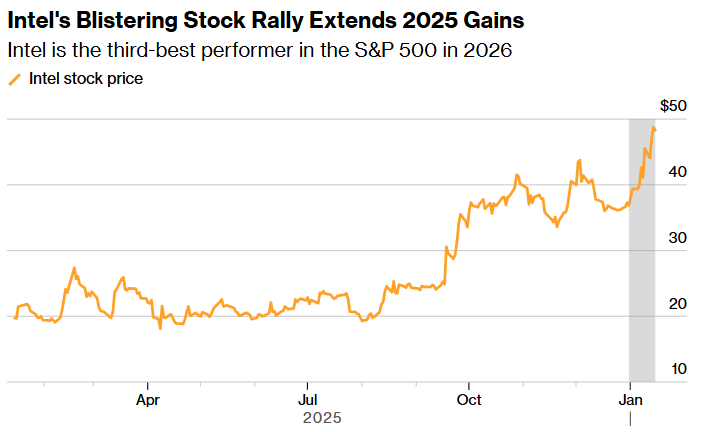
Core Viewpoint - Intel's stock has seen significant gains, reflecting investor optimism about new foundry clients and a potential return to the AI sector, despite previously abandoning it in 2024 [1] Group 1: Stock Performance - Intel's stock rose 31% at the beginning of 2026, following an 84% increase in 2025, making it the third-best performer in the S&P 500 [1] - The stock is nearing a two-year high after a 60% drop in 2024, indicating a recovery from previous underperformance compared to AI-focused competitors [1] Group 2: Analyst Ratings and Predictions - Analysts from Citigroup and KeyBanc have recently upgraded Intel's stock ratings, with the number of buy ratings reaching a one-year high [4] - KeyBanc's John Vinh raised Intel's rating to "overweight," citing strong market demand and progress in foundry business, with a target price of $60, indicating a 24% upside from the recent closing price of $48.32 [4] - The average target price from analysts is $40.66, suggesting a potential 16% decline in stock price over the next 12 months [4] Group 3: Market Opportunities - Intel is expected to benefit from the tight supply of advanced packaging from TSMC and has a unique opportunity to attract foundry clients with government support [5] - Demand for Intel's CPU chips, used in personal computers and data centers, remains strong, complementing the offerings from competitors like NVIDIA [5] Group 4: Geopolitical Factors - Intel's relationship with former President Trump has led to government investment, which has positively impacted its balance sheet [6] - As one of the few domestic chip manufacturers, Intel's position may enhance its stock price amid geopolitical tensions affecting major foundry operators like TSMC [6] Group 5: Future Outlook - The upcoming earnings report on January 22 will be crucial for investors looking for signs of performance improvement [4] - Analysts predict a 1% revenue decline for Intel in 2025, followed by a 3% growth in 2026, making future guidance from executives critical [7]
英特尔周五尾盘上涨7.4%
Xin Lang Cai Jing· 2026-01-02 20:49
Core Viewpoint - Intel (INTC) shares rose by 7.4% on Friday, driven by the release of its client system-on-chip (SoC) Panther Lake and ambitions in the foundry business, which boosted market confidence [1] Group 1 - Intel's client SoC Panther Lake release is a significant factor in the recent stock price increase [1] - The company's ambitions in the foundry business are contributing to positive market sentiment [1]
存储之王回归?大摩:三星HBM业务已实现全面赶超,2026年盈利或暴增150%
美股IPO· 2025-11-24 07:45
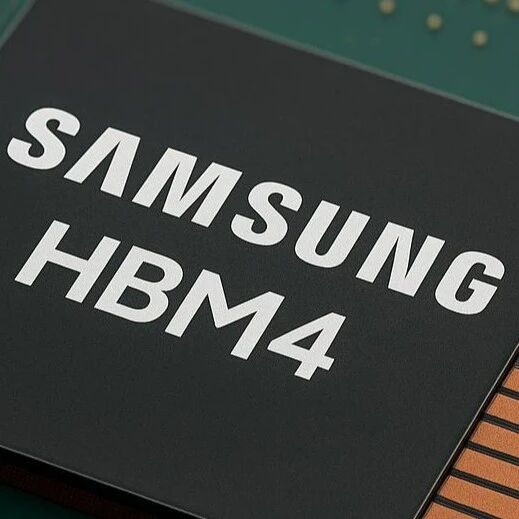
Core Viewpoint - Morgan Stanley believes that Samsung is regaining dominance in the memory market with its "technology-first" strategy, projecting a more than 150% increase in earnings per share from 2025 to 2026 [3][5]. Group 1: High Bandwidth Memory (HBM) Developments - Samsung has achieved significant progress in the High Bandwidth Memory (HBM) sector, with HBM4 products undergoing multiple qualification tests, and initial results expected in early December [3]. - The company currently has an effective DRAM capacity of 500,000 wafers, significantly surpassing its competitors [3][5]. - Samsung's unique advantages in high-speed (>11 Gbps) and end-to-end solutions from DRAM to packaging are expected to enhance its market share [3]. Group 2: DRAM Market Dynamics - The DRAM order fulfillment rate has dropped to around 70% of customer demand, indicating a continued visibility into the first half of 2026 [3]. - Samsung's management is adopting a more rational strategy, focusing on sustainable profitability through collaboration with key customers rather than chasing market trends [3]. Group 3: NAND Pricing Forecasts - NAND contract pricing is expected to increase significantly, with forecasts indicating a rise of 25-30% for enterprise SSDs in Q4 2025 and a gradual decrease in growth rates into 2026 [4]. Group 4: Foundry Business Recovery - Samsung's foundry business is showing signs of recovery, with improved utilization rates and advanced process performance driving profitability [5]. - The company has secured multiple orders in the 2nm process area, indicating a positive shift in its customer-centric culture [5]. - Morgan Stanley projects Samsung's earnings per share to reach 14,464 KRW in 2026, nearly 50% higher than current market consensus [5].