油气

Search documents
美欧制裁俄油企事件发酵 全球油气市场再掀波澜
Zhong Guo Hua Gong Bao· 2025-11-07 08:42
Group 1 - The Western sanctions against the Russian oil and gas industry continue, with the US and EU implementing new restrictions on Russian oil companies, impacting global oil trade flows [1][2] - The sanctions have led to a temporary increase in international oil prices, with NYMEX and ICE crude oil contracts rising significantly, although prices have since retracted [2][3] - India's oil imports from Russia are expected to be affected, with a slight decrease projected for 2025, but overall imports remain significantly higher than in 2022 [2][3] Group 2 - Indian refiners are likely to comply with the sanctions, but the search for alternative crude sources will impact oil prices in India and globally [3] - The Indian refining sector is adjusting its crude import structure, increasing imports from Colombia, Canada, and the Middle East while reducing Russian crude imports [3] - OPEC+ has decided to pause production increases in the first quarter of 2026 after a slight increase in December, reflecting concerns over global supply-demand balance amid geopolitical risks [4][5] Group 3 - OPEC+ aims to balance market share and oil prices, having restored significant production levels since April, but faces challenges from US shale oil production [4][5] - There is a notable divergence in forecasts between OPEC and the International Energy Agency regarding global oil demand and supply, indicating uncertainty in the market [5]
欧洲头条丨美“气”太多 欧盟难以“下咽”
Yang Shi Xin Wen Ke Hu Duan· 2025-11-07 06:38
Core Points - The sixth Transatlantic Energy Cooperation Partners Conference was held in Athens, Greece, focusing on European energy security, affordability, and reliability, covering key areas such as artificial intelligence, vertical gas corridors, energy infrastructure security, nuclear technology, and fuel diversification [1] Group 1: Vertical Gas Corridor - The "Vertical Gas Corridor" project emerged as a focal point of the conference, connecting Greece, Bulgaria, Romania, Moldova, Ukraine, Hungary, and Slovakia, facilitating the transport of U.S. liquefied natural gas (LNG) to Central and Eastern Europe since its launch in 2022 [3] - EU Energy and Housing Commissioner Dan Jørgensen emphasized the project's critical importance for European energy security, stating that without energy security, there is no overall security [5] Group 2: U.S. Sanctions on Russia - On October 22, the U.S. announced sanctions against Russian oil companies, including Lukoil, which accounted for half of Russia's total oil exports, causing significant concern among EU member states [7] - The sanctions have led to legislative actions in Bulgaria to ensure energy supply security, highlighting the potential impact on the fuel market in Bulgaria and the broader EU [9] Group 3: Shift in Energy Supply - The EU has significantly reduced its energy dependence on Russia, with imports of natural gas and oil from Russia dropping from 45% and 27% in 2022 to 13% and 3% in 2023, respectively [9] - The U.S. has rapidly filled the market share left by Russia, becoming the largest source of LNG and oil for Europe, accounting for 55% and 17% of total imports as of July [9] - A new trade agreement indicates that the EU will purchase up to $750 billion worth of energy products from the U.S. over the next three years, potentially leading to 70% of LNG imports coming from the U.S. if Russia's share is fully replaced [9][10] Group 4: Challenges in Energy Transition - Concerns have been raised regarding the feasibility of the EU's plan to purchase $750 billion in energy from the U.S. within three years, as it would require a threefold increase in imports of oil, coal, and LNG [10] - The demand for natural gas in the EU is expected to decline by 7% by 2030 due to the increased development of renewable energy sources [12] - European Parliament members have warned that increasing U.S. LNG imports could undermine EU climate agreements and expose the EU to political leverage risks, indicating a complex energy dependency shift from Russia to the U.S. [12]


平安证券(香港)港股晨报-20251107
Ping An Securities Hongkong· 2025-11-07 03:03
Market Overview - The Hong Kong stock market experienced fluctuations, with the Hang Seng Index closing at 23,831 points, down 145 points or 0.61% [1] - The market saw a significant increase on a previous day, with the Hang Seng Index rising 2.12% to 26,485.90 points, and the Hang Seng Technology Index soaring 2.74% [1] - Southbound funds recorded a net inflow of 31.2 billion HKD in the first four trading days of November, significantly surpassing last year's total of 80.79 billion HKD [3] Key Sectors - The semiconductor sector showed strong performance, with companies like Hua Hong Semiconductor and SMIC seeing stock increases of over 9% and 7% respectively [1] - The report emphasizes the importance of technology sectors such as artificial intelligence, semiconductors, and industrial software as core investment themes for the future [3] - The energy sector, particularly companies like China National Offshore Oil Corporation and China Petroleum, is highlighted for its low valuation and high dividend yield [9] Company Performance - Hua Hong Semiconductor reported a record high in sales for the third quarter, although its net profit decreased by 42.6% year-on-year [11] - China Petroleum signed contracts worth nearly 17.5 billion USD at the recent China International Import Expo [11] - BYD's sales figures for October showed a significant volume, with over 20,000 units sold for its new model [11] Investment Recommendations - The report suggests focusing on companies in the technology sector, particularly those involved in AI and semiconductor production, as they are expected to benefit from long-term growth opportunities [3] - It also recommends considering state-owned enterprises with lower valuations and higher dividends, as well as upstream non-ferrous metal companies benefiting from anticipated interest rate cuts [3]
行业整合及产能优化持续推进,石油ETF(561360)涨超1.5%
Sou Hu Cai Jing· 2025-11-07 02:41
Core Viewpoint - The oil refining sector is expected to benefit from cost control and demand recovery in the first three quarters of 2025, leading to improved profitability for some companies [1] Industry Summary - The overall industry is influenced by fluctuations in international oil prices and downstream demand, maintaining a high operating rate for refining companies [1] - The trading sector is impacted by commodity price volatility, with some companies achieving performance growth through supply chain optimization and risk management [1] - Long-term trends indicate ongoing industry consolidation and capacity optimization, with leading companies possessing cost advantages showing strong profitability stability [1] ETF Overview - The oil ETF (561360) tracks the oil and gas industry index (H30198), which selects listed companies involved in oil and gas exploration, extraction, processing, and related services [1] - The index reflects the overall performance of listed companies in the oil and gas industry, characterized by high industry concentration and a focus on the energy sector, highlighting its cyclical nature [1]
国家能源局召开学习贯彻党的二十届四中全会精神座谈会
国家能源局· 2025-11-07 01:51
Core Viewpoint - The article emphasizes the importance of implementing the spirit of the 20th Central Committee's Fourth Plenary Session within the energy sector, highlighting the need for political awareness and alignment with the central government's decisions [3][4]. Group 1: Key Messages from the Meeting - The meeting focused on the significance of understanding and implementing the achievements of the "14th Five-Year Plan" period, which are attributed to the leadership of the Central Committee and the guidance of Xi Jinping's thoughts [3]. - It is crucial to grasp the core essence of the plenary session's spirit, including the strategic tasks and major principles for the "15th Five-Year Plan" period [3][4]. - The meeting underscored the necessity of strengthening the Party's leadership as a fundamental guarantee for advancing modernization in China [4]. Group 2: Energy Development Strategies - The energy sector must prioritize energy security by enhancing domestic supply capabilities and diversifying overseas resource supplies to ensure a stable energy supply chain [4]. - There is a commitment to advancing the green and low-carbon transformation of energy, focusing on building a new energy system and promoting green energy consumption [4]. - The importance of technological innovation in the energy sector was highlighted, with an emphasis on smart, green, and integrated development to drive quality and efficiency changes [4]. - The meeting called for deepening energy system reforms and enhancing the market framework to stimulate vitality and optimize the business environment [4]. - Strengthening international cooperation in the energy sector is essential, with a focus on maintaining strategic confidence and expanding high-level openness while ensuring energy security [4]. Group 3: Regional Focus on Gansu Province - Gansu Province is recognized as a significant energy province, responsible for both meeting its energy needs and undertaking key tasks like "West-to-East Power Transmission" [5]. - The province has unique advantages in developing and utilizing renewable energy, which can facilitate its transition to a green and low-carbon energy system [5][6]. - The energy sector in Gansu is encouraged to leverage its strengths, accelerate technological innovation, and deepen market system construction to contribute to high-quality energy development [6].
“十四五”以来我省能源转型底色更绿、韧性更强
Da Zhong Ri Bao· 2025-11-07 01:00
Core Insights - Since the "14th Five-Year Plan," Shandong has made significant progress in energy transition, achieving a greener and more resilient energy system, with one-third of electricity consumption coming from green energy [2][3] Energy Supply and Infrastructure - Shandong has established a robust energy supply system, maintaining coal and crude oil production at approximately 86 million tons and 22 million tons respectively, with coal storage capacity reaching 20 million tons and gas storage capacity at 2.52 billion cubic meters [2] - The total installed power capacity in Shandong reached 250 million kilowatts, ranking second in the country, with an expected annual electricity generation of around 700 billion kilowatt-hours [2] Clean Energy Development - The installed capacity of non-fossil energy sources has historically surpassed coal power, reaching 134 million kilowatts, which is 2.8 times that of 2020, accounting for 53.4% of total power capacity, an increase of 22.6 percentage points [3] - Shandong has developed 5.92 million kilowatts of offshore wind power, ranking third nationally, and has maintained the highest photovoltaic power generation capacity in the country at 91.728 million kilowatts [3] Energy Storage and Consumption - The province has accelerated the development of diverse energy storage facilities, with new energy storage capacity increasing more than fivefold compared to the end of 2022, reaching over 9.6 million kilowatts [3] - Currently, one-third of the electricity consumed in Shandong is from clean energy sources, with renewable energy generation expected to reach 164.7 billion kilowatt-hours by 2024 [3] Market Reforms and Investments - Shandong has implemented key reforms to energize the energy market, with registered electricity market participants reaching 43,000 and transaction volumes accounting for 51% of total electricity consumption [4] - Annual investments in energy projects have exceeded 200 billion yuan, supporting stable investment and growth [4] Infrastructure and Public Benefits - The province has established a leading urban and rural charging service network, with 1.488 million charging facilities, a 19-fold increase since 2020, achieving full coverage in charging stations [4] - Shandong has introduced a tiered electricity pricing policy, significantly reducing costs for electric vehicle charging, with prices as low as 0.222 yuan per kilowatt-hour during off-peak hours [4]
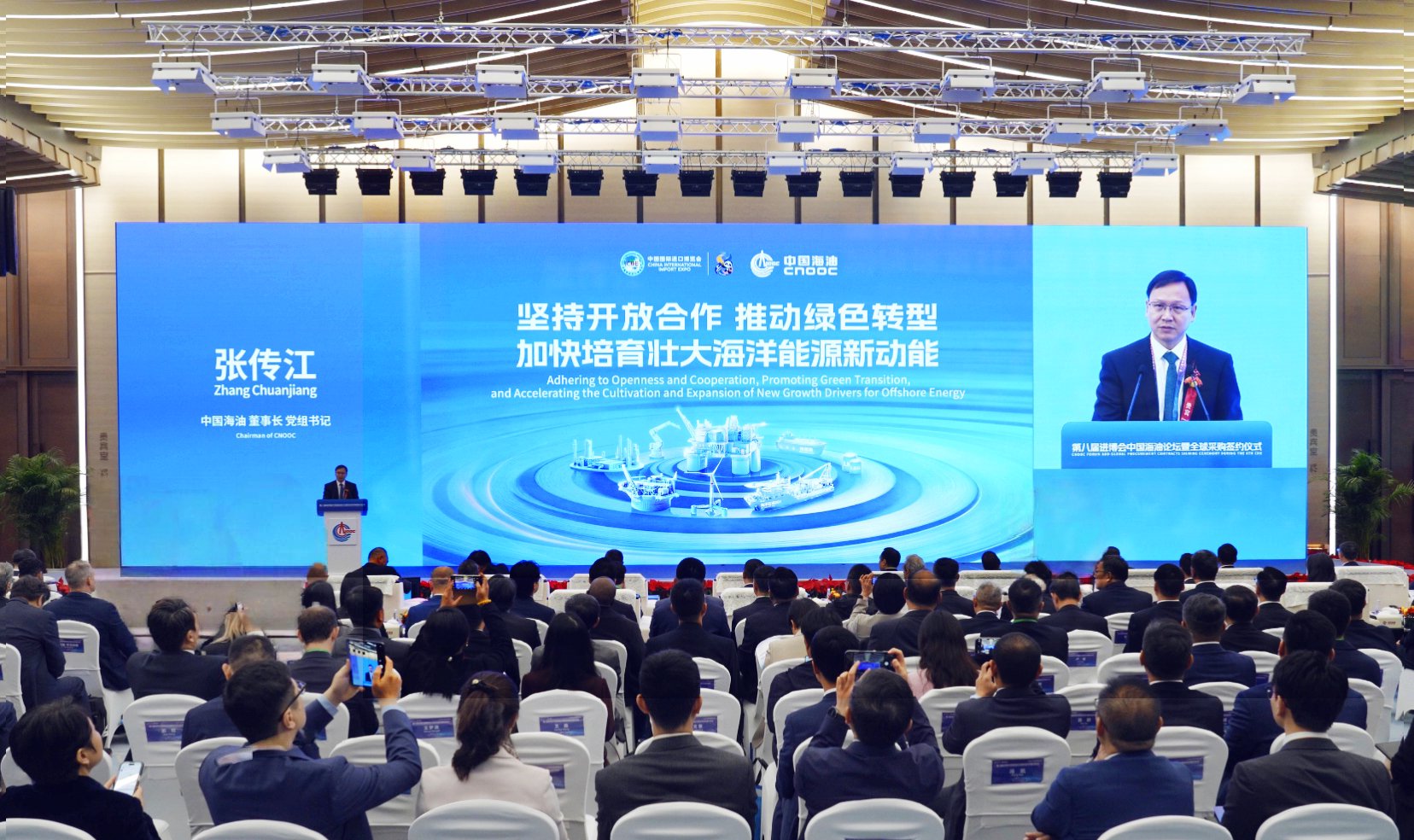
聚焦进博会|“三桶油”进博会累计签约超五千亿元 中国海油签约额创历史新高
Di Yi Cai Jing· 2025-11-06 14:45
Core Insights - The "Three Barrel Oil" companies (China National Petroleum Corporation, Sinopec, and China National Offshore Oil Corporation) have signed significant contracts at the 8th China International Import Expo, indicating a strong commitment to international cooperation in the energy sector [2][3][5] Group 1: Contract Details - China National Offshore Oil Corporation signed contracts exceeding $130 billion (approximately 926 billion RMB), marking a record high for the company at this expo [2] - Sinopec signed agreements with 34 partners from 17 countries, covering 24 product categories with a total procurement amount exceeding $409 billion [3] - China National Petroleum Corporation signed 43 procurement agreements with 41 global partners, totaling $174.85 billion, showing a stable increase compared to the previous year [3] Group 2: Cumulative Agreements - The total contracts signed by the "Three Barrel Oil" companies at this expo reached nearly $714 billion (approximately 5,082 billion RMB) [3] - Since the first expo, China National Petroleum Corporation, Sinopec, and China National Offshore Oil Corporation have collectively signed contracts worth approximately $5,588 billion (around 39.8 trillion RMB) with international suppliers [3] Group 3: Strategic Focus - High-level executives emphasized the importance of open cooperation, energy security, green transformation, and fostering new productive forces in their speeches [5] - The geopolitical landscape, including conflicts like the Russia-Ukraine and Israel-Palestine situations, has impacted the stability of the energy supply chain and investment rhythms in the oil and gas sector [5] - The executives highlighted the need for collaboration in the evolving global energy landscape, focusing on sustainable development and technological innovation [5][6] Group 4: Future Initiatives - The General Manager of China National Petroleum Corporation proposed leveraging the Belt and Road Initiative to enhance bilateral and multilateral cooperation in the energy sector [6] - There is a push for the development and utilization of low-carbon technologies such as carbon capture, utilization, and storage (CCUS), hydrogen, and solar energy [6] - The establishment of a high-level international cooperation system for innovation and the application of artificial intelligence in the energy sector is also a priority [6]



聚焦进博会|“三桶油”进博会累计签约超五千亿元,中国海油签约额创历史新高
Di Yi Cai Jing· 2025-11-06 14:45
Core Viewpoint - The recent China International Import Expo (CIIE) highlighted significant procurement agreements by China's major oil companies, emphasizing the importance of multilateral cooperation, energy security, green transition, and technological innovation in the energy sector [1][4][5] Group 1: Procurement Agreements - China National Offshore Oil Corporation (CNOOC) signed contracts exceeding $130 billion (approximately 926 billion RMB), marking a historical high for a single CIIE [1] - China Petroleum and Chemical Corporation (Sinopec) and China National Petroleum Corporation (CNPC) also secured substantial agreements, with Sinopec's procurement amounting to over $40.9 billion and CNPC's agreements totaling $17.485 billion [2] - Cumulatively, the "Three Barrel Oil" companies signed contracts worth nearly $71.4 billion (approximately 508.2 billion RMB) at this year's CIIE, contributing to a total of approximately $558.8 billion (around 3.98 trillion RMB) since the first CIIE [2] Group 2: Industry Challenges and Responses - Geopolitical tensions, such as the Russia-Ukraine conflict and the Israel-Palestine conflict, have impacted the stability of the international energy market and increased energy supply security risks [4] - The transition from conventional to unconventional oil and gas exploration and the need for technological upgrades in energy equipment are critical challenges facing the industry [4] - The global push for a green low-carbon transition is a pressing issue that energy companies must address [4] Group 3: Strategic Initiatives - CNOOC's chairman emphasized the necessity of open cooperation for energy security and the importance of green transition for sustainable development [6] - The general manager of CNPC advocated for leveraging the Belt and Road Initiative to enhance bilateral and multilateral cooperation in the energy sector [6] - There is a focus on advancing low-carbon technologies such as carbon capture, utilization, and storage (CCUS), hydrogen, and solar energy, alongside fostering international collaboration in innovation and artificial intelligence applications [6]
俄罗斯10月油气收入同比下降超26%
Ge Long Hui A P P· 2025-11-06 12:38
格隆汇11月6日|据塔斯社的计算和俄罗斯财政部的统计数据,2025年10月,俄罗斯的石油和天然气收 入同比下降26.6%,从上年同期的12118亿卢布(约合149亿美元)降至8886亿卢布(约合109亿美元),不过 收入较上月(5825亿卢布或72亿美元)增长了52.6%,这一增幅主要归因于季度征收的额外利润税,在10 月带来了3278亿卢布(约合40.5亿美元)的收入。1-10月,石油和天然气收入下降了21.4%,降至7.498万 亿卢布(约合925亿美元),去年同期,这一数字为9.539万亿卢布(约合1180亿美元)。 ...
ETF今日收评 | 半导体、芯片相关ETF涨超4% 影视ETF跌超2%
Mei Ri Jing Ji Xin Wen· 2025-11-06 07:44
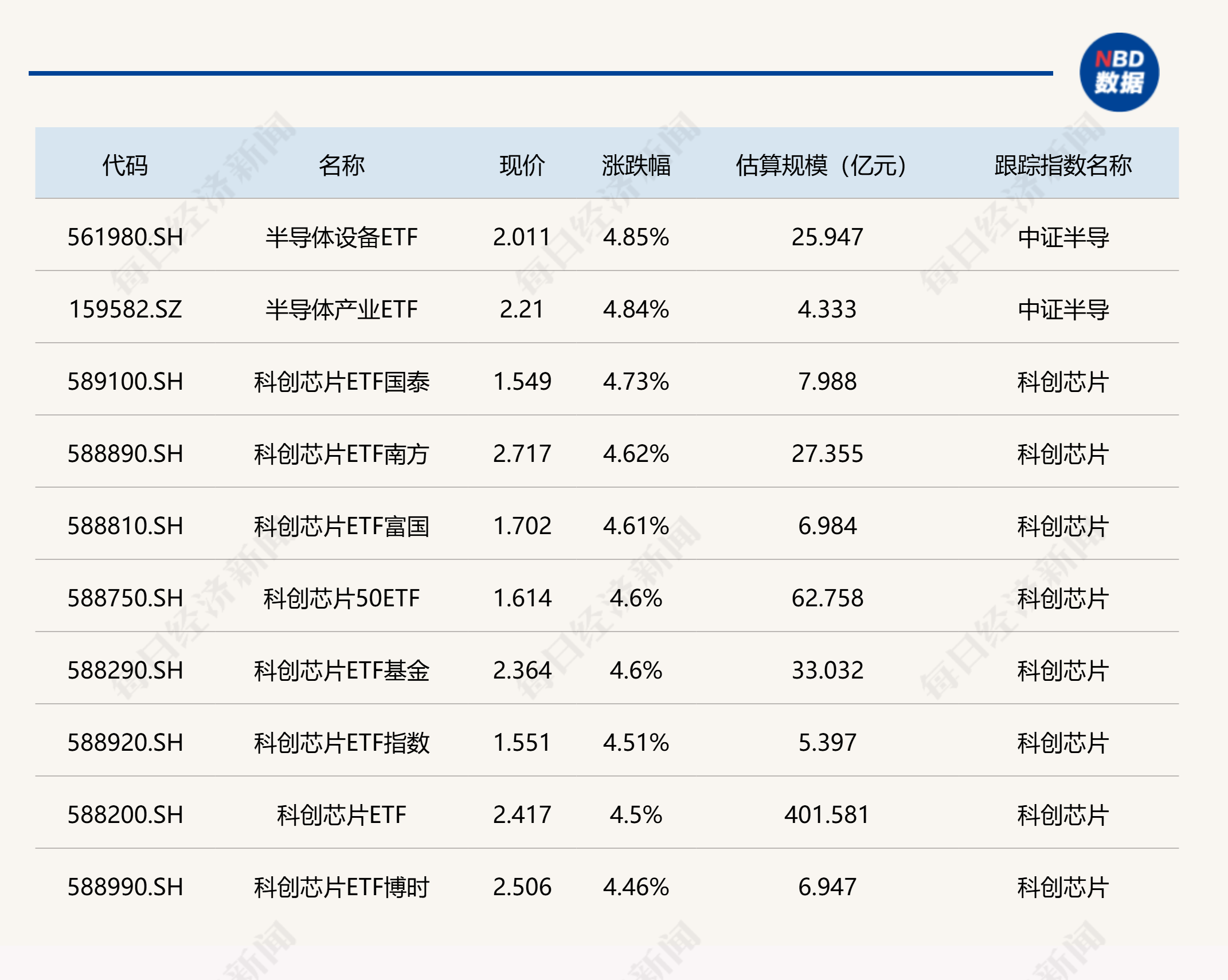
Market Overview - The market showed strong performance throughout the day, with the Shanghai Composite Index rising nearly 1% to reclaim the 4000-point level [1] - The chemical sector experienced a collective surge, while the semiconductor chip concept continued to rise [1] - The electric grid equipment sector maintained its strong performance, and the electrolytic aluminum concept was also active [1] - In contrast, the film and tourism sectors saw a collective decline [1] ETF Performance - Semiconductor and chip-related ETFs rose over 4% [1] - Specific ETFs such as the Semiconductor Equipment ETF and various Innovation Chip ETFs showed significant gains, with the Semiconductor Equipment ETF at 2.011 and a rise of 4.8% [2] AI and Technology Insights - Brokerages noted that as AI models evolve, the commercial models for AI applications are becoming clearer [3] - The release of Sora 2.0 introduced social attributes, expanding OpenAI's monetization channels and enhancing user engagement [3] - OpenAI secured orders for storage and GPU components from major companies like Samsung, SK Hynix, and AMD, indicating a growing demand for AI infrastructure [3] Sector Analysis - The film ETF declined over 2%, reflecting challenges in the media sector [4] - Long-term expectations for the media industry are optimistic, with anticipated recovery in content supply and continued technological empowerment from AI [5] - Companies in the film, gaming, and advertising sectors are recommended for monitoring due to their potential strong performance [5]