
石油ETF

Search documents
多只油气相关ETF上周份额大减, 超10亿元资金抢筹德明利!
摩尔投研精选· 2026-03-16 10:19
Core Viewpoint - The article highlights the trading activities in the Shanghai and Shenzhen stock markets, focusing on the top traded stocks, sector performances, and ETF transactions, indicating significant movements in capital flows and investor sentiment. Group 1: Stock Market Trading - The total trading volume of the Shanghai and Shenzhen Stock Connect reached 302.8 billion, with Zijin Mining and CATL leading in trading volume for the Shanghai and Shenzhen markets respectively [1][4][5]. - The top ten stocks traded on the Shanghai Stock Connect included Zijin Mining, Bawei Storage, and China Aluminum, with transaction amounts of 32.25 billion, 22.29 billion, and 19.32 billion respectively [3][4]. - On the Shenzhen Stock Connect, CATL topped the list with a transaction amount of 46.70 billion, followed by Xinyi Technology and Yangguang Power with 33.59 billion and 33.31 billion respectively [3][5]. Group 2: Sector Performance - The electronic sector saw the highest net inflow of capital, amounting to 68.92 billion, with a net inflow rate of 1.84% [7]. - Other sectors with significant net inflows included semiconductors (56.21 billion, 3.31%) and automotive (20.58 billion, 8.75%) [7]. - Conversely, the new energy sector experienced the largest net outflow of capital at -146.74 billion, with a net outflow rate of -4.30% [8][9]. Group 3: ETF Transactions - The A500 ETF Fund (512050) recorded the highest trading volume among ETFs at 102.34 billion, with a 4.32% increase compared to the previous trading day [14]. - The top ten ETFs by trading volume also included the Zhonghan Semiconductor ETF (513310) with 99.87 billion, showing a significant increase of 113.97% from the previous day [14][15]. - Several oil and gas-related ETFs saw substantial reductions in shares, with the Oil ETF (561360) decreasing by 1.167 billion shares, leading the decline [17].






ETF生态周报(2026.03.02-03.06)——ETF市场整体综合面板
华宝财富魔方· 2026-03-12 09:37
Market Overview - As of March 6, 2026, the total market size of ETFs reached 5.30 trillion yuan, a decrease of 0.72 trillion yuan since the beginning of the year, with the number of listed ETFs increasing to 1,445, adding 45 new listings [2][22] - The stock-type ETFs accounted for 3.09 trillion yuan, while bond-type ETFs totaled 737.49 billion yuan, and commodity-type ETFs increased by 106.15 billion yuan to 356.61 billion yuan, driven by strong demand for gold as a safe haven [2][22] Performance Disparity - Last week, leading military industry ETFs and dividend ETFs had PE percentiles close to 100, while the Hang Seng Technology ETF (15.57), pharmaceutical ETF (32.73), and electric power ETF (44.71) remained at historical low valuations, indicating potential investment opportunities [2][12][18] - The performance of various sectors showed significant divergence, with cyclical manufacturing ETFs like oil rising by 8.20%, while broader indices like the CSI 300 and CSI 500 experienced declines of 1.23% and 3.62%, respectively [12][16] Fund Flows - Overall, funds showed a defensive tendency last week, with broad-based ETFs experiencing net outflows, while commodity (gold) and fixed-income ETFs attracted capital, with SGE gold seeing a net inflow of 877.57 billion yuan year-to-date [3][20] - The main inflow channels were thematic ETFs (+2,016 billion yuan) and cyclical manufacturing ETFs (+1,443 billion yuan), indicating a clear trend of capital migrating from broad-based ETFs to thematic and cyclical sectors [3][33] Issuance Dynamics - The issuance of ETFs accelerated last week, with 77 ETFs in the process of being issued (up 48% week-on-week), and 12 new funds established (up 140%) [4][52] - New products primarily focused on energy sectors, with electric grid equipment, electric power, and photovoltaic ETFs dominating the new listings, reflecting current market trends [4][52] Trading Activity - The total trading volume of ETFs was approximately 2.9 trillion yuan last week, with bond-type ETFs leading the increase, followed by stock-type ETFs [39] - The short-term bond ETF from Hai Fu Tong had a weekly trading volume of 2,991.97 billion yuan, indicating high liquidity in the bond market [41] Valuation Insights - The valuation structure showed that core broad-based ETFs remained relatively stable, while growth and small-cap valuations were more volatile, reflecting a higher sensitivity to market fluctuations [12][18] - The Hang Seng Technology ETF and other low-valuation sectors like pharmaceuticals are attracting attention for potential long-term investments due to their historical low PE percentiles [18][20]

ETF市场整体综合面板
HWABAO SECURITIES· 2026-03-12 05:40
1. Report Industry Investment Rating No relevant content provided. 2. Core Viewpoints of the Report - The overall ETF market in the week of 2026.03.02 - 2026.03.06 showed a trend of structural differentiation. The equity market was generally weak, with high - valuation broad - based ETFs under pressure, while bonds provided hedging, and sectors with defensive/resource attributes such as oil and electricity were relatively dominant. There was a clear migration of funds from equity broad - based ETFs to gold, fixed - income, and some thematic ETFs, indicating a defensive tendency [21][22][31]. - The issuance of ETFs accelerated significantly last week, with new products mainly in the energy direction. However, the grid equipment ETF was at a high valuation, and the concentrated issuance might increase congestion, while the power ETF had a relatively reasonable valuation and controllable risks [4]. 3. Summary by Relevant Catalogs 3.1 Scale: Total Expansion and Structural Stratification (Market/Product/Institution) 3.1.1 Product Scale - As of March 6, 2026, the total number of ETFs in the whole market was 1,446, with a total scale of 53,029.83 billion yuan and 33,703.54 billion shares. Stock - type ETFs were the absolute main force, with 1,131 funds, a scale of 30,882.03 billion yuan, and 21,131.36 billion shares. The scale of cross - border ETFs was 9,452.05 billion yuan, bond - type ETFs was 7,374.88 billion yuan, commodity - type ETFs was 3,566.12 billion yuan, and currency - type ETFs was 1,749.61 billion yuan [11][13]. - Compared with the previous week, the overall share increased by 30.9 billion, but the scale decreased by 83.6 billion yuan. Stock - type ETFs increased in number and share but decreased in scale, while bond - type, commodity - type, and currency - type ETFs increased in both share and scale [12]. 3.1.2 Institution Scale - Last week, the top 20 fund companies managed a total net asset value of 23 trillion yuan, accounting for 62% of the whole market, showing a significant industry head effect and a high level of concentration. The top 10 fund companies mainly focused on currency and equity (stocks + ETFs). E Fund and China Asset Management had leading and more balanced total scales, Tianhong was more focused on currency - type products, and Bosera, Fullgoal, and Penghua had a more fixed - income - oriented structure [14]. - Compared with the previous week, the scale fluctuations last week mainly came from the stock and ETF sectors. Some leading institutions' equity and ETF scales declined, while some medium - sized institutions showed an incremental trend, and the differentiation among institutions increased [16]. 3.2 Performance: Rise - Fall Differentiation and Valuation Position 3.2.1 Large - Category ETFs - Last week, the domestic equity market was generally weak, with broad - based indexes generally retreating. The small - and medium - cap indexes (CSI 500/CSI 1000) had larger declines, and the valuation quantiles were still at a high level. Structurally, there was obvious differentiation. The oil ETF in the cyclical manufacturing direction rose against the trend, and the power ETF in the dividend/utilities direction also rose, while the securities ETF fell [21]. - Bonds strengthened slightly, and cross - border (QDII) ETFs were also weak. Overall, the main trend last week was the general decline of domestic equities, high - valuation broad - based indexes under pressure, bonds providing hedging, and sectors with defensive/resource attributes such as oil and electricity being relatively dominant [22]. 3.2.2 CITIC First - Level Industry Index - Last week, industry performance showed obvious differentiation. Sectors such as petroleum and petrochemicals, coal, and banks were strong but with high valuations; sectors such as power and public utilities, agriculture, forestry, animal husbandry, and fisheries, and communications were strong but with relatively low valuations; sectors such as computers, electronics, and machinery were weak and with high valuations; sectors such as food and beverages, commercial retail, and real estate were weak and with low valuations [26]. 3.2.3 Representative ETF Products - In terms of scale, Huatai - Bertrands SSE 50 ETF (510300) ranked first with 208.329 billion yuan. In terms of trading activity, bond - type ETFs were prominent, and among equity - type ETFs, the Hang Seng Tech ETF and A500ETF were the most actively traded. In terms of valuation, military - leading ETFs and dividend ETFs were at historical high levels, while the Hang Seng Tech ETF, pharmaceutical ETF, Nasdaq ETF, and power ETF were at historical low levels, which had certain allocation attractiveness for medium - and long - term investors [28]. - Among the top 20 indexes, the SSE 50 ETF had the largest scale but a significant decline last week. Most equity - type index ETFs had a net outflow of funds, while safe - haven and fixed - income assets were favored by funds. The SGE Gold 9999 had the most prominent performance, and some thematic ETFs also showed good inflow trends [30]. 3.3 Funds: Sector Liquidity and Net Inflow Structure 3.3.1 Whole - Market Overview: Scale and Net Redemption - Last week, the total scale of the whole - market ETFs reached 5.30 trillion yuan, slightly shrinking by 0.72 trillion yuan compared with the beginning of the year. The number of listed ETFs increased to 1,445, with 45 new ones compared with the beginning of the year. Stock - type ETFs were still the main force, but their scale decreased compared with the beginning of the year. Bond - type ETFs had the largest shrinkage, while commodity - type ETFs performed the best, and currency - type and cross - border ETFs had a slight increase [34]. 3.3.2 Large - Category Funds: Stocks/Bonds/Commodities/Cross - Border No specific content provided in the text for a detailed summary. 3.3.3 Internal Equity: Broad - Based vs. Industry/Theme vs. Strategy - Last week, the funds of major broad - based ETFs were generally weak, with the SSE 50 having a continuous net outflow in the past 60 days, and the ChiNext also under great outflow pressure. The main directions of capital inflow were thematic ETFs and cyclical manufacturing ETFs, while broad - based ETFs continued to be under pressure, indicating an obvious migration of funds from broad - based to thematic and cyclical directions [49][50]. 3.3.4 Top 20 Stock - Type ETF Redemption Net Inflows - Last week, energy and safe - haven assets were the main directions pursued by funds. The oil ETF had the highest net inflow, and the grid equipment ETF and other energy - related ETFs also had high net inflows. Gold ETFs continued the net inflow trend. The Hang Seng Tech ETF also received a net inflow despite a decline [54]. 3.3.5 Leveraged Funds: Top 20 Margin - Trading Net Buys and the Relationship with Redemption - Last week, the grid equipment ETF had the highest margin - trading net buy, followed by the Hang Seng Tech Index ETF and the Hong Kong Stock Connect Internet ETF. The medical ETF also had a relatively high margin - trading net buy. Gold - related ETFs had a large margin - trading net buy in total. There were four typical relationships between margin - trading and redemption, and the power ETF was the only one in the "double - strong" quadrant [56][57]. 3.4 ETF Trading Congestion 3.4.1 Top 10 ETFs in Terms of Turnover and Trading Volume - Last week, the total trading volume of the ETF market was about 2.9 trillion yuan. The increase in volume mainly came from bond - type ETFs, followed by stock - type ETFs. In the bond - type ETFs, the short - term financing ETF had the highest trading volume and turnover rate. In the stock - type ETFs, the electronic industry ETFs were the most actively traded, and the oil and petrochemical ETFs had a high turnover rate but relatively low trading volume. The large - cap style still dominated the market trading volume, and the game between growth and balanced styles was the core main line of current stock - type ETF trading [61][68][71]. 3.5 Issuance Dynamics and Trading Congestion - Last week, the ETF issuance market accelerated significantly, with 77 funds being issued, a 48% increase compared with the previous week. 12 funds were established (a 140% increase compared with the previous week), and 7 funds were listed (a 133% increase compared with the previous week). The supply of new products accelerated significantly. The newly listed ETFs were mainly in the energy and manufacturing directions, but the grid equipment ETF was at a high - valuation and high - congestion level, while the power ETF had a relatively reasonable valuation [78][80].
国泰海通|策略:外资逆势流入A股与港股
国泰海通证券研究· 2026-03-11 14:03
Market Overview - The market transaction activity has increased, but the marginal profit effect has decreased. The average daily trading volume for the entire A-share market rose to 2.6 trillion, with an average daily limit-up count of 70.8 stocks and a limit-up rate of 74.0% [1] - The proportion of stocks that increased in value has dropped to 22.5%, and the median weekly return for all A-shares decreased to -3.4% [1] Fund Flow Analysis - Foreign capital inflow was recorded at 1.14 billion USD, with northbound trading accounting for 28.7% of total trading volume [2] - The issuance scale of equity public funds increased to 2.65 billion, indicating a rise in overall stock positions [2] - Financing capital saw a slight outflow, with net selling amounting to 18.04 billion, representing 9.2% of total trading volume [2] Industry Allocation - Significant inflows were observed in the oil and petrochemical sectors, with financing capital net inflow of 2.59 billion and ETF inflow of 14.37 billion [3] - The top sectors for foreign capital inflow included non-ferrous metals (+0.541 billion USD) and banks (+0.143 billion USD), while machinery and home appliances saw outflows [3] Hong Kong and Global Fund Flow - Southbound capital experienced a net outflow of 8.09 billion, marking a significant decline since 2022 [4] - Global foreign capital showed marginal inflows into Japan (+3.38 billion USD) and China (+2.95 billion USD), while the US saw outflows [4]

外资大幅加仓中国的传闻
表舅是养基大户· 2026-03-09 13:31
Core Viewpoint - The article discusses the strong performance of A-shares and H-shares in the Chinese stock market compared to other Asia-Pacific markets, highlighting the potential for foreign capital to increase its allocation to China amid geopolitical tensions [1][3][15]. Group 1: Market Performance - A-shares and H-shares have shown resilience, with a decline of around 1% compared to 5-6% in Japan and South Korea, indicating a "China asset" outperformance [3][4]. - The Hang Seng Index and Wind All A Index have experienced declines of -8.47% and -4.31% respectively, while the Nikkei 225 and Korean Composite Index have seen larger declines [6]. Group 2: Foreign Capital Inflow - There are indications of foreign capital increasing its allocation to A-shares, as evidenced by record high securities investment surpluses in January [15]. - In the Hong Kong market, passive index products have consistently seen inflows, suggesting a trend of foreign investment [16][18]. Group 3: Geopolitical Context - The Hong Kong Financial Secretary noted that ongoing tensions in the Middle East are driving U.S. funds into Hong Kong, as nearly 60% of listed companies are mainland enterprises, providing stability [20][24]. - The diversification of energy imports and proactive energy transition in China are highlighted as strengths in the current geopolitical climate [10][12]. Group 4: Investment Strategy - The article emphasizes that foreign capital is not merely increasing allocations but is also correcting under-allocated positions in China, as evidenced by the low representation of China in global indices [26][30]. - The current low interest rate environment is identified as a significant factor driving investment decisions, with A-shares being viewed as a valuable asset class [35][39]. Group 5: Market Trends and Recommendations - The article suggests that investors should focus on long-term capital and appropriate risk matching, especially in the context of potential market volatility [53]. - It advocates for a diversified investment approach, particularly in high-quality equity investments, as a favorable strategy for ordinary investors [53].

未知机构:盘前03061昨晚美股震荡调整盘中因为传美国考虑出台法规-20260306
未知机构· 2026-03-06 02:20
Summary of Conference Call Notes Industry Overview - The notes reflect the current state of the U.S. stock market, particularly focusing on the impact of geopolitical tensions and regulatory considerations on technology and energy sectors [1][2][3][4][5][6][7][8]. Key Points and Arguments 1. **U.S. Stock Market Volatility**: The U.S. stock market experienced fluctuations due to rumors of new regulations requiring global approval for AI chip purchases, leading to a significant drop in chip stocks [1]. 2. **Geopolitical Tensions**: Ongoing tensions in the Middle East have created uncertainty, with fluctuating oil prices impacting market sentiment. Initial spikes in oil prices were followed by a recovery after news of potential U.S. measures to stabilize the market [2][3][5][6]. 3. **Government Policy Response**: The recent government work report from the two sessions was largely in line with expectations, lacking new initiatives to alleviate geopolitical concerns. This resulted in a significant outflow of capital from the market, indicating a cautious investor sentiment [7]. 4. **Market Dynamics**: The A-share market followed global trends with moderate performance, suggesting limited buying interest. The market is expected to take 2-3 weeks to digest recent volatility, with no immediate expectations for a rebound [7]. 5. **Sector Rotation**: The market is experiencing a rotation between cyclical and technology stocks, with a focus on computing power and related sectors. Recent performance in mechanical and electrical equipment, as well as public utility ETFs, has been positive [7][8]. 6. **Investment Strategies**: There is a potential shift in investor focus towards mid-term asset impacts, with interest in oil and agricultural ETFs. The notes suggest that recent volatility has allowed for speculative sentiment to be digested, creating opportunities in certain sectors [8]. 7. **Technology Sector Outlook**: The technology sector is expected to see increased investment, particularly in ETFs that have experienced significant declines. Recommendations include the Science and Technology Innovation 100 ETF and others that have shown potential for recovery [8]. Additional Important Content - The notes highlight the importance of monitoring geopolitical developments and their potential impact on market dynamics, particularly in the energy and technology sectors [2][3][4][5][6][7][8]. - The mention of specific ETFs indicates a strategic approach to investment, focusing on sectors that may benefit from current market conditions and investor sentiment [8].
金融工程日报:沪指缩量下行,连板率创近一个月新低-20260304
Guoxin Securities· 2026-03-04 13:33
- The report does not contain any quantitative models or factors for analysis[1][2][3]
金融工程日报:市场放量下挫,科技股回调显著-20260303
Guoxin Securities· 2026-03-03 13:42
- The provided content does not include any quantitative models or factors for analysis[1][2][3]
节后红包行情持续,把握中证A500ETF(159338)、现金流ETF(159399)配置窗口
Sou Hu Cai Jing· 2026-02-26 01:17
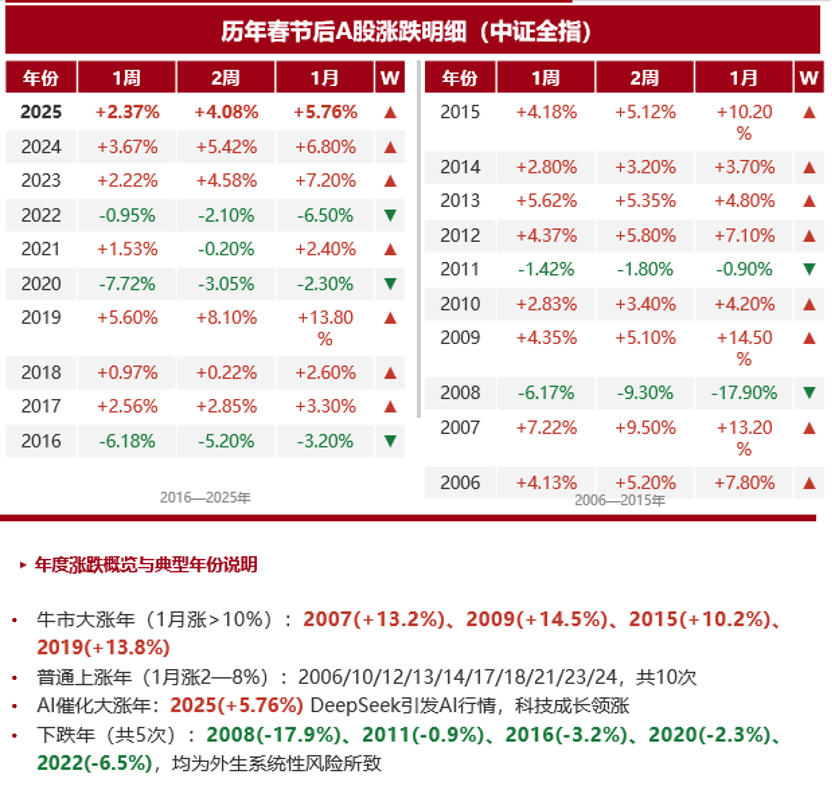
Core Insights - The post-Spring Festival "red envelope" market trend shows a significant historical winning rate, with a 76% success rate in the first two weeks after the festival from 2006 to 2025, which is notably higher than the annual average of approximately 52% [1] - The average gains during the post-festival period are substantial, with a 1-week average increase of 1.6%, 2-week increase of 2.5%, and a 1-month increase of 4.6%. In bull market years, the average gain in January exceeds 13% [1] - The 2025 post-festival AI technology market is expected to drive significant growth, with a projected 1-week increase of 2.37% and a 1-month increase of 5.76%, reaffirming the post-festival effect [1] Historical Performance - The detailed performance of the A-share market post-Spring Festival from 2006 to 2025 shows varied results, with 2025 recording a 1-week gain of 2.37%, a 2-week gain of 4.08%, and a 1-month gain of 5.76% [2] - Other notable years include 2024 with a 1-week gain of 3.67% and a 1-month gain of 6.80%, and 2023 with a 1-week gain of 2.22% and a 1-month gain of 7.20% [2] Investment Strategy - Investors are encouraged to adopt a core-satellite strategy to capitalize on the red envelope market opportunities, with recommended core allocations in the CSI A500 ETF (159338) and cash flow ETF (159399). Satellite allocations may include semiconductor equipment ETF (159516) and oil ETF (561360) [6]
地缘升温推动油价上行,石油ETF(561360)涨近3%,资金持续抢筹,近20日净流入超23亿元,规模超30亿元
Sou Hu Cai Jing· 2026-02-25 03:43
Group 1 - The core viewpoint of the article highlights that rising geopolitical tensions, particularly regarding Iran, are driving oil prices upward, with the oil ETF (561360) increasing by nearly 3% on February 25, and a net inflow of over 2.3 billion yuan in the past 20 days, bringing its total scale to over 3 billion yuan [1] - The oil and petrochemical industry is experiencing heightened risks due to the tense geopolitical situation in Iran and ongoing risks from the Russia-Ukraine conflict, which may lead to a strong fluctuation in oil prices in the short term [1] - In the medium to long term, oil prices are expected to be anchored by fundamentals, with OPEC+ increasing production and the development of oil fields in the Americas potentially leading to a continued oversupply situation, suggesting a possibility of further downward adjustment in oil price levels [1] Group 2 - Domestic oil companies are reducing their performance sensitivity to oil prices through integrated upstream and downstream layouts and diversifying their oil and gas sources, while also accelerating investments in domestic offshore oil and gas resource development to decrease reliance on foreign energy [1] - The oil ETF (561360) tracks the oil and gas industry index (H30198), which focuses on exploration, extraction, production, and sales within the oil and gas sector, selecting listed company securities that cover the entire industry chain, reflecting the overall performance of the oil and gas industry with high industry concentration and cyclical characteristics [1]