
装备制造业

Search documents
新动能加速壮大,产业升级亮点纷呈:8月经济数据勾勒国民经济稳进图景
Yang Shi Wang· 2025-09-16 02:38
Economic Overview - The national economy is maintaining a stable and progressive development trend, supported by coordinated macro policies and the cultivation of new growth drivers [1] - Employment and prices are generally stable, indicating a balanced economic environment [1] Service Sector - The service production index increased by 5.6% year-on-year, with modern service sectors like information transmission and business services showing significant growth of 12.1% and 7.4% respectively [3] - Retail sales in the service sector grew by 5.1% in the first eight months, outpacing the growth rate of goods retail sales [3] Investment Trends - Fixed asset investment rose by 0.5% year-on-year from January to August, with manufacturing investment growing by 5.1%, indicating strong support for manufacturing upgrades [3][7] - Investment in equipment and tools saw a notable increase of 14.4% year-on-year in the first eight months, reflecting the impact of large-scale equipment updates [7] Agricultural and Industrial Performance - Early rice production saw a slight increase, while the area for autumn grain planting remained stable with a slight increase [4] - In August, the industrial added value for large-scale industries grew by 5.2% year-on-year, with manufacturing added value increasing by 5.7%, particularly in equipment and high-tech manufacturing sectors [4] Technological Advancements - The "Artificial Intelligence +" initiative is being implemented, leading to a growing preference for smart terminal products [6] - New product output, such as industrial robots and robot reducers, has maintained rapid growth, with the added value of integrated circuit manufacturing and electronic materials exceeding 20% [6] - Continuous innovation policies are enhancing new productive forces and driving the development of new growth drivers [6]


8月多项主要指标回落幅度收窄,我国经济“稳”的态势未变
Xin Hua Cai Jing· 2025-09-16 00:07
Economic Overview - The national economic performance in August shows a stable and improving trend, with key indicators reflecting a steady state [1][2] - The overall economic operation in August is characterized by stability, with a solid foundation for continued growth in the third quarter [1][8] Production and Demand Indicators - In August, the industrial added value for large-scale industries grew by 5.2% year-on-year, a decrease of 0.5 percentage points from the previous month, but the decline was smaller than the previous month's 1.1 percentage points [2] - The service production index decreased by 0.2 percentage points to 5.6%, showing strong resilience [2] - Retail sales of consumer goods increased by 3.4% year-on-year, with a smaller decline of 0.3 percentage points compared to the previous month [2] - Fixed asset investment grew by 0.5% year-on-year from January to August, with a slowdown of 1.1 percentage points compared to the previous period [2] Employment and Price Stability - The urban unemployment rate in August was 5.3%, slightly up from the previous month but consistent with the same period last year, indicating stable employment [3] - The Consumer Price Index (CPI) fell by 0.4% year-on-year, primarily due to a drop in food prices, while the core CPI rose by 0.9%, marking a continuous increase over four months [3] New and Old Growth Drivers - The transition from old to new growth drivers is progressing steadily, with significant growth in high-tech manufacturing and modern services [4] - In August, the added value of equipment manufacturing and high-tech manufacturing increased by 8.1% and 9.3% year-on-year, respectively [4] - The online retail sales from January to August grew by 9.6%, outpacing the overall retail sales growth [5] Policy and Future Outlook - The government is expected to implement new measures to stabilize the macroeconomic environment and support employment in the fourth quarter [8] - Recent policies aim to enhance urban development and improve resource allocation efficiency, which may further stimulate economic growth [7][8]
透视8月经济“成绩单”:工业生产较快增长 消费潜能继续释放
Shang Hai Zheng Quan Bao· 2025-09-16 00:01
Economic Growth and Stability - China's economy shows stable growth with industrial and service sectors maintaining rapid expansion, while market sales and import-export scales continue to grow [1] - Key production demand indicators' growth rates remain consistent with the previous months, indicating a stable economic trend [1] Industrial Production and Investment - In August, industrial production increased significantly, with industrial added value growing by 5.2% year-on-year, particularly in equipment manufacturing and high-tech manufacturing, which grew by 8.1% and 9.3% respectively [2] - Fixed asset investment from January to August increased by 0.5%, with a notable decline in private investment by 2.3% [2] - Infrastructure investment rose by 2.0%, while manufacturing investment grew by 5.1%, and real estate development investment saw a decline of 12.9% [2] Private Investment Trends - Among 31 manufacturing sectors, 16 experienced double-digit growth in private investment, with the automotive manufacturing sector seeing a 22.6% increase [3] - The growth in private investment is driven by the push towards high-quality development in green industries such as new energy vehicles and artificial intelligence [3] Consumer Market Dynamics - Consumer spending is supported by ongoing initiatives, with retail sales of consumer goods increasing by 4.6% year-on-year from January to August, and a 3.4% increase in August alone [4] - The "old-for-new" policy has positively impacted sales in furniture, home appliances, and communication devices, with respective year-on-year growth rates of 18.6%, 14.3%, and 7.3% in August [4] - Service sector retail sales grew by 5.1% year-on-year, indicating a shift in economic growth dynamics towards service consumption [4][5] Real Estate Market Recovery - The real estate market shows signs of recovery, with new housing sales declining by 4.7% from January to August, a reduction in the decline compared to the previous year [6] - New home prices in major cities are stabilizing, with a narrowing decline in prices across first, second, and third-tier cities [6] - The inventory of unsold properties has decreased for six consecutive months, indicating effective inventory reduction measures [6] Macroeconomic Policy Outlook - The overall economic operation remains stable, with expectations for enhanced macroeconomic policies to support growth, particularly in the fourth quarter [7] - Potential measures include increased fiscal spending, interest rate cuts, and stronger efforts to stabilize the real estate market [7]
8月生产、内需、外贸等运行平稳 经济转型升级稳步推进
Xin Hua Wang· 2025-09-15 23:40
Economic Overview - The overall economic operation in August is stable, with steady progress and no change in growth stability [5][10] - Industrial production shows rapid growth, with the industrial added value for large enterprises increasing by 5.2% year-on-year and 0.37% month-on-month [7] - The service sector's production index grew by 5.6% year-on-year, outperforming industrial growth [7] Consumption and Investment - From January to August, the total retail sales of consumer goods increased by 4.6% year-on-year, with service retail sales up by 5.1% [8] - Fixed asset investment rose by 0.5% year-on-year, while excluding real estate development, it grew by 4.2% [8] - In August, retail sales of furniture, home appliances, and cultural office supplies saw growth rates exceeding 10% due to consumption policies [11] Employment and Prices - The urban unemployment rate in August was 5.3%, consistent with the previous year [10] - The Consumer Price Index (CPI) decreased by 0.4% year-on-year, primarily due to falling food prices, while the core CPI rose by 0.9% [10] Trade Performance - In August, the total import and export value of goods increased by 3.5% year-on-year, with both exports and imports achieving three consecutive months of growth [9] Industrial and Technological Development - The manufacturing sector, particularly in high-tech and equipment manufacturing, showed significant growth, with high-tech manufacturing increasing by 9.3% year-on-year [12] - The production of new energy vehicles and related components saw substantial increases, with production of lithium-ion batteries for vehicles rising by 44.2% [12] Policy Impact - The Producer Price Index (PPI) showed signs of stabilization, with a narrowing year-on-year decline, reflecting the effectiveness of macroeconomic policies [13] - Policies aimed at boosting consumption and stabilizing employment have been effective, with various sectors experiencing price increases [14] - The government continues to implement proactive macroeconomic policies to support economic stability and growth [14][15]
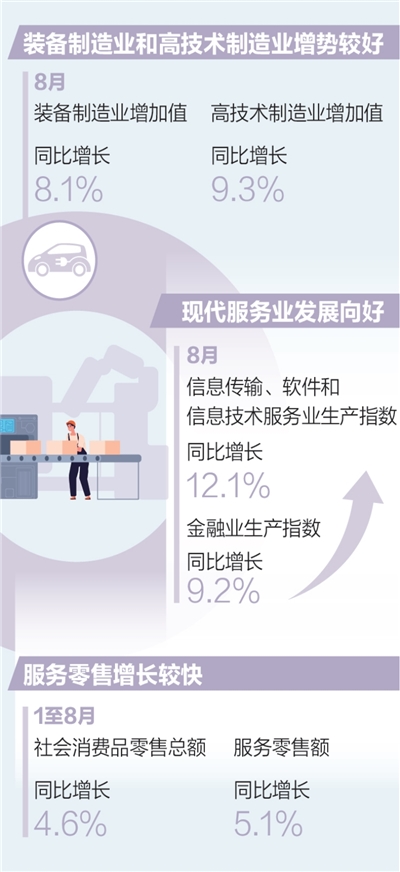
透视8月经济“成绩单”
Shang Hai Zheng Quan Bao· 2025-09-15 23:30
Economic Growth and Stability - China's economy shows stable growth with industrial and service sectors maintaining rapid expansion, as indicated by the National Bureau of Statistics [1] - Key production demand indicators have shown consistent growth rates comparable to the first seven months of the year, reflecting a steady economic trend [1] Industrial Production and Investment - In August, industrial production increased significantly, with industrial added value growing by 5.2% year-on-year, driven by robust growth in equipment manufacturing and high-tech manufacturing, which rose by 8.1% and 9.3% respectively [2] - Fixed asset investment from January to August grew by 0.5%, with a notable decline in private investment by 2.3% [2] - Infrastructure investment increased by 2.0%, while manufacturing investment rose by 5.1%, and real estate development investment saw a decline of 12.9% [2] Consumer Market Trends - Social retail sales increased by 4.6% year-on-year from January to August, with August showing a 3.4% year-on-year increase [4] - The "old-for-new" policy has positively impacted retail sales in various categories, including furniture and home appliances, which saw increases of 18.6% and 14.3% respectively in August [4] - Service retail sales grew by 5.1% year-on-year, indicating a shift towards service-driven economic growth [4][5] Real Estate Market Developments - The real estate market has shown signs of recovery, with new housing sales declining by 4.7% year-on-year, a reduction in the decline compared to previous periods [6] - New home prices have also seen a narrowing decline, with first, second, and third-tier cities experiencing reduced year-on-year price drops [6] - The inventory of unsold properties has decreased for six consecutive months, indicating effective inventory reduction measures [6] Macroeconomic Policy Outlook - The macroeconomic policies are expected to strengthen, with potential new measures aimed at stabilizing employment, businesses, and market expectations [7] - Analysts anticipate that fiscal measures and interest rate cuts may be introduced in the fourth quarter to counter external demand slowdowns and support economic growth targets [7]
8月经济边际改善,政策仍需适时加力丨温彬专栏
2 1 Shi Ji Jing Ji Bao Dao· 2025-09-15 22:38
Core Viewpoint - The economic indicators for August show a marginal improvement compared to July, indicating a gradual recovery in the macroeconomic environment, supported by ongoing policy efforts aimed at achieving annual economic and social development goals [1][6][13]. Economic Indicators - The manufacturing PMI for August is at 49.4%, a slight increase of 0.1 percentage points from the previous month, indicating a less severe contraction [3]. - The industrial added value growth rate for August decreased by 0.5 percentage points to 5.2%, a smaller decline than the 1.1 percentage points drop in July [3]. - Retail sales growth for social consumer goods fell by 0.3 percentage points to 3.4%, again a smaller decline than the previous month's 1.1 percentage points [3]. - Fixed asset investment growth for January to August is at 0.5%, slowing by 1.1 percentage points compared to January to July, which is less than the 1.2 percentage points decline from the previous month [3]. Export and Service Sector Performance - Exports maintained resilience with a year-on-year growth of 4.4% in August, down from 7.2% in July, but still reflecting a two-year compound growth rate of 6.5% [3][4]. - The service sector showed strong performance, with the service production index falling only 0.2 percentage points to 5.6% in August, and the business activity index rising to 50.5%, the highest this year [4]. New Growth Drivers - New growth drivers are performing strongly, with the added value of equipment manufacturing and high-tech manufacturing increasing by 8.1% and 9.3% year-on-year, respectively [4]. - Investment in information services and aerospace manufacturing grew significantly, with year-on-year increases of 34.1% and 28.0% [4]. Price Trends - The CPI for August showed a year-on-year decrease of 0.4%, while the core CPI increased by 0.9%, marking the highest growth in 18 months, indicating a release of service consumption potential [4]. - The PPI remained flat month-on-month, ending an eight-month decline, with a year-on-year decrease of 2.9%, narrowing from 3.6% in the previous month [4]. Monetary and Fiscal Policy - The loan balance growth in August was 6.8%, slightly down from 6.9% in July, while the social financing stock grew by 8.8%, down from 9.0% [5]. - The government issued 1.4 trillion yuan in new debt in August, a decrease of 251.9 billion yuan year-on-year, indicating a reduced support role for government debt in social financing [10]. Policy Coordination - The coordination between fiscal and monetary policies is expected to strengthen, with discussions on financial market operations and government bond issuance management [11]. - New policies aimed at promoting consumption and stabilizing the real estate market are being introduced, including measures to enhance service consumption and support housing market recovery [12]. Overall Economic Outlook - The current macroeconomic policy is characterized by a gradual and supportive approach, with potential for more robust counter-cyclical adjustments if economic pressures increase [13].
宏观政策发力显效 经济运行稳中有进
Sou Hu Cai Jing· 2025-09-15 22:24
Economic Overview - The macroeconomic policies are effectively coordinated, leading to a stable overall operation of the national economy, with steady progress in transformation and upgrading, and new achievements in high-quality development [1] - The economic growth remains stable, with key production and demand indicators showing consistent growth in the first eight months [2] Employment and Prices - The urban survey unemployment rate in August was 5.3%, slightly up from the previous month but consistent with the same period last year, indicating stable employment [2] - In August, the consumer price index (CPI) decreased by 0.4% year-on-year, primarily due to falling food prices, while the core CPI, excluding food and energy, rose by 0.9%, marking an expansion in the price increase for four consecutive months [2] Industrial Growth and Innovation - The transformation and upgrading of industries continue, with significant growth in sectors such as smart vehicle equipment manufacturing (17.7% increase) and integrated circuit manufacturing (23.5% increase) in August [3] - The high-tech manufacturing sector saw an 8.1% increase, while modern service industries like information technology services grew by 12.1% [3] Policy Effects - The implementation of proactive macro policies has shown positive effects, with consumer demand being stimulated through policies like the third batch of consumption upgrades [4] - Retail sales in categories such as home appliances and furniture maintained double-digit growth in August, reflecting the effectiveness of these policies [4] Market Dynamics - The logistics industry showed improvement, with an increase in railway freight volume and rapid growth in express delivery services [5] - The Producer Price Index (PPI) stabilized in August, indicating positive changes in production prices, particularly in coal mining and black metal industries [5] Future Outlook - The long-term supportive conditions for economic growth remain unchanged, with macro policies effectively promoting stability and the dual circulation strategy gradually taking shape [6] - Consumer potential is expected to continue being released, with new consumption patterns emerging and significant growth in sectors like green and digital consumption [6] Market Vitality - The construction of a unified national market is enhancing market vitality, with manufacturing profits increasing by 4.8% year-on-year in the first seven months [7] - The manufacturing and service sectors showed positive business activity expectations in August, indicating a favorable outlook for future economic performance [7]
8月份经济运行总体平稳 社会消费品零售总额环比增速由负转正
Mei Ri Jing Ji Xin Wen· 2025-09-15 15:41
Economic Overview - In August, the overall economic operation remained stable, with solid progress in high-quality development, characterized by steady production growth, expanding domestic demand, increasing foreign trade and reserves, overall stability, and ongoing transformation and upgrading with a prominent role of innovation [1] Consumer Market - In August, the retail sales of consumer goods reached 39,668 billion yuan, a year-on-year increase of 3.4%, showing resilience in the consumption market [2] - From January to August, the total retail sales of consumer goods amounted to 323,906 billion yuan, with a year-on-year growth of 4.6% [2] - The rural consumption market outpaced urban areas, with retail sales in rural areas growing by 4.6% year-on-year, 1.4 percentage points higher than urban growth [2] Industrial Production - In August, the industrial added value of enterprises above designated size grew by 5.2% year-on-year, maintaining a rapid growth trend [3] - The manufacturing sector saw an increase of 5.7%, while high-tech manufacturing grew by 9.3%, indicating structural optimization within the industrial economy [3] Investment Trends - Fixed asset investment showed resilience despite short-term pressures, with a total of 326,111 billion yuan from January to August, reflecting a year-on-year increase of 0.5% [4] - Infrastructure investment grew by 2.0%, while manufacturing investment increased by 5.1%, indicating ongoing support for economic growth [4] - High-tech industries, such as information services and aerospace manufacturing, experienced significant investment growth, with increases of 34.1% and 28.0% respectively [4] Policy Impact - The implementation of proactive macro policies has positively influenced economic performance, particularly in expanding domestic demand and enhancing production efficiency [5][6] - The "Artificial Intelligence+" initiative has led to a notable increase in the production of new products, such as industrial robots and drones, contributing to the growth of the digital economy [6]
【新华解读】8月多项主要指标回落幅度收窄 我国经济“稳”的态势未变
Xin Hua Cai Jing· 2025-09-15 14:53
Economic Overview - The national economic performance in August shows a stable and improving trend, with key indicators reflecting a steady state [2][5][11] - The overall economic operation remains stable, with a solid foundation for continued growth in the third quarter [2][11] Production Sector - In August, the industrial added value for large-scale industries grew by 5.2% year-on-year, a decrease of 0.5 percentage points from the previous month, but the decline was smaller than the 1.1 percentage points drop in July [2][5] - The service production index decreased by 0.2 percentage points to 5.6%, showing strong resilience [2][5] Demand Side - The total retail sales of consumer goods in August saw a year-on-year growth of 3.4%, down 0.3 percentage points from the previous month, but the decline was less than the 1.1 percentage points drop in July [4][5] - Fixed asset investment from January to August increased by 0.5% year-on-year, with a slowdown of 1.1 percentage points compared to January to July, but the decline was less than the previous month's 1.2 percentage points [4][5] Employment and Prices - The urban unemployment rate in August was 5.3%, slightly up from the previous month but unchanged from the same period last year, indicating stable employment [5] - The Consumer Price Index (CPI) in August fell by 0.4% year-on-year, primarily due to a drop in food prices, while the core CPI, excluding food and energy, rose by 0.9%, marking an expansion in growth for four consecutive months [5] New and Old Growth Drivers - The transition from old to new growth drivers is progressing steadily, with significant growth in high-tech manufacturing and modern services [6][7] - In August, the added value of equipment manufacturing and high-tech manufacturing increased by 8.1% and 9.3% year-on-year, respectively, outpacing the overall industrial growth [7] Policy Impact - Policies aimed at expanding domestic demand, such as large-scale equipment updates and consumer replacement programs, are showing positive effects [8] - Investment in equipment and tools increased by 14.4% year-on-year in the first eight months, contributing to a 2.1 percentage point rise in fixed asset investment [8] Future Outlook - The economic indicators suggest that the third quarter is likely to maintain a stable and improving development trend, supported by ongoing macroeconomic policies [9][11] - New incremental measures may be introduced in the fourth quarter to stabilize the macroeconomic environment and employment market [10]
前八月固定资产投资稳定增长,高技术制造业带动作用明显
2 1 Shi Ji Jing Ji Bao Dao· 2025-09-15 14:05
Economic Overview - In the first eight months of the year, national fixed asset investment (excluding rural households) reached 326.111 billion yuan, with a year-on-year growth of 0.5%. Excluding real estate development investment, fixed asset investment grew by 4.2% [1] - Infrastructure investment increased by 2.0% year-on-year, while manufacturing investment rose by 5.1%. Real estate development investment saw a decline of 12.9% [1] Manufacturing Sector - Manufacturing investment grew by 5.1%, outpacing overall investment growth by 4.6 percentage points, contributing 1.3 percentage points to total investment growth [1] - Investment in consumer goods manufacturing increased by 9.0%, and equipment manufacturing investment grew by 3.2%. High-tech manufacturing sectors, such as aerospace and computer equipment, saw significant investment growth of 28.0% and 12.6%, respectively [1] Investment Trends - The data indicates a structural shift in investment, with a notable increase in investments related to downstream and consumer-related industries, reflecting a trend towards demand-driven investment [1] - The real estate sector is transitioning from a focus on new growth to managing existing stock, indicating a shift in investment strategy [1] Private Investment - Private investment decreased by 2.3% year-on-year, but when excluding real estate development, it grew by 3.0% [2] - The government is implementing measures to stimulate private investment, focusing on removing barriers and enhancing support for private enterprises [3][4] Consumer Demand - The third batch of consumer goods replacement policies has been implemented, contributing to the release of consumer demand and driving sales growth in related goods [2] - In August, retail sales of household appliances and cultural office supplies continued to show double-digit growth, indicating strong consumer demand [2] Future Outlook - The government aims to maintain a stable economic environment while promoting high-quality development through various macroeconomic policies [3] - The focus will be on enhancing the investment environment for private enterprises, particularly in green industries and future technologies [3][4]