
可穿戴设备

Search documents
Connect大会日程公布,Meta首款消费级智能眼镜真要来了?
Hua Er Jie Jian Wen· 2025-08-31 10:58
Core Insights - Meta is poised to unveil its first consumer-grade smart glasses with display capabilities at the upcoming Connect conference, with CEO Mark Zuckerberg scheduled to present on "AI Smart Glasses" [1][6] - The conference agenda includes multiple sessions focused on a new developer toolkit, indicating a strong emphasis on the smart glasses project [3][4] Group 1: Product Launch and Features - The anticipated smart glasses, codenamed "Hypernova," are expected to feature a heads-up display (HUD) that shows time, weather, notifications, and more, controlled via a gesture-based wristband [6][7] - The glasses are projected to weigh around 70 grams, slightly heavier than the existing Ray-Ban Meta glasses, and are expected to retail for approximately $800 [6][7] Group 2: Developer Engagement and SDK - Meta is actively engaging third-party developers, particularly in the generative AI space, to create experimental applications for the upcoming smart glasses [4][7] - The new SDK is seen as a crucial step in building a wearable device ecosystem, with two potential formats: a server-side SDK for integrating Meta AI or a device-specific SDK for the more powerful "Hypernova" glasses [7][8] Group 3: Market Implications - The launch of "Hypernova" could set new standards in the industry for smart glasses, potentially leading to a more sustainable ecosystem for edge devices and AI applications [8] - As the conference approaches, the market is closely watching how Meta's developments in smart glasses will influence the competitive landscape of future computing platforms [9]



苹果状告OPPO高管窃密,离职前夜打包63份文件U盘带走
36氪· 2025-08-24 09:00
Core Viewpoint - Apple has filed a lawsuit against former Apple Watch sensor architect Chen Shi for allegedly stealing trade secrets before joining Chinese smartphone manufacturer OPPO, which could undermine Apple's competitive advantage in wearable technology [3][7][12]. Group 1: Incident Details - Chen Shi worked as a sensor system architect for Apple Watch from January 2020 to June 2025, earning a monthly salary of $28,000 and was involved in the development of confidential technologies [6]. - Before leaving Apple, Chen Shi misled the company about his intentions, claiming he would return to China to care for his elderly parents and not seek new employment, while he had already accepted a position at OPPO [7]. - Evidence presented in court indicates that Chen Shi held numerous one-on-one meetings with Apple Watch team members to gather information on ongoing research and secretly downloaded 63 confidential files, including critical design documents and algorithms, just days before his departure [8][10]. Group 2: Implications for Apple - Apple argues that allowing Chen Shi and OPPO to benefit from this behavior would jeopardize its commitment to innovation and the value of its trade secrets, potentially giving competitors an unfair advantage [12]. - The health sensor technology is a cornerstone of Apple's market dominance in wearables, with the Series 9 model contributing 62% of the revenue for Apple's wearables division in 2024 [16]. - Apple emphasizes that the algorithms behind its sensor technologies are the result of extensive clinical validation and development, and any leakage could significantly reduce competitors' R&D costs and timelines [17]. Group 3: OPPO's Developments - Chen Shi is now leading a sensor technology development team at OPPO's Silicon Valley research center, where the company has made significant advancements in health tracking technology [11][19]. - OPPO's health tracking capabilities have improved dramatically since acquiring InnoPeak Technology, with their prototype showing a blood oxygen monitoring accuracy that closely resembles Apple's, with a deviation rate of only 1.2% [19]. - The lawsuit highlights a broader trend of employee poaching and trade secret theft involving Chinese companies, with Apple having initiated 17 employee-related lawsuits in the past five years, three of which involved criminal proceedings [20].


苹果起诉跳槽至OPPO前员工,称63份机密文件被窃取
Xin Lang Cai Jing· 2025-08-23 21:18
Core Points - Apple has filed a lawsuit against former Apple Watch sensor architect Chen Shi for allegedly stealing trade secrets before joining OPPO [1][4] - OPPO has denied the allegations, stating that they respect the trade secrets of all companies, including Apple [1] - The lawsuit claims that Chen Shi downloaded 63 confidential files just three days before leaving Apple and transferred them to a USB drive [2] Summary by Sections - **Allegations Against Chen Shi** - Chen Shi is accused of systematically stealing core business secrets to assist OPPO in developing competitive wearable devices [1] - He allegedly concealed his intention to join OPPO while engaging in numerous one-on-one meetings with Apple Watch technology team members [1][4] - The lawsuit states that Chen Shi misled Apple by claiming he was returning to China to care for his elderly parents [3] - **OPPO's Response** - OPPO's legal department claims to have reviewed the lawsuit and found no evidence linking Chen Shi's actions to his employment at OPPO [1] - OPPO asserts that it respects the trade secrets of all companies and has not infringed upon Apple's secrets [1] - **Legal Actions and Implications** - Apple argues that Chen Shi violated confidentiality and intellectual property agreements, and that OPPO was aware of and condoned his actions [4] - The lawsuit highlights that allowing Chen Shi and OPPO to act without consequences would undermine Apple's commitment to innovation and the value of its trade secrets [4] - Apple is seeking an injunction to prevent Chen Shi and OPPO from incorporating Apple's confidential health sensor technology into their competitive products [4]
苹果起诉跳槽至OPPO的前员工,涉窃取63份机密文件
Guan Cha Zhe Wang· 2025-08-23 07:38
Core Viewpoint - Apple has filed a lawsuit against former employee Chen Shi, accusing him of systematically stealing trade secrets before joining competitor OPPO, which could undermine Apple's innovation and competitive edge in wearable technology [1][2]. Group 1: Allegations Against Chen Shi - The lawsuit claims that Chen Shi accessed confidential documents related to Apple's health sensor technology before leaving the company to assist OPPO in developing competitive wearable devices [1]. - Chen Shi allegedly concealed his intention to join OPPO by stating he was returning to China to care for his elderly parents, while he was actually gathering sensitive information [2]. - It is reported that Chen Shi downloaded 63 confidential files just three days before his departure and transferred them to a USB drive [1][2]. Group 2: OPPO's Response - OPPO has stated that it respects the trade secrets of all companies, including Apple, and denies any wrongdoing regarding the allegations [3]. - The company has expressed its commitment to cooperating with legal proceedings to clarify the facts surrounding the case [3]. Group 3: Legal Implications - Apple is seeking an injunction to prevent Chen Shi and OPPO from using its confidential health sensor technology in their competitive products, emphasizing the potential harm to its business and innovation [2].

消费电子行业深度跟踪报告:秋季新品密集发布期将至,重视AI端侧低位布局机遇
CMS· 2025-08-21 06:14
Investment Rating - The report maintains a positive investment outlook for the consumer electronics sector, emphasizing the focus on AI edge innovation and the potential for investment opportunities in the supply chain related to Apple and Android products [6][26]. Core Insights - The report highlights the upcoming autumn product launches and the importance of AI innovations, particularly with the release of GPT-5, which is expected to drive commercial applications [1][2]. - It notes that Apple's Q3 revenue guidance indicates high single-digit growth, supported by a significant $100 billion investment in the U.S. and potential tariff exemptions [1][13]. - The report emphasizes the growth in various segments, including smartphones, PCs, wearables, and automotive, while also tracking the impact of tariffs and AI innovations on sales [1][11][29]. Summary by Sections Terminal Trends and Innovation Tracking - **Smartphones**: Q2 global smartphone shipments grew by 1%, with a notable decline in China at -4%. The report anticipates that the iPhone 17, with enhanced AI features, will boost sales in Q3 [2][32]. - **PCs/Tablets**: Q2 PC shipments increased by 6.5%, but growth is expected to slow in H2 due to inventory adjustments and reduced demand [3][32]. - **Wearables**: AI/AR glasses saw a significant increase in shipments, up 87% year-on-year, driven by Meta's products [4][32]. - **Smart Home**: TV shipments are expected to see a slight increase, while demand for the Nintendo Switch remains strong [5][32]. - **Automotive**: The domestic automotive market saw a 13% increase in H1 sales, with a focus on the development of intelligent driving technologies [11][32]. - **Robotics**: Companies like Zhiyuan and Yushun have secured commercial orders, indicating growth in the robotics sector [12][32]. Industry Chain Tracking - **Brand Companies**: Apple has announced a $100 billion investment in the U.S., while Xiaomi reported record Q2 performance, highlighting the importance of smartphone market dynamics [13][32]. - **Assembly**: The upcoming product season is expected to drive demand, with a focus on AI innovations in cloud and edge computing [14][32]. - **Main Chips**: The domestic AIoT SoC industry is performing well, with a focus on AI applications in the second half of the year [15][32]. - **Optics**: The report emphasizes the importance of innovations in optical components, particularly in relation to intelligent driving technologies [18][32]. - **Displays**: TV panel prices have started to decline, with a slight increase in shipments in H1 [19][32]. - **Passive Components**: Domestic companies are expected to see continued growth, driven by AI applications [24][32]. - **Equipment**: The report highlights the potential for domestic equipment manufacturers to benefit from PCB expansion and 3D printing innovations [25][32]. Investment Recommendations - **Apple Supply Chain**: The report suggests focusing on the Apple supply chain due to low valuations and frequent catalysts, with companies like Luxshare Precision and GoerTek highlighted as key beneficiaries [26][28]. - **Android Supply Chain**: It recommends monitoring AI innovations and subsidy policies that could enhance sales for domestic brands like Xiaomi and Transsion [27][28]. - **AI Terminal Applications**: The report sees significant investment opportunities in the AI terminal application space, particularly in smartphones, PCs, wearables, and robotics [28][29].


AI 眼镜“秒变”直男程序员“脱单神器”,首次亮相被抢购一空!CEO 坦言:好产品要么能帮用户赚钱,要么能解决实际痛点
AI前线· 2025-08-19 07:19
Core Insights - AI glasses are positioned as the next generation of interactive terminals that integrate artificial intelligence and wearable technology, currently undergoing a critical phase of technological breakthroughs and industrial ecosystem restructuring [2] - By 2025, the industry is expected to exhibit three major trends: multimodal large models enabling natural interaction and proactive service capabilities, a mature supply chain, and the dual drive of new market demands for scene implementation [2] - Despite the promising outlook, challenges such as hardware weight, battery life, and core issues related to edge-cloud collaborative computing and data processing remain to be addressed [2] Industry Trends - The AI glasses market is anticipated to evolve into a consumer product that could potentially exceed one billion users, following the trajectory of PCs and smartphones [2] - The domestic AI glasses market is witnessing the emergence of companies like Fuxi Technology, which is gaining recognition and has established partnerships with major players like Meta and Huawei [3][4] - The market is characterized by a "hundred schools of thought" competition, with various players defining their market directions and focusing on different applications such as AI meetings, displays, translations, and health monitoring [21][22] Company Insights - Fuxi Technology, founded by a 90s tech entrepreneur, has become a leading supplier in the AI glasses sector, serving numerous listed companies and focusing on consumer market development [3][4] - The company initially targeted B-end clients but has shifted its focus to the C-end market, recognizing the limited growth potential in the B-end sector [7] - The first product from Fuxi Technology is a pair of AI glasses designed for social scenarios, particularly aimed at enhancing social skills for young men [16] Product Development - The AI glasses are designed to assist users in social interactions, with features that provide real-time reminders and emotional support during social engagements [18][19] - The product leverages reinforcement learning and deep learning to offer contextually appropriate responses in social situations, enhancing user experience [19][20] - The company aims to address the emotional and economic needs of users, believing that solving these core issues will drive product adoption [32] Market Dynamics - The AI glasses market is still in its infancy, with a limited number of players possessing core technologies, leading to a potential supply-demand imbalance for skilled professionals in the field [25] - The anticipated growth in AI glasses sales is projected to reach 96 million units by 2030, with a significant increase expected between 2025 and 2030 [20] - The core competitive advantage of AI glasses lies in their ability to provide solutions in specific scenarios, such as social interactions and educational applications, where traditional devices may not be suitable [24]

AI 眼镜“秒变”直男程序员“脱单神器”,首次亮相被抢购一空!CEO 坦言:好产品要么能帮用户赚钱,要么能解决实际痛点
Sou Hu Cai Jing· 2025-08-19 03:18
Industry Overview - AI glasses are positioned as the next generation of interactive terminals that integrate artificial intelligence and wearable technology, currently undergoing a critical phase of technological breakthroughs and industrial ecosystem restructuring [1] - By 2025, the industry is expected to exhibit three major trends: multimodal large models enabling natural interaction and proactive service capabilities, a mature supply chain driving market demand, and deepened collaboration across the industrial chain [1] - The AI glasses market is projected to reach sales of 96 million units by 2030, with a rapid growth phase anticipated between 2025 and 2030, particularly around 2027 when sales could reach 10 million to 30 million units [18] Company Profile - Fuxi Technology, founded by a 90s tech entrepreneur, is emerging as a leading supplier in the AI glasses sector, having served multiple listed companies and actively collaborating with major players like Meta and Huawei [2] - The company has successfully transitioned from a B2B focus to targeting the consumer market, aiming to create its own AI glasses brand [5][12] - The first product, designed for social scenarios, particularly targeting young males to enhance their social skills, has already garnered significant interest, with prototype units sold out after a showcase [12][14] Product Development - The initial product is a "dating glasses" aimed at helping users improve their social interactions, with plans for promotion through platforms like Xiaohongshu to generate buzz and market education [13][15] - The product leverages AI to provide real-time assistance in social situations, utilizing data from publicly available datasets and reinforcement learning to enhance user experience [16] - The company emphasizes the importance of addressing user pain points, focusing on economic benefits and emotional value to drive sales [26] Market Challenges - The AI glasses market faces challenges such as hardware weight, battery life, and the need for effective cloud-edge collaboration for data processing [1] - The integration of hardware and software presents significant complexity, with the need for careful selection of components to optimize user experience [10] - The current market is still in its infancy, with a limited number of players possessing core technologies, leading to a potential talent shortage in the industry as demand for skilled professionals is expected to surge [20]
美股异动|马西莫医疗跌超4.3% 苹果宣布更新Apple Watch血氧测量功能
Ge Long Hui· 2025-08-14 15:02
Core Viewpoint - Masimo Corporation (MASI.US) experienced a decline of over 4.3%, trading at $149.14, following Apple's announcement of a new blood oxygen measurement feature for its Apple Watch models after receiving U.S. government approval [1] Company Impact - The introduction of the blood oxygen measurement feature on Apple Watch Series 9, Series 10, and Apple Watch Ultra 2 could pose a competitive threat to Masimo, which specializes in medical monitoring technologies [1] Market Reaction - The stock price drop of Masimo reflects investor concerns regarding the potential impact of Apple's new feature on the company's market position and revenue [1]

美股异动 | 华米科技盘初飙涨超48% Q2营收增长46.2%,Q3指引大超预期
Ge Long Hui· 2025-08-04 14:17
Core Insights - Huami Technology (ZEPP.US) experienced a rapid stock price increase of over 48%, reaching a high of $19.26, the highest since March 2022, with a cumulative rise of over 550% in the past month [1] Financial Performance - For the second quarter ending June 30, 2025, the company reported a significant revenue growth of 46.2% year-over-year, exceeding previous guidance and marking the first overall revenue growth since 2021 [1] - The core brand Amazfit has been identified as the growth engine, with strong sales from the Bip 6 and Active 2 series, as well as robust performance from the high-end T-Rex 3 model. New products like the Balance 2 smartwatch and Helio wristband launched in June also contributed significantly [1] - The company reported a GAAP net loss of $7.7 million and an adjusted net loss of $6.16 million, representing a year-over-year reduction of 28.6% and 30.2% respectively, with a stable gross margin of 36.2% [1] Future Outlook - Management anticipates third-quarter revenue to reach between $72 million and $76 million, reflecting a year-over-year growth of 70% to 79% [1] - CEO Huang Wang stated that the current quarter marks the beginning of an upward cycle, supported by a rich pipeline of innovations that will sustain growth in the second half of the year and beyond, reinforcing Amazfit's leadership in the performance wearables sector [1]

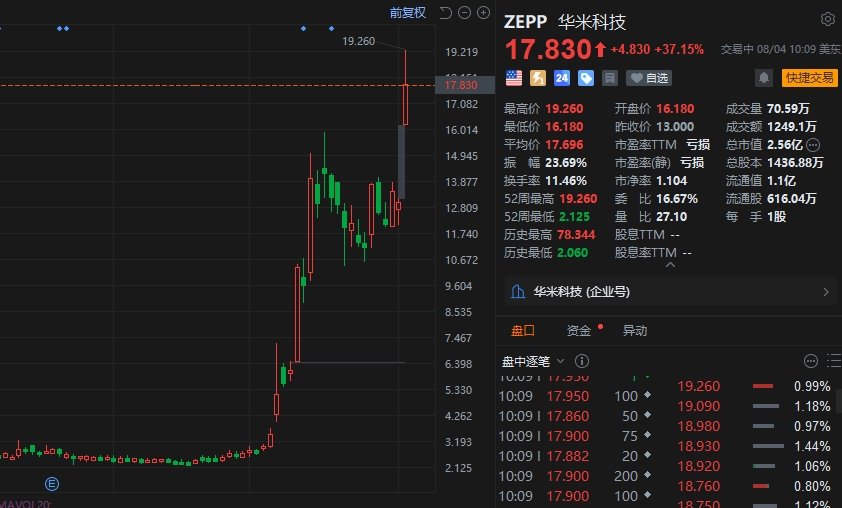
华米科技营收增长46.2%,3季度指引大超预期,夜盘暴涨20%
Ge Long Hui A P P· 2025-08-04 03:50
Core Insights - Huami Technology (ZEPP.US) reported a significant revenue growth of 46.2% year-on-year for the second quarter ending June 30, 2025, marking the first overall revenue increase since 2021 [1] - The core brand Amazfit has become the growth engine, with strong sales from the Bip 6 and Active 2 series, and the high-end T-Rex 3 model performing well [1] - The company has narrowed its GAAP net loss to $7.7 million and adjusted net loss to $6.16 million, a reduction of 28.6% and 30.2% respectively compared to the same period last year, with a stable gross margin of 36.2% [1] Financial Performance - The financial health of the company continues to improve, with operating expenses decreasing quarter-on-quarter and cash reserves reaching $95.3 million at the end of the period [1] - The company strategically increased inventory to address new product launches and tariff risks while advancing a stock buyback plan to demonstrate long-term confidence [1] Strategic Initiatives - The strategic transformation has shown significant results, with Zepp focusing on building the Amazfit brand ecosystem and launching the AI-enabled Zepp OS 5.0 system [1] - Marketing efforts include signing NFL star Derrick Henry and utilizing multi-platform global marketing, resulting in a second-place brand progress ranking in the U.S. market during Amazon Prime membership days, and a 60% year-on-year sales increase in the EMEA region [1] Future Outlook - For the third quarter, management expects revenue to reach between $72 million and $76 million, representing a year-on-year growth of 70% to 79% [2] - The CEO indicated that this quarter marks the beginning of an upward cycle, supported by a rich pipeline of innovations to sustain growth in the second half of the year and beyond, solidifying Amazfit's leadership in the performance wearables sector [2]